Mitsubishi S3L2 Marine Engine Spare Parts
Mitsubishi S3L2 Marine Engine Spare Parts
Mitsubishi S3L2 Marine Engine Spare Parts
The Mitsubishi S3L2 is a compact three-cylinder diesel engine used in generator sets, auxiliary equipment, small machinery and various marinized installations.
It is the kind of engine that can remain in service for many years when the fuel, cooling and lubrication systems are properly maintained. Because many S3L2 engines are now older working engines, however, ordering spare parts sometimes requires more investigation than simply giving the model name.
An S3L2 that has already been repaired several times may no longer have every component it originally left the factory with. Starter motors, alternators, fuel-system components, water pumps and external marine cooling equipment may have been replaced during its working life.
For this reason, Alfa Marine Spare Parts recommends identifying Mitsubishi S3L2 spare parts using:
Engine Model + Engine Serial Number + Existing Part Number + Clear Photographs
Depending on availability, we can support requirements for genuine, OEM-quality, selected aftermarket and professionally rebuilt or remanufactured components.
What Is the Mitsubishi S3L2 Engine?
The Mitsubishi S3L2 belongs to Mitsubishi's compact diesel engine range.
It uses a straightforward inline three-cylinder diesel layout designed for applications where compact dimensions, dependable operation and relatively simple maintenance are important.
Typical applications can include:
- Marine Auxiliary Equipment
- Generator Sets
- Pumps
- Small Industrial Equipment
- Construction Equipment
- Agricultural Equipment
- Other Engine-Driven Machinery
When an S3L2 has been adapted for marine service, additional cooling and exhaust components can be installed around the base engine.
This distinction becomes important when identifying replacement parts.
Mitsubishi S3L2 Technical Information
General characteristics of the S3L2 include:
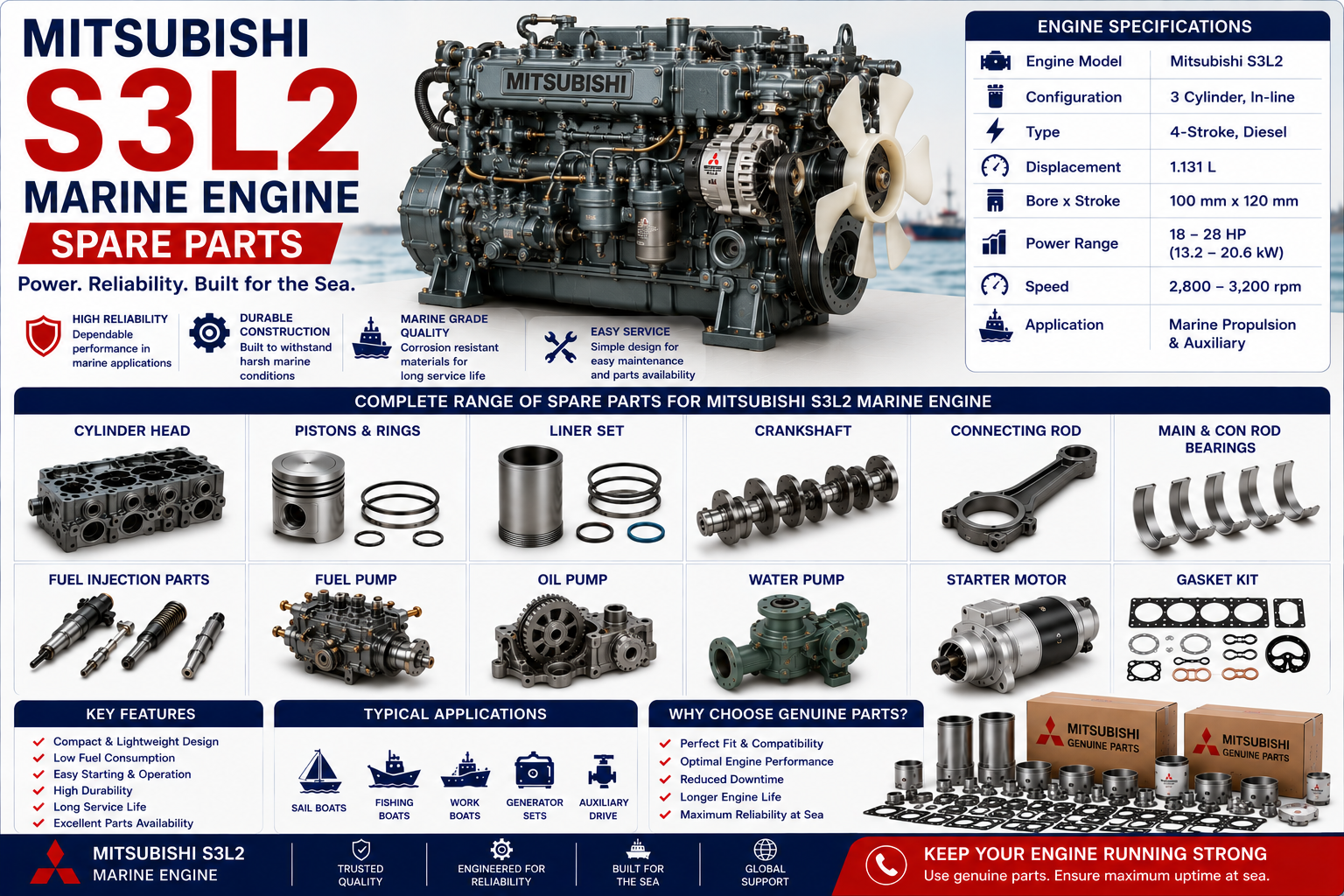
Technical InformationMitsubishi S3L2ManufacturerMitsubishiEngine ModelS3L2Engine TypeFour-Stroke DieselCylinder ArrangementInlineNumber of Cylinders3CoolingWater CooledFuelDieselAspirationNaturally AspiratedApproximate Displacement1.3 LitersTypical ApplicationsGenerator / Industrial / Auxiliary Equipment
Exact output, speed, dimensions and installation specifications can vary according to the particular S3L2 version and equipment application.
For spare-parts identification, the actual engine identification information should take priority over general specifications.
Is the Mitsubishi S3L2 a Marine Engine?
The S3L2 can be found in marine-related applications, particularly as an auxiliary or generator engine.
However, it is important to distinguish between:
the Mitsubishi base engine
and
the complete marinized installation.
Depending on how the engine was converted or installed, additional components can include:
- Raw-Water Pump
- Heat Exchanger
- Seawater Hoses
- Cooling Pipes
- Water-Cooled Exhaust Components
- Marine Engine Mounts
- Marine Electrical Components
- Installation-Specific Brackets
These parts may not be identical across every S3L2 installation.
Why Is Correct Mitsubishi S3L2 Parts Identification Important?
Imagine a vessel operator requests:
“Mitsubishi S3L2 water pump.”
That sounds straightforward.
But which pump is required?
Is it the engine coolant circulation pump?
Or is it an external raw-water pump fitted as part of the marine conversion?
Has the original pump already been replaced?
Does the existing component carry its own manufacturer number?
These questions matter.
For configuration-sensitive components, provide:
- Complete Engine Model
- Engine Serial Number
- Engine Identification Plate
- Existing Part Number
- Component Manufacturer Number
- Casting Number Where Available
- Clear Photographs
- Quantity Required
- Vessel or Equipment Application
Mitsubishi S3L2 Routine Service Parts
Routine maintenance requirements can include:
- Engine Oil Filters
- Fuel Filters
- Air Filter Components
- Fuel-System Seals
- Cooling-System Components
- Thermostats
- Water Pump Components
- Gaskets
- O-Rings
- Oil Seals
- Drive Components
- Electrical Components
Regular maintenance is also an opportunity to observe whether the engine's behavior is changing.
What Should You Watch Between S3L2 Services?
Do not only record the engine hours.
Pay attention to how the engine actually behaves.
Ask:
Does it take longer to start than before?
Has the cranking speed changed?
Is there more smoke immediately after starting?
Does the engine idle smoothly?
Is vibration increasing?
Does coolant temperature rise under load?
Is oil pressure changing after the engine becomes hot?
Is the engine using more lubricating oil?
Are you adding coolant more frequently?
These small changes can provide early warning of developing problems.
Mitsubishi S3L2 Fuel-System Parts
Potential requirements can include:
- Fuel Injectors
- Injector Nozzles
- Injection Pump Components
- Fuel Supply Components
- Fuel Filters
- Fuel Pipes
- Fuel Connections
- Injector Seals
- Pump Seals
- Gaskets
- O-Rings
A clean and unrestricted fuel supply is essential for reliable starting and stable operation.
Why Is My Mitsubishi S3L2 Difficult to Start?
Difficult starting does not automatically mean the injectors need replacement.
Possible causes include:
- Weak Battery
- Slow Cranking
- Poor Battery Connections
- Restricted Fuel Filter
- Air Entering the Fuel System
- Poor Fuel Supply
- Injector Problems
- Injection Pump Problems
- Low Compression
- Valve-Sealing Problems
Start by observing what the engine actually does.
If the starter turns the engine slowly, investigate the starting circuit.
If the engine cranks normally but takes a long time to fire, fuel delivery and mechanical condition become more relevant.
Mitsubishi S3L2 Fuel Injectors
Potential requirements can include:
- Complete Fuel Injectors
- Injector Nozzles
- Injector Seals
- Injector Hardware
- Related Fuel Components
What Are Possible Signs of an S3L2 Injector Problem?
Possible symptoms include:
- Difficult Starting
- Rough Idle
- Uneven Running
- Increased Exhaust Smoke
- Abnormal Combustion Noise
- Reduced Power
- Increased Fuel Consumption
But remember:
A symptom is not automatically a diagnosis.
Low compression, poor valve sealing or incorrect fuel delivery can produce similar behavior.
One S3L2 Cylinder Is Weak — Should I Replace the Injector?
Not before investigating further.
A weak cylinder can result from:
- Injector Condition
- Fuel Delivery
- Injection Pump Operation
- Low Compression
- Intake Valve Leakage
- Exhaust Valve Leakage
- Piston Ring Wear
- Cylinder Wear
On a three-cylinder engine, one weak cylinder can make the complete engine noticeably rough.
You may experience:
- Increased Vibration
- Poor Idle
- Difficult Starting
- Reduced Power
- Increased Smoke
Identifying the weak cylinder is useful.
Finding why it is weak is the important part.
Mitsubishi S3L2 Injection Pump Parts
Potential requirements can include:
- Injection Pump Components
- Fuel Supply Components
- Pump Seals
- Fuel Pipes
- Fuel Connections
- Gaskets
- O-Rings
Where possible, provide the identification details from the injection equipment currently installed.
Why Does the S3L2 Run Normally at Idle but Lose Power Under Load?
An engine needs considerably less fuel while idling than when it is producing useful power.
A restriction may therefore remain almost unnoticed at idle.
When load increases, the problem becomes obvious.
Possible causes include:
- Restricted Fuel Filter
- Restricted Fuel Line
- Poor Fuel Supply
- Air in the Fuel System
- Restricted Air Intake
- Injector Problems
- Injection Pump Problems
- Low Compression
- Excessive Mechanical Load
This is particularly relevant for generator applications.
An S3L2 generator may sound perfectly acceptable without electrical load and then struggle when the generator is loaded.
Mitsubishi S3L2 Air-Intake Parts
Potential requirements can include:
- Air Cleaner Components
- Air Filter Elements
- Intake Hoses
- Intake Connections
- Clamps
- Intake Gaskets
Can a Restricted Air Filter Make the S3L2 Smoke?
Yes.
If the engine cannot receive enough combustion air, symptoms can include:
- Black Smoke
- Reduced Power
- Poor Load Response
- Increased Fuel Consumption
Before adjusting or replacing fuel-injection components, make sure the engine can breathe properly.
Mitsubishi S3L2 Cooling-System Parts
Potential requirements can include:
- Water Pumps
- Water Pump Components
- Thermostats
- Thermostat Housings
- Cooling Hoses
- Cooling Pipes
- Gaskets
- O-Rings
- Seals
- Marine Cooling Components Where Applicable
Why Is My Mitsubishi S3L2 Running Hot?
Possible causes include:
- Low Coolant Level
- Coolant Leakage
- Thermostat Problems
- Water Pump Problems
- Restricted Cooling Passages
- Damaged Cooling Hoses
- Poor Coolant Circulation
- Radiator Restriction in Applicable Installations
- Heat Exchanger Fouling in Marine Installations
- Reduced Raw-Water Flow in Marine Installations
Do not automatically order a water pump because the temperature is high.
The complete cooling circuit should be inspected.
Why Does the S3L2 Overheat Only Under Load?
This can be an important diagnostic clue.
At idle or light load, the cooling system may still remove enough heat.
Once the engine begins working harder, heat production increases.
A cooling system with reduced capacity may then struggle.
Possible areas include:
- Water Pump Performance
- Thermostat Operation
- Cooling Passages
- Heat Exchanger Condition
- Raw-Water Flow on Marine Installations
The engine's behavior under normal working load can therefore tell you more than its behavior while idling at the dock.
Mitsubishi S3L2 Water Pump Parts
Potential requirements can include:
- Complete Water Pumps
- Pump Housings
- Pump Shafts
- Bearings
- Mechanical Seals
- Impellers
- Gaskets
- O-Rings
Does an S3L2 Water Pump Have to Leak Before It Is Bad?
No.
A pump can deteriorate internally without creating an obvious external coolant leak.
Possible problems include:
- Impeller Wear
- Internal Corrosion
- Bearing Wear
- Seal Deterioration
- Reduced Pumping Efficiency
If the engine is gradually running hotter, coolant circulation deserves investigation even if the pump appears dry.
Mitsubishi S3L2 Marine Cooling Components
A marinized S3L2 can use additional equipment such as:
- Raw-Water Pump
- Heat Exchanger
- Sea Strainer
- Seawater Hoses
- Cooling Pipes
- Water-Cooled Exhaust Components
- Additional Cooling Connections
These components should be identified from the actual installation.
Are All Mitsubishi S3L2 Raw-Water Pumps the Same?
No.
An external raw-water pump can depend on the particular marine conversion or equipment manufacturer.
For identification, provide:
- Mitsubishi S3L2 Engine Model
- Engine Serial Number
- Existing Pump Number
- Pump Manufacturer
- Clear Photographs
- Mounting Arrangement
- Hose Connections
This is more reliable than ordering simply by the words “S3L2 marine water pump.”
Mitsubishi S3L2 Lubrication-System Parts
Potential requirements can include:
- Engine Oil Pumps
- Oil Pump Components
- Oil Filters
- Oil Pressure Components
- Gaskets
- O-Rings
- Front Crankshaft Seals
- Rear Crankshaft Seals
What Can Cause Low Oil Pressure on an S3L2?
Possible causes include:
- Low Oil Level
- Incorrect Oil
- Deteriorated Oil
- Excessively Hot Oil
- Fuel Dilution
- Restricted Oil Filter
- Oil Pump Wear
- Pressure-Regulating Problems
- Main Bearing Wear
- Connecting Rod Bearing Wear
- Crankshaft Wear
- Incorrect Pressure Indication
Do not automatically replace the oil pump.
The complete lubrication system and internal engine condition should be considered.
Why Should Hot S3L2 Oil Pressure Be Watched?
Oil pressure immediately after a cold start does not tell the whole story.
As the engine reaches operating temperature, increased internal clearances can become more noticeable.
Compare oil pressure under similar:
- Engine Temperature
- Engine Speed
- Engine Load
A gradual change in hot oil pressure can provide useful information about engine condition.
Mitsubishi S3L2 Cylinder Head Parts
Potential requirements can include:
- Complete Cylinder Heads
- Cylinder Head Gaskets
- Intake Valves
- Exhaust Valves
- Valve Guides
- Valve Seats
- Valve Springs
- Rocker Components
- Valve Cover Gaskets
- Related Hardware
What Should Be Checked During an S3L2 Cylinder Head Repair?
Inspect:
- Cracking
- Corrosion
- Flatness
- Sealing Surface
- Intake Valves
- Exhaust Valves
- Valve Seats
- Valve Guides
- Injector Seating Areas
- Cooling Passages
- Previous Machining
- Signs of Overheating
The condition of the cylinder head should determine whether it can be reused, reconditioned or needs replacement.
Why Can an S3L2 Head Gasket Fail Again?
Because the gasket may be the result of another problem rather than the original cause.
Possible underlying issues include:
- Previous Overheating
- Cylinder Head Distortion
- Damaged Sealing Surfaces
- Cooling-System Problems
- Incorrect Previous Assembly
If the root cause remains, replacing the gasket alone may only provide a temporary repair.
Mitsubishi S3L2 Piston and Piston Ring Parts
Potential requirements can include:
- Pistons
- Piston Ring Sets
- Piston Pins
- Retaining Components
- Related Internal Parts
Does High Oil Consumption Mean the S3L2 Needs New Piston Rings?
Not necessarily.
Possible causes include:
- Piston Ring Wear
- Cylinder Wear
- Piston Wear
- External Oil Leakage
- Valve-Related Wear
- Other Internal Engine Problems
New piston rings installed into excessively worn cylinders may not restore proper sealing.
Inspect and measure before deciding the repair.
Mitsubishi S3L2 Main and Connecting Rod Bearings
Potential requirements can include:
- Main Bearings
- Connecting Rod Bearings
- Thrust Components
- Related Internal Parts
Bearing condition can also provide useful clues about what has been happening inside the engine.
Damage can be associated with:
- Poor Lubrication
- Contaminated Oil
- Excessive Clearance
- Crankshaft Problems
- Incorrect Previous Assembly
Mitsubishi S3L2 Crankshaft Parts
Potential requirements can include:
- Crankshaft
- Main Bearings
- Connecting Rod Bearings
- Thrust Components
- Front Crankshaft Seal
- Rear Crankshaft Seal
Why Should an S3L2 Crankshaft Be Measured Before Ordering Bearings?
An older S3L2 may already have been overhauled.
Its crankshaft may have been:
- Polished
- Repaired
- Machined
- Replaced
During overhaul, inspect and measure:
- Main Journals
- Connecting Rod Journals
- Journal Diameter
- Surface Condition
- Scoring
- Taper
- Out-of-Round Condition
The practical rule is:
Measure first. Confirm the bearing requirement second.
Mitsubishi S3L2 Starter Motor Parts
Potential requirements can include:
- Complete Starter Motors
- Starter Solenoids
- Starter Components
- Electrical Connections
- Mounting Components
The Mitsubishi S3L2 Cranks Slowly — Is the Starter Bad?
Possibly, but check the complete starting circuit first.
Possible causes include:
- Weak Battery
- Low Battery Charge
- Corroded Battery Terminals
- Damaged Battery Cables
- Poor Ground Connection
- Loose Starter Connections
- Starter Motor Wear
A voltage-drop problem can make a healthy starter appear weak.
Mitsubishi S3L2 Alternator Parts
Potential requirements can include:
- Complete Alternators
- Alternator Components
- Drive Components
- Pulleys
- Electrical Connections
- Mounting Components
Why Does the S3L2 Battery Keep Going Flat?
Possible causes include:
- Weak Battery
- Alternator Problem
- Charging-System Wiring
- Poor Electrical Connections
- Drive Problems
- Electrical Loads Remaining Connected
If charging the battery solves the problem only temporarily, investigate the charging system rather than repeatedly recharging the battery.
Mitsubishi S3L2 Gaskets and Seals
Potential requirements can include:
- Complete Engine Gasket Sets
- Partial Gasket Sets
- Cylinder Head Gaskets
- Valve Cover Gaskets
- Intake Gaskets
- Exhaust Gaskets
- Water Pump Gaskets
- Oil Pump Gaskets
- Fuel-System Seals
- Cooling-System O-Rings
- Front Crankshaft Seals
- Rear Crankshaft Seals
Mitsubishi S3L2 Overhaul Parts
Depending on the condition found during dismantling, an S3L2 overhaul can require:
- Pistons
- Piston Rings
- Piston Pins
- Main Bearings
- Connecting Rod Bearings
- Connecting Rods
- Cylinder Head Components
- Intake Valves
- Exhaust Valves
- Valve Guides
- Valve Seats
- Crankshaft Seals
- Complete Engine Gasket Set
- Fuel Injectors
- Injection Pump Components
- Water Pump Components
- Oil Pump Components
More extensive repairs may require:
- Crankshaft
- Camshaft Components
- Complete Cylinder Head
- Complete Water Pump
- Starter Motor
- Alternator
- Marine Cooling Components
Should I Order an S3L2 Overhaul Kit Before Opening the Engine?
Some known service components can certainly be prepared beforehand.
But for a major overhaul, the final internal parts order should ideally follow inspection and measurement.
Once the engine is dismantled, determine:
How much cylinder wear is present?
Can the pistons be reused?
What condition is the crankshaft in?
Which bearings are actually required?
Can the cylinder head be reconditioned?
Are the connecting rods serviceable?
A better overhaul sequence is:
Identify → Diagnose → Disassemble → Clean → Inspect → Measure → Confirm Parts → Rebuild
Genuine Mitsubishi S3L2 Parts
Depending on availability, genuine components can be supplied for selected maintenance, repair and overhaul requirements.
OEM-Quality Mitsubishi S3L2 Parts
Depending on the component and availability, OEM-quality options may be available for selected:
- Fuel-System Components
- Pumps
- Filters
- Bearings
- Cooling Components
- Electrical Components
- Internal Engine Parts
Aftermarket Mitsubishi S3L2 Parts
Selected aftermarket alternatives may be available, depending on the exact component and specification, including:
- Filters
- Gaskets
- Seals
- Bearings
- Pistons
- Piston Rings
- Water Pumps
- Maintenance Components
- Selected Internal Engine Parts
Compatibility should always be confirmed against the exact engine configuration.
Remanufactured Mitsubishi S3L2 Components
Depending on availability, professionally rebuilt or remanufactured options may be available for selected components such as:
- Fuel Injectors
- Injection Components
- Cylinder Heads
- Starter Motors
- Alternators
- Pumps
Who Do We Supply?
Alfa Marine Spare Parts supports Mitsubishi S3L2 parts requirements for:
- Shipyards
- Ship Repairers
- Marine Engineers
- Chief Engineers
- Technical Superintendents
- Fleet Operators
- Marine Service Companies
- Commercial Fishing Companies
- Offshore Operators
- Workboat Operators
- Generator Service Companies
- Government Fleets
- Maritime Contractors
- Boat Builders
- Marine Equipment Distributors
Worldwide Mitsubishi S3L2 Parts Supply
We support Mitsubishi S3L2 spare-parts requirements for customers in major marine markets and ports, including:
- Spain
- Italy
- Monaco
- Netherlands
- France
- Germany
- United Kingdom
- Dubai / UAE
- Nigeria
- Miami / Florida
- Texas
- Toronto / Canada
- Caribbean
- Central America
- South America
- Other International Marine Locations
For urgent requirements, provide the vessel or equipment location together with the required destination port.
Why Choose Alfa Marine Spare Parts for Mitsubishi S3L2 Parts?
For an older engine, good parts supply is not simply about matching the words “Mitsubishi S3L2” in a catalog.
The actual configuration matters.
Alfa Marine Spare Parts supports identification and sourcing for maintenance, repair and overhaul requirements, with particular attention to:
Engine Model + Serial Number + Existing Part Number + Photographs
This is especially useful for components that may vary between installations.
What Information Should I Send for Mitsubishi S3L2 Parts?
Please provide:
- Complete Mitsubishi S3L2 Model
- Engine Serial Number
- Photograph of Engine Identification Plate
- Existing Part Number
- Part Description
- Quantity Required
- Clear Component Photographs
- Vessel or Equipment Application
- Delivery Country or Port
For starters, alternators, pumps and marine-specific equipment, include identification from the component currently installed whenever possible.
Complete Spare Parts & Component Guide
Mitsubishi S3L2 Components, Maintenance and Repair Parts
The Mitsubishi S3L2 is a compact three-cylinder diesel engine, but a small engine still depends on the same fundamentals as a larger marine diesel:
clean fuel, correct lubrication, good cooling, healthy compression and reliable electrical supply.
The advantage of a compact engine is that changes are often easy to notice.
A weak cylinder can make the whole engine vibrate.
A restricted fuel filter can show up quickly when load increases.
A tired battery can turn a normal start into a long cranking session.
A partially restricted cooling circuit may look acceptable at idle but struggle once the engine is working.
For maintenance and repair, the best approach is:
Observe → Test → Diagnose → Inspect → Confirm → Repair
Mitsubishi S3L2 Routine Maintenance Parts
Depending on the exact engine version and installation, routine maintenance requirements can include:
- Engine Oil Filters
- Fuel Filters
- Air Filter Components
- Fuel-System Seals
- Thermostats
- Water Pump Components
- Cooling-System Components
- Gaskets
- O-Rings
- Oil Seals
- Drive Components
- Electrical Components
Routine maintenance should also be used to compare how the engine behaves now with how it behaved before.
What Should Be Checked During Routine S3L2 Maintenance?
Ask:
Does the engine start as quickly as before?
Has cranking speed changed?
Does it smoke more at startup?
Has vibration increased?
Does it run hotter under load?
Has oil consumption changed?
Is coolant level staying stable?
Is hot oil pressure lower than before?
Are there new fuel, oil or coolant leaks?
These small changes can give an early warning long before complete failure.
Mitsubishi S3L2 Fuel-System Maintenance
The fuel system directly affects:
- Starting
- Combustion
- Engine Power
- Exhaust Smoke
- Fuel Consumption
- Engine Smoothness
Potential requirements can include:
- Fuel Injectors
- Injector Nozzles
- Injection Pump Components
- Fuel Supply Components
- Fuel Filters
- Fuel Pipes
- Fuel Connections
- Injector Seals
- Pump Seals
- Gaskets
- O-Rings
The Mitsubishi S3L2 Is Hard to Start — Where Should You Begin?
Do not immediately assume the injectors need replacement.
Start with the basics.
Possible causes can include:
- Weak Battery
- Slow Cranking Speed
- Poor Battery Connections
- Restricted Fuel Filter
- Air Entering the Fuel System
- Poor Fuel Supply
- Injector Problems
- Injection Pump Problems
- Low Compression
- Valve Problems
If the engine cranks slowly, investigate the starting system first.
If cranking speed is normal but the engine takes too long to fire, fuel delivery and compression become more relevant.
Why Can Air in the Fuel System Cause Repeated Starting Problems?
Air can enter through:
- Loose Fuel Connections
- Damaged Hoses
- Filter Seals
- Fuel Supply Components
- Deteriorated Fittings
Possible symptoms include:
- Long Cranking
- Starting and Stopping
- Rough Running
- Loss of Power
- Repeated Need to Bleed the System
If bleeding restores the engine only temporarily, find where the air is entering.
Repeated bleeding is not the final repair.
Mitsubishi S3L2 Fuel Injector Maintenance
Potential requirements can include:
- Complete Fuel Injectors
- Injector Nozzles
- Injector Seals
- Injector Hardware
- Related Fuel Components
What Are Possible Signs of an S3L2 Injector Problem?
Possible symptoms can include:
- Difficult Starting
- Rough Idle
- Uneven Running
- Increased Exhaust Smoke
- Abnormal Combustion Noise
- Reduced Power
- Increased Fuel Consumption
Similar symptoms can also result from:
- Low Compression
- Valve Leakage
- Injection Pump Problems
- Poor Fuel Supply
The injector should be inspected or tested before replacement.
One S3L2 Cylinder Is Weak — What Should Be Checked?
On a three-cylinder engine, one weak cylinder can strongly affect the complete engine.
Possible areas include:
- Injector Condition
- Fuel Delivery
- Injection Pump Operation
- Compression
- Intake Valve
- Exhaust Valve
- Piston Rings
- Cylinder Condition
You may notice:
- Increased Vibration
- Rough Idle
- Reduced Power
- More Smoke
- Difficult Starting
The weak cylinder is only the starting point of the diagnosis.
Mitsubishi S3L2 Injection Pump Maintenance
Potential requirements can include:
- Injection Pump Components
- Fuel Supply Components
- Pump Seals
- Fuel Pipes
- Fuel Connections
- Gaskets
- O-Rings
Why Can the S3L2 Run Fine at Idle but Struggle Under Load?
At idle, the engine needs relatively little fuel and air.
Once load increases, demand rises.
A restriction that is barely noticeable at idle can become obvious under working conditions.
Possible causes can include:
- Restricted Fuel Filter
- Restricted Fuel Line
- Poor Fuel Supply
- Air in the Fuel System
- Restricted Air Intake
- Injector Problems
- Injection Pump Problems
- Low Compression
- Excessive Mechanical Load
This is especially important on generator sets.
An engine may sound healthy with no electrical load and then struggle once the generator is loaded.
Mitsubishi S3L2 Air-Intake Maintenance
Inspect:
- Air Cleaner
- Air Filter Element
- Intake Hoses
- Intake Connections
- Clamps
- Intake Gaskets
Why Can Restricted Airflow Cause Black Smoke?
If the engine cannot get enough air, combustion can deteriorate.
Possible symptoms include:
- Black Smoke
- Reduced Power
- Poor Load Response
- Increased Fuel Consumption
Before making major changes to the fuel system, confirm that the air intake is clean and unrestricted.
Mitsubishi S3L2 Cooling-System Maintenance
Potential requirements can include:
- Water Pumps
- Thermostats
- Thermostat Housings
- Cooling Hoses
- Cooling Pipes
- Gaskets
- O-Rings
- Seals
- Marine Cooling Components Where Fitted
What Should Be Checked If the S3L2 Runs Hot?
Possible causes can include:
- Low Coolant Level
- Coolant Leakage
- Poor Coolant Condition
- Thermostat Problems
- Water Pump Problems
- Restricted Cooling Passages
- Damaged Cooling Hoses
- Heat Exchanger Fouling
- Reduced Raw-Water Flow on Marine Installations
Do not automatically replace the water pump or thermostat.
Inspect the complete cooling circuit.
Why Does the S3L2 Overheat Only Under Load?
At light load, the cooling system may still remove enough heat.
When engine output increases, cooling demand rises.
A partially restricted system can then become inadequate.
Check:
- Water Pump Performance
- Thermostat Operation
- Cooling Passages
- Heat Exchanger Condition
- Raw-Water Flow
- Sea Strainer Where Fitted
Mitsubishi S3L2 Water Pump Maintenance
Potential requirements can include:
- Complete Water Pumps
- Pump Housings
- Pump Shafts
- Bearings
- Mechanical Seals
- Impellers
- Gaskets
- O-Rings
Does an S3L2 Water Pump Have to Leak Before It Is Worn?
No.
A water pump can lose efficiency internally before an obvious leak appears.
Possible problems can include:
- Impeller Wear
- Internal Corrosion
- Bearing Wear
- Seal Deterioration
- Reduced Pumping Efficiency
A dry pump exterior does not automatically mean coolant circulation is healthy.
Mitsubishi S3L2 Marine Cooling Maintenance
A marinized S3L2 may use additional cooling equipment such as:
- Raw-Water Pump
- Heat Exchanger
- Sea Strainer
- Seawater Hoses
- Cooling Pipes
- Exhaust Cooling Components
- Additional Cooling Connections
These components can depend on the actual marine conversion.
Why Should the Existing Raw-Water Pump Be Identified?
Because not every S3L2 marine installation uses the same external pump.
For identification, provide:
- Engine Model
- Engine Serial Number
- Existing Pump Number
- Pump Manufacturer
- Clear Photographs
- Mounting Arrangement
- Hose Connections
This is more reliable than ordering from the engine name alone.
What If Raw-Water Flow Starts to Drop?
Inspect:
- Sea Intake
- Sea Strainer
- Raw-Water Pump
- Pump Impeller Where Applicable
- Seawater Hoses
- Heat Exchanger
- Exhaust Cooling Circuit
Reduced raw-water flow may first become noticeable when engine temperature begins rising under sustained load.
Mitsubishi S3L2 Heat Exchanger Maintenance
Where fitted, potential requirements can include:
- Complete Heat Exchangers
- Heat Exchanger Cores
- Housing Components
- End Covers
- Gaskets
- O-Rings
- Seals
- Cooling Connections
What Can Reduce S3L2 Heat Exchanger Performance?
Possible causes can include:
- Salt Deposits
- Scale
- Sediment
- Marine Growth
- Corrosion
- Foreign Material
- Reduced Raw-Water Flow
A partially restricted heat exchanger may work acceptably at idle and become inadequate when engine load increases.
Mitsubishi S3L2 Lubrication-System Maintenance
Potential requirements can include:
- Engine Oil Pumps
- Oil Pump Components
- Engine Oil Filters
- Oil Pressure Components
- Gaskets
- O-Rings
- Crankshaft Seals
What Should You Look for During an S3L2 Oil Change?
Do not only drain the old oil.
Inspect it.
Look for:
- Fuel Smell
- Water Contamination
- Metallic Material
- Sludge
- Unusual Debris
- Major Changes From Previous Oil Changes
The old oil can provide useful clues about internal engine condition.
What Can Cause Low Oil Pressure on an S3L2?
Possible causes can include:
- Low Oil Level
- Incorrect Oil
- Deteriorated Oil
- Fuel Dilution
- Restricted Oil Filter
- Oil Pump Wear
- Pressure-Regulating Problems
- Main Bearing Wear
- Connecting Rod Bearing Wear
- Crankshaft Wear
- Incorrect Pressure Indication
Should the S3L2 Oil Pump Be Replaced Immediately?
Not simply because oil pressure appears low.
First confirm actual pressure.
Then compare pressure with:
- Engine Temperature
- Engine Speed
- Engine Load
If pressure falls significantly when the engine becomes fully warm, internal clearances may deserve further investigation.
Mitsubishi S3L2 Cylinder Head Maintenance
Potential requirements can include:
- Complete Cylinder Heads
- Cylinder Head Gaskets
- Intake Valves
- Exhaust Valves
- Valve Guides
- Valve Seats
- Valve Springs
- Rocker Components
- Valve Cover Gaskets
What Can Cause Low Compression on an S3L2?
Possible causes can include:
- Intake Valve Leakage
- Exhaust Valve Leakage
- Valve Seat Damage
- Piston Ring Wear
- Cylinder Wear
- Piston Damage
- Cylinder Head Gasket Problems
Low compression can produce symptoms similar to fuel-system trouble.
What Should Be Inspected When the S3L2 Cylinder Head Is Removed?
Check:
- Cracking
- Corrosion
- Flatness
- Sealing Surface
- Intake Valves
- Exhaust Valves
- Valve Seats
- Valve Guides
- Injector Seating Areas
- Cooling Passages
- Previous Machining
- Heat Damage
Do not treat cylinder-head work as only a gasket replacement.
Find out why the repair became necessary.
Why Can a New S3L2 Head Gasket Fail Again?
Possible underlying causes can include:
- Engine Overheating
- Cylinder Head Distortion
- Damaged Sealing Surfaces
- Cooling-System Problems
- Incorrect Previous Assembly
If the cause remains, another gasket can fail.
Mitsubishi S3L2 Valve-Train Maintenance
Potential requirements can include:
- Intake Valves
- Exhaust Valves
- Valve Guides
- Valve Seats
- Valve Springs
- Rocker Components
- Related Hardware
Can Valve Problems Cause Difficult Starting?
Yes.
Poor valve sealing can reduce compression.
Possible symptoms include:
- Difficult Starting
- Rough Running
- Reduced Power
- Uneven Combustion
- Increased Smoke
This is why a hard-starting S3L2 should not automatically receive new injectors.
Mitsubishi S3L2 Piston and Ring Maintenance
Potential requirements can include:
- Pistons
- Piston Ring Sets
- Piston Pins
- Retaining Components
- Related Internal Parts
What Can Cause Excessive Blow-By on an S3L2?
Possible causes can include:
- Piston Ring Wear
- Cylinder Wear
- Piston Wear
- Ring-Groove Wear
- Internal Damage
Installing new piston rings into badly worn cylinders may not restore proper sealing.
Mitsubishi S3L2 Cylinder Inspection
During overhaul, inspect for:
- Wear
- Scoring
- Surface Damage
- Taper
- Out-of-Round Condition
Visual inspection is useful, but measurements provide a much better basis for deciding which parts are required.
Mitsubishi S3L2 Connecting Rod and Bearing Maintenance
Potential requirements can include:
- Connecting Rods
- Connecting Rod Bearings
- Main Bearings
- Thrust Components
- Related Hardware
Why Should Damaged Bearings Be Investigated?
Bearing damage can result from:
- Poor Lubrication
- Oil Contamination
- Excessive Clearance
- Crankshaft Damage
- Incorrect Assembly
- Excessive Load
If the original cause remains, replacement bearings can be damaged again.
Mitsubishi S3L2 Crankshaft Inspection
During overhaul, inspect:
- Main Journals
- Connecting Rod Journals
- Journal Diameter
- Surface Condition
- Scoring
- Taper
- Out-of-Round Condition
- Evidence of Previous Repair
Why Should the Crankshaft Be Measured Before Ordering Bearings?
An older S3L2 may have been rebuilt before.
The crankshaft could have been:
- Polished
- Repaired
- Machined
- Replaced
Therefore:
Do not assume bearing size from the engine model alone.
Measure first. Select bearings second.
Mitsubishi S3L2 Starter Motor Maintenance
Potential requirements can include:
- Complete Starter Motors
- Starter Solenoids
- Starter Components
- Electrical Connections
- Mounting Hardware
What If the S3L2 Cranks Slowly?
Possible causes can include:
- Weak Battery
- Low Battery Charge
- Corroded Battery Terminals
- Poor Ground Connection
- High-Resistance Battery Cables
- Loose Starter Connections
- Starter Motor Wear
The complete starting circuit should be checked before the starter is replaced.
Why Is Cranking Speed Important?
A diesel engine needs sufficient cranking speed for reliable starting.
Slow cranking can make a mechanically healthy engine difficult to start.
That is why hard starting is not automatically a fuel-system problem.
Mitsubishi S3L2 Alternator Maintenance
Potential requirements can include:
- Complete Alternators
- Alternator Components
- Drive Components
- Pulleys
- Electrical Connections
- Mounting Hardware
What If the S3L2 Battery Keeps Going Flat?
Possible causes can include:
- Weak Battery
- Alternator Problems
- Charging-System Wiring
- Poor Electrical Connections
- Drive Problems
- Unwanted Electrical Loads
If external charging solves the problem only temporarily, investigate why the battery is not staying charged.
Mitsubishi S3L2 Gaskets and Seals
Potential requirements can include:
- Complete Engine Gasket Sets
- Partial Gasket Sets
- Cylinder Head Gaskets
- Valve Cover Gaskets
- Intake Gaskets
- Exhaust Gaskets
- Water Pump Gaskets
- Oil Pump Gaskets
- Fuel-System Seals
- Cooling-System O-Rings
- Front Crankshaft Seals
- Rear Crankshaft Seals
Why Should an Oil Leak Be Traced Before Ordering a Seal?
Oil can travel along engine surfaces.
A leak higher on the engine can make a lower seal appear responsible.
A practical approach is:
Clean → Run → Inspect → Locate Fresh Oil → Confirm Source
This can prevent replacing the wrong component.
Mitsubishi S3L2 Overhaul Planning
Before dismantling the engine, record:
- Engine Model
- Engine Serial Number
- Operating Hours Where Known
- Starting Behavior
- Exhaust Smoke
- Oil Pressure
- Operating Temperature
- Oil Consumption
- Coolant Consumption
- Known Leaks
- Previous Repairs
- Existing Part Numbers
This information can become useful once the engine has been opened.
What S3L2 Overhaul Parts Can Be Required?
Depending on inspection findings:
- Pistons
- Piston Rings
- Piston Pins
- Main Bearings
- Connecting Rod Bearings
- Connecting Rods
- Cylinder Head Components
- Intake Valves
- Exhaust Valves
- Valve Guides
- Valve Seats
- Crankshaft Seals
- Complete Gasket Set
- Fuel Injectors
- Injection Pump Components
- Water Pump Components
- Oil Pump Components
Additional components may be required after inspection.
What Is a Practical Mitsubishi S3L2 Overhaul Sequence?
A sensible approach is:
Identify → Diagnose → Disassemble → Clean → Inspect → Measure → Confirm Parts → Rebuild
This allows the final parts list to reflect actual engine condition rather than assumptions.
Identifying Mitsubishi S3L2 Replacement Parts
For accurate parts identification, provide:
- Complete Mitsubishi S3L2 Model
- Engine Serial Number
- Photograph of Engine Identification Plate
- Existing Part Number
- Component Manufacturer Number Where Applicable
- Clear Photographs
- Quantity Required
For marine-specific cooling components, water pumps, starter motors and alternators, details from the component currently installed can be especially useful.
Browse Mitsubishi and Other Marine Engine Brands
https://alfamarinespareparts.com/our-brand
Browse Marine Engine Spare Parts
https://alfamarinespareparts.com/spareparts
For the Mitsubishi S3L2, the most useful maintenance question is often not:
“Which part should we replace?”
It is:
“What changed in the engine, and what is causing it?”
Finding the cause first can make the repair more effective and reduce unnecessary parts replacement.
Supply & Support
Mitsubishi S3L2 Spare Parts Support for Maintenance, Repair and Overhaul
The Mitsubishi S3L2 is a compact three-cylinder diesel engine used in generator sets, auxiliary equipment and a range of smaller industrial and marine-related applications.
Many S3L2 engines stay in service for years, which means the component fitted today may not always be exactly the same as the component originally installed.
During its working life, an S3L2 may already have had:
- Fuel Injector Repairs
- Injection Pump Repairs
- Water Pump Replacement
- Thermostat Replacement
- Cylinder Head Work
- Piston and Ring Replacement
- Main Bearing Replacement
- Connecting Rod Bearing Replacement
- Starter Motor Replacement
- Alternator Replacement
- Gasket Replacement
- Marine Cooling Modifications
- Partial Overhaul
- Complete Engine Rebuild
That service history matters when ordering replacement parts.
Alfa Marine Spare Parts supports Mitsubishi S3L2 Marine Engine Spare Parts requirements for routine maintenance, repair, emergency requirements and overhaul.
Depending on availability, supply options can include genuine components, OEM-quality parts, selected aftermarket alternatives and professionally rebuilt or remanufactured components.
Why Is Correct Mitsubishi S3L2 Parts Identification Important?
A request such as:
“Need Mitsubishi S3L2 water pump.”
is a good starting point, but it may not be enough to confirm the correct component.
Useful questions include:
Is it the engine coolant pump or a marine raw-water pump?
What is the Engine Serial Number?
Is there a number on the pump currently installed?
Has the engine been marinized by another equipment manufacturer?
Has the old pump already been replaced once before?
This is especially important on older engines.
For accurate parts identification, provide:
- Complete Mitsubishi S3L2 Model
- Engine Serial Number
- Engine Identification Plate
- Existing Part Number
- Component Manufacturer Number
- Casting Number Where Available
- Clear Photographs
- Quantity Required
- Vessel or Equipment Application
- Delivery Country or Port
What If the Mitsubishi S3L2 Part Number Cannot Be Read?
This is common on older engines.
Part numbers may become:
- Corroded
- Painted Over
- Scratched
- Covered With Oil
- Covered With Dirt
- Partially Unreadable
If the number cannot be confirmed, send photographs showing:
- Complete Component
- Mounting Points
- Hose Connections
- Fuel Connections
- Electrical Connections Where Applicable
- Casting Marks
- Remaining Numbers
- Manufacturer Markings
Several small details together can often be enough to improve identification.
Mitsubishi S3L2 Parts for Planned Maintenance
Potential maintenance requirements can include:
- Engine Oil Filters
- Fuel Filters
- Air Filter Components
- Fuel-System Seals
- Thermostats
- Water Pump Components
- Cooling-System Components
- Gaskets
- O-Rings
- Oil Seals
- Drive Components
- Electrical Components
Planned maintenance is also a good opportunity to compare the current engine condition with how it normally behaves.
What Changes Should Be Watched on an Older S3L2?
Pay attention to changes in:
- Starting Time
- Cranking Speed
- Exhaust Smoke
- Engine Noise
- Vibration
- Operating Temperature
- Oil Pressure
- Oil Consumption
- Coolant Consumption
- Fuel Consumption
- Engine Power
- Fuel Leakage
- Oil Leakage
- Coolant Leakage
A gradual change can be the first sign of wear.
Mitsubishi S3L2 Fuel Injector Support
Potential requirements can include:
- Complete Fuel Injectors
- Injector Nozzles
- Injector Seals
- Injector Hardware
- Related Fuel Components
How Can You Tell If an S3L2 Injector Needs Attention?
Possible warning signs include:
- Difficult Starting
- Rough Idle
- Uneven Running
- Increased Exhaust Smoke
- Reduced Power
- Increased Fuel Consumption
- Abnormal Combustion Noise
But these symptoms are not exclusive to injector problems.
Similar behavior can result from:
- Poor Fuel Supply
- Injection Pump Problems
- Air in the Fuel System
- Low Compression
- Valve Leakage
Testing and diagnosis can prevent unnecessary injector replacement.
Should All Three S3L2 Injectors Be Replaced If One Cylinder Is Weak?
Not automatically.
First determine why that cylinder is not contributing correctly.
Check:
- Injector Condition
- Fuel Delivery
- Injection Pump Operation
- Compression
- Intake Valve
- Exhaust Valve
- Piston Rings
- Cylinder Condition
On a three-cylinder engine, one weak cylinder can noticeably affect the complete engine.
The engine may:
- Vibrate More
- Run Roughly
- Produce More Smoke
- Lose Power
- Become Harder to Start
Finding the weak cylinder is useful.
Finding the cause is more important.
Mitsubishi S3L2 Injection Pump Support
Potential requirements can include:
- Injection Pump Components
- Fuel Supply Components
- Pump Seals
- Fuel Pipes
- Fuel Connections
- Gaskets
- O-Rings
What If the S3L2 Has Poor Power Under Load?
An engine can idle reasonably well and still struggle when it is asked to work.
Possible causes can include:
- Restricted Fuel Filter
- Poor Fuel Supply
- Restricted Fuel Line
- Air Entering the Fuel System
- Restricted Air Intake
- Injector Problems
- Injection Pump Problems
- Low Compression
- Excessive Mechanical Load
A generator engine may sound perfectly normal with no electrical load and then lose speed once the generator is loaded.
That operating condition provides useful diagnostic information.
Why Should Fuel Filters Be Checked Before Expensive Fuel-System Parts?
A partially restricted filter can sometimes pass enough fuel for idle operation.
Under load, fuel demand increases.
The engine may then:
- Lose RPM
- Respond Slowly
- Produce Smoke
- Struggle to Carry Load
- Run Unevenly
Checking the basic fuel supply first can prevent unnecessary injection-system work.
Mitsubishi S3L2 Cooling-System Support
Potential requirements can include:
- Water Pumps
- Thermostats
- Thermostat Housings
- Cooling Hoses
- Cooling Pipes
- Gaskets
- O-Rings
- Seals
- Marine Cooling Components Where Applicable
What If the S3L2 Temperature Is Gradually Increasing?
A gradual temperature increase should not be ignored.
Possible causes include:
- Low Coolant Level
- Coolant Leakage
- Thermostat Deterioration
- Water Pump Wear
- Restricted Cooling Passages
- Heat Exchanger Fouling
- Reduced Raw-Water Flow
- Deteriorated Cooling Hoses
The important question is not only:
“Is it overheating?”
Also ask:
“Is it running hotter than it did before under the same load?”
A temperature trend can reveal reduced cooling capacity before an alarm occurs.
Mitsubishi S3L2 Water Pump Support
Potential requirements can include:
- Complete Water Pumps
- Pump Housings
- Pump Shafts
- Bearings
- Mechanical Seals
- Impellers
- Gaskets
- O-Rings
Can an S3L2 Water Pump Be Worn Without Leaking?
Yes.
Possible internal problems can include:
- Impeller Damage
- Internal Corrosion
- Bearing Wear
- Seal Deterioration
- Reduced Pumping Efficiency
A pump can look dry externally while coolant circulation has already started to deteriorate.
Mitsubishi S3L2 Marine Cooling Support
A marinized S3L2 can use additional equipment such as:
- Raw-Water Pump
- Heat Exchanger
- Sea Strainer
- Seawater Hoses
- Cooling Pipes
- Exhaust Cooling Components
- Additional Cooling Connections
These components can vary between installations.
Why Should the Existing S3L2 Raw-Water Pump Be Identified?
Because the raw-water pump may depend on the marinization arrangement rather than only the base engine.
When requesting one, provide:
- Engine Model
- Engine Serial Number
- Pump Manufacturer
- Existing Pump Number
- Photographs
- Mounting Arrangement
- Hose Connections
This is safer than assuming every marine S3L2 uses the same pump.
What If Raw-Water Flow Starts to Drop?
Possible areas to inspect include:
- Sea Intake
- Sea Strainer
- Raw-Water Pump
- Pump Impeller Where Applicable
- Seawater Hoses
- Heat Exchanger
- Exhaust Cooling Circuit
Reduced seawater flow may first become obvious when engine temperature begins increasing under sustained load.
Mitsubishi S3L2 Heat Exchanger Support
Where fitted, potential requirements can include:
- Complete Heat Exchangers
- Heat Exchanger Cores
- Housing Components
- End Covers
- Cooling Connections
- Gaskets
- O-Rings
- Seals
Why Can an S3L2 Heat Exchanger Work at Idle but Struggle Under Load?
A partially restricted exchanger may still remove enough heat while the engine is lightly loaded.
Once output increases, much more heat must be transferred.
Reduced heat-transfer efficiency can result from:
- Salt Deposits
- Scale
- Sediment
- Marine Growth
- Corrosion
- Restricted Raw-Water Flow
This can explain why an engine behaves normally at the dock but becomes hot when working continuously.
Mitsubishi S3L2 Lubrication-System Support
Potential requirements can include:
- Engine Oil Pumps
- Oil Pump Components
- Engine Oil Filters
- Oil Pressure Components
- Gaskets
- O-Rings
- Crankshaft Seals
What If the S3L2 Oil Pressure Is Lower Than Before?
Possible causes include:
- Low Oil Level
- Incorrect Oil
- Deteriorated Oil
- Fuel Dilution
- Restricted Oil Filter
- Oil Pump Wear
- Pressure-Regulating Problems
- Increased Bearing Clearance
- Crankshaft Wear
- Incorrect Pressure Indication
Do not immediately order an oil pump.
First confirm whether the pressure is genuinely low.
Why Is Hot Oil Pressure Worth Watching?
Cold lubricating oil is thicker.
An older engine may therefore show apparently healthy oil pressure shortly after starting.
Once fully warm, increased internal clearances can become more noticeable.
Compare oil pressure under similar:
- Engine Temperature
- Engine Speed
- Engine Load
A gradual reduction in hot oil pressure can provide useful information about internal engine wear.
Mitsubishi S3L2 Cylinder Head Support
Potential requirements can include:
- Complete Cylinder Heads
- Cylinder Head Gaskets
- Intake Valves
- Exhaust Valves
- Valve Guides
- Valve Seats
- Valve Springs
- Rocker Components
- Valve Cover Gaskets
What Should Be Inspected During S3L2 Cylinder Head Repair?
Inspect:
- Cracking
- Corrosion
- Flatness
- Sealing Surfaces
- Intake Valves
- Exhaust Valves
- Valve Seats
- Valve Guides
- Injector Seating Areas
- Cooling Passages
- Previous Machining
- Heat Damage
Inspection should determine whether the head can be reused, reconditioned or needs replacement.
Why Should the Cause of S3L2 Cylinder Head Damage Be Found?
Imagine the engine has overheated badly.
The cylinder head is removed.
It is reconditioned.
A new head gasket is installed.
The engine goes back into service.
But the restricted heat exchanger that caused the overheating was never cleaned.
The repaired cylinder head is now exposed to the same problem again.
A proper repair should address both:
the damaged component
and:
the reason it became damaged.
Mitsubishi S3L2 Internal Engine Support
Potential requirements can include:
- Pistons
- Piston Rings
- Piston Pins
- Connecting Rods
- Main Bearings
- Connecting Rod Bearings
- Thrust Components
- Crankshaft
- Camshaft Components
- Gaskets
- Oil Seals
What If the S3L2 Has Excessive Blow-By?
Possible causes include:
- Piston Ring Wear
- Cylinder Wear
- Piston Wear
- Ring-Groove Wear
- Internal Damage
Do not automatically order piston rings.
If the cylinders are already badly worn, new rings alone may not restore proper sealing.
Why Should S3L2 Cylinders Be Measured?
Visual inspection can identify obvious scoring or damage.
Measurement can reveal:
- Cylinder Wear
- Taper
- Out-of-Round Condition
These measurements help determine whether parts can be reused or additional repair work is required.
Mitsubishi S3L2 Crankshaft and Bearing Support
Potential requirements can include:
- Crankshaft
- Main Bearings
- Connecting Rod Bearings
- Thrust Components
- Crankshaft Seals
Why Should Bearing Size Never Be Guessed on an Older S3L2?
Because the engine may have been overhauled previously.
The crankshaft could have been:
- Polished
- Repaired
- Machined
- Replaced
Inspect and measure:
- Main Journals
- Connecting Rod Journals
- Journal Diameter
- Taper
- Out-of-Round
- Surface Condition
Then determine the correct bearing requirement.
Measure first. Select bearings second.
Mitsubishi S3L2 Starter Motor Support
Potential requirements can include:
- Complete Starter Motors
- Starter Solenoids
- Starter Components
- Electrical Connections
- Mounting Hardware
Why Does the S3L2 Crank Slowly?
Possible causes include:
- Weak Battery
- Low Battery Charge
- Corroded Battery Terminals
- Poor Ground Connection
- High-Resistance Battery Cables
- Loose Starter Connections
- Starter Wear
A healthy starter cannot perform correctly if sufficient electrical power is not reaching it.
Mitsubishi S3L2 Alternator Support
Potential requirements can include:
- Complete Alternators
- Alternator Components
- Drive Components
- Electrical Connections
- Mounting Hardware
What If the S3L2 Starts After Charging but the Battery Becomes Weak Again?
Charging the battery may solve the symptom temporarily.
The actual question is:
Why did the battery become discharged?
Possible causes include:
- Weak Battery
- Alternator Problem
- Charging-System Wiring
- Poor Electrical Connections
- Drive Problems
- Unwanted Electrical Load
The complete charging system should be investigated.
Mitsubishi S3L2 Gaskets and Seals
Potential requirements can include:
- Complete Engine Gasket Sets
- Partial Gasket Sets
- Cylinder Head Gaskets
- Valve Cover Gaskets
- Intake Gaskets
- Exhaust Gaskets
- Water Pump Gaskets
- Oil Pump Gaskets
- Fuel-System Seals
- Cooling-System O-Rings
- Front Crankshaft Seals
- Rear Crankshaft Seals
Why Should an Oil Leak Be Traced Before Ordering a Seal?
Oil can travel along engine surfaces.
A leak from higher on the engine can make a lower crankshaft seal look like the problem.
A useful approach is:
Clean → Run → Inspect → Locate the First Fresh Oil → Confirm Source
This can prevent replacement of the wrong seal.
Mitsubishi S3L2 Overhaul Support
A planned overhaul can require:
- Pistons
- Piston Rings
- Piston Pins
- Main Bearings
- Connecting Rod Bearings
- Connecting Rods
- Cylinder Head Components
- Intake Valves
- Exhaust Valves
- Valve Guides
- Valve Seats
- Crankshaft Seals
- Complete Gasket Set
- Fuel Injectors
- Injection Pump Components
- Water Pump Components
- Oil Pump Components
Depending on inspection findings, additional requirements may include:
- Crankshaft
- Camshaft Components
- Complete Cylinder Head
- Complete Water Pump
- Starter Motor
- Alternator
- Marine Cooling Components
What Is a Practical Mitsubishi S3L2 Overhaul Sequence?
Instead of building the entire parts order from assumptions, use:
Identify → Diagnose → Disassemble → Clean → Inspect → Measure → Confirm Parts → Rebuild
This allows the final parts requirement to reflect the actual condition of the engine.
Mitsubishi S3L2 Parts for Emergency Repairs
For an urgent vessel, auxiliary engine or generator requirement, provide:
- Complete Mitsubishi S3L2 Model
- Engine Serial Number
- Existing Part Number
- Part Description
- Quantity Required
- Clear Photographs
- Vessel or Equipment Location
- Required Delivery Country or Port
For pumps, starters, alternators and marine cooling components, identification from the component currently installed can be especially useful.
Why Choose Alfa Marine Spare Parts for Mitsubishi S3L2 Parts?
Alfa Marine Spare Parts supports Mitsubishi S3L2 engine spare parts requirements for planned maintenance, repair and complete overhaul.
For older engines, we focus on accurate component identification before ordering.
The combination of:
Engine Model + Serial Number + Existing Part Number + Clear Photographs
is particularly valuable when identifying configuration-sensitive components.
Depending on component and availability, supply possibilities can include genuine, OEM-quality, selected aftermarket and professionally rebuilt or remanufactured components.
Who Do We Support?
Alfa Marine Spare Parts supports Mitsubishi S3L2 requirements for:
- Shipyards
- Ship Repairers
- Marine Engineers
- Chief Engineers
- Technical Superintendents
- Fleet Operators
- Marine Service Companies
- Commercial Fishing Companies
- Workboat Operators
- Generator Service Companies
- Offshore Operators
- Government Fleets
- Boat Builders
- Maritime Contractors
- Marine Equipment Distributors
Worldwide Mitsubishi S3L2 Parts Support
Alfa Marine Spare Parts supports Mitsubishi S3L2 requirements across major marine markets, including Spain, Italy, Monaco, France, the Netherlands, Belgium, Germany, Greece, the United Kingdom, Dubai and the UAE, Nigeria, Miami and Florida, Texas, Toronto and Canada, the Caribbean, Central America, South America and other international marine locations.
Other Engine Types From the Same Brand
Alfa Marine Spare Parts also supports spare-parts requirements for other Mitsubishi diesel engine families, including:
- Mitsubishi L2E
- Mitsubishi L3E
- Mitsubishi S4S
- Mitsubishi S6S
- Mitsubishi S6A3
- Mitsubishi S6B3
- Mitsubishi S6R
- Mitsubishi S12A2
- Mitsubishi S12R
- Mitsubishi S16R
- Mitsubishi S16R2
- Mitsubishi S6U
- Mitsubishi S8U
- Mitsubishi S12U
- Mitsubishi S16U
Similar Mitsubishi engine-family names do not mean components are interchangeable.
For the Mitsubishi S3L2, always confirm the complete engine identification before ordering configuration-sensitive parts.
FAQS
Mitsubishi S3L2 Marine Engine Spare Parts — Part 4Frequently Asked Questions About Mitsubishi S3L2 Engine Parts
The Mitsubishi S3L2 is a compact three-cylinder diesel engine used in generator sets, auxiliary equipment and marinized installations.
Because many S3L2 engines have been in service for years, correct spare-parts identification is important. The starter, alternator, water pump, injection equipment or external marine cooling components fitted today may not always be identical to the original installation.
For the most reliable identification, provide:
Complete Engine Model + Engine Serial Number + Existing Part Number + Clear Photographs
Can You Supply Mitsubishi S3L2 Engine Spare Parts?
Yes. Alfa Marine Spare Parts supports Mitsubishi S3L2 Marine Engine Spare Parts requirements for maintenance, repair and overhaul.
Depending on engine configuration and availability, requirements can include:
- Fuel Injectors
- Injector Nozzles
- Injection Pump Components
- Fuel Filters
- Fuel-System Components
- Water Pumps
- Thermostats
- Cooling-System Components
- Marine Cooling Components
- Heat Exchanger Components
- Oil Pumps
- Oil Filters
- Cylinder Heads
- Cylinder Head Gaskets
- Intake Valves
- Exhaust Valves
- Valve Guides
- Valve Seats
- Pistons
- Piston Rings
- Piston Pins
- Connecting Rods
- Main Bearings
- Connecting Rod Bearings
- Crankshaft Components
- Camshaft Components
- Starter Motors
- Alternators
- Gaskets
- O-Rings
- Oil Seals
- Overhaul Components
Depending on availability, supply options can include genuine, OEM-quality, selected aftermarket and professionally rebuilt or remanufactured components.
What Information Should I Send When Requesting Mitsubishi S3L2 Parts?
Please provide:
- Complete Mitsubishi S3L2 Model
- Engine Serial Number
- Photograph of Engine Identification Plate
- Existing Part Number
- Component Manufacturer Number Where Available
- Part Description
- Quantity Required
- Clear Photographs
- Vessel or Equipment Application
- Delivery Country or Port
For pumps, starter motors, alternators and marine-specific components, identification from the existing component is especially useful.
Can I Order S3L2 Parts Using Only the Engine Model?
The model may be enough to begin identifying common maintenance parts.
For configuration-sensitive components, additional information is recommended.
This is especially important for:
- Injection Equipment
- Water Pumps
- Starter Motors
- Alternators
- Marine Cooling Components
- Gasket Sets
- Internal Engine Parts
The Engine Serial Number and existing part number can help reduce the risk of an incorrect replacement.
What If My S3L2 Engine Identification Plate Is Difficult to Read?
Take several clear photographs from different angles.
Good lighting can sometimes reveal numbers that are difficult to see directly.
Also photograph:
- Complete Engine
- Fuel Injection Equipment
- Water Pump
- Starter Motor
- Alternator
- Marine Cooling Equipment Where Applicable
Do not discard the old component until the replacement has been correctly identified.
What If the Old Part Number Cannot Be Read?
This is common on older engines.
The number may be:
- Corroded
- Painted Over
- Scratched
- Covered With Oil
- Covered With Dirt
- Partially Damaged
Send photographs showing:
- Complete Component
- Mounting Arrangement
- Hose Connections
- Fuel Connections
- Electrical Connections
- Casting Marks
- Remaining Numbers
- Manufacturer Markings
Several small identification details together can often be enough to narrow down the correct part.
Can You Supply Mitsubishi S3L2 Fuel Injectors?
Depending on specification and availability, requirements can include:
- Complete Fuel Injectors
- Injector Nozzles
- Injector Seals
- Injector Hardware
- Related Fuel Components
What Are Possible Signs of an S3L2 Injector Problem?
Possible symptoms include:
- Difficult Starting
- Rough Idle
- Uneven Running
- Increased Exhaust Smoke
- Reduced Power
- Increased Fuel Consumption
- Abnormal Combustion Noise
These symptoms do not automatically prove that an injector has failed.
Similar behavior can result from:
- Poor Fuel Supply
- Injection Pump Problems
- Air in the Fuel System
- Low Compression
- Valve Leakage
Diagnosis should come before replacement.
Should All Three S3L2 Injectors Be Replaced If One Cylinder Is Weak?
Not automatically.
First investigate that cylinder.
Check:
- Injector Condition
- Fuel Delivery
- Injection Pump Operation
- Compression
- Intake Valve Condition
- Exhaust Valve Condition
- Piston Rings
- Cylinder Condition
Because the S3L2 has only three cylinders, one weak cylinder can noticeably affect the complete engine.
Can You Supply Mitsubishi S3L2 Injection Pump Parts?
Depending on configuration and availability, requirements can include:
- Injection Pump Components
- Fuel Supply Components
- Pump Seals
- Fuel Pipes
- Fuel Connections
- Gaskets
- O-Rings
Identification from the injection equipment currently installed should be provided whenever possible.
Why Does My S3L2 Start but Lose Power Under Load?
Possible causes include:
- Restricted Fuel Filter
- Poor Fuel Supply
- Restricted Fuel Line
- Air Entering the Fuel System
- Restricted Air Intake
- Injector Problems
- Injection Pump Problems
- Low Compression
- Excessive Mechanical Load
An engine may receive enough fuel to idle normally but not enough to produce full power under load.
Why Is My Mitsubishi S3L2 Producing Black Smoke?
Possible causes include:
- Restricted Air Intake
- Poor Combustion
- Injector Problems
- Injection Pump Problems
- Low Compression
- Excessive Engine Load
Black smoke is a symptom, not a diagnosis.
The air, fuel and mechanical systems should all be considered.
Why Is My Mitsubishi S3L2 Producing White Smoke?
White or light-colored smoke during starting can be associated with fuel that is not burning correctly.
Possible areas to investigate include:
- Cold Engine Condition
- Injector Condition
- Fuel Delivery
- Compression
- Valve Sealing
- Cylinder Condition
The timing of the smoke matters.
Smoke that disappears after warming up should be evaluated differently from smoke that continues after the engine reaches operating temperature.
Can You Supply Mitsubishi S3L2 Water Pumps?
Depending on configuration and availability, requirements can include:
- Complete Water Pumps
- Pump Housings
- Pump Shafts
- Bearings
- Mechanical Seals
- Impellers
- Gaskets
- O-Rings
Does an S3L2 Water Pump Need to Leak Before It Is Worn?
No.
A pump can lose efficiency without producing a major external leak.
Possible problems include:
- Impeller Deterioration
- Internal Corrosion
- Bearing Wear
- Seal Wear
- Reduced Pumping Efficiency
Increasing operating temperature can therefore justify checking coolant circulation even when the pump appears dry.
Why Is My Mitsubishi S3L2 Overheating?
Possible causes include:
- Low Coolant Level
- Coolant Leakage
- Thermostat Problems
- Water Pump Problems
- Restricted Cooling Passages
- Damaged Cooling Hoses
- Poor Coolant Circulation
- Heat Exchanger Fouling Where Fitted
- Reduced Raw-Water Flow on Marine Installations
The complete cooling circuit should be inspected.
Why Does the S3L2 Overheat Only Under Load?
At idle, the engine produces relatively little heat.
Under working load, cooling demand increases.
A partially restricted cooling system may therefore appear normal at idle and become inadequate when the engine is working harder.
Check:
- Water Pump Performance
- Thermostat Operation
- Cooling Passages
- Heat Exchanger Condition
- Raw-Water Circuit
- Sea Strainer Where Fitted
Can You Supply Marine Cooling Components for an S3L2?
Depending on the marine conversion, requirements can include:
- Raw-Water Pumps
- Heat Exchangers
- Seawater Hoses
- Cooling Pipes
- Exhaust Cooling Components
- Cooling Connections
- Gaskets
- Seals
Are All Mitsubishi S3L2 Raw-Water Pumps the Same?
No.
The external raw-water pump can depend on:
- Marinization Package
- Vessel Builder
- Generator Manufacturer
- Cooling Arrangement
- Previous Repairs
- Previous Modifications
For identification, provide:
- Engine Model
- Engine Serial Number
- Existing Pump Number
- Pump Manufacturer
- Clear Photographs
- Mounting Arrangement
- Hose Connections
What If S3L2 Raw-Water Flow Is Weak?
Inspect:
- Sea Intake
- Sea Strainer
- Raw-Water Pump
- Pump Impeller Where Applicable
- Seawater Hoses
- Heat Exchanger
- Exhaust Cooling Circuit
Reduced raw-water flow can cause temperature problems that only become obvious once the engine is operating continuously under load.
Can You Supply Mitsubishi S3L2 Heat Exchanger Parts?
Where fitted, potential requirements can include:
- Complete Heat Exchangers
- Heat Exchanger Cores
- Housing Components
- End Covers
- Gaskets
- O-Rings
- Seals
- Cooling Connections
What Can Reduce S3L2 Heat Exchanger Efficiency?
Possible causes include:
- Salt Deposits
- Scale
- Sediment
- Marine Growth
- Corrosion
- Foreign Material
- Reduced Raw-Water Flow
A heat exchanger does not need to become fully blocked before engine temperature begins increasing.
Can You Supply Mitsubishi S3L2 Oil Pumps?
Depending on configuration and availability, requirements can include:
- Complete Oil Pumps
- Oil Pump Components
- Oil Pressure Components
- Gaskets
- O-Rings
Does Low S3L2 Oil Pressure Mean the Oil Pump Has Failed?
Not automatically.
Possible causes include:
- Low Oil Level
- Incorrect Oil
- Deteriorated Oil
- Fuel Dilution
- Restricted Oil Filter
- Oil Pump Wear
- Pressure-Regulating Problems
- Main Bearing Wear
- Connecting Rod Bearing Wear
- Crankshaft Wear
- Incorrect Pressure Indication
Confirm actual oil pressure before major components are replaced.
Why Can Oil Pressure Drop When the S3L2 Gets Hot?
As lubricating oil reaches operating temperature, its viscosity changes.
On a worn engine, increased internal clearances may become more noticeable.
Possible areas include:
- Oil Pump Condition
- Main Bearing Clearance
- Connecting Rod Bearing Clearance
- Crankshaft Journal Condition
Compare pressure under similar engine speed, temperature and load conditions.
Can You Supply Mitsubishi S3L2 Cylinder Heads?
Depending on availability, requirements can include:
- Complete Cylinder Heads
- Cylinder Head Gaskets
- Intake Valves
- Exhaust Valves
- Valve Guides
- Valve Seats
- Valve Springs
- Rocker Components
- Valve Cover Gaskets
Should an S3L2 Cylinder Head Be Rebuilt or Replaced?
Inspection should determine that decision.
Check:
- Cracking
- Corrosion
- Flatness
- Sealing-Surface Condition
- Intake Valves
- Exhaust Valves
- Valve Seats
- Valve Guides
- Cooling Passages
- Previous Machining
- Heat Damage
A serviceable cylinder head may be suitable for reconditioning.
A severely damaged or dimensionally unsuitable component may require replacement.
Why Can a New S3L2 Head Gasket Fail Again?
Because the gasket may have been the damaged component rather than the original cause.
Possible underlying problems include:
- Engine Overheating
- Cylinder Head Distortion
- Damaged Sealing Surfaces
- Cooling-System Problems
- Incorrect Previous Assembly
The original problem should be corrected before the engine returns to service.
Can You Supply Mitsubishi S3L2 Pistons and Piston Rings?
Depending on availability, requirements can include:
- Pistons
- Piston Ring Sets
- Piston Pins
- Retaining Components
- Related Internal Parts
Does Excessive Blow-By Mean the S3L2 Needs New Rings?
Possibly, but not necessarily.
Possible causes include:
- Piston Ring Wear
- Cylinder Wear
- Piston Wear
- Ring-Groove Wear
- Internal Damage
Installing new rings in excessively worn cylinders may not restore proper sealing.
Inspect and measure first.
Can You Supply Mitsubishi S3L2 Main and Connecting Rod Bearings?
Depending on engine condition and specification, requirements can include:
- Main Bearings
- Connecting Rod Bearings
- Thrust Components
- Related Internal Parts
Can I Automatically Order Standard Bearings for an S3L2?
That should not be assumed on an older engine.
A previously overhauled crankshaft may have been:
- Polished
- Repaired
- Machined
- Replaced
Measure:
- Main Journal Diameter
- Connecting Rod Journal Diameter
- Taper
- Out-of-Round
- Surface Condition
Then confirm the correct bearing requirement.
Measure first. Select bearings second.
Can You Supply Mitsubishi S3L2 Crankshafts?
Depending on availability, requirements can include:
- Crankshafts
- Main Bearings
- Connecting Rod Bearings
- Thrust Components
- Crankshaft Seals
- Related Internal Components
If crankshaft damage has occurred, the reason for the damage should also be investigated.
Can You Supply Mitsubishi S3L2 Starter Motors?
Depending on configuration and availability, requirements can include:
- Complete Starter Motors
- Starter Solenoids
- Starter Components
- Electrical Connections
- Mounting Hardware
The S3L2 Starter Clicks but Does Not Crank. Does It Need Replacement?
Not necessarily.
Check:
- Battery Condition
- Battery Charge
- Battery Terminals
- Battery Cables
- Ground Connections
- Starter Connections
- Starter Solenoid
Poor electrical supply can make a healthy starter behave like a failed one.
Can You Supply Mitsubishi S3L2 Alternators?
Depending on configuration and availability, requirements can include:
- Complete Alternators
- Alternator Components
- Drive Components
- Pulleys
- Electrical Connections
- Mounting Hardware
What If the S3L2 Battery Keeps Going Flat?
Possible causes include:
- Weak Battery
- Alternator Problem
- Charging-System Wiring
- Poor Electrical Connections
- Drive Problems
- Electrical Loads Remaining Connected
If charging the battery solves the problem only temporarily, investigate why it is not staying charged.
Can You Supply Mitsubishi S3L2 Gasket Sets?
Depending on configuration and availability, requirements can include:
- Complete Engine Gasket Sets
- Partial Gasket Sets
- Cylinder Head Gaskets
- Valve Cover Gaskets
- Intake Gaskets
- Exhaust Gaskets
- Water Pump Gaskets
- Oil Pump Gaskets
- Fuel-System Seals
- Cooling-System O-Rings
- Front Crankshaft Seals
- Rear Crankshaft Seals
Can Any Mitsubishi S3L2 Gasket Kit Be Used?
Do not assume every kit marked simply “Mitsubishi S3L2 gasket set” contains the correct components for every engine configuration.
Use the complete engine identification when confirming the kit.
Can the Mitsubishi S3L2 Be Completely Overhauled?
Yes. Depending on inspection findings, a major overhaul can require:
- Pistons
- Piston Rings
- Piston Pins
- Main Bearings
- Connecting Rod Bearings
- Connecting Rods
- Cylinder Head Components
- Intake Valves
- Exhaust Valves
- Valve Guides
- Valve Seats
- Crankshaft Seals
- Complete Gasket Set
- Fuel Injectors
- Injection Pump Components
- Water Pump Components
- Oil Pump Components
More extensive repairs may also require:
- Crankshaft
- Camshaft Components
- Complete Cylinder Head
- Complete Water Pump
- Starter Motor
- Alternator
- Marine Cooling Components
Should I Buy a Complete S3L2 Overhaul Kit Before Dismantling the Engine?
Some known service items can be prepared beforehand.
For internal engine parts, the final order should ideally follow inspection and measurement.
Once dismantled, determine:
Are the cylinders still serviceable?
Can the pistons be reused?
What condition is the crankshaft in?
Which bearing specification is actually required?
Can the cylinder head be reconditioned?
Are the connecting rods serviceable?
A practical approach is:
Identify → Diagnose → Disassemble → Clean → Inspect → Measure → Confirm Parts → Rebuild
Do You Supply Genuine Mitsubishi S3L2 Parts?
Depending on availability, genuine components can be supplied for selected maintenance, repair and overhaul requirements.
Are OEM-Quality Mitsubishi S3L2 Parts Available?
Depending on the component and availability, OEM-quality options may be available for selected:
- Fuel-System Components
- Pumps
- Filters
- Bearings
- Cooling Components
- Electrical Components
- Internal Engine Parts
Are Aftermarket Mitsubishi S3L2 Parts Available?
Depending on the component and availability, selected aftermarket alternatives may be available for:
- Filters
- Gaskets
- Seals
- Bearings
- Pistons
- Piston Rings
- Water Pumps
- Maintenance Components
- Selected Internal Engine Parts
Compatibility should always be confirmed against the exact S3L2 configuration.
Are Remanufactured Mitsubishi S3L2 Components Available?
Depending on availability, professionally rebuilt or remanufactured options may be available for selected:
- Fuel Injectors
- Injection Components
- Cylinder Heads
- Starter Motors
- Alternators
- Pumps
Do You Support Urgent Mitsubishi S3L2 Parts Requests?
Yes.
For urgent vessel, generator or auxiliary-engine requirements, provide:
- Complete Mitsubishi S3L2 Model
- Engine Serial Number
- Existing Part Number
- Part Description
- Quantity Required
- Clear Photographs
- Vessel or Equipment Location
- Required Delivery Country or Port
For pumps, starters, alternators and marine-specific components, include identification from the existing component whenever possible.
Contact & Request Information
For Mitsubishi S3L2 Marine Engine Spare Parts, fuel injectors, injection-pump components, water pumps, raw-water pumps, heat exchangers, cooling components, cylinder-head parts, pistons, bearings, crankshafts, starter motors, alternators, gaskets or complete overhaul requirements, contact:
Alfa Marine Spare Parts
Email: request@alfamarinespareparts.com
When sending your inquiry, include the complete engine model, Engine Serial Number, existing part number, quantity required and clear photographs.
For urgent marine requirements, also include the vessel or equipment location and required delivery country or nearest port.