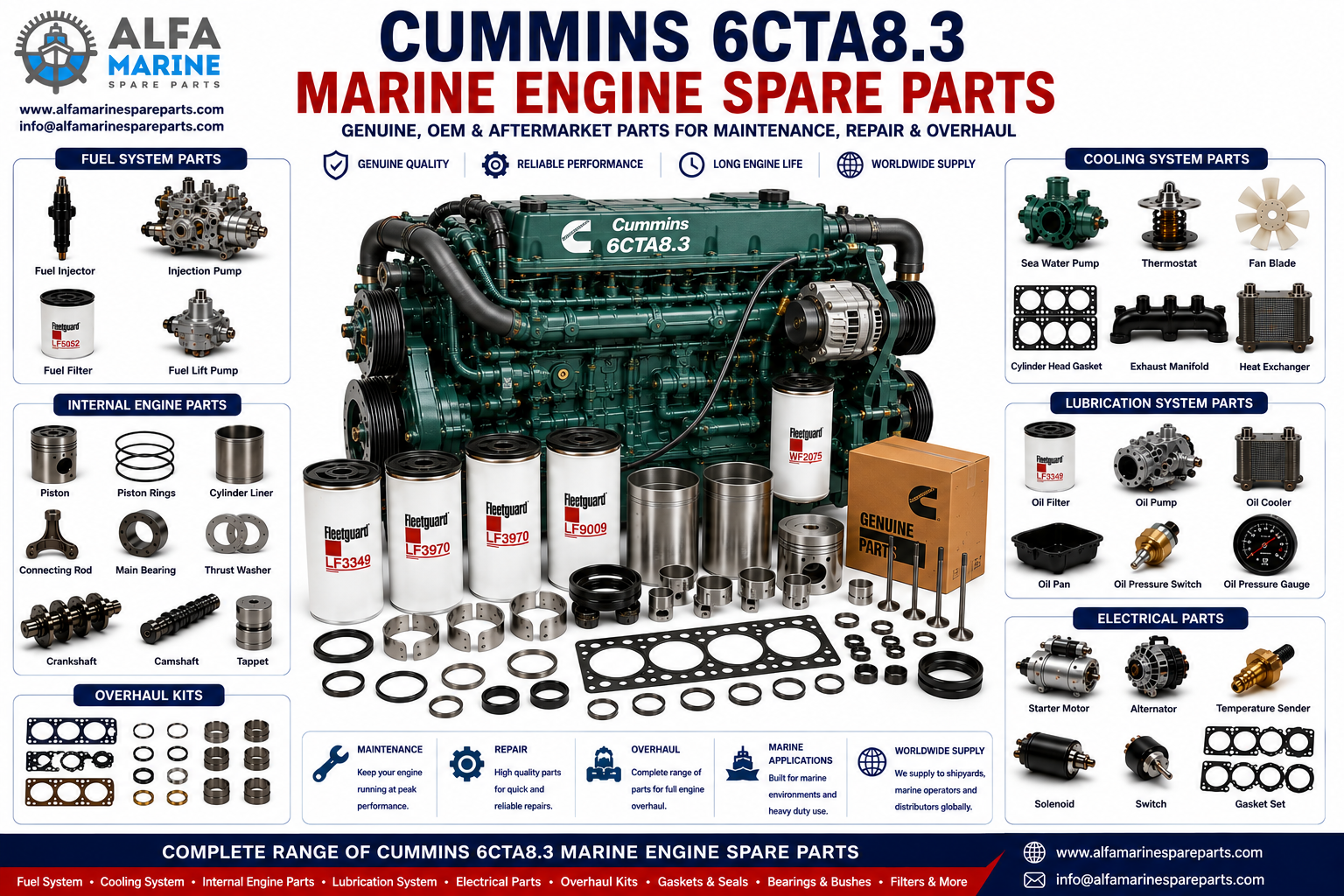
Cummins 6CTA8.3 Marine Engine Parts
The Cummins 6CTA8.3 Marine Engine belongs to the Cummins C Series family and is built around an inline six-cylinder, 8.3-liter diesel platform.
The 6CTA8.3 combines turbocharging with charge-air cooling, making the turbocharger, intake system, charge-air cooler and marine cooling circuit important parts of the complete engine installation.
In marine service, these engines can accumulate many operating hours. By the time spare parts are required, the engine may already have been repaired or overhauled several times.
The turbocharger may have been replaced. The fuel injection pump may have been rebuilt. Injectors may have been serviced. The cylinder head may have been reconditioned. The crankshaft may have been machined during a previous overhaul. The seawater pump, heat exchanger, oil cooler, starter motor or alternator may also have been changed.
This is why ordering by the words “Cummins 6CTA8.3” alone is not always enough.
For more accurate parts identification, useful information includes:
- Exact Engine Model
- Engine Serial Number
- CPL Number Where Available
- Existing Cummins Part Number
- Component Manufacturer Number
- Part Description
- Quantity Required
- Clear Photographs
- Vessel Application
Alfa Marine Spare Parts supports Cummins 6CTA8.3 Marine Engine Spare Parts requirements for routine maintenance, repair and major engine overhaul.
Depending on availability, supply options can include:
- Genuine Cummins Parts
- OEM-Quality Components
- Selected Aftermarket Parts
- Remanufactured Components
- Maintenance Parts
- Repair Components
- Overhaul Parts
What Is the Cummins 6CTA8.3 Marine Engine?
The Cummins 6CTA8.3 is an inline six-cylinder diesel engine from the Cummins C Series family.
The engine uses turbocharging and charge-air cooling to support higher output from its 8.3-liter displacement.
Major engine systems can include:
- Cylinder Block
- Cylinder Head
- Pistons
- Piston Rings
- Piston Pins
- Connecting Rods
- Crankshaft
- Main Bearings
- Connecting Rod Bearings
- Camshaft
- Timing Gear System
- Fuel Injection System
- Turbocharger
- Charge-Air System
- Air Intake System
- Exhaust System
- Freshwater Cooling System
- Marine Raw-Water System
- Lubrication System
- Starting System
- Charging System
Depending on the marine installation, additional equipment can include:
- Marine Seawater Pump
- Heat Exchanger
- Charge-Air Cooler
- Oil Cooler
- Marine Exhaust Components
- Raw-Water Pipework
- Cooling Hoses
Cummins 6CTA8.3 Technical Information
Exact power ratings, governed speed, fuel equipment and marine cooling arrangements can vary according to the individual engine specification and application.
Technical InformationCummins 6CTA8.3ManufacturerCumminsEngine FamilyC SeriesEngine Model6CTA8.3Cylinder ArrangementInline 6-CylinderEngine CycleFour-Stroke DieselDisplacementApprox. 8.3 LitersBoreApprox. 114 mmStrokeApprox. 135 mmAspirationTurbochargedCharge-Air SystemCharge-Air Cooled / AftercooledFuelDieselCoolingLiquid CooledLubricationPressure Lubrication
The exact rated output and operating speed should be confirmed from the individual engine identification rather than assumed from another 6CTA8.3 installation.
What Does Cummins 6CTA8.3 Mean?
The model designation helps identify the engine configuration.
The 6 identifies the six-cylinder arrangement.
The C refers to the Cummins C Series family.
The T identifies turbocharging.
The A identifies the charge-air-cooled or aftercooled configuration.
The 8.3 refers to the engine's approximate displacement in liters.
This means the 6CTA8.3 should not automatically be treated as identical to every other Cummins C Series engine.
Why Is Correct 6CTA8.3 Identification Important?
Two engines can both be described as Cummins 6CTA8.3 Marine Engines but still have differences in:
- CPL
- Power Rating
- Fuel-System Equipment
- Turbocharger
- Charge-Air Cooler
- Cooling Arrangement
- Marine Accessories
- Starter Motor
- Alternator
- Pumps
- Gaskets
- Hoses
- Pipework
An older vessel may also have replacement equipment that differs from the engine's original configuration.
This becomes particularly important when ordering expensive components.
Why Is the Cummins Engine Serial Number Important?
The engine model provides the basic family identification.
The Engine Serial Number — ESN — provides more specific identification for the individual engine.
For a parts inquiry, a strong identification combination is:
Engine Model + Engine Serial Number + CPL + Existing Part Number
This can be particularly important for:
- Fuel Injectors
- Fuel Injection Pump
- Turbocharger
- Charge-Air Cooler
- Freshwater Pump
- Seawater Pump
- Heat Exchanger
- Cylinder Head
- Pistons
- Bearings
- Crankshaft
- Starter Motor
- Alternator
Why Is the CPL Number Useful?
CPL means Control Parts List.
Where available, the CPL provides additional information about the original engine configuration.
Two 6CTA8.3 engines with different CPLs should not automatically be assumed to use every component interchangeably.
When requesting parts, include the CPL whenever it is available.
What Cummins 6CTA8.3 Marine Engine Spare Parts Are Available?
Depending on the engine configuration and availability, potential requirements can include everything from routine filters to major internal overhaul components.
Cummins 6CTA8.3 Fuel-System Parts
Potential requirements can include:
- Fuel Injectors
- Injector Components
- Fuel Injection Pump
- Injection Pump Components
- Fuel Transfer Pump
- Fuel Filters
- Fuel-Water Separator Elements
- High-Pressure Fuel Pipes
- Fuel Supply Pipes
- Fuel Return Components
- Injector Seals
- Gaskets
- O-Rings
What Are Signs of a Cummins 6CTA8.3 Fuel-System Problem?
Possible symptoms can include:
- Difficult Starting
- Rough Running
- Uneven Cylinder Operation
- Increased Exhaust Smoke
- Reduced Engine Power
- Poor Acceleration
- Increased Fuel Consumption
- Abnormal Combustion Noise
However, these symptoms do not automatically confirm an injector or injection-pump problem.
Similar symptoms can also result from:
- Restricted Fuel Filters
- Air Entering the Fuel System
- Restricted Airflow
- Charge-Air Leakage
- Turbocharger Problems
- Low Compression
- Valve Problems
The symptom should therefore be used as the beginning of diagnosis rather than the final conclusion.
Cummins 6CTA8.3 Fuel Injectors
Potential requirements can include:
- Complete Fuel Injectors
- Injector Components
- Injector Seals
- High-Pressure Fuel Lines
- Fuel Return Components
- Associated Hardware
One Cylinder Is Running Differently — Should All Six Injectors Be Replaced?
Not automatically.
If five cylinders appear to operate normally and one behaves differently, investigate that cylinder first.
Possible areas include:
- Injector Performance
- Fuel Delivery
- Cylinder Compression
- Intake Valve Condition
- Exhaust Valve Condition
- Valve Adjustment
- Piston Condition
- Piston Ring Condition
- Cylinder Condition
Replacing all six injectors will not correct a mechanical problem affecting only one cylinder.
Cummins 6CTA8.3 Fuel Injection Pump Parts
Depending on the exact engine configuration, potential requirements can include:
- Complete Fuel Injection Pump
- Injection Pump Components
- Fuel Control Components
- Fuel Transfer Components
- Fuel Connections
- Gaskets
- O-Rings
- Seals
For injection-pump requirements, identification from the currently installed pump can be especially useful.
Cummins 6CTA8.3 Turbocharger Parts
The turbocharger is a major part of the 6CTA8.3 air-management system.
Potential requirements can include:
- Complete Turbocharger
- Turbocharger Cartridge
- Compressor Components
- Turbine Components
- Bearings
- Seals
- Oil Supply Components
- Oil Drain Components
- Intake Connections
- Exhaust Connections
- Turbocharger Gaskets
- Mounting Hardware
The Cummins 6CTA8.3 Has Lost Power — Is the Turbocharger Bad?
Possibly, but not necessarily.
Reduced power can also result from:
- Restricted Air Filter
- Intake Restriction
- Intake Leakage
- Charge-Air Leakage
- Charge-Air Cooler Restriction
- Exhaust Leakage
- Exhaust Restriction
- Restricted Fuel Filters
- Insufficient Fuel Supply
- Injector Problems
- Injection Pump Problems
- Low Compression
- Valve Problems
- Excessive Vessel or Propeller Load
A replacement turbocharger cannot repair a restricted fuel system or low-compression cylinder.
What Are Possible Signs of a 6CTA8.3 Turbocharger Problem?
Possible symptoms can include:
- Reduced Engine Power
- Poor Response Under Load
- Black Exhaust Smoke
- Abnormal Turbocharger Noise
- Oil Leakage
- Increased Oil Consumption
- Reduced Boost Performance
- Higher Exhaust Temperature
These symptoms should be considered together with the complete air, exhaust and fuel systems.
Why Can a Replacement Turbocharger Fail Again?
Because the turbocharger may have been damaged by another problem.
Before installing a replacement unit, investigate:
- Turbocharger Lubricating-Oil Supply
- Turbocharger Oil Drain
- Engine Oil Condition
- Air Intake Restriction
- Foreign-Object Damage
- Exhaust Restriction
- Abnormal Exhaust Temperature
Replacing the turbocharger without correcting the original cause can expose the replacement unit to the same failure condition.
Cummins 6CTA8.3 Charge-Air Cooler Parts
Charge-air cooling is an important part of the 6CTA8.3 configuration.
Potential requirements can include:
- Complete Charge-Air Cooler
- Cooler Core
- Cooler Housing Components
- Air Connections
- Cooling Connections
- Charge-Air Pipes
- Hoses
- Clamps
- Gaskets
- O-Rings
- Seals
Why Is the Charge-Air Cooler Important?
When the turbocharger compresses incoming air, the temperature of that air increases.
The charge-air cooler reduces the temperature before the compressed air enters the engine.
If the charge-air system becomes restricted or inefficient, possible effects can include:
- Reduced Engine Power
- Black Smoke
- Poor Response Under Load
- Higher Intake-Air Temperature
- Higher Exhaust Temperature
- Increased Thermal Load
Can a Charge-Air Leak Look Like Turbocharger Failure?
Yes.
The turbocharger may still be producing compressed air, but some of that air can escape before reaching the cylinders.
Possible leakage areas include:
- Charge-Air Hoses
- Pipe Connections
- Cooler Connections
- Gaskets
- O-Rings
- Seals
Possible symptoms can include:
- Reduced Power
- Black Smoke
- Poor Acceleration
- Higher Exhaust Temperature
The complete charge-air system should therefore be inspected before automatically replacing the turbocharger.
What If the Charge-Air Cooler Becomes Restricted?
A restricted charge-air cooler can reduce engine performance even when the turbocharger itself remains serviceable.
Possible effects include:
- Reduced Airflow
- Higher Intake-Air Temperature
- Reduced Engine Power
- Increased Exhaust Smoke
- Higher Exhaust Temperature
- Increased Thermal Loading
Both the air side and cooling side should be considered during inspection.
Cummins 6CTA8.3 Air Intake Parts
Potential requirements can include:
- Air Filter Elements
- Air Cleaner Components
- Intake Pipes
- Intake Hoses
- Charge-Air Pipes
- Intake Connections
- Clamps
- Gaskets
- Seals
Why Can a Restricted Air Filter Make the 6CTA8.3 Produce Black Smoke?
The turbocharger still depends on an adequate supply of clean air.
If intake airflow becomes restricted, possible symptoms can include:
- Black Exhaust Smoke
- Reduced Engine Power
- Poor Response Under Load
- Increased Exhaust Temperature
- Increased Fuel Consumption
The intake should therefore be checked before expensive turbocharger or fuel-system components are replaced.
Cummins 6CTA8.3 Exhaust-System Parts
Potential requirements can include:
- Exhaust Manifold Components
- Turbocharger Exhaust Connections
- Exhaust Pipes
- Exhaust Gaskets
- Sealing Components
- Fasteners
- Associated Hardware
Why Does an Exhaust Leak Before the Turbocharger Matter?
The turbocharger turbine is driven by exhaust-gas energy.
If exhaust escapes before reaching the turbine, the available energy can be reduced.
Possible signs include:
- Soot Around Exhaust Joints
- Abnormal Exhaust Noise
- Reduced Engine Response
- Reduced Turbocharger Performance
Cummins 6CTA8.3 Marine Cooling-System Parts
The cooling system is especially important in marine service because the engine can operate under substantial load for extended periods.
Potential requirements can include:
- Freshwater Pump
- Thermostats
- Thermostat Housing Components
- Charge-Air Cooler Cooling Components
- Heat Exchanger
- Marine Seawater Pump
- Oil Cooler
- Cooling Pipes
- Cooling Hoses
- Gaskets
- O-Rings
- Seals
Why Can a Cummins 6CTA8.3 Marine Engine Overheat?
Possible causes can include:
- Low Coolant Level
- Poor Coolant Condition
- Thermostat Problems
- Reduced Freshwater-Pump Performance
- Restricted Internal Cooling Passages
- Charge-Air Cooling Problems
- Heat Exchanger Restriction
- Oil Cooler Restriction
- Reduced Seawater Flow
- Blocked Sea Strainer
- Raw-Water-System Restrictions
Marine cooling should be considered as one complete heat-transfer system.
Why Does the 6CTA8.3 Overheat Mainly Under Load?
This is a useful diagnostic clue.
At light load, the engine produces less heat.
When vessel load increases, considerably more heat must be removed.
A cooling system that has gradually lost part of its capacity may therefore appear normal at idle but struggle when the vessel demands more power.
Possible areas to investigate include:
- Freshwater Pump
- Thermostat
- Charge-Air Cooler
- Heat Exchanger
- Oil Cooler
- Seawater Pump
- Sea Strainer
- Raw-Water Pipework
- Internal Cooling Passages
Cummins 6CTA8.3 Freshwater Pump Parts
Potential requirements can include:
- Complete Freshwater Pump
- Pump Housing
- Pump Shaft
- Bearings
- Mechanical Seal
- Impeller
- Gaskets
- O-Rings
Does a Bad Freshwater Pump Always Leak?
No.
A pump can lose circulation performance without producing a major visible coolant leak.
Possible problems can include:
- Bearing Wear
- Mechanical-Seal Deterioration
- Impeller Damage
- Internal Corrosion
- Cavitation
- Reduced Pumping Efficiency
Cooling-system diagnosis should therefore consider circulation performance as well as visible leakage.
Cummins 6CTA8.3 Marine Seawater Pump Parts
Depending on the marine installation, potential requirements can include:
- Complete Seawater Pump
- Pump Housing
- Pump Shaft
- Bearings
- Mechanical Seal
- Flexible Impeller Where Applicable
- Wear Plate
- Cover Plate
- Gaskets
- O-Rings
Are All Cummins 6CTA8.3 Seawater Pumps the Same?
No such assumption should be made.
The pump can depend on:
- Exact Engine Configuration
- CPL
- Vessel Builder
- Marine Conversion
- Cooling-System Design
- Previous Replacement
- Previous Modification
For seawater-pump identification, provide:
- Engine Serial Number
- CPL Number Where Available
- Pump Manufacturer
- Pump Model
- Existing Pump Number
- Clear Photographs
- Mounting Arrangement
- Pipe Connections
What Can Cause Low Seawater Flow?
Possible causes include:
- Restricted Sea Strainer
- Blocked Seawater Intake
- Damaged Flexible Impeller Where Applicable
- Worn Seawater Pump
- Pump-Shaft Problems
- Air Entering the Raw-Water Circuit
- Restricted Raw-Water Pipework
- Heat Exchanger Restriction
- Charge-Air Cooler Restriction
- Debris in the Cooling Circuit
Reduced seawater flow may first become obvious when engine temperature begins to rise at higher load.
What If the Seawater Pump Impeller Has Missing Blades?
Finding the damaged impeller is only part of the repair.
The missing fragments should be located where possible.
They can become trapped in:
- Cooling Hoses
- Pipe Connections
- Heat Exchanger Inlets
- Oil Cooler Passages
- Charge-Air Cooling Passages
- Other Raw-Water Restrictions
Installing a new impeller without checking downstream components can leave part of the cooling system restricted.
Cummins 6CTA8.3 Marine Heat Exchanger Parts
Potential requirements can include:
- Complete Heat Exchanger
- Heat Exchanger Core
- Tube Bundle
- Housing
- End Covers
- Cooling Connections
- Gaskets
- O-Rings
- Seals
What Can Reduce Heat Exchanger Performance?
Possible causes include:
- Salt Deposits
- Scale
- Sediment
- Marine Growth
- Corrosion Products
- Impeller Debris
- Restricted Seawater Flow
A partially restricted heat exchanger may still cope with light operation but become inadequate when the engine is operating under heavier load.
Cummins 6CTA8.3 Oil Cooler Parts
Potential requirements can include:
- Complete Oil Cooler
- Oil Cooler Core
- Oil Cooler Housing
- Oil Connections
- Cooling Connections
- Gaskets
- O-Rings
- Seals
Cummins 6CTA8.3 Lubrication-System Parts
Potential requirements can include:
- Engine Oil Pump
- Oil Pump Components
- Engine Oil Filters
- Oil Cooler Components
- Oil Pressure Components
- Oil Pipes
- Gaskets
- O-Rings
- Front Crankshaft Seal
- Rear Crankshaft Seal
Does Low Oil Pressure Mean the 6CTA8.3 Oil Pump Is Bad?
Not automatically.
Possible causes can include:
- Low Oil Level
- Incorrect Lubricating Oil
- Deteriorated Oil
- Restricted Oil Filter
- Oil Pump Wear
- Pressure-Regulating Problems
- Excessive Main-Bearing Clearance
- Excessive Connecting Rod Bearing Clearance
- Crankshaft Wear
- Internal Engine Wear
- Instrumentation Problems
If excessive internal bearing clearance is responsible, replacing only the oil pump will not correct the underlying problem.
Cummins 6CTA8.3 Cylinder Head Parts
Potential requirements can include:
- Complete Cylinder Head
- Cylinder Head Gasket
- Intake Valves
- Exhaust Valves
- Valve Guides
- Valve Seats
- Valve Springs
- Rocker Components
- Valve-Train Components
- Injector Sealing Components
- Valve Cover Gaskets
When Should the Cummins 6CTA8.3 Cylinder Head Be Inspected?
Cylinder-head inspection may become necessary following:
- Severe Overheating
- Coolant Loss
- Head-Gasket Failure
- Low Compression
- Valve Problems
- Uneven Cylinder Performance
- Abnormal Combustion
- Major Engine Overhaul
Rebuild or Replace the Cummins 6CTA8.3 Cylinder Head?
That decision should follow inspection.
Important areas include:
- Cracking
- Corrosion
- Flatness
- Sealing-Surface Condition
- Intake Valve Condition
- Exhaust Valve Condition
- Valve Seats
- Valve Guides
- Previous Machining
- Heat Damage
A serviceable cylinder head may be suitable for rebuilding or reconditioning.
A severely damaged or dimensionally unsuitable head may require replacement.
Why Can a New Head Gasket Fail Again?
Because the gasket may not have been the original problem.
Possible contributing conditions can include:
- Engine Overheating
- Cylinder Head Distortion
- Damaged Sealing Surfaces
- Cooling-System Problems
- Previous Assembly Problems
Replacing the gasket without correcting the underlying cause can result in another failure.
Cummins 6CTA8.3 Pistons and Piston Rings
Potential requirements can include:
- Pistons
- Piston Ring Sets
- Piston Pins
- Piston Pin Components
- Retaining Components
What Are Possible Signs of Piston, Ring or Cylinder Wear?
Possible symptoms can include:
- Excessive Blow-By
- Increased Oil Consumption
- Reduced Compression
- Difficult Starting
- Exhaust Smoke
- Reduced Engine Performance
Does Excessive Blow-By Mean the 6CTA8.3 Only Needs New Rings?
Not necessarily.
Possible causes include:
- Worn Piston Rings
- Cylinder Wear
- Piston Wear
- Ring-Groove Wear
- Internal Engine Damage
New rings cannot compensate for excessive cylinder or piston wear.
The piston, rings and cylinder condition should be inspected together.
Cummins 6CTA8.3 Connecting Rod Parts
Potential requirements can include:
- Connecting Rods
- Connecting Rod Bearings
- Big-End Bearings
- Small-End Components
- Connecting Rod Bolts
- Associated Hardware
Connecting rods should receive careful inspection following:
- Bearing Failure
- Lubrication Failure
- Piston Damage
- Severe Internal Engine Damage
Cummins 6CTA8.3 Crankshaft and Bearing Parts
Potential requirements can include:
- Complete Crankshaft
- Main Bearings
- Connecting Rod Bearings
- Thrust Components
- Crankshaft Gear Components
- Front Crankshaft Seal
- Rear Crankshaft Seal
Why Should the Crankshaft Be Measured Before Ordering Bearings?
An older marine engine may already have undergone previous overhaul work.
The crankshaft may have been:
- Polished
- Repaired
- Reground
- Replaced
Inspection should consider:
- Main Journal Diameter
- Connecting Rod Journal Diameter
- Surface Condition
- Scoring
- Taper
- Out-of-Round Condition
- Heat Damage
- Previous Machining
If journal dimensions have changed, the required bearing specification can also change.
Measure first. Select bearings second.
Cummins 6CTA8.3 Camshaft and Timing Parts
Potential requirements can include:
- Camshaft
- Camshaft Components
- Timing Gears
- Gear-Train Components
- Timing Cover Components
- Timing Cover Gaskets
- Valve-Train Components
- Related Bushings
These components should be inspected during a major overhaul rather than automatically assumed to be reusable.
Cummins 6CTA8.3 Gasket Sets and Seals
Potential requirements can include:
- Complete Engine Gasket Set
- Upper Gasket Set
- Lower Gasket Set
- Cylinder Head Gasket
- Valve Cover Gasket
- Intake Gaskets
- Exhaust Gaskets
- Turbocharger Gaskets
- Charge-Air Cooler Gaskets
- Heat Exchanger Gaskets
- Oil Cooler Gaskets
- Water Pump Gaskets
- Thermostat Gaskets
- Injector Seals
- O-Rings
- Front Crankshaft Seal
- Rear Crankshaft Seal
The gasket package should be matched to the exact Cummins 6CTA8.3 engine configuration.
Cummins 6CTA8.3 Starter Motor and Alternator Parts
Potential requirements can include:
- Starter Motor
- Starter Solenoid
- Alternator
- Drive Belts
- Pulleys
- Belt-Tension Components
- Electrical Connections
For older marine installations, identification from the component currently installed can help because electrical equipment may have been changed previously.
Cummins 6CTA8.3 Overhaul Parts
A planned overhaul can require:
- Pistons
- Piston Rings
- Piston Pins
- Main Bearings
- Connecting Rod Bearings
- Thrust Components
- Cylinder Head Components
- Intake Valves
- Exhaust Valves
- Crankshaft Seals
- Complete Gasket Sets
- Engine Seal Kits
- Fuel-System Components
- Turbocharger Components
- Charge-Air Components
- Cooling-System Components
- Lubrication-System Components
Depending on inspection findings, additional requirements may include:
- Complete Cylinder Head
- Crankshaft
- Connecting Rods
- Camshaft
- Fuel Injectors
- Fuel Injection Pump Components
- Complete Turbocharger
- Charge-Air Cooler Components
- Freshwater Pump
- Seawater Pump
- Heat Exchanger Components
- Oil Pump
- Oil Cooler
- Starter Motor
- Alternator
Should a Complete Cummins 6CTA8.3 Overhaul Kit Be Ordered Before Disassembly?
Some planned maintenance and overhaul components can be prepared beforehand.
For a major rebuild, however, the final internal parts requirement should ideally follow inspection and measurement.
Once the engine is opened, the workshop can determine:
What condition are the cylinder bores in?
Can the pistons be reused?
Has the crankshaft previously been machined?
Which bearing specification is required?
Can the cylinder head be reconditioned?
Are the connecting rods serviceable?
What condition is the turbocharger in?
Does the charge-air cooler require attention?
A practical overhaul sequence is:
Identify → Disassemble → Clean → Inspect → Measure → Confirm Parts → Rebuild
What Information Should You Send for Cummins 6CTA8.3 Parts?
For accurate Cummins 6CTA8.3 Marine Engine Spare Parts identification, provide:
- Engine Model: Cummins 6CTA8.3
- Engine Serial Number
- CPL Number Where Available
- Photograph of the Engine Identification Plate
- Existing Cummins Part Number
- Component Manufacturer Number
- Part Description
- Quantity Required
- Clear Photographs
- Vessel Application
- Delivery Country or Nearest Port
For turbochargers, fuel equipment, charge-air components, freshwater pumps, seawater pumps, heat exchangers, starter motors and alternators, identification from the currently installed component is particularly useful.
Who Do We Supply?
Alfa Marine Spare Parts supports Cummins 6CTA8.3 Marine Engine Spare Parts requirements for:
- Shipyards
- Ship Repairers
- Marine Engineers
- Chief Engineers
- Technical Superintendents
- Fleet Operators
- Marine Service Companies
- Commercial Fishing Companies
- Offshore Operators
- Government Fleets
- Maritime Contractors
- Boat Builders
- Marine Equipment Distributors
- Commercial Vessel Operators
Worldwide Cummins 6CTA8.3 Marine Engine Parts Supply
Alfa Marine Spare Parts supports Cummins 6CTA8.3 requirements across major marine markets, including Spain, Italy, Monaco, France, the Netherlands, Belgium, Germany, Greece, the United Kingdom, Dubai and the UAE, Nigeria, Miami and Florida, Texas, Toronto and Canada, the Caribbean, South America and other international seaports.
Whether the requirement involves fuel injectors, a turbocharger, charge-air cooler, freshwater pump, seawater pump, heat exchanger, cylinder head, crankshaft, bearings, gasket sets or a complete Cummins 6CTA8.3 overhaul parts package, accurate identification remains the starting point.