Cummins 4B Marine Engine Parts
The Cummins 4B Marine Engine belongs to Cummins’ well-known B Series diesel-engine family. The basic 4B3.9 is an inline four-cylinder, 3.9-liter diesel platform, while closely related marine versions include turbocharged 4BT configurations. Cummins confirms a 3.9-liter displacement and four-cylinder inline arrangement for the 4B3.9 family.
For marine engineers, the attraction of the Cummins 4B family is straightforward: it is compact, mechanically accessible and built around a relatively simple heavy-duty diesel platform.
But simplicity does not mean that every Cummins 4B Marine Engine Spare Part can be ordered using only the words “Cummins 4B.”
The exact engine designation matters.
A vessel may have:
4B
4B3.9
4BT3.9
4BTA3.9
or another application-specific version.
These engines belong to the same wider family, but differences in aspiration, cooling equipment, fuel-system configuration and marinization can affect the parts required.
Alfa Marine Spare Parts supports Cummins 4B Marine Engine Spare Parts requirements for:
- Routine Maintenance
- Fuel-System Repairs
- Cooling-System Repairs
- Marine Seawater-System Repairs
- Turbocharger Repairs Where Applicable
- Lubrication-System Repairs
- Cylinder Head Repairs
- Internal Engine Repairs
- Major Engine Overhauls
Depending on availability, supply options can include:
- Genuine Cummins Parts
- OEM-Quality Components
- Selected Aftermarket Parts
- Remanufactured Components
- Maintenance Parts
- Repair Components
- Overhaul Parts
What Is the Cummins 4B Marine Engine?
The Cummins 4B is an inline four-cylinder diesel from the Cummins B Series.
Cummins identifies the 4B3.9 family as:
Technical InformationCummins 4B3.9ManufacturerCumminsEngine FamilyB Series / 4B3.9Cylinder ArrangementInline 4-CylinderDisplacement3.9 LitersFuelDieselEngine CycleFour-StrokeBore × Stroke102 × 119 mmRelated Versions4B, 4BT, 4BTA
Cummins lists the 4B3.9 as a four-cylinder, 3.9-liter engine, while its marine ReCon 4BT documentation confirms the same 102 × 119 mm bore and stroke and 3.9-liter displacement for the turbocharged marine-related version.
Exact power output, aspiration, cooling arrangement and marine accessories should be confirmed from the engine serial number and installed engine configuration.
What Is the Difference Between Cummins 4B, 4BT and 4BTA?
This is one of the most important questions when ordering parts.
In general:
4B → Base four-cylinder B Series configuration
4BT → Turbocharged four-cylinder B Series
4BTA → Turbocharged and aftercooled four-cylinder B Series configuration
Cummins currently documents marine ReCon 4BT engines as four-cylinder, 3.9-liter turbocharged/aftercooled units, demonstrating how marine configurations within this family can differ from the basic 4B designation.
These differences can affect:
- Turbocharger Components
- Aftercooler Components
- Air Intake Components
- Exhaust Components
- Cooling-System Components
- Hoses
- Pipes
- Gaskets
- Fuel-System Components
- Mounting Hardware
That is why the complete engine model should always be checked.
Why Is the Cummins Engine Serial Number Important?
The engine model gives you the family.
The Engine Serial Number — ESN — identifies the individual engine much more precisely.
Cummins provides engine-specific manuals and parts information through its QuickServe and engine manual systems using the engine serial number.
For a 4B parts request, useful information includes:
- Engine Model
- Engine Serial Number
- CPL Number Where Available
- Existing Cummins Part Number
- Component Manufacturer Number
- Clear Photographs
- Vessel Application
- Quantity Required
For older marine engines, the existing component should also be checked because it may have been replaced during a previous repair.
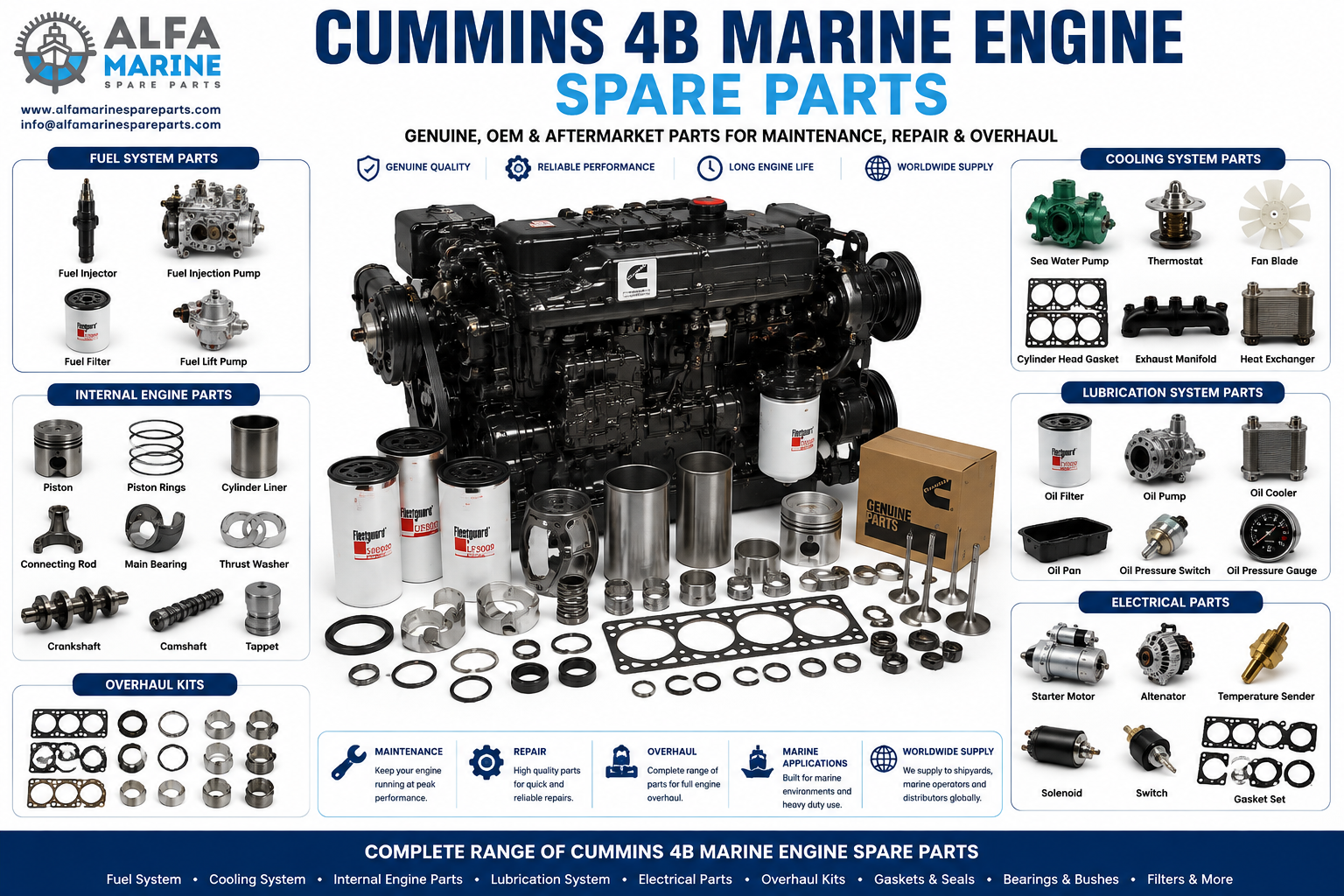
What Spare Parts Are Available for the Cummins 4B Marine Engine?
Potential requirements can include everything from normal service items to complete overhaul components.
Fuel-System Parts
- Fuel Injectors
- Injector Components
- Fuel Injection Pump Components
- Fuel Transfer Pump Components
- Fuel Filters
- Fuel-Water Separator Elements
- Fuel Pipes
- Fuel Return Components
- Injector Seals
- O-Rings
- Gaskets
Air Intake Parts
- Air Filters
- Air Cleaner Components
- Intake Pipes
- Intake Hoses
- Intake Manifold Components
- Gaskets
- Clamps
- Seals
Turbocharger Parts Where Applicable
- Complete Turbocharger
- Turbocharger Cartridge
- Compressor Components
- Turbine Components
- Bearings
- Seals
- Oil Supply Components
- Oil Drain Components
- Turbocharger Gaskets
Cooling-System Parts
- Freshwater Pump
- Thermostat
- Thermostat Housing Components
- Heat Exchanger Components
- Marine Seawater Pump
- Cooling Hoses
- Cooling Pipes
- Gaskets
- O-Rings
- Seals
Lubrication-System Parts
- Engine Oil Pump
- Oil Filters
- Oil Cooler Components
- Oil Pressure Components
- Oil Pipes
- Gaskets
- O-Rings
- Crankshaft Seals
Cylinder Head Parts
- Cylinder Head
- Cylinder Head Gasket
- Intake Valves
- Exhaust Valves
- Valve Guides
- Valve Seats
- Valve Springs
- Rocker Components
- Valve-Train Components
- Valve Cover Gaskets
Internal Engine Parts
- Pistons
- Piston Rings
- Piston Pins
- Connecting Rods
- Connecting Rod Bearings
- Main Bearings
- Thrust Components
- Crankshaft
- Camshaft
- Timing Components
- Gaskets
- Seals
Cummins 4B Fuel-System Parts
The fuel system has to provide clean fuel consistently to four cylinders.
Potential requirements can include:
- Fuel Injectors
- Injector Components
- Injection Pump Components
- Fuel Transfer Pump
- Fuel Filters
- Fuel-Water Separator Elements
- Fuel Lines
- Return Lines
- Injector Seals
- O-Rings
- Gaskets
What Happens When the Cummins 4B Fuel System Starts Losing Performance?
Possible symptoms can include:
- Difficult Starting
- Rough Running
- Uneven Cylinder Operation
- Increased Exhaust Smoke
- Reduced Power
- Increased Fuel Consumption
- Poor Response Under Load
- Abnormal Combustion Noise
But none of those symptoms automatically means an injector has failed.
The same symptoms can also involve:
- Restricted Fuel Filters
- Air Entering the Fuel System
- Poor Fuel Supply
- Low Compression
- Valve Problems
- Restricted Airflow
This is why diagnosis should come before parts replacement.
Cummins 4B Fuel Injectors
Potential requirements can include:
- Complete Injectors
- Injector Components
- Injector Seals
- Fuel Pipes
- Return Components
- Associated Hardware
One Cylinder Is Running Poorly — Should All Four Injectors Be Replaced?
Not automatically.
If three cylinders appear normal and one is behaving differently, that cylinder gives the engineer a logical place to start.
Possible causes include:
- Injector Performance
- Fuel Delivery
- Cylinder Compression
- Intake Valve Condition
- Exhaust Valve Condition
- Valve Adjustment
- Piston Condition
- Piston Ring Condition
- Cylinder Wear
Replacing four injectors without identifying the cause of one bad cylinder may not correct the problem.
Cummins 4B Injection Pump Parts
Depending on the exact engine version, potential requirements can include:
- Complete Fuel Injection Pump
- Injection Pump Components
- Fuel Control Components
- Fuel Supply Components
- Fuel Transfer Components
- Fuel Connections
- Gaskets
- O-Rings
- Seals
The identification plate or manufacturer number on the currently installed pump can be very useful when ordering.
Cummins 4B Air Intake Parts
Potential requirements can include:
- Air Filter Element
- Air Cleaner
- Intake Pipes
- Intake Hoses
- Intake Manifold Components
- Clamps
- Gaskets
- Seals
Why Can a Dirty Air Filter Make a Cummins 4B Smoke?
A diesel engine needs sufficient air to burn the fuel being injected.
If airflow is restricted, possible symptoms include:
- Black Smoke
- Reduced Power
- Poor Response Under Load
- Increased Exhaust Temperature
- Increased Fuel Consumption
Before assuming that the injectors or injection pump have failed, checking the intake system is a sensible first step.
Cummins 4BT and 4BTA Turbocharger Parts
Turbocharger components apply to turbocharged versions of the B Series rather than every basic 4B configuration.
Cummins documents marine ReCon 4BT engines as turbocharged/aftercooled 3.9-liter engines.
Potential requirements can include:
- Complete Turbocharger
- Turbocharger Cartridge
- Compressor Components
- Turbine Components
- Bearings
- Seals
- Oil Feed Components
- Oil Drain Components
- Intake Connections
- Exhaust Connections
- Turbocharger Gaskets
- Mounting Hardware
The Cummins 4BT Has Lost Power — Is the Turbocharger Bad?
Possibly, but not necessarily.
Reduced power can also result from:
- Restricted Air Filter
- Intake Restriction
- Intake Leakage
- Aftercooler Restriction Where Applicable
- Exhaust Restriction
- Restricted Fuel Filters
- Poor Fuel Supply
- Injector Problems
- Injection Pump Problems
- Low Compression
- Excessive Propeller or Vessel Load
A new turbocharger cannot repair a restricted fuel supply or low-compression cylinder.
Why Can a New Turbocharger Fail Again?
Because the first turbocharger may have failed as a consequence of another problem.
Before installing a replacement, investigate:
- Lubricating-Oil Supply
- Turbocharger Oil Drain
- Engine Oil Condition
- Intake Restriction
- Foreign-Object Damage
- Exhaust Restriction
- Excessive Exhaust Temperature
The replacement turbocharger should not be exposed to the same condition that damaged the original unit.
Cummins 4B Marine Cooling-System Parts
Marine cooling deserves particular attention because marine engines may operate for long periods under substantial load.
Potential requirements can include:
- Freshwater Pump
- Thermostats
- Thermostat Housing Components
- Heat Exchanger Components
- Seawater Pump
- Raw-Water Components
- Oil Cooler
- Cooling Pipes
- Cooling Hoses
- Gaskets
- O-Rings
- Seals
Why Can a Cummins 4B Marine Engine Overheat?
Possible causes include:
- Low Coolant Level
- Poor Coolant Condition
- Thermostat Problems
- Freshwater Pump Deterioration
- Restricted Cooling Passages
- Heat Exchanger Restriction
- Oil Cooler Restriction
- Restricted Seawater Flow
- Blocked Sea Strainer
- Raw-Water-System Problems
Marine cooling involves more than one pump or one heat exchanger.
The entire heat-transfer path should be considered.
Why Does the Engine Overheat Only When the Boat Is Under Load?
This is an important clue.
At idle, the engine produces relatively little heat.
When vessel load increases, much more heat must be removed.
A cooling system that has lost part of its capacity may therefore operate normally at idle but begin overheating during harder operation.
Possible areas to investigate include:
- Freshwater Pump
- Thermostat
- Heat Exchanger
- Seawater Pump
- Sea Strainer
- Raw-Water Pipework
- Oil Cooler
- Cooling Passages
Cummins 4B Freshwater Pump Parts
Potential requirements can include:
- Complete Water Pump
- Pump Housing
- Pump Shaft
- Bearings
- Mechanical Seal
- Impeller
- Gaskets
- O-Rings
Does a Bad Water Pump Always Leak?
No.
A pump can lose circulation performance without producing a large external leak.
Possible problems can include:
- Bearing Wear
- Seal Failure
- Impeller Damage
- Internal Corrosion
- Cavitation
- Reduced Pumping Efficiency
Cooling-system diagnosis should therefore look beyond visible leakage.
Cummins 4B Marine Seawater Pump Parts
Depending on the marine installation, potential requirements can include:
- Complete Seawater Pump
- Pump Housing
- Pump Shaft
- Bearings
- Mechanical Seal
- Flexible Impeller Where Applicable
- Wear Plate
- Cover Plate
- Gaskets
- O-Rings
Are All Cummins 4B Marine Seawater Pumps the Same?
No such assumption should be made.
The seawater pump can depend on:
- Exact Engine Model
- Marine Conversion
- Vessel Builder
- Cooling-System Arrangement
- Previous Replacement
For identification, provide:
- Pump Manufacturer
- Pump Model
- Existing Part Number
- Cummins Engine Serial Number
- Clear Photographs
- Mounting Arrangement
- Pipe Connections
What Can Cause Low Seawater Flow?
Possible causes include:
- Restricted Sea Strainer
- Blocked Hull Intake
- Damaged Flexible Impeller Where Applicable
- Worn Seawater Pump
- Shaft or Seal Problems
- Restricted Raw-Water Pipework
- Heat Exchanger Restriction
- Debris Inside the Cooling Circuit
Low seawater flow may become most obvious when engine load increases.
Cummins 4B Marine Heat Exchanger Parts
Potential requirements can include:
- Complete Heat Exchanger
- Heat Exchanger Core
- Tube Bundle
- Housing
- End Covers
- Gaskets
- O-Rings
- Seals
- Cooling Connections
Why Can the Heat Exchanger Gradually Lose Performance?
Marine heat exchangers can be affected by:
- Salt Deposits
- Scale
- Sediment
- Marine Growth
- Corrosion Products
- Debris
- Restricted Seawater Flow
A partially restricted exchanger can appear satisfactory at low load and become inadequate as engine output increases.
Cummins 4B Lubrication-System Parts
Potential requirements can include:
- Engine Oil Pump
- Oil Pump Components
- Engine Oil Filters
- Oil Cooler
- Oil Cooler Components
- Oil Pressure Components
- Oil Pipes
- Gaskets
- O-Rings
- Front Crankshaft Seal
- Rear Crankshaft Seal
Low Oil Pressure — Does the Cummins 4B Need a New Oil Pump?
Not automatically.
Possible causes include:
- Low Oil Level
- Incorrect Engine Oil
- Deteriorated Oil
- Restricted Oil Filter
- Oil Pump Wear
- Pressure-Regulating Problems
- Excessive Main-Bearing Clearance
- Excessive Connecting Rod Bearing Clearance
- Internal Engine Wear
- Instrumentation Problems
If excessive internal clearance is causing pressure loss, installing a new oil pump will not correct the underlying wear.
Cummins 4B Cylinder Head Parts
Potential requirements can include:
- Complete Cylinder Head
- Cylinder Head Gasket
- Intake Valves
- Exhaust Valves
- Valve Guides
- Valve Seats
- Valve Springs
- Rocker Components
- Valve-Train Components
- Injector Sealing Components
- Valve Cover Gaskets
When Should the Cummins 4B Cylinder Head Be Inspected?
Cylinder-head inspection may become necessary after:
- Engine Overheating
- Coolant Loss
- Head-Gasket Failure
- Low Compression
- Valve Problems
- Uneven Cylinder Performance
- Abnormal Combustion
- Major Engine Overhaul
Rebuild or Replace the Cummins 4B Cylinder Head?
The decision should follow inspection.
Important areas include:
- Cracking
- Corrosion
- Flatness
- Sealing Surfaces
- Intake Valves
- Exhaust Valves
- Valve Seats
- Valve Guides
- Previous Machining
- Heat Damage
A serviceable head may be suitable for rebuilding.
A severely damaged or dimensionally unsuitable cylinder head may require replacement.
Cummins 4B Pistons and Piston Rings
Potential requirements can include:
- Pistons
- Piston Ring Sets
- Piston Pins
- Piston Pin Components
- Retaining Components
Possible signs of piston, ring or cylinder wear include:
- Excessive Blow-By
- Increased Oil Consumption
- Reduced Compression
- Difficult Starting
- Exhaust Smoke
- Reduced Power
Does Excessive Blow-By Mean the Cummins 4B Only Needs New Rings?
Not necessarily.
Possible causes include:
- Worn Piston Rings
- Cylinder Wear
- Piston Wear
- Ring-Groove Wear
- Internal Engine Damage
New rings cannot compensate for excessive cylinder wear.
The piston, rings and cylinder condition should be inspected together.
Cummins 4B Connecting Rod Parts
Potential requirements can include:
- Connecting Rods
- Connecting Rod Bearings
- Big-End Bearings
- Small-End Components
- Connecting Rod Bolts
- Associated Hardware
Connecting rods deserve careful inspection following bearing failure, lubrication failure or major piston damage.
Cummins 4B Main and Connecting Rod Bearings
Potential requirements can include:
- Main Bearing Sets
- Connecting Rod Bearing Sets
- Thrust Components
Bearing selection should follow the exact engine specification and actual crankshaft condition.
Why Should the Cummins 4B Crankshaft Be Measured Before Ordering Bearings?
An older marine engine may already have undergone an overhaul.
Its crankshaft may have been:
- Polished
- Repaired
- Reground
- Replaced
Inspection should consider:
- Main Journal Diameter
- Connecting Rod Journal Diameter
- Surface Condition
- Scoring
- Taper
- Out-of-Round Condition
- Heat Damage
- Previous Machining
Measure first. Select bearings second.
Cummins 4B Crankshaft Parts
Potential requirements can include:
- Complete Crankshaft
- Main Bearings
- Connecting Rod Bearings
- Thrust Components
- Crankshaft Gear Components
- Front Crankshaft Seal
- Rear Crankshaft Seal
Cummins 4B Camshaft and Timing Parts
Potential requirements can include:
- Camshaft
- Camshaft Components
- Timing Gears
- Gear-Train Components
- Timing Covers
- Timing Cover Gaskets
- Valve-Train Components
- Related Bushings
These components should be inspected during a major overhaul rather than automatically assumed to be reusable.
Cummins 4B Gasket Sets and Seals
Potential requirements can include:
- Complete Engine Gasket Set
- Upper Gasket Set
- Lower Gasket Set
- Cylinder Head Gasket
- Valve Cover Gaskets
- Intake Gaskets
- Exhaust Gaskets
- Turbocharger Gaskets Where Applicable
- Aftercooler Gaskets Where Applicable
- Oil Cooler Gaskets
- Cooling-System Gaskets
- Injector Seals
- O-Rings
- Front Crankshaft Seal
- Rear Crankshaft Seal
The gasket package should be matched to the exact engine configuration.
A 4B, 4BT and 4BTA should not automatically be assumed to require identical complete gasket packages.
Cummins 4B Starter Motor Parts
Potential requirements can include:
- Complete Starter Motor
- Starter Solenoid
- Starter Components
- Electrical Connections
- Associated Hardware
The Cummins 4B Cranks Slowly — Does It Need a Starter?
Not automatically.
Before replacing the starter motor, check:
- Battery Condition
- Battery Voltage
- Battery Cables
- Ground Connections
- Electrical Connections
- Starter Control Circuit
Poor electrical connections can imitate starter-motor failure.
Cummins 4B Alternator Parts
Potential requirements can include:
- Complete Alternator
- Alternator Components
- Drive Belts
- Pulleys
- Belt-Tension Components
- Electrical Connections
For an older marine installation, identification from the currently fitted alternator is useful because it may have been replaced previously.
Cummins 4B Overhaul Parts
A planned overhaul can require:
- Pistons
- Piston Rings
- Piston Pins
- Main Bearings
- Connecting Rod Bearings
- Thrust Components
- Cylinder Head Components
- Intake Valves
- Exhaust Valves
- Crankshaft Seals
- Complete Gasket Set
- Engine Seal Kit
- Fuel-System Components
- Cooling-System Components
- Lubrication-System Components
Depending on the exact configuration and inspection findings, additional requirements can include:
- Complete Cylinder Head
- Crankshaft
- Connecting Rods
- Camshaft
- Fuel Injectors
- Injection Pump Components
- Turbocharger Where Applicable
- Aftercooler Components Where Applicable
- Freshwater Pump
- Seawater Pump
- Heat Exchanger Components
- Oil Pump
- Oil Cooler
- Starter Motor
- Alternator
Should a Complete Cummins 4B Overhaul Kit Be Ordered Before Disassembly?
Some planned service parts can be prepared in advance.
For a major rebuild, however, the final parts requirement should ideally follow inspection and measurement.
Once the engine is opened, the workshop can answer:
What condition are the cylinders in?
Can the pistons be reused?
Has the crankshaft been machined previously?
Which bearings are actually required?
Can the cylinder head be rebuilt?
Are the connecting rods serviceable?
What condition are the marine cooling components in?
A practical sequence is:
Identify → Disassemble → Clean → Inspect → Measure → Confirm Parts → Rebuild
Cummins also provides engine-specific parts catalogs and technical documentation through its Engine Serial Number and QuickServe systems, reinforcing the importance of matching parts to the individual engine rather than only to the broad B Series name.
What Information Should You Send for Cummins 4B Parts?
For accurate identification, provide:
- Engine Model: Cummins 4B / 4B3.9
- Exact Variant — 4B, 4BT or 4BTA
- Engine Serial Number
- CPL Number Where Available
- Photograph of Engine Identification Plate
- Existing Cummins Part Number
- Component Manufacturer Number
- Part Description
- Quantity Required
- Clear Photographs
- Vessel Application
- Delivery Destination
For fuel equipment, turbochargers, freshwater pumps, seawater pumps, heat exchangers, starter motors and alternators, identification directly from the currently installed component is particularly useful.
Browse Cummins and Other Marine Engine Brands
https://alfamarinespareparts.com/our-brand
Browse Marine Engine Spare Parts