Yanmar Marine Heat Exchanger Maintenance: Cleaning, Gasket Replacement & Part Numbers
A Yanmar marine heat exchanger is one of the most critical components protecting a marine diesel engine from destructive high temperatures. Marine engines operate in a demanding environment where the cooling system must constantly fight against raw seawater, salt deposits, scale, corrosion, and stubborn marine growth. Over time, even a minor restriction inside the cooling core can dramatically reduce thermal efficiency. The engine may still appear to run perfectly normal at idle, but once the vessel accelerates and engine load increases, the coolant temperature begins climbing rapidly.
When this happens, operators often blame the entire cooling system or assume a major mechanical failure has occurred. However, the root cause is frequently much simpler: the internal tube bundle has fouled, and the heat exchanger can no longer transfer heat efficiently. This guide breaks down essential heat exchanger maintenance for popular Yanmar marine diesel engines, including cleaning procedures, raw-water troubleshooting, gasket replacement, and critical part-number references.
1. Yanmar Marine Engine Types Equipped with Heat Exchangers
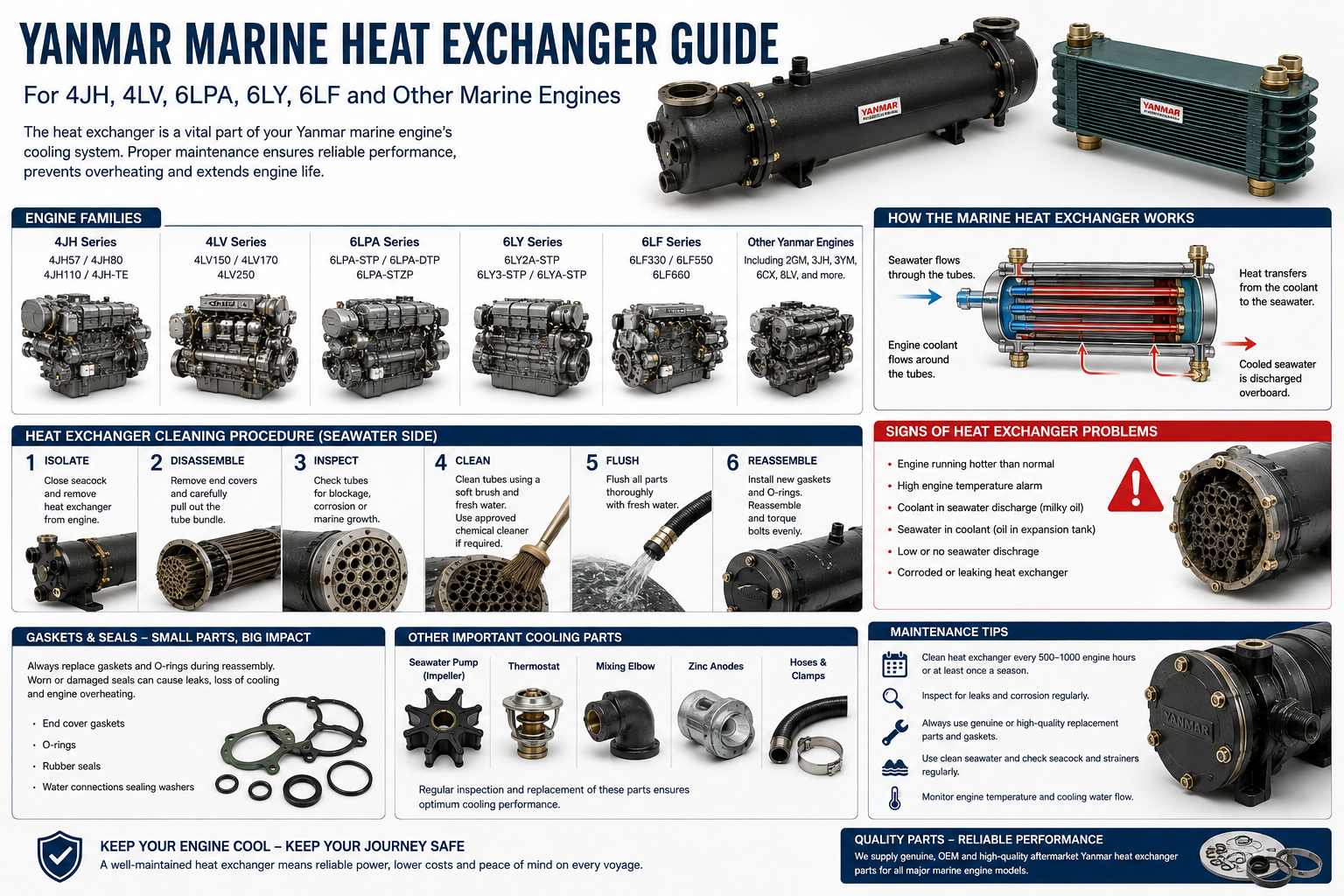
Indirect cooling networks feature heavily across almost the entire Yanmar marine diesel line. Common engine families running these systems include:
- Yanmar GM & YM Series: Compact auxiliary sailboat propulsion engines, such as the classic Yanmar 1GM10, 2GM20, 3GM30, 2YM15, and 3YM30AE.
- Yanmar JH Series: Widely popular mid-range mid-duty configurations, including the modern common-rail 3JH40, 4JH45, 4JH57, 4JH80, and Yanmar 4JH110 engines.
- Yanmar LV & LY Series: High-performance, rapid-acceleration yacht engines spanning the 4LV150 to 4LV250 series and the complete 6LY line (6LY2, 6LY3, 6LY440).
- Commercial Yanmar Engines: Large-scale continuous-duty platforms, including the 6LF, 6LT, 6AY, and 6GY series.
Because actual cooling configurations change significantly between engine generations, you should never buy components blindly. Heat exchangers, end covers, O-rings, and sealing gaskets must always be verified using your specific engine model and complete factory serial number to prevent costly ordering mistakes.
2. Tracing the Symptoms of a Clogged Heat Exchanger
Most heat-exchanger-cooled Yanmar engines rely on a dual-circuit configuration. The internal side contains a closed circuit filled with clean fresh water and corrosion inhibitors (coolant), while the external side draws raw seawater directly from the ocean to act as the cooling agent. The raw water follows a strict path: Seacock → Seawater Strainer → Raw-Water Pump → Heat Exchanger → Exhaust Mixing Elbow.
Inside the exchanger housing, the scorching engine coolant circulates tightly around a copper-alloy or cupronickel tube bundle through which cold seawater is pumped. This allows heat to transfer seamlessly without the two fluids ever mixing together.
When mineral scale, salt crystals, or biological growth gradually blanket the tubes, performance drops incrementally. This results in a classic symptom: the engine overheats only at high RPM. While idling around the marina or cruising at low speeds, the temperature gauge stays completely normal because the thermal load is minimal. But the moment you drop the throttles to cruising speed, the needle climbs toward the alarm zone. Backing off the throttle instantly drops the temperature back down. This specific operational pattern is a definitive indicator that your heat exchanger core is restricted or your raw-water flow rate is dropping under load.
🛒 Fixing an Overheating Engine? Don't risk cracking an expensive cylinder head or blowing a head gasket. Explore our inventory of premium Genuine & Aftermarket Yanmar Spare Parts to find compatible cooling components today.
3. The Danger of Shredded Raw-Water Pump Impellers
Before pulling your heat exchanger apart for service, it is highly recommended to evaluate the upstream raw-water circuit. Even an immaculate heat exchanger core cannot function if an insufficient volume of sea water reaches it. Inspect your seacock for obstructions, check the sea strainer for debris, and pull the cover plate off your raw-water pump.
A very common and dangerous problem occurs when a raw-water pump impeller throws a blade. When these rubber fins tear off, they do not dissolve in the water flow. Instead, the water pressure forces the loose rubber fragments straight downstream, where they jam tightly into the inlet side of the heat exchanger tubes, oil cooler, or intercooler. If you extract a worn impeller and notice that portions of the rubber fins are missing, do not simply slap a new impeller into the pump housing. You must locate and remove those loose rubber shards from the entrance of the heat exchanger, or your engine will continue to run hot.
4. Cleaning Procedures and Sealing Best Practices
When opening a Yanmar heat exchanger for standard service, extreme care must be taken during the mechanical cleaning phase. Aggressive scraping with metal wire brushes, steel screwdrivers, or harsh rods is strictly forbidden. The walls of the internal cooling tubes are exceptionally thin; a single microscopic scratch or deep puncture will convert a minor cooling problem into a catastrophic internal seawater leak, contaminating your engine's oil and internal combustion chambers. For stubborn scale and calcification, an extended flush with a mild, marine-safe chemical descaling solution is the safest method to restore full thermal transfer.
Furthermore, every single time you remove the end covers of the housing, the sealing elements must be discarded and replaced. Under the intense thermal cycles of a running engine, rubber seals become permanently compressed, brittle, hard, and prone to cracking. Attempting to save a few dollars by reusing a old, flattened seal after spending hours meticulously cleaning a core will almost always result in an immediate external leak upon reassembly.
5. Yanmar Heat Exchanger Part Number References
Yanmar incorporates an extensive array of distinct cooling components based on specific suffix codes and historical revisions. Below are several widely encountered cooling reference examples:
| Part NumberTypical Description / ReferenceApplication Context | ||
| 129470-44950 | Heat exchanger-related core component | Popular Yanmar marine applications |
| 119773-42600 | Heat exchanger housing / end-cover seal | Specific mid-range marine engines |
| 129670-01340 | Premium sealing O-ring | Core Yanmar internal cooling lines |
| 124722-13200 | End-cap structural gasket | Applicable Yanmar auxiliary assemblies |
| 119593-18880 | Cooling circuit rubber seal | Specialized common-rail Yanmar engines |
Important: These listed numbers serve strictly as reference examples. Yanmar frequently updates part numbers based on production years, regional emissions packages, and exact serial prefixes. Never buy a seal purely based on a generic description like "Yanmar 4JH gasket." Always verify your engine's precise datatag specs first.
Conclusion: Why Your Exact Model Designation Matters
There is a massive operational and mechanical difference between a broad label like Yanmar 4JH and a highly specific designation like a Yanmar 4JH110. Even within the exact same model series, different generations utilize entirely different heat exchangers, internal tube bundle lengths, end cap profiles, raw-water impellers, and thermostats. By adhering to a methodical maintenance strategy—checking for impeller pieces, using gentle descaling compounds, and installing fresh Viton seals at every service interval—you will keep your engine running cool and ensure reliable voyages.