Yanmar Marine Engine Types: What Is the Difference, and Which Engine Fits Which Vessel?
When somebody says:
“I have a Yanmar marine engine.”
that still leaves a lot of possibilities.
It could be a tiny 1GM10 pushing a sailing yacht out of the marina.
It could be a 3YM30AE in a cruising sailboat.
A 4JH110 might be installed in a larger yacht or small commercial vessel.
A 4LV250 could power a fast motorboat.
A 6LY440 may be working in a sportfishing boat or light commercial craft.
Move higher and you find 6LF and 6LT engines producing well over 500 hp.
Then Yanmar's commercial-engine side becomes very different again, with engines such as the 6AY and 6GY135W designed for much harder commercial service.
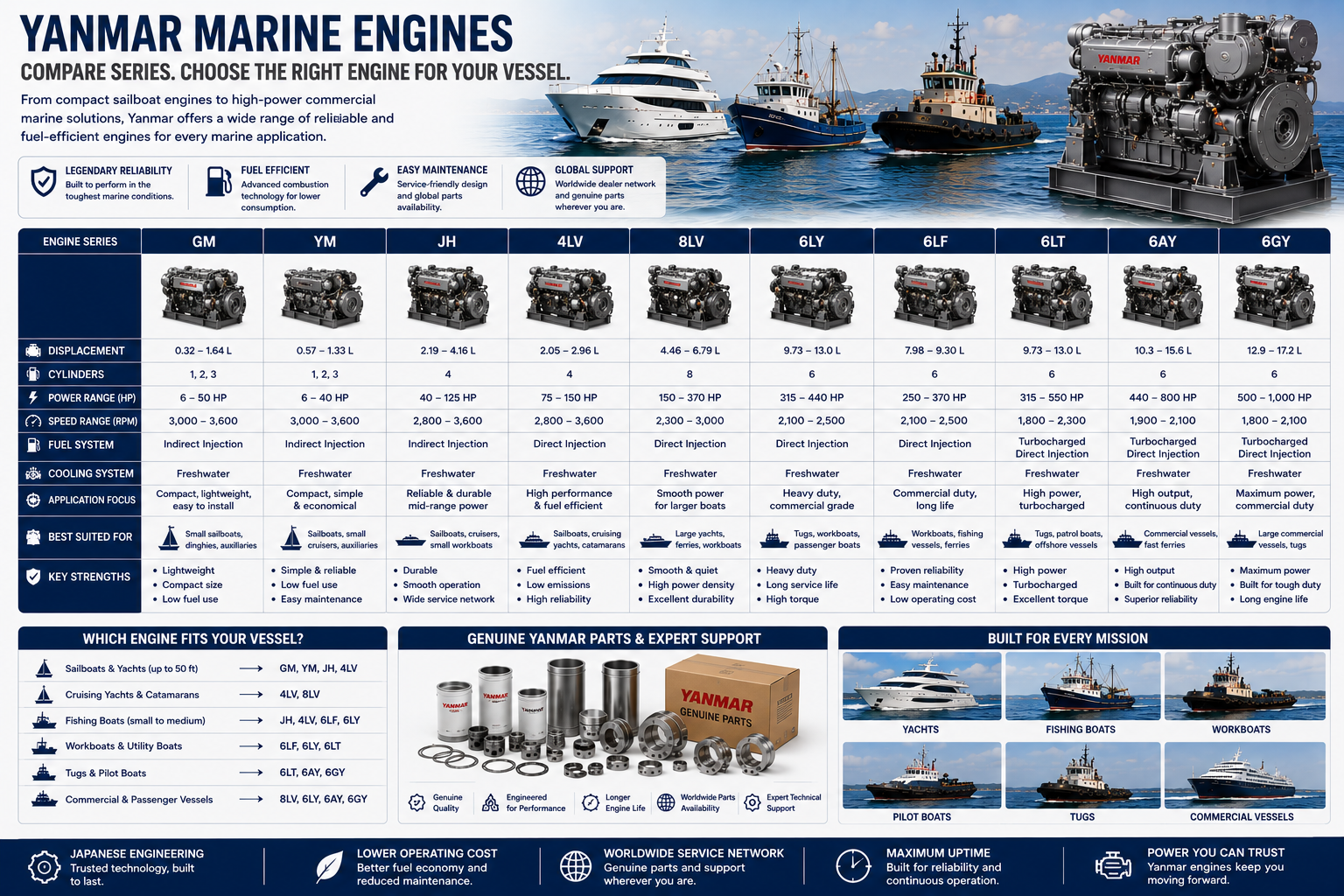
Yanmar's current recreational marine diesel range extends from approximately 10 to 640 MHP, while the company's commercial marine division supplies much larger propulsion and auxiliary engines for working vessels.
So asking:
“Which Yanmar marine engine is the best?”
isn't really the right question.
A better question is:
“Which Yanmar engine fits this boat, this duty cycle and this type of operation?”
Understanding the Main Yanmar Marine Engine Families
The easiest way to understand Yanmar is to separate the smaller yacht and light-commercial engines from the heavier commercial range.
| Yanmar FamilyGeneral Power ClassTypical CharacterCommon Application | |||
| GM | Around 9–10 hp | Very compact mechanical diesel | Small sailing yachts |
| YM | 15–30 hp | Small yacht diesel | Sailboats and displacement craft |
| JH | 40–110 hp current range | Compact yacht/small-commercial power | Sailing yachts, catamarans, small craft |
| 4LV | 150–250 hp | Modern compact four-cylinder | Motor yachts, fast cruisers, small commercial craft |
| 8LV | 320–370 hp | Compact V8 performance diesel | Motor yachts and fast craft |
| 6LY | 400–440 hp current CR range | High-output inline six | Sportfish, cruisers, light commercial |
| 6LF | 485–550 hp | Compact high-output common rail | Planing and semi-planing boats |
| 6LT | 500–640 hp | Highest-output recreational Yanmar class | Fast boats and light commercial craft |
| 6AY | Commercial 20.4 L six-cylinder | Heavy high-speed commercial engine | Fishing vessels, workboats, passenger craft |
| 6GY135W | Up to about 803 MHP depending rating | Newer commercial propulsion platform | High-speed commercial vessels |
| EY / larger commercial families | Much larger | Medium-speed commercial/auxiliary power | Ships, generators and heavy marine applications |
Yanmar's current leisure engine selector lists GM, YM, JH, 4LV, 8LV, 6LY, 6LF and 6LT families, while its commercial division separately lists engines such as 6AY and 6GY.
Yanmar GM: The Tiny Sailboat Workhorse
At the small end sits one of the most recognizable Yanmar names:
GM
The current 1GM10 is rated at approximately 9 MHP.
That is tiny compared with a 640-hp 6LT, but horsepower isn't the point.
The GM belongs in a completely different type of boat.
Where Does a Yanmar GM Fit?
Think:
- Small sailing yachts
- Day sailers
- Compact displacement boats
- Auxiliary propulsion
A sailing yacht may spend most of its life under sail.
The diesel is there to:
- Leave the marina
- Maneuver in port
- Motor through calm weather
- Charge systems depending on installation
- Bring the vessel home when wind disappears
That does not require hundreds of horsepower.
What matters is:
compact size + reliability + simple operation.
The GM Personality
The Little Sailor
Small, mechanically straightforward and built for boats where the engine is an auxiliary rather than the star of the show.
Yanmar YM Series: Small Boat Diesel Done Properly
Move slightly upward and you reach the YM Series.
Yanmar currently lists:
2YM15
3YM20
3YM30AE
with output roughly from 14 to 29.1 MHP.
The 3YM30AE, for example, is a three-cylinder 1.266-liter, naturally aspirated mechanical engine producing 21.3 kW / 29.1 MHP at 3,200 rpm.
Which Boats Suit a YM?
The YM family fits naturally in:
- Sailing yachts
- Small catamarans
- Displacement motorboats
- Auxiliary propulsion
- Repower projects replacing older small diesels
For a 30- to 40-foot cruising sailboat, a small Yanmar can be far more sensible than an oversized engine operating continually at very low load.
Why Bigger Isn't Always Better in a Sailboat
This is something many boat owners misunderstand.
Suppose one engine produces 30 hp.
Another produces 80 hp.
The 80-hp engine is not automatically a better choice.
A sailboat's hull, displacement, propeller and hull-speed characteristics determine how much useful propulsion power it can actually absorb.
Oversizing can mean:
- More weight
- More cost
- Larger installation
- Higher fuel consumption
- An engine that spends its life underloaded
Correct sizing matters more than impressive horsepower.
Yanmar JH Series: One of the Most Important Yacht Engine Families
The JH family is where Yanmar begins to cover a much wider range of vessels.
The current JH-CR Series includes:
- 3JH40
- 4JH45
- 4JH57
- 4JH80
- 4JH110
covering approximately 40–110 MHP.
Yanmar describes the family as designed for sailboats and small craft, with recreational and light-duty commercial certification depending on model.
3JH vs. 4JH: What's the Difference?
The model name helps.
3JH → three-cylinder JH
4JH → four-cylinder JH
The current 3JH40 delivers 40 MHP, while the four-cylinder family extends through 45, 57, 80 and 110 MHP.
That allows the same broad engine family to work across very different vessel sizes.
Where Does a JH Fit?
Think:
- Sailing yachts
- Catamarans
- Motor sailers
- Displacement cruisers
- Small commercial craft
- Rescue boats
- Tender applications
Yanmar specifically notes that JH-CR engines can be used with shaft drives, jet drives and, except for the 4JH110, its SD60 saildrive.
Old JH vs. Modern JH Common Rail
This is where Yanmar's development becomes interesting.
Older marine engineers may know models such as:
- 3JH5E
- 4JH5E
- 4JH4-TE
- 4JH4-HTE
- 4JH3-DTE
Yanmar still lists these older models in its engine archive.
The current JH-CR family uses common-rail fuel injection and electronic engine management.
Yanmar states that the modern JH-CR platform uses a Bosch common-rail system on its established engine architecture.
So the difference is not only horsepower.
The workshop changes too.
Mechanical JH vs. Common-Rail JH
Older Mechanical JH
Diagnosis may focus on:
- Injection timing
- Mechanical fuel pump
- Injector spray
- Compression
- Valve clearance
- Exhaust smoke
- Cooling system
Modern JH-CR
Add:
- Electronic sensors
- Common-rail pressure
- Electronic injectors
- ECU
- Fault codes
- Digital controls
- Vessel-network integration
The modern engine provides much more information.
But fuel cleanliness becomes even more important.
Yanmar 4LV: Modern Four-Cylinder Power
Move beyond approximately 100 hp and you reach the 4LV Series.
Yanmar currently offers five 4LV output versions from 150 to 250 MHP. The engine uses approximately 2.8 liters displacement, and Yanmar highlights its low noise, low vibration and strong low-end torque.
This is a big jump from a 4JH.
Which Boats Suit a 4LV?
Think:
- Motor yachts
- Fast cruisers
- Sport boats
- Patrol craft
- Small commercial boats
- Repower projects
The 4LV is interesting because it delivers substantial power while remaining a four-cylinder engine.
Why Would You Choose Four Cylinders at 250 hp?
Packaging.
A compact engine can be extremely valuable in a crowded engine room.
Less engine length can mean:
- More accommodation space
- Better service access
- Easier twin-engine installations
- Lower installation weight
Yanmar's 4LV therefore makes sense when power density matters.
JH vs. 4LV: A Simple Comparison
JH
40–110 MHP
Strong fit for sailboats and small craft.
Compact, modern common-rail options.
4LV
150–250 MHP
More suitable for powered vessels requiring acceleration and greater cruise performance.
Compact four-cylinder high-output package.
The engine families overlap in philosophy but not really in mission.
Yanmar 8LV: Compact V8 Performance
The 8LV Series changes the engine layout completely.
Instead of an inline three, four or six, you now have a V8.
Current Yanmar versions are rated at:
320 MHP
350 MHP
370 MHP.
Why Use a V8?
A V layout can package more cylinders into a shorter engine length.
That is very useful when you want substantial power without installing a very long inline engine.
This makes the 8LV attractive for:
- Motor yachts
- Sport cruisers
- Fast pleasure boats
- Twin-engine installations
- Performance-oriented craft
8LV Personality
The Compact V8
More cylinders and more power, but designed to remain manageable in a yacht engine room.
Yanmar 6LPA: The Mechanical High-Speed Favorite
Before today's common-rail engines, one particularly recognizable Yanmar model was the 6LPA.
Yanmar still lists the 6LPA-STP2 / 6LPA-STC at approximately:
315 MHP
3,800 rpm
4.164 liters
6 cylinders
with mechanical control and turbocharging/intercooling.
This engine has been popular in:
- Motor yachts
- Sportfishing boats
- Fast cruisers
- Repower projects
Why Do Some Mechanics Still Like the 6LPA?
Because it combines relatively high output with mechanical fuel control.
For owners who want fewer electronics than a modern common-rail system, that can be attractive.
But mechanical simplicity does not mean low-stress operation.
At 3,800 rpm, cooling, lubrication and turbocharger condition still matter enormously.
Yanmar 6LY: The Strong Inline-Six
The 6LY is another famous Yanmar marine engine family.
Older versions include engines such as:
- 6LY2A-UTP
- 6LY3-STP
while the current common-rail family includes:
- 6LY400
- 6LY440
The 6LY400 and 6LY440 both use a 5.813-liter six-cylinder architecture, with current ratings of 400 and 440 MHP at 3,300 rpm.
Mechanical 6LY vs. Common-Rail 6LY
This is a particularly useful comparison.
The older 6LY2A-UTP is rated around 370 MHP, uses mechanical inline-pump injection and is turbocharged/intercooled.
The newer 6LY400/440 keeps the 5.813-liter six-cylinder architecture but uses a Denso common-rail fuel system and electronic controls.
So you can almost see the evolution of marine diesel technology within one engine family.
Older 6LY: mechanical fuel injection.
New 6LY: electronically controlled common rail.
Where Does the 6LY Fit?
Yanmar describes the current 6LY-CR family as suitable for:
- Cruising
- Racing
- Light-commercial applications.
In real-world terms, think:
- Sportfishing boats
- Motor yachts
- Fast cruisers
- Patrol-type craft
- Light commercial workboats
Its high output and relatively compact six-cylinder layout make it a useful crossover between yacht and commercial markets.
Yanmar 6LF: More Power for Planing Boats
The 6LF moves to approximately 485–550 MHP.
Yanmar describes it as a compact common-rail diesel designed specifically for planing and semi-planing recreational and light-duty commercial vessels.
This description tells you almost everything about the engine's intended personality.
It is not primarily a slow-speed trawler engine.
It is for boats that want:
- Acceleration
- Cruise speed
- High power density
- Compact installation
Where Does a 6LF Fit?
Think:
- Motor yachts
- Sportfishing boats
- Fast passenger craft
- Fast workboats
- Light commercial boats
- Repower projects
Yanmar 6LT: Up to 640 MHP
The 6LT currently sits at the top of Yanmar Marine International's recreational/light-commercial diesel range.
Yanmar lists the family from approximately 500 to 640 MHP and specifically describes it as suitable for planing and semi-planing hulls, fast boats, recreational use and light-duty commercial applications.
That means one 6LT can produce more than sixty times the output of a 1GM10.
Both are Yanmar marine engines.
They simply live in completely different boats.
6LY vs. 6LF vs. 6LT
A useful way to remember them:
6LY
400–440 MHP
Compact six-cylinder power with a long Yanmar marine history.
Good crossover between performance and light commercial work.
6LF
485–550 MHP
More power for planing and semi-planing boats.
Strong yacht and fast-commercial fit.
6LT
500–640 MHP
Highest-output current Yanmar leisure/light-commercial diesel family.
Best suited to boats needing serious performance from a compact inboard package.
Yanmar's 2020 introduction of the 6LF and 6LT expanded its common-rail marine portfolio to cover 40–640 MHP.
Which Yanmar Engine Makes Sense for a Sailing Yacht?
This is one area where Yanmar is particularly strong.
Depending on vessel size:
Small sailboat
Look toward:
1GM10
2YM15
3YM20
3YM30AE
Medium cruising yacht
Look toward:
3JH40
4JH45
4JH57
Larger cruising yacht or catamaran
Possible engines include:
4JH80
4JH110
Yanmar specifically positions its JH family as a sailboat and small-craft propulsion solution.
Why Saildrive Compatibility Matters
Many sailing yachts and catamarans use saildrives instead of traditional shaft systems.
The saildrive combines gearbox and underwater drive leg into a compact installation.
Yanmar's current JH-CR family is compatible with the SD60 saildrive except for the 4JH110.
That means engine choice cannot be separated from propulsion choice.
Always think:
engine + gearbox/saildrive + propeller + vessel
as one system.
Which Yanmar Engine Makes Sense for a Motor Yacht?
Depending on yacht size and performance:
- 4JH — small displacement motorboat
- 4LV — compact motor yacht
- 8LV — higher-performance yacht
- 6LY — sportfish / cruiser
- 6LF — larger planing yacht
- 6LT — higher-output fast yacht
This progression shows why Yanmar can cover such a broad range of recreational vessels.
Its current recreational diesel portfolio spans approximately 10–640 MHP.
Which Yanmar Engine Makes Sense for a Sportfishing Boat?
Sportfishing boats often want:
- Fast acceleration
- Strong cruise speed
- Compact twin-engine installation
- Good fuel economy
- Reliability offshore
Relevant families can include:
8LV
6LY
6LF
6LT
depending on boat size.
The 6LY-CR in particular is promoted by Yanmar for cruising, racing and light-commercial duties.
Which Yanmar Engine Makes Sense for a Light Commercial Workboat?
Smaller commercial vessels can use engines such as:
- JH
- 4LV
- 6LY
- 6LF
- 6LT
depending on the duty classification and certification.
However, once the vessel spends many hours at significant load, it becomes important to look at Yanmar's dedicated commercial engine range rather than choosing simply by maximum horsepower.
Yanmar 6AY: The Commercial Workhorse
The 6AY is a very different engine from a 6LY or 6LT.
It is a six-cylinder commercial engine with:
155 mm bore
180 mm stroke
20.379-liter displacement
and turbocharging/intercooling.
That means it has more than three times the displacement of a 6LY.
This engine is not trying to be a lightweight yacht diesel.
It is built for hard commercial work.
Where Does the Yanmar 6AY Fit?
Think:
- Commercial fishing vessels
- Workboats
- Passenger boats
- Patrol vessels
- Tug-related applications
- High-hour commercial propulsion
Yanmar describes the 6AY family as offering high torque, long life, high reliability and stable performance under high loads, and notes that the family has been available with both mechanical and electronic fuel systems.
That's the sort of language you expect around a working engine.
6LT vs. 6AY: Same Brand, Completely Different Philosophy
This comparison is very useful.
Yanmar 6LT
Up to 640 MHP
Compact and relatively light.
Designed around fast planing/semi-planing recreational and light-commercial craft.
Yanmar 6AY
Around 20.4 liters displacement
Larger and heavier.
Designed around high torque, sustained load and commercial service.
The highest horsepower number alone does not tell you which one is the better engine.
The job tells you.
Yanmar 6GY135W: Newer Commercial High-Speed Power
The 6GY135W is another important commercial engine.
Yanmar currently lists several ratings for the engine, ranging from approximately:
372 kW / 499 MHP
to
599 kW / 803 MHP
depending on duty category and rated speed.
It uses:
- Six cylinders
- Heat-exchanger cooling
- IMO Tier II / III-compatible configurations
- Multiple commercial ratings.
This is exactly why a commercial vessel should not choose an engine by maximum output alone.
Why Does the Same 6GY Have Different Power Ratings?
Because Yanmar rates the engine differently depending on how hard it is expected to work.
The official 6GY135W table includes different S, L, M, H and C ratings, with power decreasing as the duty becomes more demanding.
That leads to one of the most important marine-engine rules:
The highest-power version is not automatically the best commercial engine.
If a vessel works constantly at high load, a lower continuous or heavy-duty rating can be far more appropriate.
Heavy-Duty vs. Light-Duty Marine Operation
Imagine two vessels.
Vessel A
A pleasure boat operates:
300 hours per year.
Full throttle may be used for short periods.
Vessel B
A commercial fishing boat operates:
4,500 hours per year.
It may spend long periods at substantial engine load.
Could both use the same maximum-power rating?
Possibly not.
That is why Yanmar publishes multiple commercial ratings and distinguishes recreational/light-duty engines from dedicated commercial platforms.
Yanmar Medium-Speed Commercial Engines
Beyond high-speed engines such as the 6AY and 6GY, Yanmar also manufactures much larger medium-speed commercial engines.
Its commercial lineup includes families such as:
- 6EY18
- 6EY21
- 6EY22
- 6EY26
- 8EY26
- 6EY33
- 8EY33
alongside related auxiliary-engine versions.
These engines belong to another world entirely.
Think:
- Ships
- Ferries
- Large commercial vessels
- Main generator plants
- Heavy auxiliary installations
A medium-speed ship engine should not be compared directly with a 4JH yacht engine simply because both say Yanmar.
Yanmar Marine Auxiliary Engines
Some Yanmar engines onboard a vessel never drive the propeller.
Yanmar's commercial auxiliary lineup includes engines such as:
- 8EY33LW
- 6EY33LW
- 8EY26LW
- 6EY26LW
- 6EY22LW
- 6EY21ALW
- 6EY18LW
- 6N165LW
- 6NY16LW
- 6AYL
- 12AYL
- 6HAL2
- 4HAL2
- 6CHL
- 4CHL
- 4JHL.
These may drive shipboard generators supplying power for:
- Lighting
- Pumps
- Navigation
- Refrigeration
- Hydraulic equipment
- Hotel loads
- Deck machinery
So a vessel can have Yanmar propulsion engines and separate Yanmar auxiliary engines serving completely different duties.
What Is the Difference Between Propulsion and Auxiliary Engines?
A propulsion engine exists to move the vessel.
Its load changes with:
- Propeller demand
- Vessel speed
- Sea conditions
- Maneuvering
A generator engine usually operates near a fixed rpm and sees changing electrical load instead.
That changes:
- Fuel calibration
- Cooling requirements
- Governor/control behavior
- Maintenance pattern
- Rating
The engines may share technology, but the job is different.
Yanmar 6EY and 8EY: Large Commercial Engineering
When you see designations such as 6EY22AW, you've moved far beyond yacht propulsion.
Yanmar even lists specific large marine gear arrangements for its 6EY22AW propulsion installation.
These engines belong around serious commercial vessel machinery.
They require maintenance planning at a very different scale, including:
- Cylinder heads
- Fuel injection equipment
- Turbochargers
- Large cooling systems
- Bearings
- Pistons
- Liners
- Pumps
A major overhaul is a shipyard engineering project, not a weekend yacht-engine service.
Mechanical vs. Common-Rail Yanmar
The Yanmar fleet now contains both generations.
Traditional Mechanical Examples
- 1GM10
- YM Series
- 3YM30AE
- Older JH versions
- 6LPA
- 6LY2A
These use mechanical or less electronically sophisticated injection arrangements depending on model.
Common-Rail Examples
- JH-CR
- 4LV
- Modern 6LY
- 6LF
- 6LT
Yanmar currently states that its common-rail marine lineup covers approximately 40–640 MHP.
What Does Common Rail Actually Change?
Traditional fuel injection links injection timing and pressure much more directly to mechanical pump operation.
Common rail maintains high fuel pressure in a shared rail and allows electronic controls to manage injection more precisely.
Potential benefits include:
- Better combustion control
- Lower smoke
- Improved fuel efficiency
- Quieter operation
- Better engine response
- Emissions control
But it requires:
- Extremely clean fuel
- Reliable sensors
- Proper electronic diagnostics
A contaminated fuel tank can become very expensive on a high-pressure common-rail engine.
Which Yanmar Engine Is Easier to Repair?
If the mechanic works in a remote port with basic tools, they may prefer an older mechanical:
3YM
4JH
6LPA
or mechanical 6LY.
If the operator has strong electronic diagnostic support, a modern common-rail engine offers excellent control and monitoring.
Neither is universally better.
Ask:
Where will the boat operate?
Who will maintain it?
What parts support is available?
Why Yanmar Is So Common in Repowers
Yanmar actively markets modern engines for repower projects and highlights advantages including improved acceleration, efficiency, lower running costs, modern electronics and diagnostics.
The brand is especially popular when owners want to replace:
- Aging sailboat diesels
- Older mechanical engines
- Obsolete yacht propulsion
- Heavier older motors
with more compact modern equipment.
But repowering is not simply:
old horsepower = new horsepower.
What Must Be Checked During a Yanmar Repower?
Before choosing the engine, check:
- Engine dimensions
- Weight
- Rated rpm
- Gearbox ratio
- Shaft alignment
- Propeller
- Engine mounts
- Exhaust diameter
- Cooling-water capacity
- Fuel supply
- Electrical system
- Control system
- Service access
A 440-hp 6LY and a different 440-hp engine may have very different torque curves, rated speed and installation requirements.
Horsepower alone does not make engines interchangeable.
Quick Yanmar Marine Engine Comparison
| Yanmar Engine FamilyApprox. OutputBest Known ForTypical Boat | |||
| GM | ~9 MHP | Tiny simple auxiliary diesel | Small sailboat |
| YM | 14–29 MHP | Compact yacht propulsion | Sailboats |
| JH-CR | 40–110 MHP | Modern common-rail small craft power | Yachts, catamarans |
| 4LV | 150–250 MHP | Compact high-output four-cylinder | Motor yachts, small fast boats |
| 8LV | 320–370 MHP | Compact V8 power | Performance yachts |
| 6LPA | ~315 MHP | Mechanical high-speed six | Older motor yachts/sportboats |
| 6LY-CR | 400–440 MHP | Powerful compact inline-six | Sportfish, cruisers |
| 6LF | 485–550 MHP | High-output planing-boat engine | Yachts, fast commercial |
| 6LT | 500–640 MHP | Top leisure/light-commercial output | Large fast boats |
| 6AY | 20.379 L commercial six | Torque and high-load durability | Fishing/workboats |
| 6GY135W | Up to ~803 MHP depending rating | Newer heavy commercial power | Commercial craft |
| EY Series | Large commercial class | Medium-speed ship machinery | Ships, generators |
Current power values and application descriptions come from Yanmar's official recreational and commercial product ranges.
Yanmar Marine Engine “Personalities”
Sometimes the easiest way to remember the range is to give each family a character.
GM — The Little Sailor
Tiny, straightforward and made for boats that mostly move under sail.
YM — The Cruiser's Companion
A little more power for ordinary cruising yachts.
JH — The Yacht All-Rounder
Enough models to cover modest sailboats through substantial catamarans and small craft.
4LV — The Compact Performer
Four cylinders delivering up to 250 MHP for boats where installation space matters.
8LV — The Small V8
320–370 MHP in a compact performance package.
6LY — The Strong Six
A famous Yanmar inline-six evolved from mechanical injection into modern common rail.
6LF — The Fast-Boat Engine
Made for planing and semi-planing boats that need more output.
6LT — The 640-Horsepower Performer
The top end of Yanmar's current leisure/light-commercial inboard diesel range.
6AY — The Commercial Workhorse
Big displacement, high torque and designed to keep working under heavy load.
6GY — The New Commercial Performer
Multiple ratings for different operating duties, up to about 803 MHP.
Which Yanmar Would You Choose for Different Boats?
30-Foot Sailing Yacht
Likely candidates:
2YM15
3YM20
3YM30AE
depending on displacement.
40- to 50-Foot Sailing Yacht
Possible choices:
3JH40
4JH45
4JH57
Large Catamaran
Depending on displacement:
4JH57
4JH80
4JH110
Twin installations are especially common in catamarans.
Small Motor Yacht
Consider:
4LV
or possibly a higher-output JH depending on boat design.
Sportfishing Boat
Potential families:
8LV
6LY
6LF
6LT
Light Commercial Fast Boat
Consider:
JH
4LV
6LY
6LF
6LT
with the correct commercial rating.
Heavy Commercial Fishing Vessel
Now look more naturally toward:
6AY
6GY
or larger dedicated commercial families.
Ship Generator
Move into Yanmar's dedicated auxiliary range such as:
AYL
EY-LW
and related commercial products.
Common Yanmar Marine Engine Spare Parts
Depending on the engine family, marine maintenance and overhaul can involve:
- Engine oil filters
- Fuel filters
- Air filters
- Fuel injectors
- Injector nozzles
- Injection pumps
- Common-rail pumps
- Fuel transfer pumps
- Turbochargers
- Charge-air coolers
- Seawater pumps
- Raw-water pump impellers
- Freshwater pumps
- Heat exchangers
- Oil coolers
- Thermostats
- Exhaust elbows
- Water-cooled exhaust manifolds
- Cylinder heads
- Intake valves
- Exhaust valves
- Valve guides
- Pistons
- Piston rings
- Cylinder liners
- Connecting rods
- Main bearings
- Connecting-rod bearings
- Crankshaft components
- Camshaft components
- Oil pumps
- Starters
- Alternators
- Sensors
- Electronic control components
- Gaskets
- O-rings
- Oil seals
- Complete overhaul components
Yanmar maintains a dedicated global marine parts program for its propulsion systems.
Why Cooling-System Parts Matter So Much
A healthy marine diesel needs dependable cooling.
Typical Yanmar installations can involve:
- Raw-water pump
- Heat exchanger
- Intercooler
- Freshwater pump
- Thermostat
- Exhaust mixing elbow
- Hoses
- Sea strainer
A decrease in raw-water flow can show up first as:
- Higher coolant temperature
- Higher exhaust temperature
- Reduced cooling-water discharge
- Steam at exhaust outlet
Ignore it long enough and a simple impeller problem can become a much more expensive engine problem.
Raw-Water Pumps and Impellers
On many smaller Yanmar yacht engines, the raw-water pump and impeller deserve routine attention.
Impellers can deteriorate through:
- Age
- Heat
- Dry running
- Debris
- Long storage
- Repeated flexing
If an impeller loses blades, finding the missing pieces is important.
They may be trapped downstream in:
- Heat exchanger
- Hose
- Oil cooler
- Other cooling passages
Replacing the impeller without finding the broken pieces may leave the restriction in the system.
Exhaust Mixing Elbows Matter Too
Smaller Yanmar yacht installations often use a wet-exhaust mixing elbow.
This component mixes cooling water into the exhaust stream.
Over time it may suffer from:
- Carbon deposits
- Corrosion
- Internal restriction
- Seawater deterioration
A restricted exhaust elbow can affect engine breathing and temperature.
It can sometimes look like a fuel or turbocharger problem when the actual restriction is in the exhaust system.
Fuel-System Differences Across Yanmar Generations
When ordering fuel parts, first establish whether the engine uses:
mechanical injection
or
common rail.
For example:
- 3YM30AE — mechanical inline-pump injection.
- 6LPA — mechanical control.
- 6LY2A — mechanical inline pump.
- 6LY400 / 440 — Denso common rail.
- JH-CR — modern common rail.
A fuel injector for one generation should never be assumed to fit another simply because both engines say “6LY.”
Why Exact Yanmar Engine Identification Matters
A customer might write:
“I need a Yanmar seawater pump.”
That is far too broad.
Even:
“I need a Yanmar 4JH water pump.”
may not be enough.
Is it:
4JH45?
4JH57?
4JH80?
4JH110?
Or an older:
4JH4-TE?
4JH4-HTE?
The full model matters.
A good inquiry should include:
Manufacturer: Yanmar
Complete engine model: __________
Engine serial number: __________
Existing part number: __________
Propulsion type: Shaft / saildrive / other
Quantity: __________
Photographs: Recommended
Don't Confuse an Old 6LY With a New 6LY-CR
This is particularly important.
The name 6LY may refer to engines from different generations.
A 6LY2A-UTP uses mechanical injection and produces approximately 370 MHP.
A modern 6LY440 uses Denso common rail and electronic control and produces 440 MHP.
They share basic family history.
But many components and systems are completely different.
Always use the complete designation.
Buying a Used Yanmar Marine Engine: What Should You Check?
Before purchasing a used engine, ask for:
- Full model
- Serial number
- Engine hours
- Maintenance history
- Cold-start video
- Hot-running video
- Oil pressure
- Coolant temperature
- Exhaust smoke
- Blow-by condition
- Injector history
- Turbocharger history
- Raw-water pump history
- Heat-exchanger condition
- Previous overheating
- Previous overhaul
- Reason for removal
For sailboat engines, also inspect:
- Engine mounts
- Saildrive where fitted
- Corrosion
- Exhaust elbow
- Raw-water system
A clean engine can still have an unhealthy cooling or exhaust system.
Marine Engineer Tip
Don't choose a Yanmar by horsepower alone.
Check:
Complete engine model
Boat displacement
Sailing / displacement / planing hull
Annual operating hours
Commercial or recreational duty
Rated rpm
Gearbox or saildrive
Propeller
Cooling system
Engine-room space
Service access
Parts availability
A 600-hp engine intended for light-duty fast-boat operation and a lower-rated 20-liter commercial diesel are not interchangeable solutions simply because their horsepower numbers are close.
Frequently Asked Questions
What Are the Main Yanmar Recreational Marine Engine Families?
Yanmar currently lists GM, YM, JH-CR, 4LV, 8LV, 6LY-CR, 6LF and 6LT diesel families, spanning approximately 10 to 640 MHP.
Which Yanmar Engines Are Popular for Sailboats?
The GM, YM and JH families are the main small-boat and sailing-yacht classes. Yanmar specifically describes the JH-CR as a sailboat and small-craft propulsion family.
How Much Power Does a 3YM30AE Produce?
The 3YM30AE produces 21.3 kW / 29.1 MHP at 3,200 rpm from a 1.266-liter three-cylinder engine.
How Powerful Is the Current Yanmar JH Range?
The current JH-CR family covers approximately 40–110 MHP.
How Powerful Is the Yanmar 4LV?
Current 4LV versions cover 150–250 MHP.
Is the Yanmar 8LV a V8?
Yes. The 8LV is Yanmar's compact eight-cylinder marine family, currently available at approximately 320, 350 and 370 MHP.
How Powerful Is the Yanmar 6LY?
The current common-rail 6LY family includes 400 and 440 MHP models.
Is the 6LY Mechanical or Electronic?
It depends on generation. Older engines such as the 6LY2A use mechanical inline-pump injection, while current 6LY400/440 engines use electronically controlled Denso common rail.
How Powerful Is the Yanmar 6LF?
The current family covers approximately 485–550 MHP.
How Powerful Is the Yanmar 6LT?
Yanmar currently lists the 6LT from approximately 500–640 MHP.
What Is the Yanmar 6AY?
The 6AY is a large six-cylinder commercial engine with approximately 20.379 liters displacement, turbocharging and intercooling.
How Powerful Is the Yanmar 6GY135W?
Depending on duty rating, Yanmar currently lists approximately 372–599 kW, or about 499–803 MHP.
Does Yanmar Make Larger Ship Engines?
Yes. Yanmar's commercial division offers medium-speed propulsion and auxiliary families including multiple EY-Series engines.
Yanmar Marine Engine Spare Parts
Alfa Marine Spare Parts can assist with Yanmar marine engine spare-parts inquiries across engine families such as:
- Yanmar 1GM10
- Yanmar 2YM15
- Yanmar 3YM20
- Yanmar 3YM30AE
- Yanmar 3JH40
- Yanmar 4JH45
- Yanmar 4JH57
- Yanmar 4JH80
- Yanmar 4JH110
- Yanmar 4LV
- Yanmar 8LV
- Yanmar 6LPA
- Yanmar 6LY
- Yanmar 6LY-CR
- Yanmar 6LF
- Yanmar 6LT
- Yanmar 6AY
- Yanmar 6GY
- Selected Yanmar commercial and auxiliary engines
Depending on the engine and availability, requirements may include genuine, OEM, aftermarket, remanufactured or reconditioned components.
Common Yanmar Parts We Can Help Identify
Parts requirements may include:
- Oil filters
- Fuel filters
- Air filters
- Injectors
- Injector nozzles
- Injection pumps
- Common-rail pumps
- Turbochargers
- Seawater pumps
- Raw-water pump impellers
- Freshwater pumps
- Heat exchangers
- Intercoolers
- Exhaust elbows
- Cylinder heads
- Intake valves
- Exhaust valves
- Pistons
- Piston rings
- Cylinder liners
- Main bearings
- Connecting-rod bearings
- Crankshaft components
- Camshaft components
- Gasket sets
- O-rings
- Oil seals
- Sensors
- Electronic components
- Overhaul parts
Related Yanmar Marine Engine Pages
- Yanmar 1GM10 Marine Engine Spare Parts
- Yanmar 2YM15 Marine Engine Spare Parts
- Yanmar 3YM20 Marine Engine Spare Parts
- Yanmar 3YM30AE Marine Engine Spare Parts
- Yanmar 3JH40 Marine Engine Spare Parts
- Yanmar 4JH45 Marine Engine Spare Parts
- Yanmar 4JH57 Marine Engine Spare Parts
- Yanmar 4JH80 Marine Engine Spare Parts
- Yanmar 4JH110 Marine Engine Spare Parts
- Yanmar 4LV Marine Engine Spare Parts
- Yanmar 8LV Marine Engine Spare Parts
- Yanmar 6LPA Marine Engine Spare Parts
- Yanmar 6LY Marine Engine Spare Parts
- Yanmar 6LF Marine Engine Spare Parts
- Yanmar 6LT Marine Engine Spare Parts
- Yanmar 6AY Marine Engine Spare Parts
- Yanmar 6GY Marine Engine Spare Parts
Why Choose Alfa Marine Spare Parts?
Yanmar is another brand where saying only the family name may not be enough.
A request might say:
“Need parts for Yanmar 4JH.”
But which one?
4JH45?
4JH57?
4JH80?
4JH110?
Or an earlier mechanical 4JH version?
The same problem appears with 6LY engines.
A mechanical 6LY2A and modern common-rail 6LY440 require very different fuel-system components.
Alfa Marine Spare Parts assists marine engineers, shipyards, yacht managers, fishing-vessel operators, commercial fleets and marine service companies with Yanmar marine diesel spare-part requirements.
The approach is simple:
identify the exact engine first, then identify the correct component.
Worldwide Yanmar Marine Spare Parts Supply
Alfa Marine Spare Parts supports:
- Shipyards
- Ship repair companies
- Marine engineers
- Chief engineers
- Technical superintendents
- Sailing-yacht owners
- Motor-yacht operators
- Fishing fleets
- Workboat operators
- Passenger-vessel operators
- Patrol craft
- Commercial vessel operators
- Offshore operators
- Maritime contractors
- Marine service companies
- Marine equipment distributors
For an accurate inquiry, provide:
Yanmar engine model + serial number + current part number + quantity + photographs where available.
Contact Alfa Marine Spare Parts
Email: request@alfamarinespareparts.com
Website:
https://alfamarinespareparts.com
Marine Spare Parts Catalog:
https://alfamarinespareparts.com/spareparts
One Final Thought
Yanmar marine engines become much easier to understand when you stop seeing them as a long list of model numbers and instead look at the job each family is designed to perform.
The GM and YM engines are the small sailing-boat specialists.
The JH family is the yacht all-rounder, ranging from approximately 40 to 110 MHP in its current common-rail form.
The 4LV and 8LV move into more performance-oriented motorboat territory.
The 6LY is the strong inline-six that bridges older mechanical Yanmar engineering and modern common-rail technology.
The 6LF and 6LT move into powerful planing and semi-planing boats, with the 6LT reaching approximately 640 MHP.
Then the philosophy changes.
The 6AY is a 20.4-liter commercial workhorse designed for torque and sustained high-load service, while the newer 6GY135W uses different ratings to cover multiple commercial duties.
And beyond those engines, Yanmar's EY families move into true ship-engine and auxiliary-generator territory.
So when somebody asks:
“Which Yanmar marine engine is best?”
the useful answer is:
Best for what boat?
Because the right Yanmar for a sailing yacht, sportfishing boat, fast workboat, commercial fishing vessel and ship generator will never be the same.