
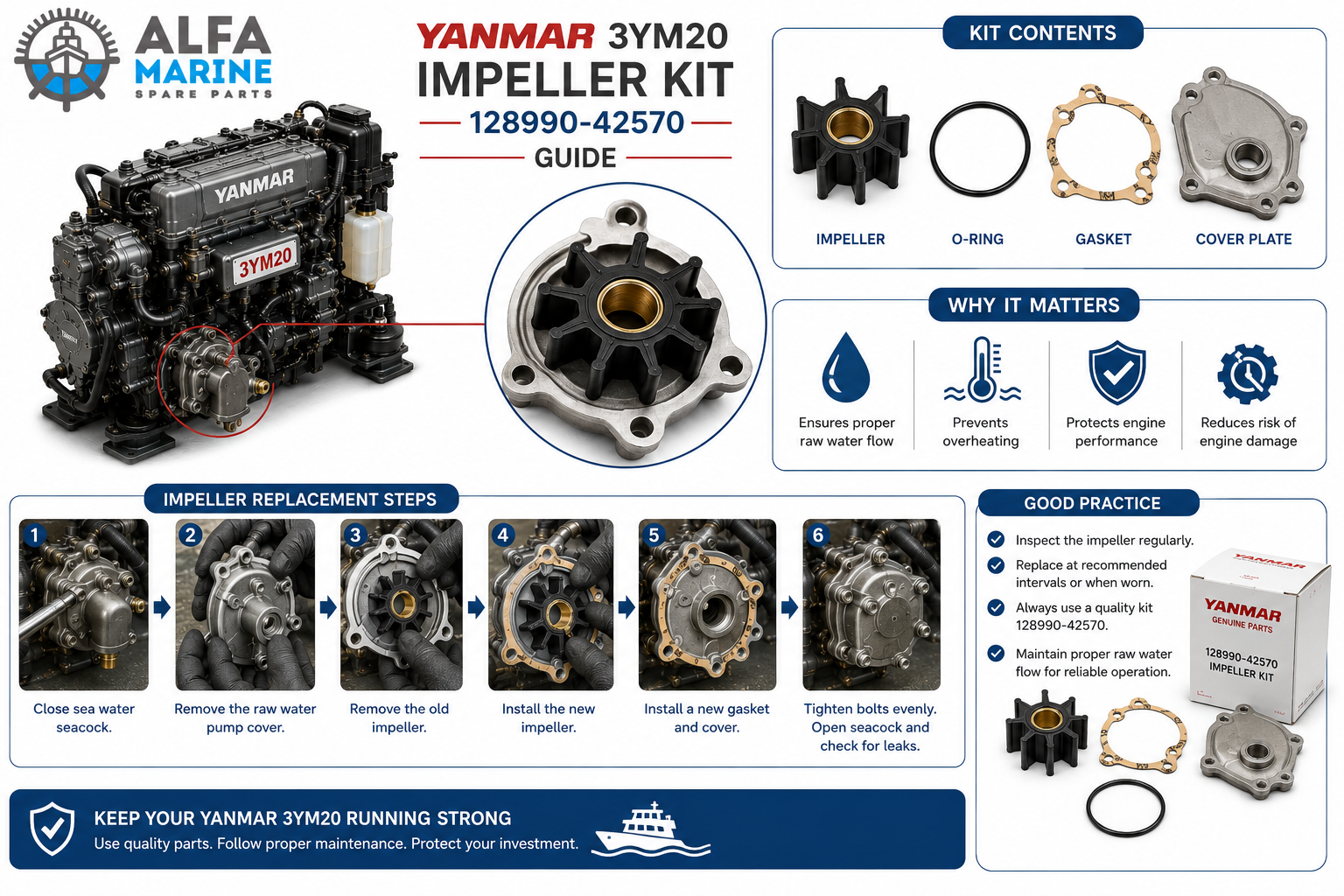
Yanmar 3YM20 Impeller Kit 128990-42570 Inspection Guide
The seawater-pump impeller is a small but important cooling-system component on the Yanmar 3YM20 marine engine.
The impeller kit covered in this guide is:
Yanmar Part Number: 128990-42570
The flexible impeller rotates inside the seawater pump and is a wear component that requires periodic inspection. If the impeller becomes damaged or the pump's internal components deteriorate, seawater-pump performance can decrease.
This is why an impeller replacement should involve more than simply removing the old part and fitting a new one.
The condition of the old impeller, wear plate and accessible pump components can provide useful information about the cooling system.
For filters, impellers, pumps and other components, visit Yanmar Marine Engine Parts.
Yanmar 3YM20 Impeller Part Number
The seawater-pump impeller reference discussed in this article is:
| EngineComponentPart Number | ||
| Yanmar 3YM20 | Seawater Pump Impeller Kit | 128990-42570 |
Yanmar identifies 128990-42570 as an impeller kit.
Before ordering a replacement, always verify:
Engine model + engine serial number + existing part number
This helps confirm the correct component for the exact engine and seawater-pump configuration.
What Should You Check on a Yanmar 3YM20 Impeller?
Yanmar's YM Series maintenance instructions provide specific inspection points for the seawater pump.
During inspection, look for:
- Cracked impeller blades
- Nicked impeller blades
- Marred blade edges or surfaces
- Scratched blade edges or surfaces
- Damage to the wear plate
- Other obvious internal pump deterioration
These inspection points matter even when the impeller still appears complete.
An impeller does not need to have completely broken vanes before its condition deserves attention.
Cracking, surface damage or other deterioration can indicate that the component should no longer remain in service.
Don't Just Replace a Damaged Impeller
When removing an old impeller, inspect it carefully before disposal.
Ask:
Are all the vanes still present?
Are any vanes cracked?
Are the vane edges damaged?
Are pieces missing?
Are there unusual scratches or wear marks?
Is the wear plate damaged?
The answers can help determine whether you are dealing with routine wear or a cooling-system problem that deserves further investigation.
A new impeller restores the pump with a new wear component, but it does not automatically correct every problem that may have contributed to the old impeller's condition.
Missing Impeller Vanes? Account for the Missing Material
A particularly important finding is an impeller with pieces missing from one or more vanes.
If part of the old impeller is gone, don't simply install the replacement and forget about the missing material.
As a general marine cooling-system diagnostic practice, consider whether broken rubber fragments may have travelled downstream through the seawater circuit.
Depending on the vessel's cooling-system arrangement, fragments can potentially become trapped at restrictions or cooling passages and interfere with seawater flow.
This is general marine-engine diagnostic practice and should not be interpreted as a specific 3YM20 instruction from Yanmar's YM Series manual.
The practical principle is straightforward:
If part of the impeller is missing, consider where it may have gone.
Why Missing Impeller Pieces Can Matter
Imagine the following sequence:
Impeller deteriorates → vane breaks → fragment moves downstream → damaged impeller is replaced → fragment remains elsewhere in the cooling circuit
The seawater pump may now contain a new impeller, but the cooling system can still have a restriction.
This can explain why an engine may continue experiencing reduced cooling performance even after the impeller itself has been replaced.
If missing pieces are discovered, the seawater circuit should be considered according to the actual engine and vessel configuration.
The path may involve components such as:
Seawater intake → strainer → seawater pump → hoses → heat exchanger/cooling components → discharge
The exact arrangement varies with the installation, so follow the applicable engine and vessel documentation before dismantling cooling-system components.
Install the 3YM20 Impeller in the Correct Direction
Installation direction is important.
Yanmar's YM Series instructions specifically state that the impeller must be installed while considering the direction of rotation of the seawater pump.
Before removing the old impeller, note the orientation and pump rotation.
When fitting the replacement, install it according to Yanmar's specified procedure so that the vane direction corresponds correctly with pump rotation.
Do not simply force the flexible vanes into an arbitrary direction.
Correct installation helps ensure that the pump operates as intended when the engine is returned to service.
Inspect the Wear Plate and Pump Interior
With the seawater pump open, don't focus exclusively on the impeller.
Yanmar specifically identifies wear-plate damage as one of the conditions that should be checked during inspection.
Also visually examine accessible internal areas of the pump for abnormal condition.
Depending on what is accessible under the applicable maintenance procedure, look for:
- Wear-plate damage
- Scoring
- Corrosion
- Debris
- Abnormal wear
- Damaged surfaces
- Signs of internal contact
If significant internal pump damage is found, the appropriate pump service procedure should be followed rather than assuming that replacing the impeller alone is sufficient.
Why Seawater Impellers Become Damaged
Flexible seawater-pump impellers are wear components.
Several operating conditions can contribute to premature deterioration.
Insufficient Seawater Supply
If the pump does not receive an adequate supply of seawater, the impeller may operate under abnormal conditions.
Possible upstream causes can include a closed seacock, blocked seawater intake or restricted strainer.
Dry Running
Operating a flexible-impeller seawater pump without adequate water can rapidly damage the impeller.
Debris
Foreign material entering the seawater circuit can damage the impeller or internal pump surfaces.
Age and Service
The flexible material deteriorates through normal service and repeated operation.
Extended Inactivity
Long periods without operation can also affect flexible components and should be considered when returning an engine to service after storage.
When an impeller appears to have failed prematurely, investigating the cause can be just as important as replacing the damaged component.
Yanmar 3YM20 Running Hot? Check the Complete Seawater Supply
A damaged seawater-pump impeller can contribute to reduced cooling-water flow, but it is not the only possible cause of an overheating problem.
If a Yanmar 3YM20 begins operating hotter than normal, consider the complete seawater path.
A logical inspection sequence can include:
1. Seawater Intake
Confirm that the intake is open and unobstructed.
2. Seawater Strainer
Check for weeds, shells, sediment or other debris that could restrict flow.
3. Seawater Pump
Inspect the impeller and accessible pump components.
4. Wear Plate
Check for the damage specifically identified in Yanmar's inspection guidance.
5. Hoses and Connections
Look for obvious restriction, leakage, deterioration or abnormal hose condition.
6. Downstream Cooling Circuit
If pieces of the old impeller are missing, consider whether fragments may have travelled farther through the system.
7. Continue Diagnosis
If seawater flow is normal, investigate other areas of the cooling system according to the applicable service information.
This prevents the common mistake of repeatedly replacing the impeller without finding the actual cause of a cooling problem.
Still Overheating After Installing a New Impeller?
A new 128990-42570 impeller kit does not guarantee that every cooling-system problem has been corrected.
If the engine still operates hotter than normal after replacement, check whether:
- The impeller was installed correctly
- Pump rotation was considered during installation
- The wear plate is damaged
- The pump has abnormal internal wear
- The seawater intake is restricted
- The seawater strainer is blocked
- A hose is restricted
- Pieces of the previous impeller may remain downstream
- Another cooling-system problem exists
The condition of the old impeller can provide an important clue.
For example, an impeller damaged because the pump lacked seawater may point toward an upstream supply problem rather than an impeller-quality problem.
Keep the Removed Impeller for Inspection
Don't immediately throw the old impeller away.
Compare it with the replacement and inspect its condition.
A useful maintenance check is:
Complete impeller? → Inspect vanes → Check surfaces → Check wear plate → Look for missing material → Consider why the damage occurred
Photographing the removed impeller can also be useful for vessel maintenance records.
If the same engine repeatedly damages impellers unusually quickly, previous photographs and maintenance records can help identify a pattern.
This turns a routine replacement into useful condition-monitoring information.
Ordering Yanmar 3YM20 Impeller Kit 128990-42570
The component discussed in this guide is:
Engine: Yanmar 3YM20 Marine
Component: Seawater Pump Impeller Kit
Part Number: 128990-42570
When requesting a replacement impeller or other Yanmar Marine Engine Parts, provide:
Complete engine model + engine serial number + existing part number
If identification is uncertain, photographs of the engine identification plate and existing component can also help.
Alfa Marine Spare Parts can assist with Yanmar marine-engine parts for maintenance and repair requirements, subject to exact parts identification and availability.
Email: request@alfamarinespareparts.com
Request a Quote
Frequently Asked Questions
What is the impeller kit part number for a Yanmar 3YM20?
The seawater-pump impeller kit covered in this guide is Yanmar 128990-42570.
Is Yanmar 128990-42570 an impeller kit?
Yes. Yanmar's parts information identifies 128990-42570 as an impeller kit.
What damage should I look for on a Yanmar 3YM20 impeller?
Yanmar's YM Series instructions specifically identify cracked or nicked impeller blades, marred or scratched blade edges/surfaces and wear-plate damage as inspection points.
Does impeller installation direction matter?
Yes. Yanmar states that installation should take the seawater pump's direction of rotation into account so that the impeller vane direction is correct.
What should I do if part of the old impeller is missing?
As a general marine cooling-system diagnostic practice, consider where the missing material may have travelled and whether fragments could be restricting the downstream seawater circuit.
Can a damaged impeller cause a Yanmar 3YM20 to overheat?
A damaged impeller can reduce seawater-pump performance and therefore contribute to inadequate cooling. However, overheating has multiple possible causes, so the complete cooling system should be investigated.
Why is my 3YM20 still running hot after changing the impeller?
Possible causes include a restricted seawater intake, blocked strainer, pump wear, damaged wear plate, restricted hoses, downstream debris or another cooling-system problem.
Should the seawater pump be inspected when changing the impeller?
Yes. Yanmar's maintenance guidance calls for inspection of the inside of the seawater pump and specifically identifies impeller and wear-plate damage as conditions requiring attention.
What information should I provide when ordering Yanmar 3YM20 parts?
Provide the complete engine model, engine serial number and existing part number whenever possible.
Conclusion
A damaged Yanmar 3YM20 seawater-pump impeller 128990-42570 deserves more than a quick replacement.
Inspect the old impeller for cracks, nicks, marred or scratched surfaces, and check the wear plate and accessible pump interior while the pump is open.
If pieces of the old impeller are missing, consider where that material may have travelled and whether it could still be restricting seawater flow.
When installing the replacement, follow Yanmar's instructions regarding the seawater pump's direction of rotation and correct impeller-vane orientation.
The useful engine-room principle is:
Inspect the old impeller. Replace the damaged part. Investigate why it failed. Account for anything that's missing.
For Yanmar 3YM20 impellers and other Yanmar Marine Engine Parts, contact Alfa Marine Spare Parts.
Email: request@alfamarinespareparts.com