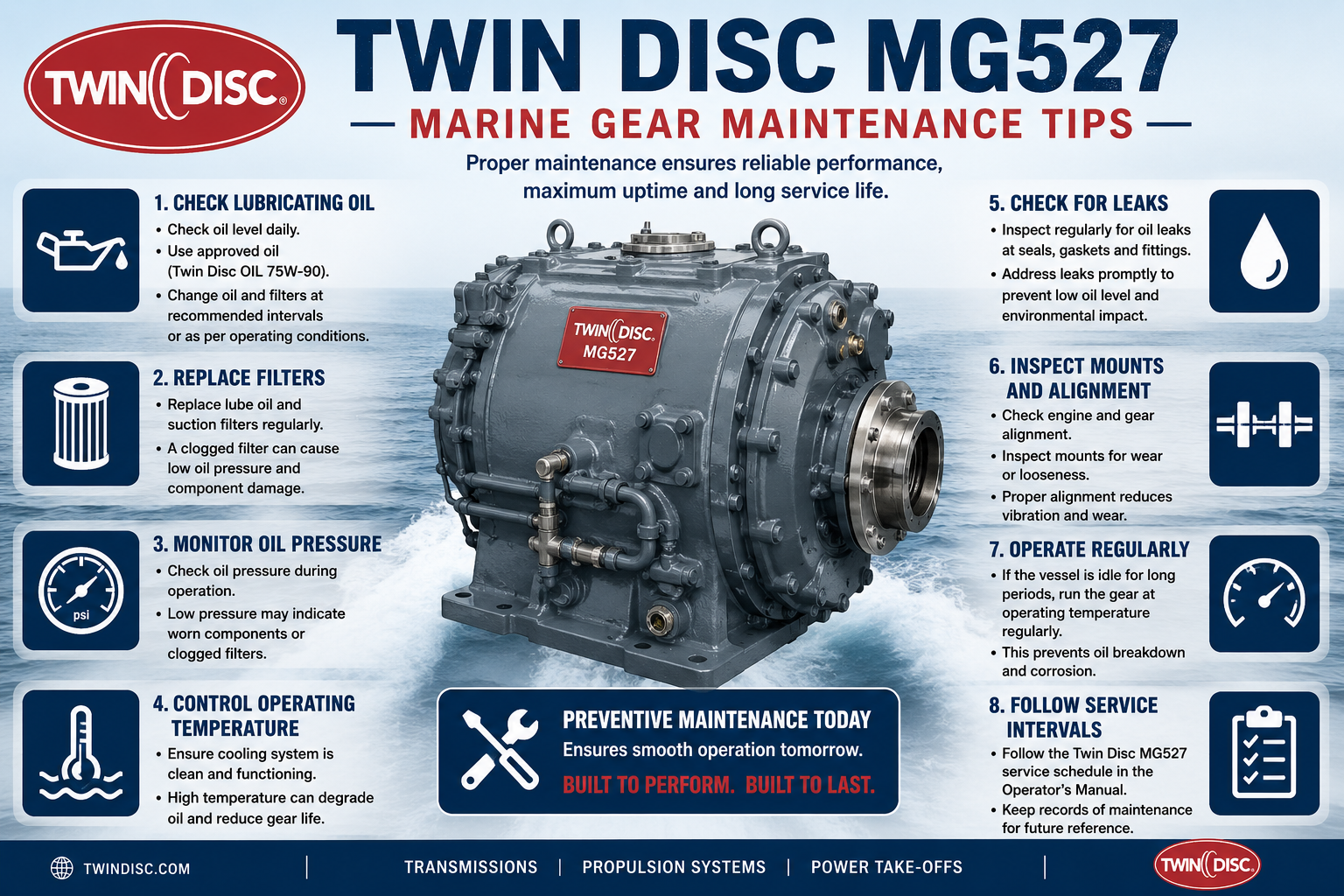
Tips for Extending the Life of the Twin Disc MG527 Marine Gear
The Twin Disc MG527 marine gear is designed for demanding marine propulsion applications, but even a strong marine transmission depends heavily on correct maintenance and operating conditions.
Marine gears rarely go from normal operation to complete failure without giving some warning.
A small oil leak, gradual temperature increase, unusual vibration, contaminated oil, delayed engagement, changing oil pressure, or a new mechanical noise may be the first indication that something inside the transmission needs attention.
For vessel owners, chief engineers, marine engineers, shipyards, fishing-vessel operators, yacht engineers, and technical superintendents, extending the service life of an MG527 is therefore not only about major overhaul intervals.
It is about watching the transmission every time the vessel operates and reacting when something changes.
Here are practical areas that deserve attention.
1. Treat the Transmission Oil as a Health Indicator
One of the simplest ways to learn what is happening inside a Twin Disc MG527 marine transmission is to inspect its oil.
Don't only ask:
“Is there enough oil?”
Also ask:
“Does the oil still look and smell normal?”
During routine inspections, look for:
- Unusually dark oil
- Burnt smell
- Milky or cloudy oil
- Foaming
- Water contamination
- Metallic particles
- Unexpected increases or decreases in oil level
These conditions can point toward different problems.
A burnt smell, for example, can be associated with excessive temperature.
Milky oil can indicate water contamination.
Metallic material deserves particular attention because it may indicate internal component wear.
Practical Tip
When changing transmission oil, don't immediately dispose of the drained oil without looking at it.
Inspect it.
Also inspect:
- Filters
- Strainers
- Magnetic plugs where fitted
- Drain plugs
- Filter housings
Sometimes the material found during an oil change gives you an early warning long before the transmission develops an obvious operational problem.
2. Use the Correct Lubricant
A marine transmission should not be filled with oil simply because someone says:
“This is what we always use.”
The lubricant must meet the requirements for the particular MG527 configuration and installation.
Lubricant condition and specification can affect:
- Clutch operation
- Bearing lubrication
- Gear protection
- Oil pressure
- Operating temperature
- Seal life
- Shift performance
This becomes particularly important on older vessels.
A transmission may have been serviced by several owners or workshops over its lifetime, and the oil currently inside it isn't necessarily proof that it is the correct lubricant.
Always verify the lubricant requirement against the applicable Twin Disc technical information for the exact transmission.
3. Keep the Oil at the Correct Level
Low oil level is an obvious problem.
But overfilling isn't desirable either.
Insufficient oil can reduce:
- Lubrication
- Cooling
- Hydraulic performance
Excessive oil can contribute to:
- Aeration
- Foaming
- Increased temperature
- Abnormal operating conditions
The more interesting situation is when the oil level keeps changing.
If you repeatedly have to add oil, ask:
“Where is it going?”
Inspect areas including:
- Input and output seals
- Oil hoses
- Pipe connections
- Cooler connections
- Gaskets
- Inspection covers
- Fittings
A small leak that requires occasional topping-up may appear harmless.
But if the leak becomes worse during a long voyage, the transmission can eventually operate with insufficient oil.
4. Don't Ignore the MG527 Oil Cooler
Transmission oil does more than lubricate components.
It also carries heat away from them.
That makes the marine gear oil cooler an important part of MG527 reliability.
Depending on the vessel's cooling arrangement, problems can develop from:
- Restricted seawater flow
- Scale
- Internal deposits
- Contaminated cooler surfaces
- Damaged cooler tubes
- Corrosion
- Restricted hoses or piping
A cooler doesn't have to become completely blocked before it causes trouble.
Its efficiency can deteriorate gradually.
The gearbox may still operate normally—but at a slightly higher temperature.
And that is exactly why temperature trends matter.
5. Ask: “Is It Running Hotter Than Before?”
There is a difference between:
“The transmission is overheating.”
and:
“The transmission is operating hotter than it normally does.”
The second question can be more useful.
Imagine your MG527 normally operates around a stable temperature under similar:
- Engine rpm
- Vessel speed
- Sea temperature
- Propeller load
Then the temperature gradually starts increasing.
The gearbox may not yet trigger an alarm.
But something has changed.
Possible areas to investigate include:
- Oil level
- Oil condition
- Oil cooler
- Cooling-water flow
- Oil pressure
- Vessel loading
- Propeller condition
- Internal transmission condition
Establishing what is normal for your vessel gives you something to compare against.
6. Monitor Oil Pressure Trends
Oil pressure is another valuable health indicator.
Don't focus only on whether the pressure is above a minimum acceptable value.
Watch how it behaves over time.
Possible causes of changing oil pressure can involve:
- Oil level
- Oil viscosity
- Oil temperature
- Filters
- Strainers
- Oil pump condition
- Internal leakage
- Control components
A chief engineer who sees the same gauges every day often knows almost instinctively where the needles normally sit.
Use that knowledge.
If the pressure suddenly—or gradually—changes from the vessel's normal operating pattern, investigate why.
7. Pay Attention to Forward and Reverse Engagement
The way an MG527 engages can tell you something about its condition.
Forward and reverse engagement should feel consistent with the transmission's established normal behavior.
Watch for changes such as:
- Delayed engagement
- Harsh engagement
- Slipping
- Inconsistent engagement
- Different behavior when hot
- Different behavior when cold
- Unusual noise during engagement
Don't automatically assume the internal clutch pack is failing.
The cause could involve:
- Oil condition
- Oil pressure
- Control system
- Linkage
- Solenoid or valve operation
- Hydraulic components
- Internal clutch components
Diagnosis should determine the cause before expensive components are replaced.
8. Don't Ignore a Small Delay in Engagement
Imagine the transmission previously engaged almost immediately.
Now there is a noticeable delay.
The vessel still moves.
The gearbox still works.
It is easy to say:
“We'll check it during the next service.”
But a change in engagement behavior deserves investigation.
A relatively small hydraulic or control problem may be easier and cheaper to correct before continued operation causes additional wear.
The important word is:
change.
If something that has behaved the same way for years begins behaving differently, find out why.
9. Listen to the MG527
Engine-room crews become familiar with the normal sound of machinery.
Use that experience.
Listen for new:
- Whining
- Grinding
- Rattling
- Knocking
- Humming
- Gear noise
- Bearing-type noise
The location and operating condition can provide useful clues.
Ask:
Does the noise occur in neutral?
Only in forward?
Only in reverse?
At idle?
At higher rpm?
Only when the transmission is hot?
Those observations can help narrow the investigation.
10. Vibration Should Never Be Automatically Blamed on the Gearbox
This is important.
A vibration near the transmission does not automatically mean:
“The MG527 is damaged.”
The vibration could originate elsewhere in the propulsion system.
Possible sources include:
- Propeller damage
- Propeller fouling
- Bent shaft
- Shaft misalignment
- Worn bearings
- Coupling problems
- Engine mounts
- Gearbox mounts
- Hull or structural issues
The transmission sits between the engine and propeller shaft.
That means vibration generated elsewhere can travel through it.
Before dismantling an expensive marine gear, investigate the entire driveline.
11. Check Engine-to-Gear Alignment
Alignment is fundamental to marine transmission life.
The engine, gearbox, coupling and propeller shaft must work together as a system.
Poor alignment can create unnecessary loading on:
- Bearings
- Shafts
- Couplings
- Seals
- Mounts
Alignment can change because of:
- Engine-mount deterioration
- Vessel movement
- Foundation problems
- Previous repairs
- Gearbox replacement
- Engine replacement
- Shaft work
After major propulsion work, alignment deserves particular attention.
12. Don't Forget the Engine Mounts
Sometimes the gearbox gets blamed for a problem caused by the engine installation.
Worn or damaged mounts can affect:
- Alignment
- Vibration
- Coupling loading
- Shaft position
Inspect mounts for:
- Cracking
- Separation
- Deteriorated rubber
- Loose fasteners
- Abnormal movement
- Uneven settling
A healthy gearbox cannot compensate indefinitely for a poorly supported engine.
13. Inspect the Coupling
The coupling connects the transmission output to the propeller shaft.
That makes it a critical part of the propulsion system.
Inspect for:
- Loose bolts
- Corrosion
- Cracking
- Abnormal wear
- Alignment problems
- Fretting
- Movement
If coupling bolts repeatedly become loose, don't simply tighten them again.
Ask why.
Repeated loosening may indicate an underlying alignment or vibration problem.
14. Propeller Condition Affects the Marine Gear
The propeller is far away from the gearbox internally, but mechanically they are connected.
A damaged or badly fouled propeller can change the load experienced by the entire drivetrain.
Possible problems include:
- Bent blade
- Damaged blade
- Marine growth
- Rope or fishing line
- Incorrect propeller
- Excessive pitch
- Cavitation-related damage
If the vessel suddenly requires more engine load to achieve its normal speed, investigate the hull and propeller before assuming the engine or transmission has developed an internal fault.
15. Avoid Continuous Overloading
Marine gears are designed around specific operating conditions and ratings.
A transmission continually operating under excessive load can experience additional thermal and mechanical stress.
Overloading can come from more than one source.
Examples include:
- Incorrect propeller
- Excessive propeller pitch
- Heavy vessel loading
- Hull fouling
- Propeller fouling
- Propulsion modifications
If the vessel can no longer achieve its normal operating rpm under load, investigate why.
The transmission may simply be reacting to a problem elsewhere.
16. Keep the Gearbox Exterior Clean
A clean engine room isn't only about appearance.
Keeping the MG527 clean makes inspection easier.
Oil leaking onto a gearbox already covered in dirt can be difficult to locate.
On a clean transmission, a fresh leak becomes obvious.
Cleanliness also makes it easier to identify:
- Loose fasteners
- Cracks
- Corrosion
- Hose deterioration
- Damaged fittings
- Oil seepage
Cleaning therefore becomes part of inspection.
17. Inspect Hoses Before They Fail
A transmission may be mechanically healthy and still lose lubrication because of a failed external hose.
Inspect oil and cooling hoses for:
- Cracking
- Hardening
- Chafing
- Bulging
- Corrosion around fittings
- Oil seepage
- Loose clamps
Pay particular attention to hoses touching:
- Sharp edges
- Hot exhaust components
- Moving components
- Vibrating structures
A relatively inexpensive hose should never be allowed to become the reason for a major gearbox failure.
18. Look Closely at Seals
Small oil leaks are common warning signs.
Possible leak locations include:
- Input shaft area
- Output shaft area
- Covers
- Gaskets
- Hydraulic connections
- Oil lines
Don't only wipe the oil away.
Clean the area and determine where the leak begins.
If a seal repeatedly fails, consider whether something else is causing it.
For example:
- Shaft movement
- Bearing wear
- Excessive temperature
- Misalignment
- Incorrect installation
Replacing the seal without correcting the cause may only produce another leak.
19. Inspect Filters and Strainers for Evidence
A filter is not simply something to throw away.
It is also an inspection tool.
During servicing, look for:
- Metallic particles
- Friction material
- Unusual debris
- Sludge
- Water contamination
Finding a small amount of normal material and finding a large quantity of metallic debris are very different situations.
If abnormal material appears, investigate where it came from.
20. Water Contamination Needs Immediate Attention
Water does not belong in transmission oil.
If the oil becomes cloudy or milky, investigate immediately.
Possible entry points may involve:
- Oil cooler failure
- Condensation
- External contamination
- Service mistakes
Water contamination can reduce lubrication quality and promote corrosion.
Changing the oil without finding the source is not enough.
The question is:
“How did the water get inside?”
21. Heat Is One of the Biggest Enemies
Excessive temperature can accelerate deterioration of:
- Oil
- Seals
- O-rings
- Clutch materials
- Bearings
That means cooling-system maintenance indirectly protects many internal components.
If the MG527 begins operating hotter than normal, don't wait until the temperature becomes extreme.
Find the reason while the problem is still developing.
22. Keep an Operating Baseline
One of the best maintenance tools costs nothing.
Record what normal looks like.
For example:
| Operating ConditionNormal Reading / Observation | |
| Oil pressure at idle | Record vessel baseline |
| Oil pressure at cruise | Record vessel baseline |
| Gear temperature | Record vessel baseline |
| Forward engagement | Normal / immediate |
| Reverse engagement | Normal / immediate |
| Gearbox noise | Record normal sound |
| Vibration | Record normal condition |
| Oil consumption | Record trend |
The exact numbers should come from the applicable MG527 documentation and the vessel's established operating condition.
Once you have a baseline, changes become easier to recognize.
23. Compare Similar Operating Conditions
Don't compare gearbox temperature at idle in winter with gearbox temperature at full load in summer.
For useful trending, compare similar conditions:
- Similar engine rpm
- Similar vessel speed
- Similar load
- Similar seawater temperature
- Similar operating duration
This makes your maintenance records much more meaningful.
24. Record Small Changes
A simple maintenance log can prevent expensive surprises.
Record observations such as:
“Small oil seepage at output seal.”
“Forward engagement slightly slower when hot.”
“Oil temperature 5°C above normal cruise trend.”
“Small metallic material found during filter inspection.”
One observation may mean little.
Several related observations can reveal a developing problem.
25. Don't Wait for the Transmission to Stop Working
This is probably the most important lesson.
A marine gear doesn't have to fail completely before it needs attention.
Warning signs may include:
- Oil leakage
- Rising temperature
- Changing oil pressure
- Delayed engagement
- Slipping
- New vibration
- New noise
- Contaminated oil
- Metallic debris
The best time to investigate is while the transmission still operates.
Once the vessel loses propulsion, your maintenance decision becomes an emergency repair.
26. When Should an MG527 Be Opened for Inspection?
There is no single operating-hour number that should automatically be applied to every MG527 installation.
Actual inspection and overhaul requirements depend on factors such as:
- Exact MG527 variant
- Duty rating
- Engine power
- Operating hours
- Vessel application
- Oil condition
- Service history
- Previous repairs
- Operating temperatures
- Symptoms
A lightly operated yacht and a commercial vessel running thousands of hours annually should not automatically follow the same overhaul assumptions.
Always use the applicable Twin Disc service information for the exact gear model and serial number when establishing maintenance intervals.
27. What Should Be Inspected During an MG527 Overhaul?
Depending on the exact transmission and condition, an overhaul inspection may involve areas such as:
- Clutch components
- Friction plates
- Steel plates
- Bearings
- Gears
- Shafts
- Oil pump
- Control valve components
- Seals
- O-rings
- Gaskets
- Fasteners
- Cooler and oil circuit components
The important point is to inspect and measure, not simply replace visible parts.
If a bearing has failed, ask why.
If clutch plates are burnt, ask why.
If a seal leaked, ask why.
The damaged component is sometimes the result—not the original cause.
28. Clutch Plates Can Tell a Story
When a marine gear is opened, clutch components can reveal useful information.
Look for:
- Discoloration
- Burnt friction material
- Uneven wear
- Distortion
- Abnormal surface condition
Burnt clutch material may point toward excessive slipping or heat.
But don't stop at:
“Replace the clutch pack.”
Investigate the hydraulic pressure, control system and operating conditions that allowed the damage to develop.
29. Bearing Condition Deserves Careful Inspection
Bearings support the rotating components inside the gearbox.
Inspect removed bearings for:
- Pitting
- Scoring
- Heat discoloration
- Surface fatigue
- Abnormal wear patterns
- Contamination damage
If one bearing looks dramatically different from the others, determine why.
Possible causes can include:
- Lubrication problems
- Misalignment
- Contamination
- Excessive load
- Shaft problems
Replacing the bearing without correcting the cause can result in another failure.
30. Don't Mix Unknown Parts During Reassembly
When rebuilding a Twin Disc marine gear, organization matters.
Keep components:
- Identified
- Clean
- Protected
- Organized by assembly
Do not casually mix:
- Shims
- Bearings
- Plates
- Fasteners
- Spacers
- Springs
Correct clearances and component locations matter.
Take photographs and mark components during disassembly when appropriate.
31. Cleanliness During Overhaul Is Critical
Transmission components operate with close tolerances.
Dirt introduced during assembly can damage:
- Bearings
- Hydraulic valves
- Oil pumps
- Clutch components
- Sealing surfaces
Keep the work area clean.
Protect open oil passages.
Clean components properly before reassembly.
And never assume a new component is automatically clean enough to install straight from packaging.
32. Replace Gaskets and Seals Correctly
Reusing an old gasket to save a small amount of money makes little sense during a major transmission repair.
Where specified for replacement, use correct:
- Gaskets
- O-rings
- Oil seals
- Locking devices
Pay attention to:
- Installation direction
- Lubrication during assembly
- Sealing surfaces
- Correct torque
- Shaft condition
A new seal installed over a damaged shaft surface may leak again quickly.
33. Inspect the Oil Cooler During Major Gear Work
If the transmission is already being overhauled, don't automatically reinstall an old oil cooler without inspecting it.
Consider:
- Internal cleanliness
- External condition
- Corrosion
- Restriction
- Leakage
- Pressure integrity
A freshly rebuilt gearbox connected to a contaminated or failing cooler can quickly develop another problem.
The supporting systems should match the condition of the rebuilt transmission.
34. Flush Contaminated Oil Circuits
If the previous transmission failure created significant debris, replacing the damaged internal components may not be enough.
Contamination may remain in:
- Oil lines
- Cooler
- Filter housing
- External piping
That material can return to the rebuilt transmission.
After a serious internal failure, cleanliness of the entire lubrication circuit matters.
35. Use the Correct Twin Disc MG527 Spare Parts
When ordering Twin Disc MG527 marine gear spare parts, provide as much identification information as possible.
Useful information includes:
- Twin Disc model
- Complete model designation
- Serial number
- Ratio
- Engine model
- Engine power
- Rated rpm
- Vessel application
- Existing part number
- Photographs
Don't rely only on:
“Twin Disc MG527.”
Different versions and configurations may require different components.
Common Twin Disc MG527 Spare Parts
Depending on the exact MG527 configuration, maintenance and overhaul requirements can include:
- Clutch plates
- Friction discs
- Steel plates
- Bearings
- Oil seals
- O-rings
- Gasket sets
- Oil pumps
- Control valves
- Solenoids
- Shafts
- Gears
- Coupling components
- Oil filters
- Oil cooler components
- Fasteners
- Overhaul kits
Part numbers should always be verified against the exact Twin Disc model and serial number before ordering.
A Better Twin Disc MG527 Parts Inquiry
Instead of sending:
“Need MG527 rebuild kit.”
send:
Manufacturer: Twin Disc
Model: MG527
Complete Model Designation: __________
Serial Number: __________
Gear Ratio: __________
Engine: __________
Engine Power: __________
Rated RPM: __________
Required Part: __________
Existing Part Number: __________
Quantity: __________
Photos: Attached
That dramatically reduces the chance of identifying the wrong component.
Frequently Asked Questions About the Twin Disc MG527
How Can I Extend the Life of a Twin Disc MG527?
Focus on correct oil, proper oil level, cooling-system condition, oil-pressure monitoring, alignment, vibration, clean filters and early investigation of changes in operating behavior.
What Are Early Signs of an MG527 Problem?
Warning signs can include:
- Delayed engagement
- Slipping
- Higher operating temperature
- Changing oil pressure
- Oil leaks
- Unusual vibration
- New mechanical noise
- Contaminated oil
- Metallic debris
Should I Be Concerned About a Small Oil Leak?
Yes.
It may not require an immediate overhaul, but the source should be identified. A small leak can become larger, and repeated oil loss can eventually affect lubrication.
What Does Milky Transmission Oil Mean?
A milky or cloudy appearance can indicate water contamination.
The source should be found rather than simply changing the oil.
Can a Dirty Oil Cooler Damage the MG527?
Restricted cooling can increase transmission oil temperature. Continued operation at excessive temperature can accelerate deterioration of oil, seals and other components.
Why Is My MG527 Engaging Slowly?
Possible causes can involve:
- Oil level
- Oil condition
- Oil pressure
- Hydraulic control components
- Control system
- Internal clutch components
The cause should be diagnosed rather than assuming the clutch pack automatically needs replacement.
Does Vibration Mean My MG527 Is Failing?
Not necessarily.
Vibration can originate from the propeller, shaft, coupling, engine mounts, alignment or other drivetrain components.
Investigate the entire propulsion system.
When Should an MG527 Be Overhauled?
There isn't one universal overhaul interval appropriate for every installation. The exact model, duty rating, operating hours, vessel application, service history and transmission condition should all be considered together with the applicable Twin Disc maintenance documentation.
Should the Oil Cooler Be Checked During an Overhaul?
Yes. Cooler condition, oil lines and the lubrication circuit deserve attention, particularly if the transmission experienced overheating or internal component failure.
What Information Is Needed When Ordering MG527 Parts?
At minimum, provide the complete transmission model, serial number, gear ratio and required component. Existing part numbers and photographs are also helpful.
Twin Disc MG527 Marine Gear Spare Parts
Alfa Marine Spare Parts can assist with inquiries for Twin Disc MG527 marine transmission spare parts for maintenance, repair and overhaul.
Parts requirements may include:
- Clutch components
- Friction plates
- Steel plates
- Bearings
- Gears
- Shafts
- Oil pumps
- Seals
- O-rings
- Gaskets
- Control components
- Solenoids
- Filters
- Cooler components
- Overhaul components
Depending on the exact transmission and availability, requirements can include genuine, OEM-quality, aftermarket, remanufactured or reconditioned components where applicable.
Browse Our Complete Catalog
Alfa Marine Spare Parts supplies marine engine and transmission spare parts for vessels operating worldwide.
Website: www.alfamarinespareparts.com
Our marine spare-parts range supports engines, transmissions and equipment from major marine brands including:
- Twin Disc
- MTU
- Caterpillar
- Cummins
- MAN
- Detroit Diesel
- Volvo Penta
- Wärtsilä
- Yanmar
- Perkins
- Scania
- Deutz
- Mitsubishi
- Komatsu
- John Deere
Contact Alfa Marine Spare Parts
For Twin Disc MG527 marine gear spare parts, send your transmission identification and required component details to:
Email: request@alfamarinespareparts.com
Website: www.alfamarinespareparts.com
For faster identification, include:
Twin Disc model + serial number + gear ratio + existing part number + quantity + photographs where available.
Final Thought
Extending the life of a Twin Disc MG527 marine gear is often less about waiting for a major scheduled overhaul and more about noticing small changes before they become major problems.
Watch the:
oil.
Watch the:
temperature.
Watch the:
oil pressure.
Feel how the transmission:
engages.
Listen for changes in:
noise and vibration.
And don't forget that the MG527 is only one part of the propulsion system.
The engine mounts, coupling, shaft, propeller, cooling system and vessel operating conditions can all influence the load experienced by the transmission.
A small oil leak can become an oil-level problem.
A partially restricted cooler can become an overheating problem.
Poor alignment can become a bearing or seal problem.
And delayed engagement that is ignored can eventually become a much more expensive repair.
The best maintenance strategy is therefore simple:
Know how your MG527 normally behaves—and investigate when that behavior changes.