Scania Marine Engine Types: What Is the Difference, and Which Engine Fits Which Vessel?
When somebody says:
“I have a Scania marine engine.”
that still leaves an important question:
Which Scania?
Is it a compact DI09 in a workboat or fishing vessel?
A DI13 in a pilot boat, patrol craft or passenger vessel?
Or a high-output DI16 V8 in a fast commercial boat or demanding propulsion installation?
Scania’s current marine engine platform is built around 9-, 13- and 16-litre engines for both propulsion and auxiliary use. Scania says its marine power range covers approximately 220 to 1,150 hp / 162 to 846 kW, depending on configuration and application.
That means the Scania marine range is relatively easy to understand compared with some brands.
There are three main engine sizes:
DI09
DI13
DI16
But within those families, there are many different ratings and configurations.
And that is where the real differences begin.
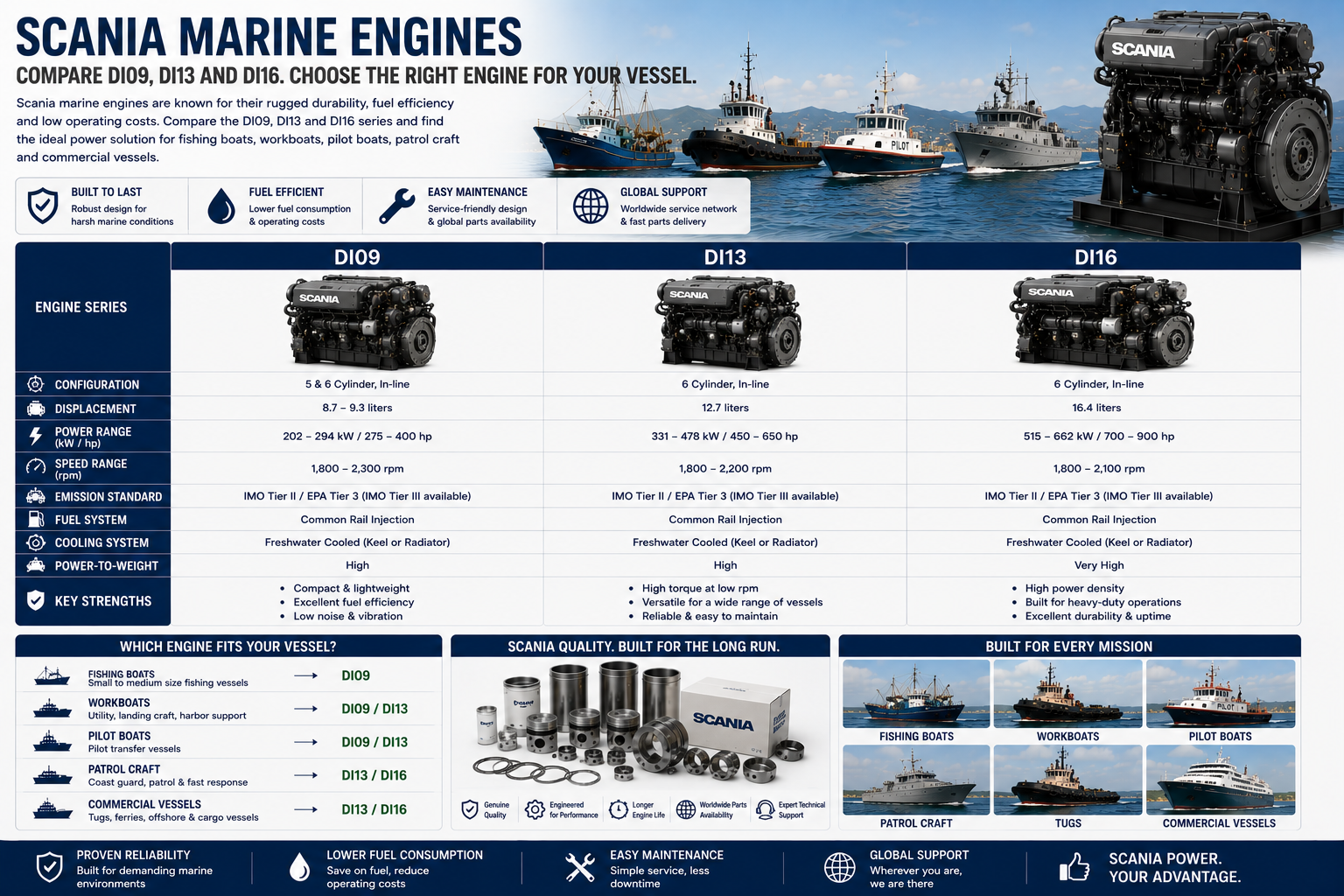
Understanding the Main Scania Marine Engine Families
| Scania FamilyApprox. SizeConfigurationGeneral CharacterTypical Marine Fit | ||||
| DI09 | 9 litre | Inline 5 | Compact commercial power | Fishing boats, workboats, auxiliaries |
| DI13 | 13 litre | Inline 6 | Versatile commercial workhorse | Pilot boats, patrol craft, passenger vessels, fishing |
| DI16 | 16 litre | V8 | High-output compact power | Fast commercial craft, larger workboats, patrol and pleasure craft |
Scania officially describes its marine range as a complete family of 9-, 13- and 16-litre engines intended for propulsion and auxiliary applications, with uses ranging from fast patrol craft to heavy river barges.
Why Scania Marine Engines Are Different From Ordinary Truck Engines
Scania is famous for trucks and buses.
So it is easy to assume:
“The marine engine is basically a truck engine with seawater cooling.”
That is too simple.
Scania says its marine propulsion engines are based on engineering proven across road transport, power generation and industrial applications, but are then tailored and optimized specifically for marine operation.
That marine adaptation can involve:
- Heat exchangers
- Keel-cooling arrangements
- Marine exhaust systems
- Marine turbocharger configuration
- Marine engine controls
- Seawater-related components
- Marine transmissions
- Different engine ratings
- Vessel-specific installation systems
The base technology may share Scania DNA.
The complete engine installation is very much marine.
Scania DI09: The Compact Commercial Worker
The DI09 is the smallest of Scania’s three main marine platforms.
Unlike most modern engines in this size class, the DI09 is built around an inline five-cylinder configuration.
That already makes it interesting.
Most marine operators are used to seeing:
four cylinders
or
six cylinders
but Scania has a long history with five-cylinder engines.
Why Five Cylinders?
A five-cylinder layout sits between the compactness of a four-cylinder and the smoother output of a larger six-cylinder.
That can provide a useful compromise between:
- Engine length
- Power
- Weight
- Smooth operation
- Installation size
For a marine engine room where space matters, that can be valuable.
Which Boats Suit a Scania DI09?
The DI09 fits naturally in applications such as:
- Fishing vessels
- Small commercial workboats
- Harbor craft
- Passenger launches
- Utility vessels
- Smaller patrol craft
- Auxiliary installations
- Marine generators
Scania’s own marine material emphasizes the range for commercial craft where reliability, torque and fuel efficiency matter.
Scania DI09 Personality
The Compact Worker
Smaller than the DI13 and DI16, but still a serious commercial diesel designed to work rather than simply provide recreational horsepower.
Why the DI09 Can Be Attractive for Fishing Boats
A smaller fishing boat usually does not need 1,000 hp.
What it often needs is:
- Reliable low- and mid-range torque
- Compact installation
- Reasonable fuel consumption
- Good access for maintenance
- Commercial-duty capability
That makes the DI09 class interesting.
An oversized engine can add unnecessary:
- Weight
- Cost
- Fuel consumption
- Installation complexity
The correct engine is not always the biggest one that fits.
Scania DI13: The Marine All-Rounder
Move up one step and you reach the DI13.
This is Scania’s 13-litre inline-six marine family.
For many vessel operators, this is probably the most versatile platform in the range.
Why?
Because a 13-litre inline six provides enough displacement for serious commercial power while avoiding the physical width and additional cylinder-bank complexity of a V8.
Scania’s marine specifications include DI13 versions across a wide range of outputs and operating duties.
Which Boats Suit a Scania DI13?
The DI13 can fit naturally in:
- Pilot boats
- Patrol craft
- Fishing vessels
- Passenger vessels
- Workboats
- Crew-transfer vessels
- Harbor craft
- River vessels
- Government craft
- Larger pleasure craft
- Auxiliary installations
This is why it deserves the title:
The Scania Marine All-Rounder
Why an Inline-Six Works Well in Commercial Boats
Marine engineers often like inline-six engines because they are relatively straightforward mechanically.
You have:
- One cylinder bank
- One row of injectors
- One main cylinder-head line
- Straightforward valve access
- Simpler exhaust routing than many V-engines
The engine is longer than a V8, but if the engine room has enough length, the inline arrangement can be very practical.
DI09 vs. DI13: What's the Main Difference?
A useful way to think about them:
Scania DI09
9-litre five-cylinder
More compact.
Better suited when the vessel needs moderate commercial power and engine-room space is limited.
Scania DI13
13-litre inline six
More displacement and substantially more output potential.
Better suited to larger workboats, patrol craft, passenger vessels and fishing boats.
The DI13 isn't automatically “better.”
It simply belongs to a higher power class.
Scania DI13 for Pilot Boats
Pilot boats have demanding operating profiles.
They may spend their working day repeatedly:
- Accelerating
- Running quickly offshore
- Matching another vessel’s speed
- Maneuvering alongside
- Returning to port
- Repeating the process
This means a pilot-boat engine needs more than peak horsepower.
It needs:
- Strong torque
- Rapid response
- Reliable cooling
- Commercial-duty capability
- Good acceleration
The DI13’s combination of substantial displacement and compact inline-six architecture makes it well suited to this kind of work.
Scania DI13 for Passenger Vessels
Passenger vessels may operate fixed schedules for many hours every day.
For these operators, priorities often include:
- Fuel economy
- Predictable maintenance
- Low vibration
- Reliability
- Long service life
This kind of operation can suit the DI13 well, provided the correct duty rating is selected.
And that last part is important.
One Scania DI13 Can Have Different Power Ratings
A common mistake is to think:
DI13 = one horsepower figure.
It does not.
Scania has produced many DI13 marine versions with different model codes and power ratings.
Official technical documentation includes model designations such as:
DI13 073M
DI13 078M
and other DI13 marine configurations.
Different engines within the same family may have different:
- Power ratings
- Rated speeds
- Cooling arrangements
- Emissions specifications
- Duty classifications
That is why the complete engine designation matters.
Scania DI16: The V8 Heavyweight
Then we arrive at the DI16.
This is Scania’s 16-litre V8 marine platform.
And this is where the character of the range changes significantly.
Instead of:
five cylinders inline
or
six cylinders inline
you now have:
eight cylinders arranged in a V.
The result is much more power in a relatively compact engine length.
Scania currently offers marine power up to approximately 846 kW / 1,150 hp, with the official DI16 076M specification showing that maximum output.
Why Does a V8 Make Sense in a Boat?
Imagine you need more than 1,000 hp.
You could build an extremely large, long inline engine.
Or you can package eight cylinders into two banks.
A V8 provides:
- Shorter overall engine length
- High power density
- Significant torque
- Compact high-output installation
That can be especially valuable in fast boats and twin-engine installations.
The tradeoff is width and greater access complexity.
Which Boats Suit a Scania DI16?
Think:
- Fast patrol craft
- Crew-transfer vessels
- Larger commercial workboats
- Passenger boats
- High-speed utility vessels
- Larger fishing vessels
- Government craft
- Rescue boats
- Performance-oriented pleasure craft
- River and inland commercial vessels
Scania’s commercial craft material specifically emphasizes high torque and strong propulsion performance, while its pleasure-craft range has historically included high-output V8 marine engines.
DI16 Personality
The Compact Heavyweight
V8 power approaching 1,150 hp without moving into a very long inline engine package.
DI13 vs. DI16: Which One Makes More Sense?
This is one of the most useful comparisons.
DI13
Inline six
Narrower.
Straightforward service access.
Excellent balance of power and commercial durability.
DI16
V8
More total output from a shorter package.
Better when high power density matters.
Which is better?
The engine room may answer the question.
If you have plenty of longitudinal space but limited width, an inline engine can be attractive.
If engine-room length is limited and more power is needed, the V8 may fit better.
Scania DI16 076M: How Powerful Can It Get?
One official Scania propulsion specification lists the DI16 076M at 846 kW / 1,150 hp.
Scania describes the engine as using a robust cylinder-block design with replaceable wet cylinder liners, which can simplify major overhaul work compared with engines where cylinder surfaces are integral to the block.
That is especially important in commercial marine service.
A high-hour engine needs to be repairable.
Wet Cylinder Liners: Why Engineers Care
A replaceable wet cylinder liner forms the running surface for the piston.
During major overhaul, the liner can be removed and replaced.
This can allow the engine to be restored without machining the entire cylinder block.
Potential advantages include:
- Easier overhaul
- Replaceable wear surfaces
- More controlled rebuild dimensions
- Longer useful block life
But liner sealing becomes critical.
Wet liners rely on seals to keep coolant where it belongs.
Damaged liner seals can lead to coolant contamination or leakage.
Scania's Modular Engine Philosophy
Scania is known for using a modular design philosophy across its engines.
The 9-, 13- and 16-litre families share design concepts and, where applicable, component principles.
This can simplify:
- Technician training
- Service procedures
- Fleet familiarity
- Parts management
For a fleet running several Scania-powered vessels, that can be useful.
The engineer moves between engines that feel related rather than completely different.
Mechanical Scania vs. Modern Electronic Scania
Older Scania engines may be familiar to mechanics who grew up with mechanical fuel injection.
Modern Scania marine engines are much more electronically controlled.
Current engines use advanced electronic fuel-management systems and engine-management controls tailored for marine operation. Scania’s modern marine power platforms also support emissions requirements and alternative fuels depending on configuration.
This changes troubleshooting.
Traditional Mechanical Diagnosis
On older engines, engineers may focus heavily on:
- Fuel pressure
- Injection timing
- Injector condition
- Compression
- Valve clearance
- Turbocharger condition
- Exhaust temperature
- Coolant temperature
Modern Electronic Diagnosis
Now add:
- ECU
- Sensors
- Electronic injectors
- Fault codes
- Wiring harnesses
- Fuel-pressure data
- Engine-load information
- CAN-bus communication
The mechanical engine has not disappeared.
Electronics simply provide another layer of control and diagnosis.
Scania Marine Cooling: Heat Exchanger or Keel Cooling
Cooling arrangement is especially important when identifying a Scania marine engine.
Scania publishes technical documentation covering both heat-exchanger and keel-cooled engine configurations.
These systems work differently.
Heat-Exchanger Cooling
A typical heat-exchanger installation uses internal engine coolant and a seawater circuit.
That can involve:
- Seawater pump
- Sea strainer
- Heat exchanger
- Hoses
- Raw-water circuit
- Corrosion protection
This is common in many marine vessels.
Keel Cooling
With keel cooling, engine coolant circulates through an external cooling surface fitted to the vessel.
This can reduce or eliminate some engine-mounted raw-water components depending on the installation.
Keel cooling is attractive for:
- Workboats
- River vessels
- Shallow-water vessels
- Boats operating in dirty water
- Commercial craft where raw-water blockage is a concern
Scania's technical documentation shows that cooling-circuit arrangements differ among DI09, DI13 and DI16 engines and even by power rating.
So never order cooling-system parts simply by writing:
“Scania DI13.”
Why Higher-Power DI13 and DI16 Cooling Can Be Different
Scania notes that higher-output DI13 and DI16 keel-cooled versions can use a separate cooling circuit for the charge-air cooler, while DI09 arrangements differ.
This matters because the more power an engine produces, the more heat must be controlled.
Higher specific power can mean more attention to:
- Charge-air temperature
- Coolant flow
- Heat rejection
- Cooler condition
A cooling circuit that is adequate for one rating may not be correct for another.
Scania Marine Auxiliary Engines
Not every Scania engine onboard drives the propeller.
Scania also offers marine auxiliary engines.
These engines are designed to operate at constant speeds of:
1,500 rpm
or
1,800 rpm
for generator and auxiliary applications.
This makes them suitable for:
- Marine generators
- Diesel-electric propulsion
- Emergency power
- Backup power
- Auxiliary machinery
Scania also notes that auxiliary engines can be integrated into diesel-electric propulsion or used as backup engines in fully electric installations.
Propulsion Engine vs. Auxiliary Engine
The difference is important.
Propulsion Engine
Its job is to move the vessel.
Engine load changes with:
- Speed
- Propeller demand
- Weather
- Current
- Maneuvering
- Hull load
Auxiliary Engine
Its job may be to run an alternator.
It often operates at constant speed.
The electrical load changes, but engine rpm may remain fixed.
That changes:
- Governor strategy
- Fuel calibration
- Cooling demand
- Rating
- Maintenance planning
So a DI13 propulsion engine and a DI13 generator engine should not automatically be treated as identical installations.
Scania and Diesel-Electric Propulsion
Scania explicitly supports auxiliary engines as part of diesel-electric propulsion systems.
Instead of directly turning a propeller shaft:
diesel engine → generator → electric motor → propeller
This can be useful on vessels with highly variable load profiles.
Examples may include:
- Ferries
- Specialized workboats
- Hybrid vessels
- Harbor craft
- Research vessels
It also makes future battery integration easier.
Scania and Hybrid Marine Power
Scania's marine power strategy increasingly includes:
- Diesel engines
- Electric machines
- Batteries
- Hybrid power systems
The company says its marine offering now combines combustion engines with electric machines and battery solutions.
This is important because the future marine engine room may not contain one engine doing everything.
Instead you might have:
Scania diesel
plus
battery
plus
electric motor
working together.
Why Hybrid Power Can Make Sense for Workboats
Imagine a harbor vessel.
During transit it needs significant propulsion power.
While waiting or maneuvering slowly, it needs very little.
Running a large diesel continually at low load may not be ideal.
A hybrid arrangement can allow:
- Engine shutdown during low-load periods
- Electric maneuvering
- Peak-load assistance
- Better use of engine operating range
- Reduced local emissions
Whether it makes economic sense depends on the vessel's actual duty cycle.
Scania and Renewable Fuels
Scania has been developing power systems around lower-carbon fuel options.
Its broader current power systems support 100% HVO in applicable platforms, and Scania has long promoted compatibility with renewable fuels as part of its emissions strategy.
For marine operators, this can matter because changing fuel may offer a way to reduce lifecycle carbon emissions without replacing the entire propulsion system.
Always verify the exact engine version and fuel approval before changing fuels.
Which Scania Engine Makes Sense for a Fishing Vessel?
Depending on vessel size:
Smaller commercial fishing vessel
Look toward:
DI09
Medium fishing vessel
A:
DI13
can provide a useful balance between displacement, torque and serviceability.
Larger or faster fishing vessel
A:
DI16
may become appropriate where substantially more output is required.
The important question is not only fishing-vessel length.
Ask:
- Vessel displacement
- Annual hours
- Propeller demand
- Towing or trawling load
- Cruise speed
- Engine duty rating
A trawler towing gear has a very different power profile from a fast fishing tender.
Which Scania Engine Makes Sense for a Workboat?
The range fits workboats particularly well.
A smaller harbor craft may use a DI09.
A larger workboat may use a DI13.
A fast or heavy vessel may require a DI16.
Scania itself describes its marine range as extending from fast patrol craft to heavy river barges operating upstream, highlighting how different vessel loads can be handled within the family.
Which Scania Engine Makes Sense for a Patrol Boat?
Patrol vessels typically require:
- Fast acceleration
- High cruise speed
- Rapid throttle response
- Compact installation
- High reliability
Depending on size, both DI13 and DI16 become attractive.
Scania specifically uses fast patrol craft as an example of its marine propulsion applications.
For very high-output installations, the DI16's V8 configuration can provide a useful power-to-size advantage.
Which Scania Engine Makes Sense for a Pilot Boat?
Pilot boats operate hard.
They often accelerate repeatedly, maintain substantial cruise speeds and spend considerable time offshore.
The DI13 can make sense where an inline-six provides sufficient output.
For larger or faster pilot craft, the DI16 may be more appropriate.
The choice should consider:
- Annual operating hours
- High-load percentage
- Propeller curve
- Gearbox
- Twin or single installation
- Required redundancy
Which Scania Engine Makes Sense for a River Barge?
This is almost the opposite of a high-speed patrol boat.
A river barge often values:
- Torque
- Continuous-duty operation
- Fuel efficiency
- Reliability
- Low-speed propulsion performance
Scania specifically uses the example of pushing heavy river barges upstream when describing the capabilities of its marine engine range.
A DI13 or DI16 configuration may make sense depending on the vessel's size and required thrust.
Which Scania Engine Makes Sense for a Pleasure Craft?
Scania has also offered high-output engines for pleasure craft.
Its dedicated pleasure-craft literature has shown power ranges around 700–1,200 hp in relevant V8 marine configurations.
For this type of boat, the DI16 is particularly interesting because high power density matters.
A fast yacht wants:
- High power
- Compact engine dimensions
- Strong acceleration
- Lower engine-room weight
But a pleasure rating and a heavy commercial rating should never be confused.
Commercial Duty vs. Pleasure Duty
Imagine two boats with the same basic DI16 engine family.
Boat A
A fast pleasure craft runs:
300 hours per year.
Full power is used occasionally.
Boat B
A commercial patrol vessel runs:
3,000+ hours per year.
High power may be used repeatedly.
Those engines cannot necessarily be treated as though they have identical power ratings.
This is why marine engine ratings matter.
The maximum horsepower on a brochure is only useful when you understand the operating profile behind it.
DI09, DI13 and DI16 at a Glance
| Engine FamilyLayoutGeneral StrengthTypical Vessel | |||
| DI09 | Inline 5 | Compact commercial power | Fishing, workboats, auxiliaries |
| DI13 | Inline 6 | Versatile torque and commercial performance | Pilot, patrol, passenger, fishing |
| DI16 | V8 | High-output power density | Fast commercial, patrol, pleasure, large workboats |
Scania's official specifications confirm that all three form the core current marine engine platform for propulsion and auxiliary use.
Scania Marine Engine “Personalities”
Sometimes the easiest way to remember the range is to give each engine a character.
DI09 — The Compact Worker
Five cylinders, modest size and built for boats where dependable commercial power matters more than impressive headline horsepower.
DI13 — The All-Rounder
Six-cylinder simplicity with enough displacement for fishing boats, passenger craft, patrol vessels and hard-working commercial boats.
DI16 — The V8 Muscle
High power density, compact length and up to approximately 1,150 hp in current marine specification.
Common Scania Marine Engine Spare Parts
Depending on engine model, rating and installation, common requirements may include:
- Oil filters
- Fuel filters
- Air filters
- Fuel injectors
- High-pressure fuel-system components
- Fuel transfer pumps
- Turbochargers
- Charge-air coolers
- Heat exchangers
- Seawater pumps
- Coolant pumps
- Thermostats
- Oil coolers
- Exhaust manifolds
- Cylinder heads
- Intake valves
- Exhaust valves
- Valve guides
- Pistons
- Piston rings
- Wet cylinder liners
- Connecting rods
- Main bearings
- Connecting-rod bearings
- Crankshaft components
- Camshaft components
- Oil pumps
- Sensors
- Engine-control modules
- Wiring components
- Gaskets
- O-rings
- Seals
- Overhaul components
Why Cooling Parts Need Exact Identification
Imagine somebody asks:
“Need Scania DI16 water pump.”
That is useful information.
But is the engine:
- Heat-exchanger cooled?
- Keel cooled?
- Using one or two cooling circuits?
- A lower- or higher-output configuration?
- Propulsion or auxiliary?
Scania's own cooling documentation shows meaningful differences between DI09, DI13 and DI16 systems and between power levels.
So model family alone may not be enough.
Why the Complete Scania Model Code Matters
Scania engines can carry full designations such as:
DI16 076M
or other DI09/DI13/DI16 codes.
The final numbers and letters identify a more precise configuration.
A request should therefore not stop at:
“Scania DI16.”
A better inquiry is:
Manufacturer: Scania
Complete model: DI16 076M
Engine serial number: __________
Current part number: __________
Application: Propulsion / auxiliary
Cooling: Heat exchanger / keel cooling
Quantity: __________
Photos: Attached
That dramatically improves parts identification.
Why Engine Serial Number Matters
Even engines carrying the same broad model designation can have production changes or different installed equipment.
This is particularly important for expensive components such as:
- Turbochargers
- Injectors
- ECU components
- Water pumps
- Cylinder heads
- Fuel-system parts
- Cooling components
Never assume two engines are identical simply because both valve covers say DI13.
Scania Wet Liners and Overhaul Planning
Scania's DI16 documentation specifically identifies a robust block using replaceable wet cylinder liners.
This matters when an engine reaches major overhaul.
Instead of treating cylinder wear as damage to the basic block, liners can be renewed.
During overhaul, components that may require inspection include:
- Liners
- Pistons
- Piston rings
- Connecting rods
- Main bearings
- Rod bearings
- Cylinder heads
- Valves
- Injectors
- Turbocharger
- Oil pump
- Cooling pumps
The condition of the removed components can tell you a great deal about how the engine has been operating.
Don't Throw Away the Old Bearings Without Looking at Them
This applies to Scania just as much as any marine diesel.
Old bearings can show:
- Scoring
- Contamination
- Oil starvation
- Edge loading
- Heat discoloration
- Abnormal journal contact
If several bearings look normal and one looks completely different, ask why.
Replacing the bearing without identifying the cause may simply reset the clock on the same problem.
Turbocharger Condition Matters
All modern high-output marine diesels depend heavily on proper airflow.
A deteriorating turbocharger can cause:
- Loss of boost
- Higher exhaust temperature
- Smoke
- Reduced power
- Poor fuel economy
Check:
- Compressor cleanliness
- Shaft condition
- Oil leakage
- Turbine deposits
- Boost performance
- Exhaust-temperature trends
On commercial engines, trend data can reveal deterioration before a major failure.
Marine Engineer Tip
Don't ask only: “Is it a Scania DI13?”
Ask:
Which DI13?
What is the engine serial number?
What is the rated power?
What is the rated rpm?
Propulsion or auxiliary?
Heat exchanger or keel cooling?
Commercial or pleasure duty?
How many annual operating hours?
These details are what turn a general engine family into an identifiable marine installation.
Frequently Asked Questions
What are the main Scania marine engine families?
Scania's current marine platform is built around 9-, 13- and 16-litre engines, corresponding to the DI09, DI13 and DI16 families, for both propulsion and auxiliary applications.
How much power do Scania marine engines produce?
Scania currently describes its marine power offering as spanning approximately 220–1,150 hp / 162–846 kW, depending on model and configuration.
Is the Scania DI09 a six-cylinder engine?
No. The DI09 is Scania's 9-litre five-cylinder engine family.
Is the Scania DI13 an inline six?
Yes. The DI13 is the 13-litre inline-six platform used across commercial propulsion and auxiliary applications.
Is the Scania DI16 a V8?
Yes. The DI16 is Scania's 16-litre V8 platform.
How powerful is the Scania DI16?
Current Scania documentation includes the DI16 076M at 846 kW / 1,150 hp.
What types of boats use Scania marine engines?
Scania describes applications ranging from fast patrol craft to heavy river barges, with the same marine platform serving commercial propulsion and auxiliary applications.
Does Scania make marine generator engines?
Yes. Scania marine auxiliary engines are designed to operate at constant 1,500 or 1,800 rpm and can be used for generating sets and diesel-electric systems.
Can Scania marine engines be keel cooled?
Yes. Scania publishes dedicated cooling-system data covering keel-cooled DI09, DI13 and DI16 marine engines.
Does Scania offer heat-exchanger-cooled marine engines?
Yes. Scania marine specifications include heat-exchanger and keel-cooling configurations depending on engine and application.
Can Scania engines be used in diesel-electric vessels?
Yes. Scania explicitly positions its auxiliary marine engines for diesel-electric operation and backup applications in electrified propulsion systems.
Does Scania support hybrid marine propulsion?
Yes. Scania's current marine offering includes combustion engines alongside electric machines and battery solutions.
Scania Marine Engine Spare Parts
Alfa Marine Spare Parts can assist with spare-parts inquiries for Scania marine engine families including:
- Scania DI09 Marine Engine
- Scania DI13 Marine Engine
- Scania DI16 Marine Engine
- Scania marine propulsion engines
- Scania marine auxiliary engines
- Selected older Scania marine engine configurations
Depending on engine model and availability, requirements may include genuine, OEM, aftermarket, remanufactured or reconditioned components.
Common Scania Parts We Can Help Identify
Parts requirements may include:
- Fuel injectors
- Fuel pumps
- Fuel filters
- Oil filters
- Air filters
- Turbochargers
- Heat exchangers
- Charge-air coolers
- Seawater pumps
- Engine coolant pumps
- Thermostats
- Oil coolers
- Cylinder heads
- Intake valves
- Exhaust valves
- Pistons
- Piston rings
- Cylinder liners
- Connecting rods
- Main bearings
- Connecting-rod bearings
- Crankshaft components
- Camshaft components
- Oil pumps
- Sensors
- Engine control units
- Wiring components
- Gaskets
- O-rings
- Seals
- Overhaul parts
Related Scania Marine Engine Pages
- Scania DI09 Marine Engine Spare Parts
- Scania DI13 Marine Engine Spare Parts
- Scania DI16 Marine Engine Spare Parts
- Scania DI09 Marine Propulsion Engine Parts
- Scania DI13 Marine Propulsion Engine Parts
- Scania DI16 Marine Propulsion Engine Parts
- Scania Marine Auxiliary Engine Spare Parts
Why Choose Alfa Marine Spare Parts?
Scania is another marine engine brand where the broad engine family is only the beginning.
A customer may say:
“Need a Scania DI16 seawater pump.”
Before identifying the component, we want to establish:
Which DI16 version?
What is the engine serial number?
What is the rated power?
Propulsion or auxiliary?
Heat-exchanger cooled or keel cooled?
What part number is currently installed?
Alfa Marine Spare Parts supports marine engineers, shipyards, ship repairers, technical superintendents, fishing fleets, workboat operators, passenger-vessel operators and other marine companies with Scania marine engine spare-parts requirements.
The objective is straightforward:
identify the exact Scania marine engine first, then identify the correct component.
Worldwide Scania Marine Spare Parts Supply
Alfa Marine Spare Parts supports:
- Shipyards
- Ship repair companies
- Marine engineers
- Chief engineers
- Technical superintendents
- Fishing fleets
- Workboat operators
- Pilot-boat operators
- Patrol-vessel operators
- Passenger-vessel operators
- River-vessel fleets
- Yacht operators
- Government fleets
- Offshore operators
- Maritime contractors
- Marine service companies
- Marine equipment distributors
For a parts inquiry, provide:
Scania engine model + full engine designation + serial number + existing part number + cooling configuration + quantity + photographs where available.
Contact Alfa Marine Spare Parts
Email: request@alfamarinespareparts.com
Website:
https://alfamarinespareparts.com
Marine Spare Parts Catalog:
https://alfamarinespareparts.com/spareparts
One Final Thought
Scania marine engines are easier to understand than many marine ranges because the main family is built around just three core sizes.
The DI09 is the compact five-cylinder commercial worker.
The DI13 is the versatile inline-six that can fit fishing vessels, pilot boats, patrol craft, passenger boats and many other workboats.
And the DI16 is the V8 heavyweight, offering high power density and reaching approximately 1,150 hp in current marine specification.
But cylinder size is only half the story.
Scania engines can be configured for different power ratings, cooling systems, propulsion or auxiliary use, and different operating duties. The same overall marine platform can propel a fast patrol boat, push a heavy river barge, run a ship's generator or form part of a diesel-electric/hybrid power system.
So when somebody asks:
“Which Scania marine engine is best?”
the answer should begin with:
What kind of vessel, how hard will it work, and how much power does it really need?
Because the right Scania for a fishing boat, pilot boat, fast patrol craft and heavy river barge will not necessarily be the same engine.