
What Causes Black Smoke From a Perkins 4.236 Marine Under Load?
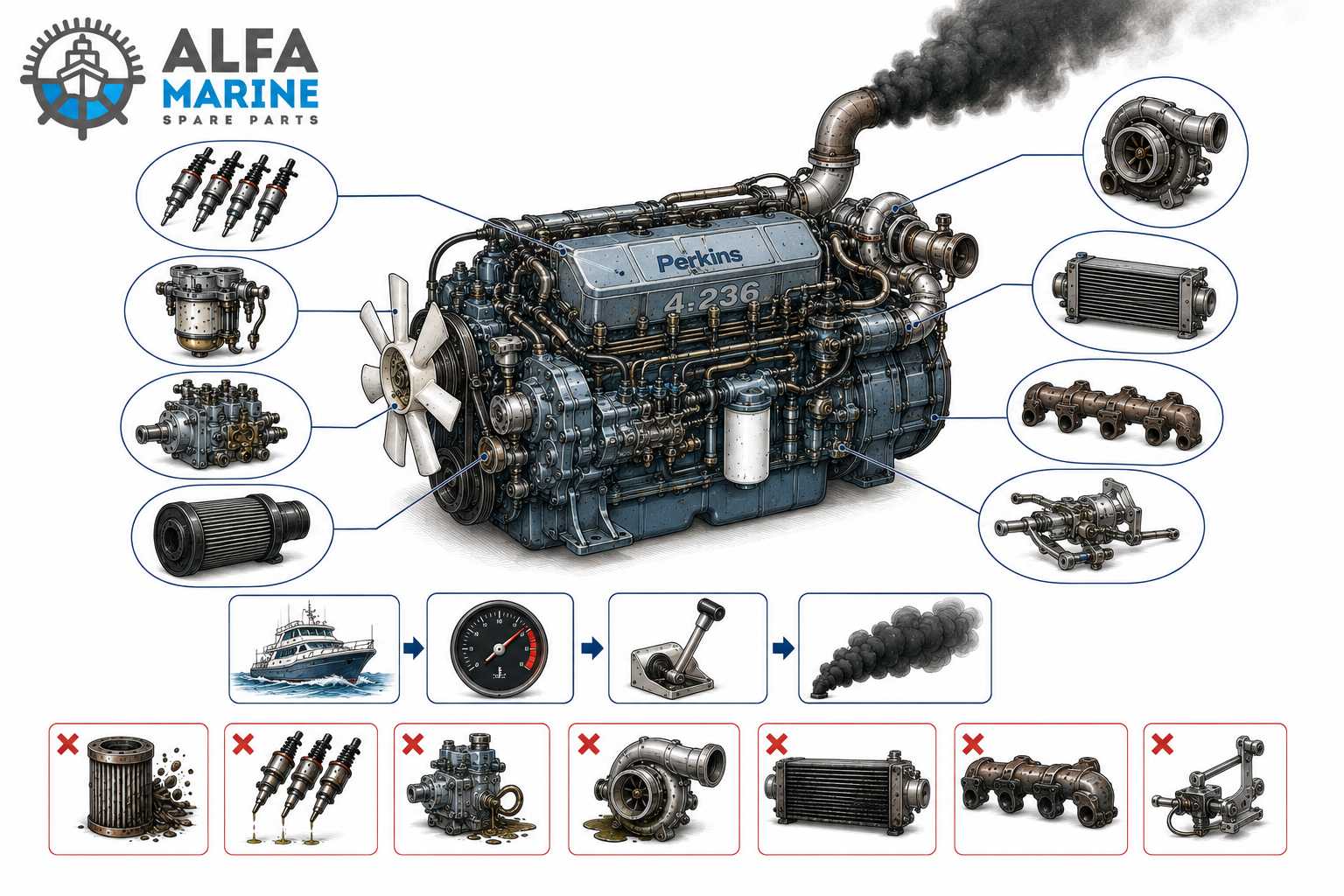
A Perkins 4.236 marine diesel that runs relatively clean at idle but produces black smoke when the vessel is under load is showing an important combustion symptom.
Black smoke generally indicates that the engine is burning fuel under conditions where there is not enough usable combustion air for the amount of fuel being delivered, combustion quality has deteriorated, or the engine is being overloaded.
On a Perkins 4.236 marine installation, important areas to investigate include:
- Restricted air intake
- Dirty or damaged air cleaner
- Injector/atomiser condition
- Fuel-injection pump condition
- Incorrect injection timing
- Exhaust restriction
- Low compression
- Internal engine wear
- Fouled hull or propeller
- Incorrect propeller specification
- Excessive vessel or driveline load
- Turbocharger/boost system only if the actual engine configuration is turbocharged
The key diagnostic question is:
Is the engine receiving insufficient air, is fuel delivery or combustion incorrect, or is the propulsion system demanding too much power?
Perkins 4.236 Marine Engine
The Perkins 4.236 is a well-known older four-cylinder diesel engine family used in marine and industrial applications.
| SpecificationPerkins 4.236 | |
| Configuration | Inline 4-cylinder |
| Cycle | Four-stroke diesel |
| Displacement | Approx. 3.9 litres |
| Displacement | Approx. 236 cu in |
| Fuel system | Mechanical diesel injection |
| Applications | Marine / industrial and other applications |
Many Perkins 4.236 marine engines have now accumulated decades of service.
During that time, components may have been:
- Rebuilt
- Reconditioned
- Replaced
- Superseded
- Modified during marinization
- Changed during previous repairs
This makes the Engine Serial Number and existing component identification particularly important when ordering replacement parts.
Browse Perkins 4.236 Marine Engine Parts.
Why Does Black Smoke Appear Mainly Under Load?
At idle, the engine requires relatively little fuel and combustion air.
When the vessel is placed under load:
Propeller load increases → fuel delivery increases → combustion-air demand increases → engine load increases
A marginal problem may therefore remain almost invisible at idle.
Under heavier load, an air restriction, injector problem, incorrect fuel delivery or excessive propulsion load becomes much more noticeable.
This is why:
Clean exhaust at idle + black smoke under load
is a useful diagnostic pattern.
The investigation should concentrate on what changes when the engine is asked to produce substantially more power.
Start With the Air Intake
Before dismantling the fuel-injection system, make sure the engine can breathe properly.
Inspect:
- Air cleaner
- Air-intake opening
- Intake hoses
- Intake piping
- Intake manifold
- Deteriorated hoses
- Internal obstructions
- Engine-room ventilation
Restricted combustion air can contribute to:
- Black smoke
- Reduced power
- Poor acceleration
- Increased fuel consumption
- Elevated exhaust temperature
A restriction may have relatively little effect at idle but become significant as fuel delivery increases under load.
Check Engine-Room Ventilation
A clean air cleaner does not automatically prove that the engine is receiving enough combustion air.
The engine room itself must have adequate ventilation.
Inspect:
- Engine-room air inlets
- Ventilation ducts
- Louvres
- Obstructions
- Closed or restricted vents
- Modifications around the engine installation
If smoke or available power changes noticeably when engine-room ventilation changes, that provides useful diagnostic information.
Do not overlook the vessel installation while concentrating only on the engine.
Can Bad Perkins 4.236 Injectors Cause Black Smoke?
Yes.
The injectors, often referred to as atomisers in older Perkins terminology, must deliver fuel in the correct quantity and spray pattern.
Poor injector performance can contribute to:
- Black smoke
- Reduced power
- Increased fuel consumption
- Rough running
- Uneven cylinder contribution
- Poor combustion
A worn or contaminated injector nozzle may no longer atomise fuel correctly.
Under light load, the effect may be relatively small.
As fuel delivery increases under load, poor atomisation can become much more noticeable.
Don't Replace All Four Injectors Immediately
Black smoke does not automatically mean all four injectors are defective.
Before replacing them, investigate:
- Air supply
- Fuel condition
- Individual-cylinder performance
- Injection-pump condition
- Injection timing
- Propulsion load
- Propeller condition
- Compression
If one cylinder behaves differently from the others, the investigation can often be narrowed.
Possible causes include:
- Injector/atomiser problem
- Compression difference
- Valve problem
- Fuel-delivery difference
This approach is better than replacing four injectors simply because black smoke is visible.
Why No Universal Perkins 4.236 Injector Part Number Is Listed
The Perkins 4.236 has a long production and service history.
Fuel-injection equipment can vary according to:
- Engine Serial Number
- Engine build
- Production period
- Marine configuration
- Fuel-injection equipment
- Existing injector specification
- Previous repairs or modifications
For this reason, one injector part number should not automatically be applied to every Perkins 4.236 marine engine.
Before ordering injectors or atomisers, provide:
Engine Serial Number + existing injector identification + fuel-injection pump identification where relevant
The same identification principle applies to many other 4.236 components.
Check the Mechanical Fuel-Injection Pump
The fuel-injection pump controls fuel delivery to the engine.
Possible areas to investigate include:
- Injection timing
- Pump condition
- Governor operation
- Fuel-control movement
- Pump calibration
- Previous pump repairs
- Incorrect adjustment
Incorrect fuel delivery can contribute to poor combustion and black smoke.
However, do not adjust the injection pump simply because black smoke is visible.
If the engine is being overloaded by the propeller, changing fuel-pump adjustment will not correct the underlying propulsion problem.
Injection Timing Matters
Incorrect injection timing can affect combustion quality and engine performance.
This becomes particularly relevant if the injection pump has recently been:
- Removed
- Rebuilt
- Replaced
- Reinstalled
- Adjusted
If black smoke or poor performance appeared after injection-system work, verify the installation and timing using the correct specifications for the individual engine.
What About the Turbocharger?
Not every Perkins 4.236-family installation has the same aspiration arrangement.
Do not automatically diagnose a turbocharger simply because a Perkins 4.236-family engine produces black smoke.
First identify the exact engine configuration.
If the actual installed engine is a turbocharged variant or marine conversion, additional areas can include:
- Turbocharger condition
- Compressor fouling
- Turbine fouling
- Bearing condition
- Air-intake restriction
- Boost leakage
- Exhaust leakage
- Exhaust restriction
For a confirmed turbocharged installation:
Black smoke + low power + abnormal boost
makes the turbocharger and complete air system important to investigate.
If the engine is naturally aspirated, this diagnostic path obviously does not apply.
Low Boost Does Not Automatically Mean a Bad Turbocharger
On a turbocharged configuration, low boost can be a symptom rather than the original failure.
Possible causes include:
- Air-intake restriction
- Charge-air leakage
- Exhaust leakage
- Exhaust restriction
- Insufficient engine fueling
- Excessive engine load
- Turbocharger condition
The complete air, fuel and exhaust system should therefore be evaluated before replacing the turbocharger.
Could the Propeller Cause Black Smoke?
Yes.
This is one of the most important marine-specific causes to investigate.
The engine itself may be serviceable while the propulsion system places excessive load on it.
Possible causes include:
- Fouled propeller
- Damaged propeller
- Excessive propeller pitch
- Incorrect propeller diameter
- Hull fouling
- Excessive vessel loading
- Driveline resistance
- Gearbox-related problems
If the engine cannot reach its expected full-load RPM and produces heavy black smoke, investigate the propeller and vessel load before unnecessarily dismantling the fuel system.
Why Propeller Overload Can Create Black Smoke
Imagine an engine trying to turn a propeller that demands more torque than expected.
The sequence can become:
Propeller load increases → engine struggles to increase RPM → governor demands more fuel → available combustion air becomes insufficient for the delivered fuel → black smoke increases
This can make a serviceable engine appear to have an injector or injection-pump problem.
One particularly useful observation is:
Engine accelerates normally without propulsion load but cannot reach expected RPM in gear and produces heavy black smoke.
That does not prove propeller overload, but it makes propulsion load an important area to investigate.
What if the Smoke Started After Propeller Work?
If the engine previously operated normally but began producing black smoke after:
- Propeller replacement
- Propeller repair
- Propeller repitching
- Gearbox replacement
- Gear-ratio change
inspect the propulsion configuration carefully.
Verify:
- Propeller diameter
- Propeller pitch
- Blade configuration
- Gearbox ratio
- Propeller condition
Do this before attempting to compensate by changing fuel-system adjustments.
Could Hull Fouling Cause Black Smoke?
Yes.
Hull fouling increases vessel resistance.
The engine must produce more power to achieve the same vessel speed.
This can contribute to:
- Increased engine load
- Reduced achievable RPM
- Increased fuel consumption
- Elevated exhaust temperature
- Black smoke
If black smoke has gradually increased while vessel performance has decreased, inspect the hull and propeller as part of the diagnosis.
Check the Exhaust System
The engine must be able to discharge exhaust gases effectively.
Inspect:
- Exhaust hose
- Exhaust piping
- Marine exhaust components
- Water-injection components where applicable
- Silencer or muffler
- Carbon deposits
- Internal restrictions
- Internally damaged or collapsed hose
An exhaust restriction may have relatively little effect at idle but become much more important as exhaust flow increases under load.
This makes exhaust restriction another possible explanation for:
Normal idle + poor power + black smoke under load
Could Low Compression Contribute to Black Smoke?
Poor mechanical condition can contribute to inefficient combustion and reduced power.
Possible causes include:
- Worn piston rings
- Cylinder wear
- Valve leakage
- Incorrect valve clearance
- Cylinder-head problems
- Uneven compression between cylinders
Other symptoms may include:
- Difficult starting
- Increased blow-by
- Oil consumption
- Uneven running
- Reduced power
- Abnormal cylinder-to-cylinder exhaust temperatures
On an older Perkins 4.236, internal engine condition becomes increasingly important once simpler fuel, air and load problems have been eliminated.
Compare Individual Cylinders
Cylinder-to-cylinder comparison can provide useful diagnostic information.
If one cylinder behaves differently from the others, investigate:
- Injector/atomiser condition
- Compression
- Valve condition
- Fuel delivery
The question is:
Is the entire engine smoking because of a system-wide problem, or is one cylinder contributing abnormally?
That distinction can prevent unnecessary replacement of multiple components.
Black Smoke With Low Power vs Black Smoke With Good Power
The complete symptom pattern matters.
| SymptomArea Worth Investigating | |
| Black smoke + low RPM | Propulsion load / air / fuel |
| Black smoke + low power | Air / injectors / compression / load |
| Smoke mainly during acceleration | Fuel response / air supply / load |
| Continuous heavy black smoke | Air / injection / load / engine condition |
| Smoke started after injector work | Injector specification / installation |
| Smoke started after pump work | Timing / calibration / installation |
| Smoke started after propeller work | Propeller / gearbox / vessel load |
| Gradually increasing smoke | Air restriction / injectors / fouling / wear |
| One cylinder abnormal | Injector / compression / valves |
| Black smoke + high temperature | Load / cooling / combustion condition |
These observations provide diagnostic direction rather than proof of a particular component failure.
Black, Blue or White Smoke?
Smoke color matters.
Black smoke generally directs the investigation toward fuel-to-air balance, combustion and engine loading.
Blue or blue-grey smoke more strongly suggests lubricating oil entering the combustion process.
White smoke can be associated with unburned fuel, low combustion temperature, compression problems or other combustion conditions.
Smoke should therefore be evaluated together with:
- Engine temperature
- Engine load
- RPM
- Starting behavior
- Oil consumption
- Coolant condition
- Exhaust temperature
- Cylinder balance
Practical Perkins 4.236 Black-Smoke Check
A sensible diagnostic sequence is:
- Confirm the exact engine model and Engine Serial Number.
- Identify the actual aspiration and marine configuration.
- Determine exactly when black smoke occurs.
- Check whether expected full-load RPM can be reached.
- Inspect the air cleaner and intake.
- Check engine-room ventilation.
- Inspect the exhaust system.
- Verify fuel condition.
- Evaluate injector/atomiser condition.
- Compare individual-cylinder performance.
- Verify injection timing where appropriate.
- Evaluate injection-pump and governor condition if indicated.
- On turbocharged configurations, inspect the turbocharger and boost system.
- Inspect the propeller.
- Inspect the hull.
- Verify propeller specification if the problem followed propulsion work.
- Consider compression and internal engine condition.
- Identify the root cause before replacing components.
The objective is to determine whether the smoke originates primarily from:
Air supply → fuel injection → combustion → exhaust → engine condition → propulsion load
Why Perkins 4.236 Part Identification Matters
Simply saying:
“I need parts for a Perkins 4.236 Marine.”
may not provide enough information to identify every component correctly.
Correct identification can depend on:
- Engine model
- Engine Serial Number
- Engine build information
- Existing part number
- Marine conversion
- Fuel-injection equipment
- Cooling arrangement
- Existing component manufacturer
- Previous modifications
Before ordering, provide:
Engine model + Engine Serial Number + existing part number + clear component photographs
Perkins 4.236 Marine Engine Parts
Alfa Marine Spare Parts supports replacement-part enquiries for Perkins 4.236 marine engines.
Browse Perkins 4.236 Marine Engine Parts.
Parts enquiries can include:
- Injectors / atomisers
- Injector nozzles
- Fuel-injection pumps
- Fuel lift pumps
- Air-intake components
- Raw-water pump components
- Freshwater pump components
- Cooling-system components
- Gaskets and seals
- Cylinder heads
- Valves
- Pistons
- Piston rings
- Bearings
- Oil pumps
- Overhaul components
Exact application should always be verified against the individual engine.
What About Perkins Sabre Marine Engines?
Perkins Sabre covers a broader range of marine engines and should not be treated as another name for the classic Perkins 4.236.
Later Perkins Sabre marine engines can have substantially different:
- Fuel systems
- Turbocharger arrangements
- Cooling systems
- Displacements
- Power ratings
- Replacement components
For example, Alfa Marine Spare Parts has dedicated pages for the Perkins M130C Marine Engine and Perkins M300C Marine Engine.
The basic black-smoke diagnostic principle remains similar:
Air + fuel + combustion + engine load
But diagnosis and replacement components must match the specific Perkins Sabre engine model.
Request Perkins 4.236 Marine Parts
If your Perkins 4.236 marine engine produces black smoke under load, avoid immediately replacing all injectors or adjusting the injection pump.
First determine whether the problem originates from:
Air restriction → fuel injection → exhaust restriction → mechanical condition → excessive propulsion load
For accurate parts identification, provide:
Engine model + Engine Serial Number + existing part number + component photographs
Email: request@alfamarinespareparts.com
Request a Quote
Alfa Marine Spare Parts
Frequently Asked Questions
Why does my Perkins 4.236 smoke black under load?
Important areas include restricted combustion air, injector/atomiser condition, injection-system problems, exhaust restriction, excessive propeller load and internal engine condition.
Can bad Perkins 4.236 injectors cause black smoke?
Yes. Poor injector atomisation can contribute to black smoke, reduced power, increased fuel consumption and uneven combustion.
Can a dirty air cleaner cause black smoke?
Yes. Restricted airflow reduces available combustion air and can become particularly noticeable as fuel delivery increases under load.
Can the injection pump cause black smoke?
Incorrect fuel delivery, timing or pump condition can contribute to black smoke. However, air supply and propulsion load should also be checked before adjusting the pump.
Can an overloaded propeller make a Perkins 4.236 smoke?
Yes. Excessive propeller load can prevent the engine from reaching expected RPM while fuel demand remains high, contributing to black smoke.
Why did my 4.236 start smoking after the propeller was changed?
Check propeller diameter, pitch, blade configuration and gearbox ratio. A propulsion change that increases engine load can cause low RPM and black smoke.
Can hull fouling cause black smoke?
Yes. Hull and propeller fouling increase vessel resistance and engine load.
Should I replace all four injectors if the engine smokes?
Not automatically. Diagnose the air system, injector condition, cylinder performance, injection system and engine load first.
Does every Perkins 4.236 have a turbocharger?
No. Identify the exact engine configuration before including a turbocharger in the diagnostic path.
How do I identify the correct Perkins 4.236 parts?
Use the Engine Serial Number, existing component part number, engine build information and clear photographs. Identification from the existing injector and injection pump can also be important for fuel-system components.