How MTU Series 4000 Marine Engines Work: Engine Types, Systems & Mechanical Operation
The MTU Series 4000 marine engine is not a single engine model. It is a large high-speed diesel engine family built around V8, V12, V16 and V20 configurations, with different versions developed for commercial marine propulsion, workboats, ferries, offshore vessels, patrol craft, yachts and other demanding applications.
For a marine engineer or mechanic, understanding the Series 4000 means looking beyond cylinder count. Fuel injection, turbocharging, charge-air cooling, lubrication, engine cooling and electronic control must work together as engine load changes.
The Alfa Marine Spare Parts MTU Series 4000 Marine Engine Parts section currently organizes 14 principal marine engine types across the four cylinder configurations.
How Many MTU Series 4000 Engine Types Are There?
The 14 engine types currently organized in the Alfa Marine Spare Parts Series 4000 section are:
These 14 pages should not be interpreted as every Series 4000 variant MTU has ever manufactured. Different generations, ratings and application-specific variants exist. For this article, the 14 engines above represent the Series 4000 marine models currently organized in the Alfa Marine Spare Parts catalogue.
MTU 8V 4000: Understanding the V8 Configuration
The MTU 8V 4000 M53 represents the eight-cylinder configuration in the current Series 4000 catalogue.
Using the established Series 4000 cylinder geometry of approximately 170 mm bore and 210 mm stroke, the V8 has a displacement of roughly 38.2 liters.
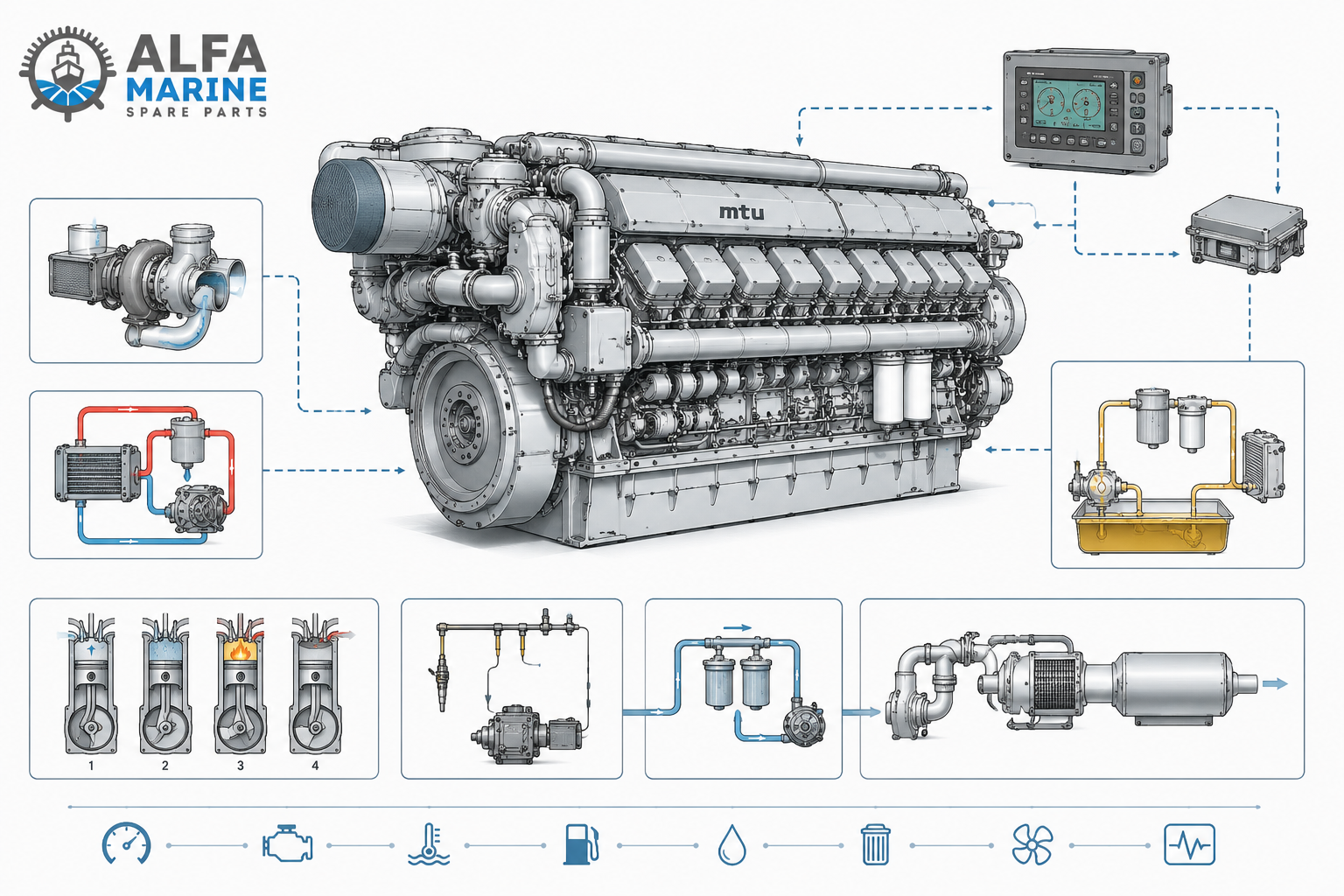
Mechanically, every cylinder operates through the four-stroke diesel cycle:
Intake → Compression → Power → Exhaust
During the intake stroke, charge air enters the cylinder. The piston then travels upward and compresses that air, raising its pressure and temperature. Fuel is injected near the end of compression, combustion produces a rapid increase in cylinder pressure, and that pressure forces the piston downward.
The connecting rod transfers the force to the crankshaft, converting reciprocating piston movement into rotational torque.
Although the V8 has fewer cylinders than the larger Series 4000 versions, its supporting systems remain critical. Fuel delivery, turbocharging, charge-air cooling, lubrication and engine cooling all have to remain balanced with the engine's operating load.
MTU 12V 4000: More Cylinders, More Thermal and Mechanical Load
The V12 group includes the MTU 12V 4000 M53, MTU 12V 4000 M73, MTU 12V 4000 M93 and MTU 12V 4000 M05.
With twelve cylinders, displacement increases to approximately 57.3 liters in the established architecture.
The basic combustion process remains the same as the V8, but increasing cylinder count changes the demands placed on the rest of the engine.
There are now twelve combustion chambers contributing to crankshaft output. This means more fuel must be delivered accurately, more combustion air must reach the cylinders, more exhaust gas must pass through the turbocharging system and more heat must be removed.
There are also more pistons, cylinder liners, connecting rods, bearings, valves and injectors operating simultaneously.
This is an important concept when working mechanically on the Series 4000: increasing engine output also increases the demands placed on every supporting system.
MTU 16V 4000: Heavy-Duty Marine Power
The V16 group contains more individual models in the current Alfa Marine catalogue than the other cylinder configurations.
These include the MTU 16V 4000 M53, MTU 16V 4000 M63, MTU 16V 4000 M73, MTU 16V 4000 M90, MTU 16V 4000 M93 and MTU 16V 4000 M05.
The V16 configuration has approximately 76.3 liters displacement with the established 170 × 210 mm architecture.
From a mechanical perspective, the V16 demonstrates particularly well how load affects an engine.
When the vessel demands more propulsive power, fuel delivery increases. Burning more fuel requires more oxygen, so the turbocharging system must provide greater airflow. Combustion pressure and exhaust-gas energy increase, while the cooling system must reject substantially more heat.
At the same time, mechanical loads on the pistons, liners, connecting rods, crankshaft and bearings increase.
This explains why some problems are almost invisible during dockside operation but become obvious during a full-load sea trial.
MTU 20V 4000: Twenty-Cylinder Series 4000 Power
The V20 group includes the MTU 20V 4000 M73L, MTU 20V 4000 M93L and MTU 20V 4000 M05.
With twenty cylinders, displacement reaches approximately 95.4 liters in the established architecture.
Twenty cylinders provide substantial potential crankshaft output, but producing power reliably requires much more than simply adding cylinders.
The engine must continuously control combustion pressure, bearing load, piston temperature, exhaust temperature, coolant temperature, oil temperature and turbocharger operating conditions.
This is why the fuel, air, lubrication and cooling systems become increasingly important as engine output rises.
How Does an MTU Series 4000 Engine Actually Work?
At its mechanical core, the MTU Series 4000 is a four-stroke compression-ignition diesel engine.
During intake, the piston moves downward and charge air enters the cylinder.
During compression, the piston travels upward with the valves closed. The air becomes highly compressed, increasing its pressure and temperature.
Fuel is then injected. The fuel ignites in the hot compressed air and combustion rapidly increases cylinder pressure. This forces the piston downward during the power stroke.
The connecting rod transfers this force to the crankshaft.
Finally, the piston moves upward during the exhaust stroke, pushing combustion gases from the cylinder.
The process repeats continuously across all cylinders, with combustion events distributed through the engine's firing order to produce usable crankshaft torque.
In a propulsion installation, this torque is transmitted through the drivetrain toward the marine gearbox and propeller.
How the MTU Series 4000 Fuel System Works
Fuel-system design depends on the particular Series 4000 generation and model, so technicians should not assume that every engine uses exactly the same injection architecture.
On electronically controlled common-rail versions, high-pressure fuel is made available to the injectors while electronic engine management determines the required injection events according to operating conditions.
This allows fuel delivery to respond precisely as engine load changes.
Mechanically, however, it also means that poor combustion does not automatically prove that an injector has failed.
An apparent injector problem can potentially involve low-pressure fuel supply, contamination, high-pressure generation, rail-pressure regulation, sensors, wiring or electronic control.
The complete fuel system should therefore be considered before expensive components are replaced.
How Turbocharging Produces More Power
The turbocharging system uses energy contained in the engine's exhaust gases.
The process can be simplified as:
Exhaust gas → Turbine → Turbocharger shaft → Compressor → Compressed air → Charge-air cooling → Engine cylinders
Hot exhaust gases leaving the cylinders rotate the turbine wheel. The turbine shares a shaft with the compressor, so exhaust energy drives the intake-air compressor.
The compressor forces more air into the engine than atmospheric pressure alone could provide.
However, compression raises air temperature. Charge-air cooling is therefore necessary because cooler compressed air is denser and contains more oxygen mass for a given volume.
That oxygen is essential when additional fuel is injected under load.
Low Boost Does Not Automatically Mean a Failed Turbocharger
When an MTU 4000 develops low boost, it is tempting to immediately suspect the turbocharger.
The complete airflow path should be investigated instead.
An intake restriction can reduce compressor airflow. A leak downstream of the compressor can lose boost pressure. A contaminated charge-air cooler can reduce airflow and cooling effectiveness, while an exhaust restriction can influence turbine performance.
Engine load itself also matters.
A useful diagnosis therefore compares boost pressure, RPM, engine load, exhaust temperature and smoke behavior together rather than treating boost pressure as an isolated measurement.
Looking for MTU Series 4000 Parts?
Working on an MTU 8V 4000 M53, one of the MTU 12V 4000 M73 family engines, an MTU 16V 4000 M93 or a MTU 20V 4000 M93L?
Alfa Marine Spare Parts can assist with components for maintenance, repair and major engine overhaul, depending on the exact engine configuration and availability.
Parts requirements can include fuel injectors, high-pressure fuel components, water pumps, oil pumps, turbochargers, cylinder heads, pistons, cylinder liners, bearings, gaskets, seals, O-rings and overhaul components.
Browse the complete MTU Series 4000 Marine Engine Parts section.
For a quotation, send:
Engine model + serial number + existing part number + quantity + photographs + delivery destination
Email: request@alfamarinespareparts.com
Submit your requirement through Request a Quote | Alfa Marine Spare Parts.
How the MTU Series 4000 Cooling System Works
A high-output diesel engine converts only part of the energy contained in its fuel into useful crankshaft power. Significant thermal energy must leave through the exhaust, lubrication and cooling systems.
The engine's coolant circuit absorbs heat from critical engine components. That heat must then ultimately be transferred through the vessel's cooling arrangement.
On the marine side, seawater presents additional challenges.
Salt deposits, marine growth, debris, corrosion, pump wear and heat-exchanger contamination can gradually reduce cooling-system capacity.
This creates one of the classic marine diesel symptoms: the engine maintains normal temperature at the dock but overheats underway.
At idle, relatively little heat needs to be rejected.
At high load, combustion produces much more thermal energy. A cooling system operating at reduced capacity may therefore appear normal at low load but become inadequate during sustained high-output operation.
A technician investigating this condition should think about flow and heat-transfer capacity, rather than focusing only on coolant level or the temperature gauge.
How Lubrication Protects an MTU Series 4000
Lubricating oil does considerably more than prevent metal surfaces from rubbing together.
Oil protects critical components including crankshaft journals, main bearings, connecting-rod bearings, camshaft components, valve-train components and turbocharger bearings. It also contributes to heat removal and contamination control.
Oil pressure is therefore important, but a single pressure reading provides limited information without operating context.
Suppose an MTU 16V 4000 M73 historically maintains a particular oil pressure at normal operating temperature and a known engine load.
If the pressure gradually decreases under comparable conditions, something has changed.
Oil viscosity, lubricant temperature, contamination, filtration, pump performance and increasing internal clearances can all influence pressure.
This is why trend analysis is more useful than immediately assuming the oil pump has failed.
Why MTU Series 4000 Problems Often Appear Under Load
One of the most valuable concepts when troubleshooting large marine diesels is understanding load-dependent failure.
At idle, fuel consumption, boost requirement, cylinder pressure, exhaust flow and cooling demand are comparatively low.
As load increases:
Fuel demand ↑ → Air demand ↑ → Boost demand ↑ → Cylinder pressure ↑ → Exhaust temperature ↑ → Cooling demand ↑ → Mechanical load ↑
A restriction that causes no noticeable problem at idle can suddenly become important.
A partially restricted fuel filter may pass sufficient fuel during maneuvering but become restrictive at high output.
A contaminated charge-air cooler may support low-load operation yet restrict airflow when the engine requires maximum combustion air.
A deteriorating cooling pump may maintain normal temperature at the dock but fail to provide adequate flow during a sea trial.
For mechanical diagnosis, don't record only that an engine “runs hot” or “loses power.”
Determine when it happens.
Does the symptom begin at 40% load? 60%? 80%? Only near maximum output?
Then observe what happens simultaneously to boost pressure, coolant temperature, oil pressure, exhaust temperature, RPM and smoke.
Those relationships can reveal considerably more than any single measurement.
Why the MTU 4000 M-Designation Matters
The complete engine designation is important when diagnosing an engine or identifying replacement parts.
Consider the V16 range:
MTU 16V 4000 M53
MTU 16V 4000 M63
MTU 16V 4000 M73
MTU 16V 4000 M90
MTU 16V 4000 M93
MTU 16V 4000 M05
They all belong to the V16 Series 4000 family, but that does not make them identical.
Different models and generations can involve differences in power rating, duty profile, fuel equipment, turbocharging, electronic management, cooling arrangements and individual engine components.
Consequently:
MTU 16V 4000
is useful identification, but:
MTU 16V 4000 M73 + engine serial number + existing part number
is much more useful when identifying a replacement component.
What Should Marine Engineers Monitor?
Good diagnosis is built around operating trends.
Depending on the vessel's instrumentation, useful measurements include engine RPM, engine load, oil pressure, oil temperature, coolant temperature, boost pressure, exhaust temperatures, fuel consumption and charge-air temperature.
Suppose an MTU 20V 4000 M73L previously operated with a stable boost and exhaust-temperature pattern at a particular RPM and vessel speed.
Months later, under comparable conditions, boost is lower and exhaust temperature has increased.
The engine may not yet produce an alarm, but the change itself is valuable information.
Comparing present readings with known-good commissioning or sea-trial data can help identify developing deterioration before it becomes a major mechanical failure.
Common MTU Series 4000 Spare Parts
Maintenance and overhaul requirements vary between engine configurations, but frequently required component groups include fuel injectors, high-pressure fuel-system components, turbochargers, cylinder heads, valves, valve guides, pistons, piston rings, cylinder liners, connecting rods, main bearings, connecting-rod bearings, crankshaft components, camshaft components, oil pumps, coolant pumps, seawater pumps, heat exchangers, charge-air cooler components, oil coolers, gaskets, O-rings, seals, sensors, filters and overhaul components.
Parts should never be selected using “MTU Series 4000” alone.
The correct approach is:
Complete engine model + serial number + existing component number + quantity
This becomes increasingly important where different Series 4000 generations or ratings use visually similar components with different specifications.
Frequently Asked Questions
How many MTU Series 4000 engine types are there?
The Alfa Marine Spare Parts Series 4000 section currently organizes 14 principal marine models: one V8, four V12, six V16 and three V20 models. Other Series 4000 generations and variants also exist.
Which MTU 8V 4000 engine is listed?
The V8 model is the MTU 8V 4000 M53.
Which MTU 12V 4000 models are listed?
The V12 group contains the MTU 12V 4000 M53, MTU 12V 4000 M73, MTU 12V 4000 M93 and MTU 12V 4000 M05.
Which MTU 16V 4000 models are listed?
The V16 group contains the MTU 16V 4000 M53, MTU 16V 4000 M63, MTU 16V 4000 M73, MTU 16V 4000 M90, MTU 16V 4000 M93 and MTU 16V 4000 M05.
Which MTU 20V 4000 models are listed?
The V20 group contains the MTU 20V 4000 M73L, MTU 20V 4000 M93L and MTU 20V 4000 M05.
Are all MTU Series 4000 parts interchangeable?
No. Cylinder configuration, M-designation, generation, power rating and application can affect component selection. Always verify the engine serial number and existing part number.
Why does an MTU Series 4000 run normally at idle but overheat under load?
Higher load creates much greater heat-rejection demand. Reduced seawater flow, heat-exchanger fouling, pump deterioration or another restriction can therefore remain almost invisible at idle and become significant during sustained loaded operation.
Why can an MTU Series 4000 lose power under load?
Possible causes include restricted fuel supply, fuel-pressure problems, insufficient boost, charge-air restrictions, cooling problems, excessive vessel load or electronic derating. Diagnosis should compare several operating parameters rather than relying on one symptom.
Request MTU Series 4000 Marine Engine Parts
Whether you are carrying out scheduled maintenance, diagnosing an engine problem or preparing a major overhaul, correct parts identification begins with the exact engine configuration.
Alfa Marine Spare Parts supports shipowners, ship managers, shipyards, marine engineers, engine rebuilders, vessel operators and marine repair companies requiring MTU Series 4000 components.
Send:
MTU engine model + engine serial number + existing part number + quantity + photographs + delivery destination
Email: request@alfamarinespareparts.com
Submit your complete requirement through Request a Quote | Alfa Marine Spare Parts.
The key to understanding the MTU Series 4000 mechanically is to stop thinking of it as one engine. The V8, V12, V16 and V20 configurations share a broad engineering platform, but each model operates within its own power, duty and application requirements. Understanding how combustion, fuel injection, turbocharging, cooling, lubrication and engine load interact makes it easier to diagnose developing problems and identify the correct replacement components.