
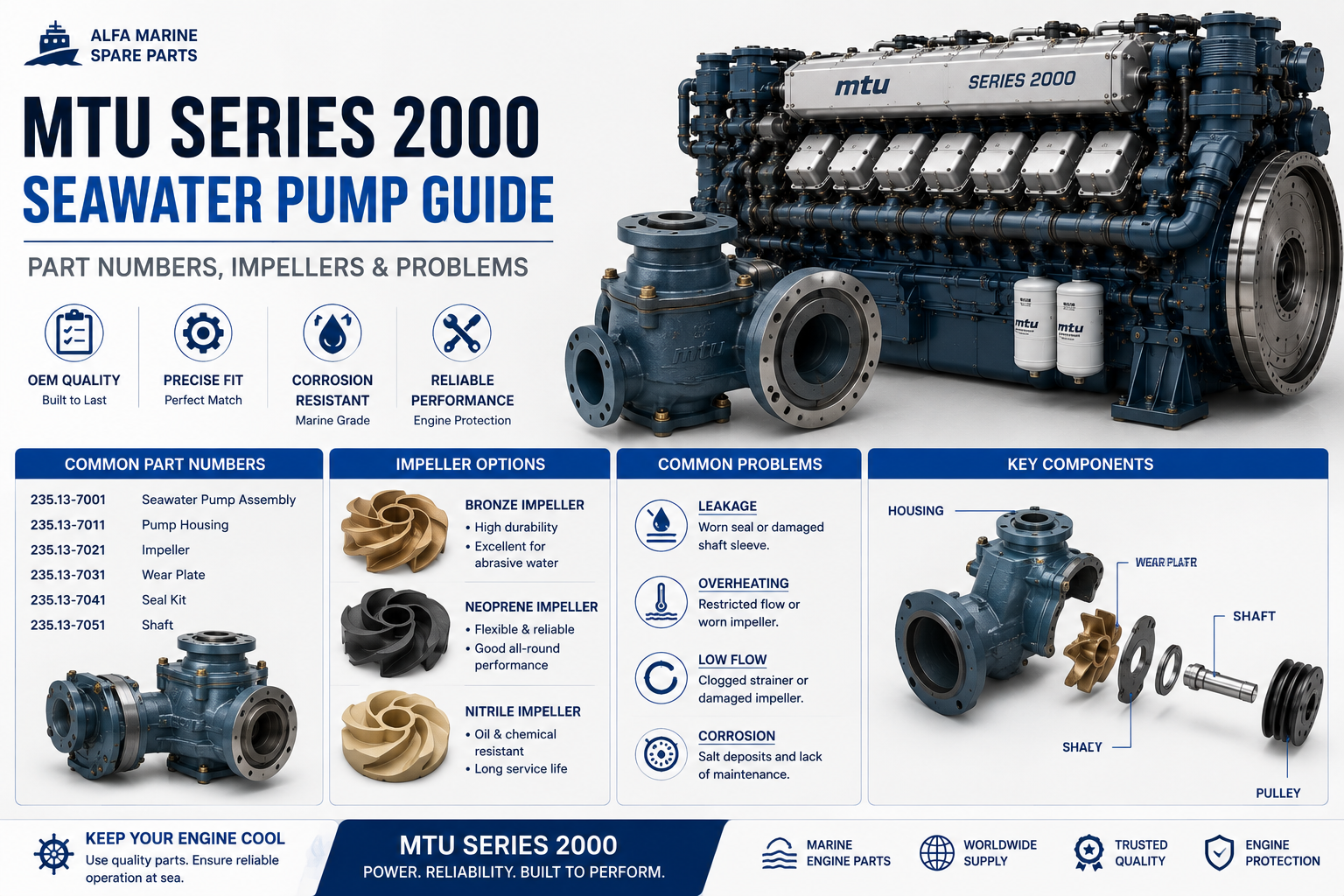
MTU Series 2000 Seawater Pump Guide: Cooling Flow, Impellers & Common Problems
The seawater pump on an MTU Series 2000 marine engine is one of those components that can quietly do its job for thousands of operating hours—until something begins to change.
And the first sign is not always an overheating alarm.
Sometimes the engineer notices something much smaller.
The engine normally runs at a familiar temperature, but lately it is operating a few degrees warmer.
At idle everything looks fine.
At cruising speed, however, the temperature slowly begins climbing.
Or perhaps you have twin MTU engines and suddenly notice:
the port engine is running cooler than the starboard engine at almost exactly the same load.
Those small differences are worth paying attention to.
A seawater pump does not necessarily go from 100% working to completely failed overnight. Pump wear, a damaged impeller, a dirty sea strainer, cooler fouling or a restricted hose can gradually reduce seawater flow.
Understanding that complete cooling path can help find the problem before a minor flow restriction becomes an overheating event.
1. MTU Series 2000 Marine Engine Types
The MTU Series 2000 marine family covers several V8, V10, V12 and V16 configurations.
Common engine types include:
MTU 8V 2000
- MTU 8V 2000 M72
- MTU 8V 2000 M84
- MTU 8V 2000 M94
MTU 10V 2000
- MTU 10V 2000 M72
- MTU 10V 2000 M84
- MTU 10V 2000 M86
- MTU 10V 2000 M94
- MTU 10V 2000 M96L
MTU 12V 2000
- MTU 12V 2000 M72
- MTU 12V 2000 M86
- MTU 12V 2000 M96L
- MTU 12V 2000 M96X
MTU 16V 2000
- MTU 16V 2000 M72
- MTU 16V 2000 M86
- MTU 16V 2000 M91
- MTU 16V 2000 M93
- MTU 16V 2000 M94
- MTU 16V 2000 M96L
- MTU 16V 2000 M97
- MTU 16V 2000 M97L
These engines do not necessarily use the same seawater pump.
Generation, engine configuration, serial number and vessel cooling arrangement all matter.
That becomes particularly important when ordering replacement pumps or overhaul components.
2. What Does the MTU 2000 Seawater Pump Actually Do?
The basic job sounds simple:
move seawater.
But that seawater is responsible for carrying a tremendous amount of heat away from a high-output marine engine.
A simplified cooling-water path may look like:
Sea intake → Seacock → Sea strainer → Seawater pump → Coolers / heat exchanger → Discharge
The exact arrangement varies between vessels.
Depending on the installation, seawater can be involved in cooling:
- Engine coolant
- Charge air
- Lubricating oil
- Marine transmission oil
- Other auxiliary systems
So when seawater flow decreases, more than one temperature may start changing.
3. Seawater Pump and Freshwater Pump Are Not the Same
This causes plenty of confusion when people request parts.
An MTU marine engine can have both a coolant/freshwater pump and a seawater pump.
They perform different jobs.
Freshwater / Coolant Pump
Circulates treated coolant through the closed engine cooling circuit.
Seawater Pump
Moves raw seawater through the marine side of the cooling system.
When requesting a replacement, saying:
“I need the water pump for my MTU 2000”
is therefore not enough.
Specify whether you need the engine coolant pump or seawater pump.
4. Why a Weak Seawater Pump Often Shows Up Under Load
Imagine an MTU engine idling at the dock.
Temperature looks perfect.
You leave the marina.
RPM increases.
Engine load rises.
Twenty minutes later the temperature is higher than normal.
Why?
Because cooling demand changes dramatically with engine load.
At idle, even a partially restricted seawater system may move enough water.
At high load, the engine produces far more heat.
Now that same restriction becomes important.
This is why:
Normal at idle + hotter under load
can be an important clue when diagnosing an MTU Series 2000 cooling problem.
5. Is the Pump Bad—or Is Something Else Restricting Flow?
This is where troubleshooting becomes interesting.
If the engine runs hot, it is easy to blame the seawater pump.
But follow the water.
Start from the beginning:
Is the seacock fully open?
Is the sea strainer clean?
Is the intake restricted?
Is the suction hose collapsing?
Is the pump actually producing enough flow?
Are the coolers restricted?
The seawater pump is only one part of the system.
Replacing a perfectly good pump will not fix a blocked sea strainer.
6. Impeller Wear
Where the pump design uses a flexible impeller, that impeller deserves regular attention.
Impellers can deteriorate because of:
- Normal service wear
- Age
- Heat
- Dry running
- Debris
- Long storage periods
When removed, inspect the blades carefully.
Look for:
- Cracks
- Missing sections
- Hardened rubber
- Permanent deformation
- Hub damage
A worn impeller may still pump water.
It may simply pump less water than it used to.
And that difference may only become obvious at high engine load.
7. The Missing Impeller Blade Problem
You remove the old impeller.
Three blades are damaged.
One blade is completely missing.
The natural reaction is:
“Good—we found the problem. Install a new impeller.”
But there is another question:
Where did the missing blade go?
Rubber pieces can travel downstream and become trapped in:
- Heat exchangers
- Oil coolers
- Charge-air coolers
- Hose connections
- Cooler end caps
Now you have a new impeller producing good flow—but part of that flow is still restricted by the remains of the old impeller.
So when impeller pieces are missing, finding them can be just as important as replacing the impeller.
8. Dry Running Can Destroy an Impeller Quickly
Flexible impellers depend on the pumped water for lubrication and cooling.
If the pump runs dry, heat can build rapidly.
This can happen after:
- Seacock left closed
- Blocked seawater intake
- Sea-strainer servicing
- Cooling-system maintenance
- Incorrect recommissioning
An engine does not necessarily need to run dry for a long period before impeller damage begins.
After a known dry-running event, inspecting the pump is sensible.
9. A New Impeller Does Not Always Mean a Healthy Pump
This is another common mistake.
The impeller is worn, so a new one is installed.
Problem solved?
Maybe.
But the rest of the pump may have:
- Housing wear
- Shaft wear
- Bearing wear
- Seal deterioration
- Cover-plate wear
- Corrosion
A new impeller inside a badly worn pump may still produce inadequate flow.
Inspect the pump as an assembly.
10. Watch for Seawater Around the Pump
One of the easiest warning signs to spot is leakage.
Look around the seawater pump for:
- Water drops
- Salt deposits
- Green corrosion
- Rust staining
- Moisture around the shaft
A small leak may not affect cooling immediately.
But it can indicate that a seal is deteriorating.
And seawater leaking onto surrounding components can eventually create much larger problems.
11. Salt Deposits Can Tell You Where the Leak Started
Sometimes the engine is dry when you inspect it.
That does not mean it has never leaked.
Seawater evaporates.
Salt remains.
White deposits around the pump, fittings or hoses can show where small leaks have been occurring.
This is one reason a clean engine room makes troubleshooting easier.
Old salt deposits are much easier to recognize when the machinery is not covered in years of oil and dirt.
12. Pump Bearings and Shaft Condition
The pump shaft and bearings also deserve attention during overhaul.
Possible signs of deterioration include:
- Grinding noise
- Rough rotation
- Shaft play
- Seal leakage
- Abnormal heat
If the shaft is badly worn where the seal runs, installing only a new seal may result in another leak shortly afterward.
Sometimes the pump needs a seal.
Sometimes it needs a proper rebuild.
13. Don't Forget the Sea Strainer
Before dismantling an expensive pump, open the sea strainer.
You may find:
- Seaweed
- Plastic
- Shell fragments
- Sand
- Marine growth
- Other debris
A partially blocked strainer can create exactly the symptoms you would expect from a weak seawater pump.
The engine may be fine at low load but gradually become hotter as RPM increases.
14. The Problem Can Be Outside the Vessel
Sometimes the pump is perfect.
The strainer is clean.
But the engine still does not receive enough seawater.
The restriction can be at the hull intake.
Possible causes include:
- Marine growth
- Plastic
- Debris
- Blocked intake screen
- Partially closed seacock
Troubleshooting should therefore begin at the sea intake, not automatically at the engine.
15. A Hose Can Look Good and Still Be Bad
Suction hoses deserve particular attention.
An aging hose may look completely normal while the engine is stopped.
At high RPM, however, pump suction increases.
A weakened hose can partially collapse internally.
The result?
Normal cooling at low RPM.
Poor cooling at high RPM.
That is an easy problem to miss if hoses are inspected only visually with the engine stopped.
16. Heat Exchanger Fouling
Suppose the pump is healthy and seawater reaches the heat exchanger correctly.
The engine can still run hot.
Why?
Because the seawater passages themselves may be restricted.
Over time they can accumulate:
- Scale
- Salt deposits
- Marine growth
- Debris
- Corrosion products
Cooling efficiency gradually decreases.
This is why a temperature trend can be more useful than waiting for an alarm.
If the same engine is slowly operating hotter every season under similar conditions, something is changing.
17. Charge-Air Cooler Problems Can Look Like Engine Problems
The MTU Series 2000 family includes high-output turbocharged engines that depend heavily on effective charge-air cooling.
If cooling performance deteriorates, you may notice:
- Higher intake temperature
- Higher exhaust temperature
- Reduced performance
- Increased smoke
The engine may appear to have a combustion or turbocharger problem.
But the real issue could be insufficient cooling-water flow through the charge-air cooler.
18. Oil Temperature Can Give Another Clue
If seawater flow affects the oil-cooling circuit, reduced flow may contribute to higher lubricating-oil temperature.
Then you may see:
coolant temperature rising
and:
oil temperature rising
at approximately the same time.
That combination should make you think about what both systems have in common.
One possibility is reduced cooling-water performance.
19. What About the Marine Gear?
On some vessel installations, seawater also helps remove heat from the transmission oil.
Now imagine:
engine temperature rises
and:
gearbox temperature rises.
It would be unusual for two unrelated systems to develop separate cooling failures at exactly the same time.
Look for the common factor.
That may be the seawater circuit.
20. Twin MTU Engines Give You a Valuable Diagnostic Tool
Twin-engine yachts make comparison extremely useful.
Imagine twin MTU 16V 2000 M96L engines.
At similar RPM and load:
Port coolant temperature: normal
Starboard coolant temperature: consistently higher
Now compare:
- Sea strainers
- Pump condition
- Cooling-water flow
- Heat exchangers
- Charge-air temperatures
- Oil temperatures
- Hoses
The healthy engine provides a reference.
This can make gradual deterioration much easier to recognize.
21. MTU Series 2000 Seawater Pump Part Numbers
This is where accurate identification becomes especially important.
There is not one universal seawater pump for every MTU Series 2000 engine.
Different models and engine builds can use different pump arrangements.
Examples of seawater-pump numbers documented in Series 2000 parts information include:
| Part NumberDescriptionExample Series 2000 Application | ||
| 0012041700 | Seawater pump assembly | Certain 12V 2000 M90 / 16V 2000 M91 configurations |
| 0002000201 | Seawater pump | Certain earlier 12V 2000 M70/M90 configurations |
| X51220700001 | Seawater pump | Listed for certain 12V 2000 M72 applications |
| 5502003101 | Seawater pump | Listed for selected Series 2000 applications |
These numbers are useful references, but they should not be treated as universal interchange numbers.
For example:
0012041700 appearing on one 16V 2000 M91 does not automatically mean every M91 uses exactly that pump.
The engine serial number and existing pump identification remain important.
22. Example: Seawater Pump 0012041700
One useful example is MTU seawater pump 0012041700, which appears in parts information for certain Series 2000 configurations.
Associated internal component numbers documented for this pump include examples such as:
| Part NumberComponent | |
| 8692040121 | Pump shaft |
| 8692010025 | Impeller |
| 8692010024 | Rotary seal |
| 8699810032 | Cylindrical roller bearing |
| 8699810033 | Angular-contact ball bearing |
| 0089978047 | Radial lip shaft seal |
| 8699970245 | Sealing ring |
| 8692010026 | Gear |
| 700429118000 | Mounting O-ring |
This is useful because a seawater-pump problem does not automatically mean the complete pump must be replaced.
Depending on its condition, the pump may need:
a seal,
a bearing,
a shaft,
an impeller,
or:
a complete overhaul.
23. A Practical Example
Suppose an engineer has an MTU 12V 2000 M90 with a leaking seawater pump.
The pump is removed.
The housing looks good.
But inspection shows:
- Shaft wear
- Seal deterioration
- Bearing roughness
Instead of immediately assuming the complete pump must be discarded, the repair can be evaluated using the correct internal components.
For certain 0012041700 pump configurations, relevant numbers can include:
Pump shaft: 8692040121
Impeller: 8692010025
Rotary seal: 8692010024
Bearing: 8699810032
Bearing: 8699810033
Mounting O-ring: 700429118000
But these numbers should still be verified against the actual pump before ordering.
24. Why We Would Never Order From the Engine Name Alone
Imagine receiving this request:
“Need seawater pump MTU 16V2000.”
There is still too much missing information.
A much better request is:
Engine: MTU 16V 2000 M91
Engine serial number: __________
Existing pump number: 0012041700
Pump markings: __________
Complete pump or repair kit: __________
Quantity: 1
Photos: Attached
Now the component can be identified much more confidently.
This matters because Series 2000 engines have existed across different generations and applications.
25. Part Numbers Can Change or Supersede
Older engines deserve additional care.
A number found on an old pump may have:
- Been superseded
- Been replaced by another assembly
- Applied only to a particular build
- Been part of an earlier configuration
So the old number is valuable—but it should still be checked against the engine serial number and current parts information.
26. Rebuild the Pump or Replace It?
This depends on what you find.
A rebuild can make sense when:
- Housing is good
- Shaft is serviceable or replaceable
- Bearings are available
- Seals are available
- Internal wear is within repairable limits
Replacement becomes more attractive when:
- Housing is badly corroded
- Shaft damage is extensive
- Drive components are damaged
- Repair reliability is questionable
The objective is not simply getting the pump to turn again.
The objective is restoring reliable seawater flow.
27. Don't Judge a Reconditioned Pump by Its Paint
A rebuilt seawater pump can be a perfectly practical solution.
But ask what was actually done.
Was it:
cleaned and painted?
Or were the:
- Bearings renewed?
- Seals renewed?
- Shaft inspected?
- Impeller inspected or renewed?
- Housing checked?
- Pump tested?
There is a big difference.
For marine cooling equipment, appearance tells you very little about internal condition.
28. MTU 8V 2000 Cooling-System Checks
For engines such as:
- MTU 8V 2000 M72
- MTU 8V 2000 M84
- MTU 8V 2000 M94
watch for:
- Pump leakage
- Salt deposits
- Strainer contamination
- Hose deterioration
- Temperature changes
A smaller Series 2000 engine still depends on reliable seawater flow.
29. MTU 10V 2000 Cooling-System Checks
For engines including:
- MTU 10V 2000 M72
- MTU 10V 2000 M84
- MTU 10V 2000 M86
- MTU 10V 2000 M94
- MTU 10V 2000 M96L
compare cooling behavior at:
idle → acceleration → cruise → high load.
If the temperature difference appears mainly at high load, reduced cooling capacity becomes particularly interesting.
30. MTU 12V 2000 Cooling-System Checks
For engines such as:
- MTU 12V 2000 M72
- MTU 12V 2000 M86
- MTU 12V 2000 M96L
- MTU 12V 2000 M96X
pay attention to:
- Seawater-pump leakage
- Pump condition
- Cooler cleanliness
- Intake restriction
- Hose condition
- Engine temperature trends
High-output V12 engines generate substantial heat when heavily loaded.
31. MTU 16V 2000 Cooling-System Checks
The V16 Series 2000 family includes engines such as:
- MTU 16V 2000 M72
- MTU 16V 2000 M86
- MTU 16V 2000 M91
- MTU 16V 2000 M93
- MTU 16V 2000 M94
- MTU 16V 2000 M96L
- MTU 16V 2000 M97
- MTU 16V 2000 M97L
At these power levels, cooling-system performance becomes increasingly important.
A relatively small reduction in seawater flow may become much more noticeable when the engine is operating near high load.
32. What Should You Inspect During a Seawater Pump Overhaul?
Depending on pump design, inspect:
Pump housing
Impeller
Pump shaft
Bearings
Mechanical/rotary seal
Shaft seal
Gear or drive components
Cover/wear surfaces
O-rings
Mounting surfaces
Do not replace only the visibly failed component without checking the components around it.
A leaking seal may have been caused by shaft wear.
A damaged bearing may have affected the seal.
One problem can create another.
33. Routine Engine-Room Checks
A quick visual inspection can reveal a lot.
Look for:
☐ Water leakage
☐ Salt deposits
☐ Corrosion
☐ Loose hoses
☐ Damaged hose clamps
☐ Dirty sea strainer
☐ Unusual pump noise
☐ Temperature changes
The engineer who knows what the engine normally looks and sounds like has a major advantage.
34. Before a Long Voyage
Cooling problems are much easier to deal with at the dock than offshore.
Before extended operation, inspect the seawater system according to the vessel's maintenance requirements.
Pay particular attention to:
- Sea intake
- Seacock
- Sea strainer
- Seawater pump
- Hose condition
- Cooler condition
- Existing leaks
Also look at the engine's recent operating history.
If temperature has been gradually increasing, investigate before departure.
35. Keep Records of Cooling-System Work
Record when you:
- Rebuild the seawater pump
- Replace seals
- Replace bearings
- Replace the impeller
- Clean the heat exchanger
- Clean the charge-air cooler
- Replace seawater hoses
These records make trends much easier to recognize.
If a pump starts leaking again shortly after overhaul, the history immediately becomes useful.
36. Frequently Asked Questions
What Does the MTU 2000 Seawater Pump Do?
It circulates raw seawater through the marine cooling system so heat can be transferred away from the engine and related equipment.
Is the Seawater Pump the Same as the Coolant Pump?
No. The seawater pump moves raw water; the coolant pump circulates treated coolant through the closed engine circuit.
Why Does My MTU 2000 Run Hot Only at High RPM?
Possible causes include reduced seawater flow, a restricted strainer, worn pump, damaged impeller, collapsing hose, fouled cooler or excessive engine load.
Can a Seawater Pump Still Work When It Is Worn?
Yes. A worn pump may still produce flow but not enough flow for high-load operation.
What Happens if Impeller Blades Are Missing?
The pieces may become trapped downstream and restrict cooling-water flow.
Does a Leaking Pump Need Complete Replacement?
Not necessarily. Depending on the pump condition, seals, bearings, shaft or other components may be repairable or replaceable.
What Is MTU Part Number 0012041700?
It is a seawater-pump assembly documented for certain MTU Series 2000 configurations, including specific 12V 2000 M90 and 16V 2000 M91 applications. Always verify compatibility against the engine serial number and existing pump.
Is 8692010025 an MTU Seawater Pump Impeller?
It is documented as an impeller associated with certain 0012041700 seawater-pump configurations. Compatibility should be confirmed before ordering.
Can I Order Using Only “MTU 16V 2000”?
That is not recommended. Include the complete engine designation, serial number and existing pump number whenever possible.
MTU Series 2000 Seawater Pump & Cooling Parts
Common requirements can include:
- Complete seawater pumps
- Raw-water pump assemblies
- Pump shafts
- Impellers
- Bearings
- Rotary seals
- Shaft seals
- Pump gears
- Pump housings
- Wear components
- O-rings
- Gaskets
- Freshwater pumps
- Heat exchangers
- Charge-air cooler components
- Oil coolers
- Thermostats
- Seawater hoses
- Cooling-system sensors
For expensive pump assemblies, identifying whether the complete pump or only its internal repair components are required can make a significant difference.
Browse Our Complete Catalog
Marine engine brands:
https://alfamarinespareparts.com/our-brand
Marine spare parts:
https://alfamarinespareparts.com/spareparts
Contact Alfa Marine Spare Parts
For MTU Series 2000 seawater pumps, impellers, pump repair parts and marine cooling-system components:
Email: request@alfamarinespareparts.com
For faster identification, send:
complete MTU engine type + engine serial number + existing seawater-pump part number + photographs + quantity + delivery location.
Final Word
When an MTU Series 2000 begins running hotter than normal, it is tempting to immediately ask:
“Is the seawater pump bad?”
A better question is:
“Where are we losing cooling-water performance?”
Start at the sea intake.
Follow the water through the strainer.
Check the hoses.
Inspect the pump.
Then continue through the heat exchangers and coolers.
If the impeller has missing pieces, find them.
If the seal is leaking, inspect the shaft.
If the pump has a new impeller but still produces poor flow, inspect the housing.
And if one engine on a twin-engine yacht suddenly runs hotter than the other, use the healthy engine as your reference.
The seawater pump is important—but it is only one link in the cooling chain.
For parts identification, the same principle applies.
A number such as 0012041700 can be extremely useful, but it should be treated as the starting point for identification rather than proof that the pump fits every MTU Series 2000 engine.
Engine model + serial number + existing pump number + photographs provide a much safer basis for identifying the correct component.