
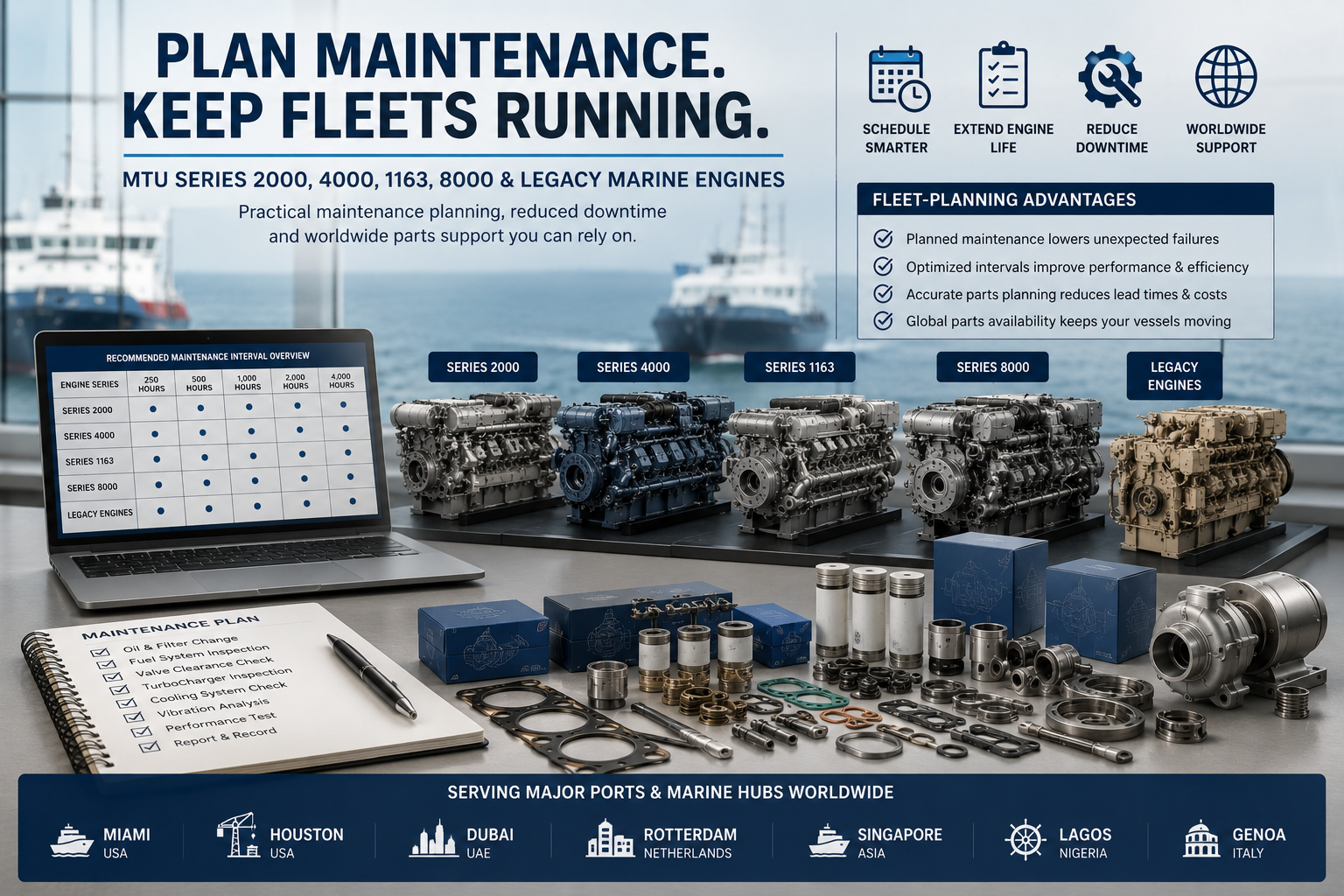

MTU Marine Engine Maintenance Guide: A Practical Fleet Planning Guide for Series 2000, 4000, 1163 & 8000
When you manage one marine engine, maintenance can sometimes live in a logbook.
When you manage an entire fleet of MTU-powered vessels, that quickly becomes impossible.
One vessel may have an MTU Series 2000 accumulating relatively modest annual hours. Another may run a Series 4000 commercially almost every day. Somewhere else in the fleet, a large Series 1163 or Series 8000 may be approaching a planned overhaul where parts availability, workshop capacity and vessel downtime all have to come together at exactly the right moment.
That is why fleet maintenance is not simply about asking:
“When is the next oil change?”
It is about knowing:
What is coming due?
Which components should already be ordered?
Which work can be combined with docking?
Which part could stop the vessel if it is not available?
The fleet-planning material that inspired this guide uses operating hours to help forecast maintenance, budgets, parts requirements and downtime. Those same planning principles work extremely well for an MTU fleet—but the actual service intervals must come from the applicable MTU schedule for the particular engine and application.
MTU maintenance documents themselves are model- and application-specific. For example, separate schedules exist for Series 2000 marine variants and for Series 4000 engines such as the 20V4000M73/M73L.
Why This Matters to MTU Fleet Managers
A good fleet maintenance program gives you something extremely valuable:
time.
Time to order parts.
Time to schedule technicians.
Time to arrange a machine shop.
Time to reserve dry-dock space.
Time to decide whether a cylinder head should be reconditioned or replaced.
Time to source a turbocharger without paying emergency freight.
The original fleet-planning material highlights the same benefits: planned maintenance, more accurate budgeting, less unexpected downtime and longer equipment life.
For MTU engines, the basic idea remains the same.
But we should never copy a generic maintenance interval from another engine manufacturer and apply it to an MTU engine.
How to Read the Maintenance Blocks Below
Each MTU family has its own organized maintenance-planning block.
The columns are intentionally different from a generic fixed-hour table because MTU maintenance requirements vary by engine model, application group, operating profile and service documentation. Specific MTU schedules exist for different Series 2000 and Series 4000 variants.
Once you obtain the correct interval from the applicable MTU maintenance schedule, you can convert hours into approximate months:
Maintenance interval ÷ annual operating hours × 12 = approximate months to service
For example, a 2,000-hour task on an engine operating 4,000 hours annually would arrive at roughly six months.
This is a planning calculation, not a replacement for MTU's official maintenance instructions.
MTU Series 2000 Marine Engine Maintenance Planning
The MTU Series 2000 is widely used in marine propulsion, particularly where compact dimensions and high power density are important. MTU's current marine portfolio continues to include Series 2000 propulsion engines.
Common marine configurations encountered in service include 8V, 10V, 12V and 16V engines, with numerous M-series variants across different generations.
MTU Series 2000 Maintenance Block
⚙️ MTU Series 2000 Component Maintenance Planning
Engine Family: MTU Series 2000
Typical Configurations: 8V • 10V • 12V • 16V
Planning Basis: Engine-specific MTU maintenance schedule + calendar requirements + operating condition
| ComponentService BasisLow-Usage PlanningHigh-Usage PlanningEngineer's Notes | ||||
| Engine Oil & Filters | MTU schedule | Convert verified interval to months | Usually reached sooner by operating hours | Track viscosity, pressure, contamination and oil consumption |
| Fuel Filters | MTU schedule / condition | Plan around annual service | Keep service stock available | Water and contamination can damage injection equipment |
| Air Filters | Condition + schedule | Inspect periodically | Inspect more often in dirty environments | Restriction affects turbocharger airflow |
| Coolant | MTU fluid/time specification | Calendar requirements may dominate | Hours and calendar both matter | Maintain correct coolant chemistry |
| Fuel Injectors | Model-specific inspection schedule | Plan before symptoms appear | Trend cylinder performance closely | Watch smoke, fuel consumption and exhaust-temperature balance |
| Valve Train | MTU schedule | Planned inspection | Operating hours accumulate faster | Monitor valve clearance and cylinder-to-cylinder differences |
| Turbochargers | Schedule + condition | Inspection may be calendar-driven | High-load operation deserves closer trending | Watch boost, deposits, oil leakage and bearing condition |
| Cylinder Heads | Condition / overhaul schedule | Plan during major maintenance | Long-hour engines require earlier forecasting | Inspect valves, seats, guides, sealing faces and cooling passages |
| Pistons & Rings | Major overhaul | Long-term planning | Operating-hour limit reached sooner | Compression, blow-by and oil consumption are useful trends |
| Main & Rod Bearings | Major overhaul / condition | Planned overhaul stock | Critical long-hour fleet item | Study removed bearing wear before disposal |
| Freshwater / Cooling Pumps | MTU schedule + condition | Inspect seals and leakage | Keep critical pump parts available | Loss of cooling capacity may appear under load first |
| Gaskets & Seals | Whenever specified or disturbed | Keep common service seals | Include in planned repair kits | A new seal does not repair a damaged mating surface |
MTU fluids documentation also treats marine Series 2000 cooling requirements separately, another reason to follow the specific engine documentation rather than a generic fleet chart.
MTU Series 2000 Engine Types to Include in Fleet Records
Depending on the age and composition of your fleet, your Series 2000 register may include engines such as:
- MTU 8V 2000 M72
- MTU 8V 2000 M84
- MTU 8V 2000 M94
- MTU 10V 2000 M72
- MTU 10V 2000 M84
- MTU 10V 2000 M86
- MTU 10V 2000 M94
- MTU 10V 2000 M96L
- MTU 12V 2000 M72
- MTU 12V 2000 M86
- MTU 12V 2000 M96L
- MTU 12V 2000 M96X
- MTU 16V 2000 M72
- MTU 16V 2000 M86
- MTU 16V 2000 M91
- MTU 16V 2000 M93
- MTU 16V 2000 M94
- MTU 16V 2000 M96L
- MTU 16V 2000 M97
- MTU 16V 2000 M97L
For older engines, always maintain serial-number records because parts revisions and supersessions become increasingly important.
MTU Series 4000 Marine Engine Maintenance Planning
The MTU Series 4000 covers a very wide range of marine duty profiles, including commercial and high-performance applications. MTU continues to offer Series 4000 propulsion engines, and separate maintenance schedules exist for individual variants and application groups.
This is exactly why a fleet manager should not create one universal "Series 4000 service interval."
MTU Series 4000 Maintenance Block
⚙️ MTU Series 4000 Component Maintenance Planning
Engine Family: MTU Series 4000
Typical Configurations: 8V • 12V • 16V • 20V
Planning Priority: Heavy-duty service, predictive maintenance and major-overhaul preparation
| ComponentService BasisFleet Planning PriorityWhat Engineers Should Watch | |||
| Engine Oil & Filters | MTU schedule + oil analysis | High | Hot oil pressure, viscosity, contamination and consumption |
| Fuel Filters | MTU schedule | Routine stock | Water and restriction |
| Fuel Injectors | Model-specific inspection | High | Cylinder balance, exhaust temperature and fuel consumption |
| Turbochargers | Schedule + condition | High / potentially long lead | Boost, deposits, bearings and oil leakage |
| Charge-Air Coolers | Inspection / cleaning | Planned maintenance | Fouling can gradually increase thermal load |
| Cylinder Heads | Condition / overhaul | High | Valves, seats, guides, cooling passages and sealing faces |
| Pistons & Liners | Major overhaul | Long-term forecast | Measure before replacing |
| Main Bearings | Overhaul / condition | Critical | Compare bearing wear positions |
| Connecting-Rod Bearings | Overhaul / condition | Critical | Oil starvation, contamination and edge loading |
| Crankshaft | Major inspection | Critical / expensive | Journals, runout, surface condition and alignment |
| Oil Pump | Inspection / performance | Medium to high | Hot-pressure trends and circulation |
| Cooling Pumps | Condition + schedule | Important onboard/fleet stock | Seals, bearings and flow |
| Heat Exchangers | Cleaning / condition | Planned | Fouling, corrosion and heat-transfer loss |
| Gaskets & O-Rings | Overhaul / disassembly | High-volume overhaul stock | Replace as required rather than reusing questionable seals |
| Complete Overhaul | MTU TBO + condition | Multi-year budget item | Parts, manpower, lifting, workshop and vessel downtime |
MTU's maintenance philosophy explicitly uses field data and component inspection to optimize maintenance and TBO while maintaining safe operation.
MTU Series 4000 Engines Your Fleet Register May Contain
Examples include:
- MTU 8V 4000 M53
- MTU 8V 4000 M70
- MTU 12V 4000 M53
- MTU 12V 4000 M70
- MTU 12V 4000 M90
- MTU 12V 4000 M93
- MTU 16V 4000 M53
- MTU 16V 4000 M63
- MTU 16V 4000 M73
- MTU 16V 4000 M90
- MTU 16V 4000 M93
- MTU 20V 4000 M73
- MTU 20V 4000 M73L
- MTU 20V 4000 M93
- Other Series 4000 marine variants
Because maintenance schedules can be application-group specific, the engine designation alone is not enough for detailed maintenance planning.
MTU Series 1163 Marine Engine Maintenance Planning
The Series 1163 belongs to MTU's large marine engine range and remains relevant both in current marine propulsion discussions and overhaul support.
These are not engines where a fleet manager should wait until dismantling begins before sourcing major components.
Cylinder heads, valves, bearings, pistons, liners, turbocharger components and sealing packages can all become part of a significant overhaul project.
MTU Series 1163 Maintenance Block
⚙️ MTU Series 1163 Component Maintenance Planning
Engine Family: MTU Series 1163
Typical Configurations: 12V • 16V • 20V
Planning Priority: Major-component reliability and overhaul logistics
| Major ComponentMaintenance FocusFleet Planning Advice | ||
| Lubrication System | Oil quality, filtration, pressure and analysis | Maintain historical oil-analysis records |
| Fuel Injection | Injector performance and cylinder balance | Forecast exchange/overhaul units |
| Turbocharging System | Boost, exhaust temperature and bearing condition | Treat as long-lead overhaul equipment |
| Cylinder Heads | Valves, seats, guides, cooling and sealing | Compare repair, reman and new replacement options before docking |
| Pistons & Liners | Wear, deposits, measurements and cooling | Photograph and measure before cleaning |
| Connecting Rods | Alignment, bearings and fasteners | Keep components identified by cylinder |
| Main & Rod Bearings | Wear patterns and lubrication history | Do not discard before inspection |
| Crankshaft | Journal condition, alignment and cracks | Build inspection time into overhaul schedule |
| Cooling System | Pumps, heat exchangers and coolant chemistry | Poor cooling can shorten life of unrelated components |
| Gaskets & Seals | Overhaul sealing integrity | Build complete sealing requirements into parts package |
| Complete Overhaul | Condition + MTU requirements | Plan workshop, parts and logistics well before shutdown |
MTU's overhaul program specifically includes Series 1163 among the engine families it continues to support.
Common MTU Series 1163 Marine Engine Types
Fleet and service records may include:
- MTU 12V 1163 variants
- MTU 16V 1163 M74
- MTU 16V 1163 M84
- MTU 16V 1163 M94
- MTU 16V 1163 TB73 / TB73L
- MTU 20V 1163 M74
- MTU 20V 1163 M84
- MTU 20V 1163 M94
- MTU 20V 1163 TB73 / TB73L
With engines of this scale, exact identification before ordering major components is essential.
MTU Series 8000 Marine Engine Maintenance Planning
The Series 8000 represents MTU's very-high-power marine range. MTU describes the family in 16V and 20V configurations, and Series 8000 engines have accumulated extensive operational experience in high-power marine service.
Maintenance planning for an engine of this scale is no longer simply an engineering-department issue.
It involves:
- Technical management
- Purchasing
- Vessel operations
- Workshops
- Logistics
- Lifting arrangements
- Classification requirements
- Parts preservation
- Downtime planning
MTU Series 8000 Maintenance Block
⚙️ MTU Series 8000 Component Maintenance Planning
Engine Family: MTU Series 8000
Typical Configurations: 16V • 20V
Planning Priority: Major-engine availability and long-lead component management
| Major ComponentMaintenance FocusFleet Manager's Planning Requirement | ||
| Lubricating-Oil System | Pressure, temperature, filtration and contamination | Keep oil-analysis history and critical filter parts |
| Oil Priming System | Pre-start lubrication | Verify system performance during planned service |
| Oil Coolers / Heat Exchangers | Temperature control | Plan cleaning, seals and pressure testing |
| Fuel Injection System | Cylinder balance and combustion quality | Forecast overhaul or exchange components |
| Turbochargers | Boost, bearings, deposits and exhaust condition | Plan specialist overhaul well in advance |
| Cylinder Heads | Valve train, sealing and cooling | Decide repair vs replacement before the critical path begins |
| Pistons & Rings | Deposits, cooling, wear and compression | Document each cylinder during disassembly |
| Cylinder Liners | Wear, seating and surface condition | Measure individually |
| Connecting Rods & Bearings | Alignment and wear | Keep position-by-position inspection records |
| Main Bearings | Crankshaft support and lubrication | Critical major-overhaul item |
| Crankshaft | Journals, alignment, cracks and surface condition | Specialist inspection may control overhaul duration |
| Camshaft & Timing Gear | Timing, bearings and alignment | Requires engine-specific procedures |
| Cooling System | Heat rejection and coolant condition | Include pumps, coolers and passages in overhaul scope |
| Major Overhaul | Complete engine condition | Coordinate parts, workshop, manpower, lifting and vessel schedule |
MTU materials continue to refer to Series 8000 as one of the company's large marine propulsion families.
MTU Series 8000 Engine Types
Common Series 8000 marine configurations include:
- MTU 16V 8000 M71L
- MTU 16V 8000 M91L
- MTU 20V 8000 M71
- MTU 20V 8000 M71L
- MTU 20V 8000 M81
- MTU 20V 8000 M81R
- MTU 20V 8000 M91L
Series 8000 documentation has historically covered both 16V and 20V configurations.
What About Older MTU Marine Engines?
A serious MTU fleet guide should not pretend that every vessel is running a current-generation engine.
Older vessels may still operate engines from families such as:
- MTU Series 183
- MTU Series 396
- MTU Series 493
- MTU Series 538
- MTU Series 595
- MTU Series 652
- MTU Series 956
MTU's overhaul program specifically references many of these legacy engine families alongside Series 1163, 2000 and 4000.
Older engines can actually require more parts planning because of superseded numbers, reduced new-stock availability and the growing importance of remanufactured or reconditioned components.
Legacy MTU Engine Maintenance Block
⚙️ Legacy MTU Marine Engine Planning
| Planning AreaWhat to Record | |
| Engine Identification | Model, serial number and complete engine data |
| Installed Part Numbers | Record actual numbers currently fitted |
| Superseded Numbers | Keep historical and replacement references |
| Critical Spare Parts | Identify parts that can stop the vessel |
| Remanufactured Options | Record proven alternatives before an emergency |
| Reconditioned Components | Maintain supplier and workshop history |
| Previous Overhauls | Keep measurements and machine-shop reports |
| Known Weak Areas | Record recurring leaks, temperatures or wear trends |
| Long-Lead Components | Review availability before scheduled overhaul |
How to Turn Operating Hours Into a Fleet Maintenance Calendar
Suppose you have three vessels.
Vessel A
Engine: MTU 16V 2000 M91
Annual usage: 800 hours
Vessel B
Engine: MTU 16V 4000 M73
Annual usage: 3,500 hours
Vessel C
Engine: MTU 20V 8000 M91L
Annual usage: 5,000 hours
Even if two maintenance tasks happened to carry the same operating-hour interval, they would arrive at very different times during the year.
This is why the original maintenance-planning concept converts operating hours into months.
A fleet spreadsheet should therefore include both:
Hours remaining
and
estimated calendar date due.
That makes maintenance understandable not only to engineers, but also to purchasing and operations departments.
Build One Maintenance Block for Every Engine
For every engine in the fleet, maintain something like this:
Vessel Maintenance Record
Vessel: __________________
MTU Engine: __________________
Engine Family: __________________
Serial Number: __________________
Current Hours: __________________
Expected Annual Hours: __________________
Next Scheduled Service: __________________
Next Major Maintenance: __________________
Oil Analysis Status: __________________
Parts Already Ordered: __________________
Critical Parts Missing: __________________
Open Technical Observations: __________________
This may look simple.
That's precisely why it works.
Planning Parts: What Should Be Onboard?
Not every spare part belongs in the engine room.
But some components deserve serious consideration depending on vessel type and operating location.
Possible onboard service stock includes:
- Oil filters
- Fuel filters
- Air filters
- O-rings
- Gaskets
- Sensors
- Belts where applicable
- Common hoses
- Sealing washers
- Service consumables
For seawater-cooled auxiliary systems, pump-related service parts may also be important depending on the installation.
What Should Be Kept as Fleet Stock?
If several vessels share the same MTU configuration, fleet-level stock can be extremely valuable.
Potential examples include:
- Fuel injectors
- Starter motors
- Alternators
- Pumps
- Sensors
- Turbocharger service components
- Cylinder-head components
- Complete gasket sets
One spare component may support several sister vessels.
What Should Usually Be Supplier-Supported?
Large or infrequently replaced parts may make more sense as supplier-supported inventory.
Examples include:
- Complete cylinder heads
- Turbochargers
- Crankshafts
- Camshafts
- Pistons
- Connecting rods
- Major bearings
- Complete overhaul kits
- Heat exchangers
- Large oil or water pumps
The important question isn't:
“Do we own this part?”
It is:
“How quickly can we obtain the correct part if we need it?”
Engine Room Reality: Hours Don't Tell the Whole Story
Two MTU engines may each have accumulated 5,000 hours.
Their condition may still be very different.
One may have:
- Excellent fuel quality
- Stable coolant chemistry
- Regular oil analysis
- Consistent operating load
- Clean air supply
The other may have experienced:
- Repeated overheating
- Fuel contamination
- Heavy transient loading
- Poor coolant condition
- Extended low-load operation
The original fleet-planning document also warns that cooling, lubrication, fuel quality and interactions between components can change maintenance needs.
That is why condition monitoring belongs beside the maintenance calendar.
What Should Fleet Managers Trend?
Don't record only engine hours.
Track:
- Fuel consumption
- Oil consumption
- Coolant consumption
- Oil-analysis results
- Exhaust temperatures
- Oil pressure
- Oil temperature
- Coolant temperature
- Turbocharger performance
- Filter contamination
- Vibration
- Repeated alarms
- Parts replaced
- Unusual inspections
Over several years, that data becomes extremely valuable.
Marine Engineer Tip
Don't ask only how many hours the engine has run. Ask what happened during those hours.
That one question changes maintenance from a calendar exercise into condition-based engineering.
When Should You Order MTU Overhaul Parts?
Not on the day the engine is dismantled.
A better process is:
First: review upcoming operating hours.
Then: identify the likely overhaul window.
Next: confirm engine serial number and BOM information.
Then: identify predictable replacement items.
After that: determine which expensive components should be ordered only after inspection.
This prevents two opposite problems:
Ordering too late.
And ordering expensive components that the engine never actually needed.
Don't Buy the Complete Overhaul Kit Before Understanding the Overhaul
A "complete rebuild kit" sounds convenient.
But the best overhaul package is the one matched to the actual engine.
During disassembly, engineers may discover:
- One reusable crankshaft
- Several worn liners
- Bearings requiring replacement
- Cylinder heads suitable for reconditioning
- One turbocharger requiring major work
- Seals that must be renewed throughout
The correct parts package should reflect that condition.
Why Oil Analysis Deserves Its Own Fleet Column
Oil analysis can help show developing changes in:
- Iron
- Copper
- Lead
- Aluminium
- Silicon
- Fuel dilution
- Water contamination
- Viscosity
- Oxidation
The real power comes from trend comparison, not one isolated laboratory report.
A fleet manager should be able to open the engine record and see whether wear metals have been:
stable
slowly increasing
or
changing suddenly.
Common Fleet Maintenance Mistakes
Avoid these:
- Using one maintenance schedule for every MTU engine.
- Copying maintenance intervals between engine families.
- Ordering parts without serial-number verification.
- Waiting until dismantling to begin sourcing everything.
- Keeping no historical oil-analysis records.
- Failing to track automatic oil replenishment.
- Treating engine hours as the only measure of condition.
- Ignoring calendar-based service requirements.
- Keeping too much obsolete inventory.
- Keeping too few critical spares.
- Discarding old overhaul components before studying their wear.
- Failing to record machine-shop measurements.
Frequently Asked Questions
Which MTU marine engine families should a fleet maintenance plan cover?
For modern fleets, the major families include MTU Series 2000, Series 4000, Series 1163 and Series 8000. MTU also continues overhaul support for several legacy families.
Can one MTU maintenance schedule be used for every engine in the same series?
No. Separate maintenance schedules exist for specific engines, ratings and application groups. Always use the documentation applicable to the particular engine.
Can operating hours be converted into months?
Yes, for planning purposes. Divide the maintenance interval by expected annual operating hours and multiply by 12. The underlying maintenance interval must still come from the applicable MTU schedule.
Should condition monitoring change maintenance decisions?
Yes. Oil analysis, temperatures, consumption, vibration, contamination and operating history provide important context around scheduled maintenance.
Should every major spare part be kept onboard?
No. A balanced strategy normally separates onboard critical spares, shared fleet stock and supplier-supported major components.
What information should I provide when requesting an MTU spare part?
Provide:
Engine model
Engine serial number
Existing part number
BOM/arrangement information when available
Quantity
Photographs
This is especially important for high-value or legacy components.
Alfa Marine Spare Parts: Supporting the Complete MTU Fleet
At Alfa Marine Spare Parts, we believe the useful question isn't simply:
“What part do you need today?”
It is also:
“What will this fleet need next?”
We support marine engineers, shipyards, fleet managers and purchasing departments with parts for MTU Series 2000, Series 4000, Series 1163, Series 8000 and legacy MTU engines.
Depending on application and availability, requirements may include:
- Genuine parts
- OEM components
- Aftermarket components
- Remanufactured components
- Reconditioned assemblies
The aim is to help identify the correct component before vessel downtime turns a routine purchase into an emergency.
Browse MTU Marine Engines & Spare Parts
Explore MTU engine families and marine spare parts:
MTU Marine Engines:
https://alfamarinespareparts.com/engines/mtu
Complete Spare Parts Catalog:
https://alfamarinespareparts.com/spareparts
Worldwide MTU Marine Spare Parts Supply
Alfa Marine Spare Parts supports:
- Shipyards
- Ship repairers
- Marine engineers
- Chief engineers
- Technical superintendents
- Fleet operators
- Yacht operators
- Ferry companies
- Marine service companies
- Offshore operators
- Government fleets
- Maritime contractors
- Commercial fishing companies
- Boat builders
- Marine equipment distributors
We support marine customers across Europe, the United States, Canada, the Middle East, Africa, Asia, Australia and other major ports worldwide.
Contact Alfa Marine Spare Parts
Email: request@alfamarinespareparts.com
MTU Engine Catalog:
https://alfamarinespareparts.com/engines/mtu
Complete Catalog:
https://alfamarinespareparts.com/spareparts
For fleet enquiries, send the engine list with model, serial number, current hours and known parts requirements. This makes it much easier to organize quotations around several vessels instead of treating every request as an isolated order.
One Final Thought
A good MTU Marine Engine Maintenance Guide should not simply tell a fleet manager to replace a filter every certain number of hours.
The real value comes from seeing the complete maintenance picture.
For every MTU engine, know:
Which engine is it?
How many hours does it run?
What does the MTU schedule require?
What is the engine condition telling you?
Which parts should already be available?
Which major components have long lead times?
When can the vessel realistically stop for maintenance?
The planning principle behind the original source is useful precisely because it turns operating hours into something fleet managers can budget and schedule around.
For an MTU-powered fleet, the philosophy can be reduced to four practical rules:
Know the engine.
Know the hours.
Know the condition.
Know where the parts are coming from.
That is how maintenance stops being reactive and starts becoming fleet reliability.