MTU Marine Cooling System Seals: O-Rings, Gaskets, Leak Detection & Replacement Guide
The cooling system seals on an MTU marine engine are some of the smallest parts in the engine room, but they are responsible for keeping several critical cooling circuits sealed.
An O-ring may cost very little compared with a coolant pump, heat exchanger, charge-air cooler or complete engine.
Yet when that O-ring starts leaking, the consequences can spread quickly.
Perhaps you notice a small coolant stain underneath an MTU engine.
Nothing is dripping while the engine is cold.
After several hours at cruising speed, however, the stain appears again.
Or perhaps there is a white salt deposit around a seawater connection.
The engine still runs normally, so the leak gets cleaned and forgotten.
A few weeks later:
the coolant level is lower again.
This is where a small seal deserves more attention.
The important question is not simply:
“Which O-ring do I need?”
It is:
“Why did this cooling-system seal start leaking?”
Age may be the reason.
But the real cause could also be corrosion, excessive temperature, a damaged sealing groove, incorrect assembly, a worn pump shaft or pressure developing where it should not.
1. Where Are Cooling System Seals Used on MTU Marine Engines?
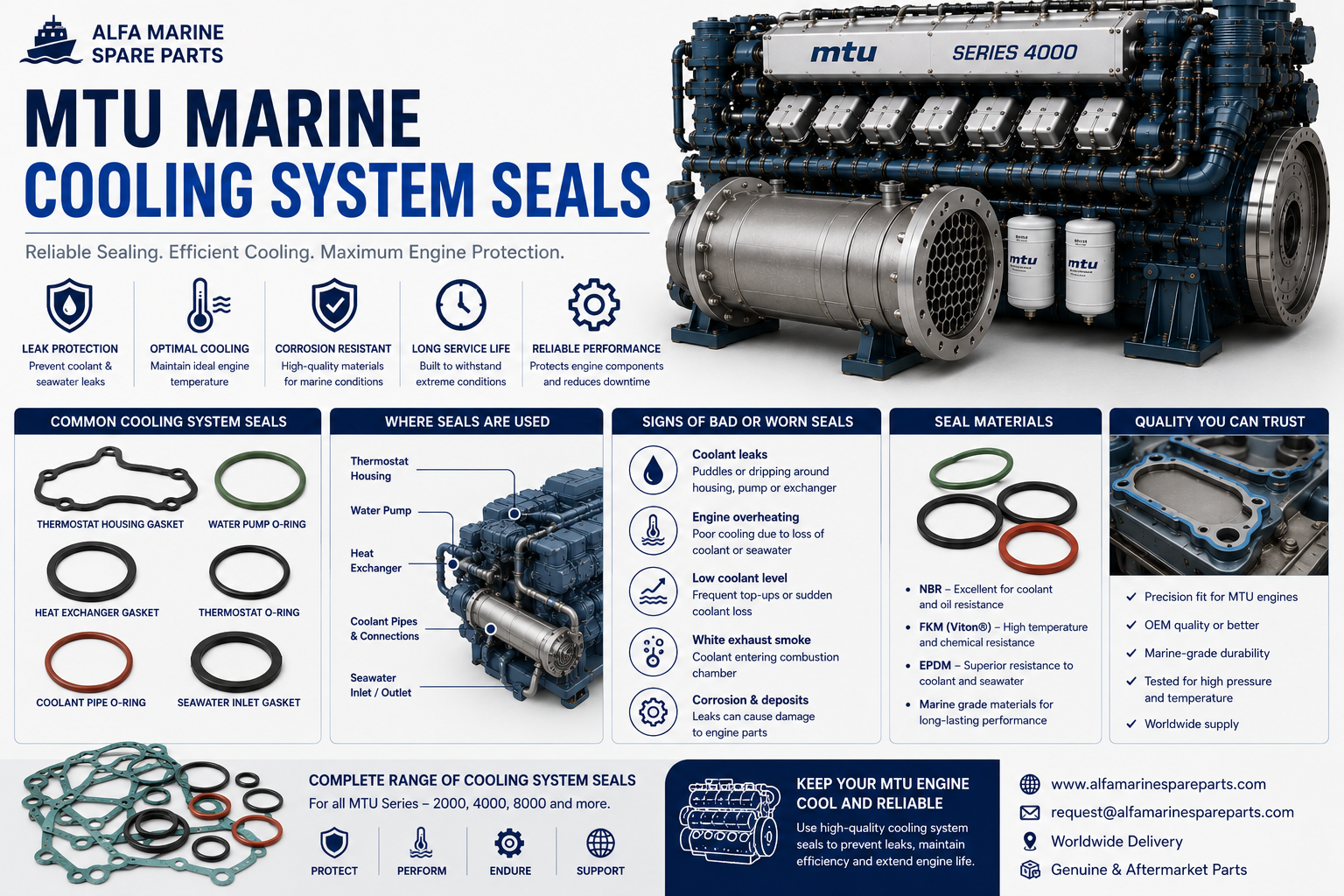
Depending on the engine series and cooling arrangement, seals can be found throughout the cooling system.
Common areas include:
- Coolant pumps
- Seawater pumps
- Heat exchangers
- Charge-air coolers
- Oil coolers
- Thermostat housings
- Coolant pipes
- Seawater pipes
- Cooler end covers
- Expansion connections
- Pump covers
- Flanges
- Sensor housings
- Drain connections
MTU's Series 4000 marine architecture, for example, can use separate high- and low-temperature cooling circuits with gear-driven coolant circulation pumps, depending on configuration.
More cooling circuits mean more joints, seals and connections that need to remain reliable.
2. Which MTU Marine Engines Use Cooling-System Seals?
Essentially every liquid-cooled MTU marine engine uses numerous cooling-system sealing components.
This guide is particularly relevant to families such as:
MTU Series 2000
- 8V 2000
- 10V 2000
- 12V 2000
- 16V 2000
including M72, M84, M86, M91, M93, M94, M96 and M97-family marine versions.
MTU Series 4000
- 8V 4000
- 12V 4000
- 16V 4000
- 20V 4000
including M53, M63, M65, M73 and M93-family versions.
Larger and Legacy MTU Marine Families
Cooling-system seals are also important on engines from families such as:
- MTU Series 396
- MTU Series 1163
- MTU Series 8000
The exact seal part number depends on the actual engine configuration.
3. What Is a Cooling-System Seal?
A seal prevents fluid from escaping or moving into an area where it does not belong.
The term can include several different components.
For example:
O-Rings
Circular elastomer seals used in grooves between mating components.
Flat Gaskets
Used between flanges, covers and housings.
Mechanical Seals
Commonly associated with rotating pump shafts.
Radial Shaft Seals
Used where a rotating shaft passes through a housing.
Profile Seals
Specially shaped seals designed for particular cooler or housing configurations.
Sealing Rings
Used at pipes, plugs, fittings and other connections.
They may all be called “seals,” but they are not interchangeable.
4. Why O-Rings Are Used So Often
O-rings are compact, effective and well suited to many engine cooling connections.
When correctly installed, an O-ring is compressed inside its sealing groove.
That compression prevents coolant or seawater from passing through the joint.
The concept is simple.
But several things must be correct:
- O-ring size
- Material
- Groove condition
- Surface condition
- Installation
- Compression
A seal that is almost the correct size can still be the wrong seal.
5. A Small O-Ring Can Stop a Large Engine
Consider an MTU 16V 4000.
It is a very large and expensive marine engine.
Yet one failed O-ring in the wrong location can create:
- Coolant loss
- Seawater leakage
- Air entry
- Pressure loss
- Cooling-system contamination
Physical size does not determine component importance.
Sometimes the cheapest part in the cooling system is the one capable of putting the vessel out of service.
6. Why Cooling Seals Eventually Deteriorate
Cooling-system seals live in a difficult environment.
They experience:
- Heat
- Pressure
- Temperature cycling
- Coolant chemicals
- Seawater exposure
- Vibration
- Compression
Over time, elastomeric seals can:
- Harden
- Flatten
- Crack
- Swell
- Lose elasticity
Eventually the seal may no longer conform properly to the surfaces around it.
That is when leakage begins.
7. Heat Cycling Matters
Think about what happens every time an engine starts.
Cold engine.
Warm-up.
Full operating temperature.
Shutdown.
Cooling.
Metal components expand and contract.
The sealing components between them must accommodate these repeated dimensional changes.
After thousands of cycles, an old O-ring may simply no longer behave like a new one.
8. The First Leak May Only Appear When the Engine Is Hot
This can make diagnosis frustrating.
The engineer inspects the engine in the morning.
Everything is dry.
The engine operates for three hours.
Now coolant appears around the flange.
Why?
As components heat:
- Pressure changes
- Metal expands
- Seal dimensions change
A deteriorated seal may therefore leak only at operating temperature.
Do not dismiss a reported leak simply because the engine is dry when cold.
9. Coolant Stains Are Useful Evidence
Coolant leakage often leaves evidence even after the fluid has evaporated.
Look for:
- Colored staining
- Crystalline residue
- Dampness
- Corrosion
- Dirt sticking to one area
Clean the area only after determining where the leak appears to originate.
Sometimes the old stain is the best clue you have.
10. Salt Deposits Usually Mean Seawater Has Been There
Seawater produces especially recognizable evidence.
After evaporation, you may find:
- White salt crystals
- Green corrosion
- Rust staining
Look carefully around:
- Seawater pumps
- Cooler connections
- Heat exchanger covers
- Charge-air cooler connections
- Pipe joints
A connection can be completely dry during inspection while still showing clear evidence of previous leakage.
11. Coolant Pump Seals
The engine coolant pump circulates treated coolant through the closed engine cooling circuit.
Its sealing system may include:
- Mechanical seal
- Housing O-rings
- Cover seals
- Mounting seals
When a pump begins leaking, determine where the fluid originates.
A leaking mounting O-ring is different from a failing shaft seal.
The repair required may therefore be completely different.
12. Mechanical Pump Seals
Mechanical seals allow a rotating shaft to pass through a pump housing while keeping coolant inside.
These seals operate under:
- Rotation
- Heat
- Pressure
- Continuous fluid exposure
Wear can eventually cause leakage around the pump shaft.
When that happens, do not assume that replacing only the mechanical seal is always enough.
Inspect the surrounding pump components too.
13. A Worn Pump Shaft Can Destroy a New Seal
Imagine the seal has failed.
A new seal is installed.
Several weeks later:
the pump leaks again.
The problem may not be the new seal.
The shaft surface may be:
- Worn
- Corroded
- Grooved
- Misaligned
A seal cannot perform properly against a damaged running surface.
This is why pump overhaul should evaluate the shaft + bearings + seals + housing together.
14. Seawater Pump Seals
The seawater pump works in an especially harsh environment.
Saltwater can attack:
- Shaft surfaces
- Bearings
- Housings
- Fasteners
- Seal surfaces
A small seawater leak around the pump can quickly lead to visible corrosion.
Do not wait for the pump to begin pouring water before investigating it.
15. Heat Exchanger Seals
Heat exchangers commonly use sealing components around:
- Covers
- Inserts
- End plates
- Fluid connections
- Cooler housings
Possible seals include:
- O-rings
- Flat gaskets
- Profile seals
- Sealing rings
The heat exchanger must keep separate fluid circuits where they belong.
A sealing failure can therefore be more serious than a simple external drip.
16. Charge-Air Cooler Seals
Turbocharged MTU marine engines depend on effective charge-air cooling.
Charge-air cooler assemblies can use seals between cooler components, housings and cooling-water connections.
If a seal fails, possible symptoms include:
- Coolant leakage
- Seawater leakage
- Pressure loss
- Corrosion
Always identify whether the leak is actually from the seal or from the cooler itself.
17. Oil Cooler Seals
Oil coolers transfer heat away from lubricating oil.
Their sealing systems must keep:
oil where oil belongs
and:
cooling fluid where cooling fluid belongs.
Internal contamination between circuits can be much more serious than an external gasket leak.
If oil or coolant condition changes unexpectedly, cooler integrity deserves investigation.
18. Thermostat Housing Seals
Thermostat housings can use:
- O-rings
- Flat gaskets
- Sealing rings
A small leak here can gradually lower coolant level.
Because the housing may be surrounded by other cooling components, the exact source can sometimes be difficult to identify.
Clean the area thoroughly and observe it while the engine warms.
19. Cooling Pipe O-Rings
Large marine engines often use rigid coolant pipes between major components.
O-rings may seal these connections.
Over time, pipe seals can deteriorate because of:
- Heat
- Vibration
- Corrosion
- Pipe movement
If a pipe connection begins leaking, inspect both the O-ring and the pipe sealing surface.
A new O-ring cannot repair a heavily corroded pipe end.
20. Why Corrosion Around the Seal Matters
When a seal is removed, inspect what was underneath it.
You may discover:
- Pitting
- Oxidation
- Scratches
- Deposits
This can explain why the seal failed.
A new O-ring installed into a badly corroded groove may begin leaking again.
The surface supporting the seal is just as important as the seal itself.
21. O-Ring Grooves Need Inspection
The groove controls how the O-ring sits and compresses.
Inspect for:
- Corrosion
- Sharp edges
- Dirt
- Old seal material
- Mechanical damage
If the groove is damaged, the O-ring may:
- Twist
- Cut
- Extrude
- Seal unevenly
Do not simply push another O-ring into a questionable groove.
22. Twisted O-Rings Can Leak Immediately
An O-ring should sit correctly in its groove.
If twisted during installation, it may not compress evenly.
That can produce a leak almost immediately after startup.
Proper seal orientation and careful assembly matter; MTU operating guidance for elastomeric seals emphasizes correct, untwisted installation.
23. Pinched Seals
A seal can also become pinched when two components are assembled.
The assembly may appear completely normal externally.
But part of the O-ring may be:
- Cut
- Flattened
- Trapped incorrectly
Then the cooling system is pressurized.
The leak appears.
If a brand-new seal leaks immediately after service, assembly damage should be high on the troubleshooting list.
24. Never Assume More Lubricant Is Better
Some seals require appropriate assembly lubrication.
But excess or incorrect lubricant can create problems depending on seal material and application.
Use a lubricant compatible with:
- Seal material
- Coolant
- Component requirements
Do not simply use whatever grease happens to be nearby.
25. Seal Material Matters
Two O-rings can look almost identical while being made from different materials.
That matters because seal materials react differently to:
- Heat
- Coolant chemistry
- Oil
- Fuel
- Seawater
Using the wrong material may result in:
- Swelling
- Hardening
- Cracking
- Premature failure
This is why ordering by dimensions alone can be risky.
26. Coolant Chemistry Affects Seal Life
Cooling-system condition matters too.
Incorrect coolant chemistry can affect:
- Corrosion protection
- Deposits
- Elastomer condition
Maintenance should therefore consider the entire coolant system rather than treating seals in isolation.
A seal repeatedly failing in a badly maintained cooling system may only be a symptom.
27. Seal Failure After Coolant Replacement
Suppose an older MTU engine develops several small leaks shortly after major cooling-system service.
It may seem as though the new coolant caused the problem.
Sometimes the real explanation is simpler.
Old seals may already have been:
- Hardened
- Marginal
- Deposited over
After the system is cleaned and serviced, the existing weakness becomes more visible.
Do not automatically blame the coolant without inspecting the actual seals and surfaces.
28. High Cooling-System Pressure
Repeated seal leakage deserves investigation.
If several otherwise unrelated cooling connections begin leaking, ask whether system pressure is correct.
Possible areas to investigate include:
- Pressure-control components
- Expansion system
- Temperature
- Combustion-related pressurization where applicable
Repeatedly changing seals without identifying abnormal pressure can become expensive.
29. One Seal Fails Repeatedly
This is an important diagnostic situation.
The same O-ring is replaced.
It leaks again.
Another new O-ring is installed.
It leaks again.
Stop changing O-rings.
Inspect:
- Groove
- Mating surface
- Pipe alignment
- Component movement
- Pressure
- Temperature
- Correct seal specification
Repeated failure usually means something else deserves attention.
30. Air Entering the Cooling Circuit
A leaking connection can sometimes allow air into a cooling circuit.
Air can reduce cooling effectiveness and contribute to:
- Temperature fluctuations
- Hot spots
- Unstable coolant level
A leak does not always mean fluid only moves outward.
Pressure conditions can change during shutdown and cooling.
31. MTU Series 2000 Cooling Seals
Series 2000 engines can contain cooling seals around:
- Coolant pumps
- Seawater pumps
- Heat exchangers
- Charge-air cooling
- Oil cooling
- Thermostat housings
- Coolant pipes
Relevant engines include:
- MTU 8V 2000
- MTU 10V 2000
- MTU 12V 2000
- MTU 16V 2000
The exact seal depends on the M-designation and serial number.
32. MTU 12V 2000 Cooling-System Seal Example
Suppose you have an:
MTU 12V 2000 M96L
with a coolant leak near a pipe connection.
Do not request:
“12V 2000 O-ring.”
Instead provide:
Engine model: MTU 12V 2000 M96L
Engine serial number: __________
Component: Coolant pipe / cooler / pump
Existing seal number: __________
Quantity: __________
Photos: Attached
There can be many different O-rings on one engine.
33. MTU Series 4000 Cooling Seals
Series 4000 cooling architecture can be more extensive because applicable versions use separate high- and low-temperature cooling circuits and gear-driven coolant circulation pumps.
Seals may therefore be associated with:
- HT coolant circuit
- LT coolant circuit
- Coolant pumps
- Turbocharger cooling
- Charge-air cooling
- Lubricating-oil cooling
- Heat exchanger connections
Correct circuit identification can help enormously when ordering parts.
34. MTU 16V 4000 Cooling-System Seal Example
Imagine a 16V 4000 M73 develops a leak around the low-temperature cooling circuit.
A useful request would include:
Engine: MTU 16V 4000 M73
Engine serial number: __________
Circuit: HT / LT / seawater
Component: __________
Existing seal number: __________
Photographs: Attached
This is far more useful than:
“Need MTU 4000 cooling seal.”
35. MTU Series 8000 Cooling Seals
Larger MTU marine engines also rely on numerous cooling-system seals around:
- Pumps
- Cooling-water pipes
- Charge-air coolers
- Oil coolers
- Heat exchangers
- Thermostatic/control components
On large engines, a relatively inexpensive seal failure can release a considerable amount of coolant.
Early leak detection becomes particularly valuable.
36. Gaskets and Seals During MTU Overhaul
Cooling-system seals are wear components.
During extensive engine or cooler overhaul work, disturbed seals should be carefully evaluated rather than automatically reused.
MTU's factory overhaul process specifically describes reassembly using new wear items including gaskets and seals, including on Series 2000 and 4000 overhaul work.
That makes practical sense.
Opening a difficult-to-access component twice because an old O-ring was reused can cost much more than the seal itself.
37. Do Not Replace Every Seal Just Because You See Coolant
First locate the exact source.
Coolant can travel along:
- Pipes
- Housings
- Cable supports
- Engine surfaces
The wet point at the bottom may be far away from the actual leak.
Clean the engine.
Run it.
Observe carefully.
Find the highest fresh wet point.
That often leads you toward the actual source.
38. UV Dye and Pressure Testing
Where appropriate and permitted by the service procedure, leak diagnosis may involve controlled pressure testing or other diagnostic methods.
The important point is to prove the leak source.
Do not dismantle half the cooling system because someone noticed coolant underneath the engine.
Diagnosis first.
Parts second.
39. Cooling Seal Problems After Major Maintenance
If the engine did not leak before service but leaks afterward, ask:
What was opened?
Inspect:
- Pipe connections
- Pump connections
- Cooler covers
- O-rings
- Sensor fittings
- Drains
A leak beginning immediately after service is often connected to something disturbed during that service.
40. Old Seal Accidentally Left in Place
Some connections can retain an old O-ring in the groove.
If another seal is fitted on top or the old one is not fully removed, the new assembly may not seat correctly.
Always confirm:
old seal removed → groove cleaned → new seal installed correctly.
This sounds simple, but simple assembly mistakes cause plenty of leaks.
41. Check Pipe Alignment Before Tightening
A coolant pipe should not require excessive force to pull it into position.
If pipe alignment is wrong, the seal may experience side loading.
That can contribute to:
- Uneven compression
- Seal extrusion
- Repeated leakage
Fix the alignment rather than forcing the connection together.
42. Do Not Use a Smaller O-Ring Because It Fits Tighter
This is not a reliable repair.
An undersized O-ring may:
- Stretch excessively
- Reduce cross-section
- Fail prematurely
Likewise, an oversized seal may pinch or extrude.
Use the correct part.
43. Do Not Identify Seals by Color Alone
Seal colors can sometimes indicate material or manufacturer coding, but color alone is not a safe identification method.
Two visually identical O-rings may have different specifications.
Use:
- Engine identification
- Component identification
- Part number
wherever possible.
44. Common Signs of Cooling-System Seal Failure
Watch for:
☐ Falling coolant level
☐ Coolant staining
☐ Salt deposits
☐ Seawater dripping
☐ Green corrosion
☐ Moisture around pump shafts
☐ Leakage after warm-up
☐ Pressure loss
☐ Repeated coolant top-ups
☐ Leak returning after seal replacement
None of these automatically tells you which seal failed.
They tell you where to begin looking.
45. Daily Engine-Room Inspection
A useful cooling-system inspection does not take long.
Look around:
- Pumps
- Coolers
- Pipe joints
- Heat exchangers
- Hoses
- Flanges
You are looking for change.
Yesterday the connection was dry.
Today there is a small coolant mark.
That is useful information.
46. A Clean Engine Makes Seal Leaks Easier to Find
An engine covered in old coolant residue makes new leakage difficult to identify.
After repairing a leak:
- Clean the area
- Dry it
- Record the repair
- Inspect it again after operation
If fresh fluid appears, you immediately know the problem remains.
47. Cooling-System Seal Replacement Checklist
Before reassembly:
☐ Confirm exact engine model
☐ Confirm engine serial number
☐ Identify exact component
☐ Verify seal part number
☐ Remove old seal
☐ Clean sealing groove
☐ Inspect groove for corrosion
☐ Inspect mating surface
☐ Check pipe alignment
☐ Install seal without twisting
☐ Use correct assembly method
☐ Refill cooling circuit correctly
☐ Inspect for leaks cold
☐ Inspect again when hot
A few extra minutes here can prevent repeating the job.
48. First Startup After Seal Replacement
After cooling-system work, stay near the engine during initial warm-up.
Watch the repaired area as:
- Temperature increases
- System pressure increases
- Pumps begin full circulation
A connection that stays dry when cold may begin leaking once the engine reaches operating temperature.
49. Check Again After High-Load Operation
After a sea trial or high-load test, inspect the seal again.
Look for:
- Fresh coolant
- Fresh salt
- Dampness
- New residue
High load creates the conditions under which many marginal cooling-system seals begin leaking.
50. Cooling System Seal Part Numbers
MTU uses many different gasket, O-ring and seal numbers across its marine engine families.
There is no single:
“MTU cooling system seal part number.”
Even one Series 4000 engine can contain numerous different O-rings.
For correct identification, provide:
Engine: MTU 16V 4000 M73
Serial Number: __________
Cooling Circuit: HT / LT / seawater
Component: Heat exchanger / pump / pipe / cooler
Existing Part Number: __________
Seal Number: __________
Quantity: __________
Photographs: Attached
That provides a much stronger basis for identification.
51. Why I Would Not Guess a Seal Number
A generic O-ring may look exactly like the original.
But the wrong:
- Diameter
- Cross section
- Elastomer material
- Temperature rating
can result in premature failure.
For cooling-system seals, correct identification is more important than simply finding something that fits into the groove.
52. Cooling System Seal Kits
Depending on the exact component, repairs may use individual seals or a complete sealing kit.
A kit can contain combinations of:
- O-rings
- Flat gaskets
- Mechanical seals
- Sealing washers
- Profile seals
Before ordering a complete kit, confirm which component it is intended to overhaul.
53. When Is a Complete Seal Kit Better?
A complete kit can make sense when a component such as:
- Coolant pump
- Seawater pump
- Heat exchanger
- Cooler
is already being dismantled extensively.
Replacing one visible leaking seal while leaving several equally old internal seals may not always be economical.
The decision should reflect the actual repair scope.
54. When Is Replacing Only One Seal Reasonable?
If the problem is clearly isolated and surrounding components are in good condition, replacing one correctly identified seal may be sufficient.
For example:
- Damaged pipe O-ring
- Leaking cover gasket
- Seal damaged during recent maintenance
There is no need to overhaul an entire cooling system every time one external O-ring leaks.
55. Frequently Asked Questions
What Are MTU Marine Cooling System Seals?
They include O-rings, gaskets, mechanical seals, shaft seals and sealing rings used to keep coolant and seawater inside their correct circuits.
Why Does My MTU Coolant Leak Only When Hot?
Heat and system pressure can cause a deteriorated seal to leak only after the engine reaches operating temperature.
Why Is There White Salt Around My MTU Engine?
It often indicates that seawater has leaked and evaporated. Inspect nearby seawater connections, pumps, coolers and seals.
Can I Reuse an O-Ring?
A disturbed, flattened, hardened or damaged O-ring may not reseal reliably. Inspect and replace according to the repair procedure.
Why Does My New O-Ring Still Leak?
Possible causes include incorrect size, wrong material, twisting, pinching, damaged groove, corrosion, poor alignment or abnormal pressure.
Can a Bad Pump Shaft Cause Repeated Seal Failure?
Yes. A worn or corroded shaft can damage or prevent proper sealing.
Are MTU 2000 and MTU 4000 Cooling Seals the Same?
Do not assume so. Seal requirements vary by engine, component and configuration.
Can Cooling-System Seals Cause Overheating?
A seal failure can contribute indirectly if it results in coolant loss, pressure loss, air entry or reduced system performance.
Do I Need the Engine Serial Number to Order a Seal?
It is strongly recommended. The existing component or seal part number is also valuable.
MTU Marine Cooling System Seal & Gasket Parts
Typical cooling-system requirements can include:
- Coolant pump seals
- Seawater pump seals
- Mechanical pump seals
- Shaft seals
- Heat exchanger gaskets
- Heat exchanger O-rings
- Charge-air cooler seals
- Oil cooler seals
- Thermostat housing gaskets
- Coolant pipe O-rings
- Seawater pipe seals
- End-cover gaskets
- Profile seals
- Flange gaskets
- Sealing rings
- Complete cooling-system seal kits
Correct identification depends on the exact MTU engine and cooling component.
Browse Our Complete Catalog
Marine engine brands:
https://alfamarinespareparts.com/our-brand
Marine spare parts:
https://alfamarinespareparts.com/spareparts
Contact Alfa Marine Spare Parts
For MTU marine cooling system seals, O-rings, gaskets, pump seals and heat exchanger sealing parts:
Email: request@alfamarinespareparts.com
For accurate identification, provide:
MTU engine model + engine serial number + cooling component + existing part number + seal number where available + quantity + photographs + delivery location.
Final Word
A cooling-system seal on an MTU marine engine is easy to underestimate.
It may be nothing more than a small O-ring.
But that O-ring may be responsible for keeping coolant inside a high-temperature circuit operating on a multi-million-euro vessel.
That is why a small leak deserves a logical investigation.
If an O-ring leaks once, inspect the seal.
If it leaks again, inspect the groove.
If a pump seal keeps failing, inspect the shaft.
If several seals begin leaking, look at cooling-system pressure and temperature.
And if the leak appears immediately after maintenance, inspect what was just disturbed.
Do not think only:
“Which seal can stop this leak?”
Think:
“Why did this sealing point stop working?”
That question often leads to a much better repair.
Whether the engine is an MTU Series 2000, Series 4000, Series 8000 or another MTU marine platform, correct identification remains essential:
engine type + serial number + cooling circuit + component + existing seal number.
The seal may be small.
Its job is not.