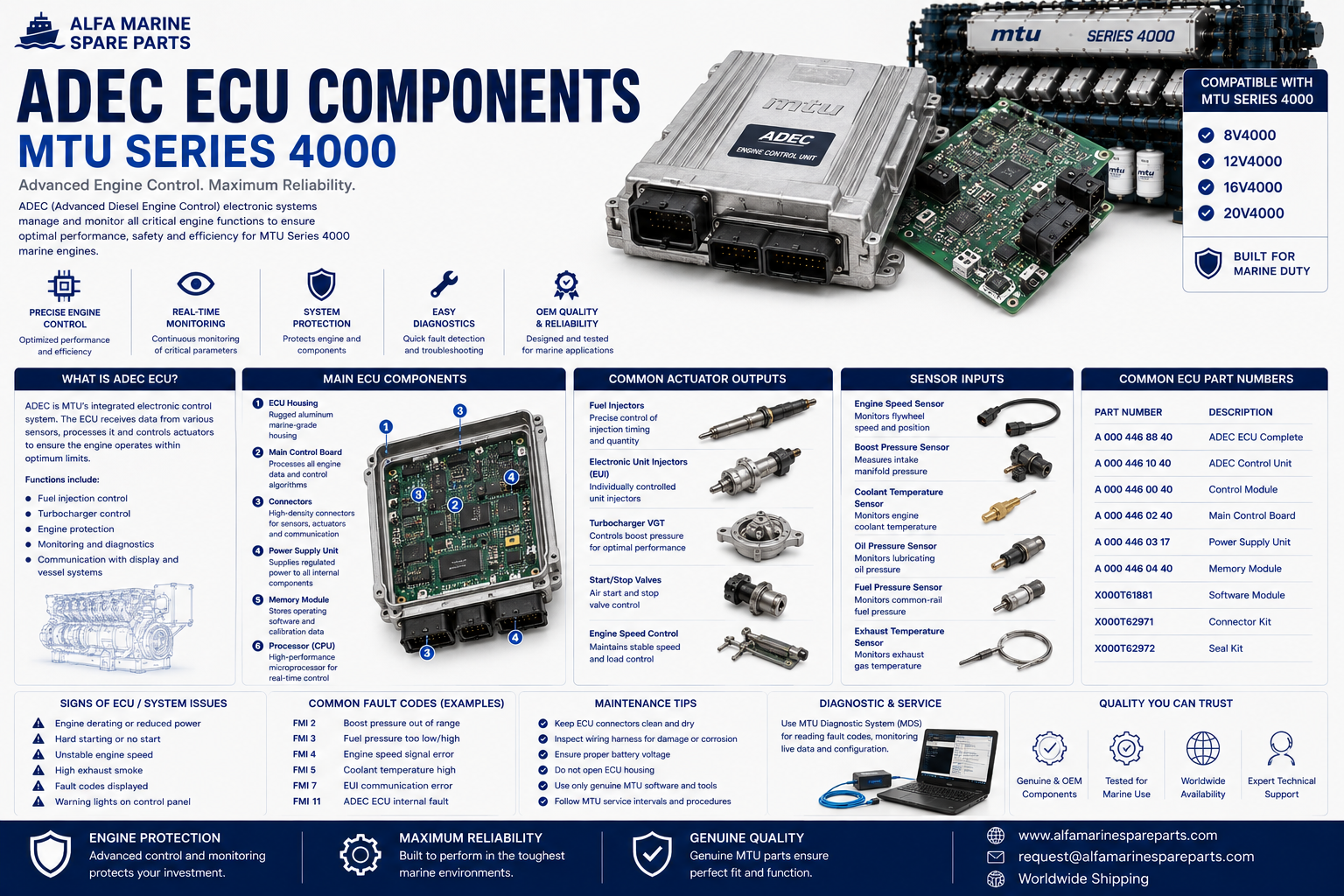
The MTU ADEC (Advanced Diesel Engine Control) ECU system is the brain behind electronic engine management on many heavy-duty MTU diesel applications. It sounds highly complicated, but the basic concept is straightforward: specialized engine sensors feed real-time operating data to the Engine Control Unit (ECU), which processes that information to regulate critical engine functions.
When everything works correctly, the system operates quietly in the background. However, when something goes wrong, troubleshooting can become difficult. An engine may suddenly throw multiple diagnostic alarms, a single cylinder may stop contributing, or the engine might derate or refuse to start entirely—even if the mechanical components appear completely normal.
The immediate reaction from many mechanics is to assume the ECU itself has failed. However, a total ECU fault is only one possibility. The root cause is frequently a faulty sensor, a damaged wiring harness, a corroded connector, an interrupted power supply, or a bad ground connection. That is why proper MTU ADEC troubleshooting should always begin with a diagnostic evaluation of the entire electronic network, rather than jumping to replace the most expensive control module.
1. What Is MTU ADEC?
ADEC stands for Advanced Diesel Engine Control. Depending on the specific engine generation and marine installation, this integrated electronic architecture monitors and controls essential functions including:
- Engine operating speed (RPM) [1]
- Common-rail fuel injection timing and volume [1]
- Critical lubrication, cooling, and fuel pressures [1]
- Boost pressure and charge-air conditions [1]
- Automated engine protection and safety alarms [1]
The easiest way to visualize the ADEC system is a continuous loop: Sensors collect real-world data → The ECU processes the input → Engine-control actuators respond dynamically. [1]
2. Supported MTU Engine Families
Electronic engine controls are utilized across several generations of MTU powerplants. If you are sourcing components, always identify your exact engine model and serial number before ordering. Common families include:
- MTU Series 2000: Including 8V, 12V, and 16V configurations across marine engine families like the M72, M84, M86, M93, and M96.
- MTU Series 4000: Including 12V, 16V, and 20V setups across commercial marine applications like the M53, M63, M73, and M93.
- MTU Series 1163: Including large-scale 12V, 16V, and 20V variants.
🛒 Need Replacement Parts? Browse our catalog for Genuine & OEM MTU Engine Parts to find compatible components for your specific engine series.
3. Understanding the ECU vs. The ADEC Network
It is vital to distinguish between the ECU and the broader ADEC system, as these terms are often mistakenly interchanged.
The Engine Control Unit (ECU) is the physical, sealed electronic computer mounted to the engine that makes operational decisions. It monitors incoming signals like fuel pressure, oil pressure, coolant temperature, and crankshaft position.
Conversely, ADEC refers to the entire electronic ecosystem. A typical ADEC layout consists of multiple interconnected modules and hardware components, including:
- Engine Interface Module (EIM): The communication bridge between the engine electronics and the vessel's bridge control systems. If the EIM or its wiring fails, the ECU may be healthy, but the boat won't respond to throttle commands.
- Engine Monitoring Unit (EMU): A dedicated secondary module on applicable engines used to handle advanced sensor monitoring and system telemetry.
- Wiring Harnesses & Connectors: The physical cables that route power and signals between modules, injectors, and sensors.
4. Troubleshooting Critical Sensors
The ECU cannot physically see or feel engine conditions; it relies entirely on electronic sensors to act as its eyes and ears. If a sensor sends faulty data, a perfectly healthy ECU will make incorrect operational decisions.
Oil & Coolant Temperature Sensors
If your panel displays a "Low Oil Pressure" or "Excessive Coolant Temperature" alarm, you must immediately verify if the engine is experiencing a genuine mechanical failure (such as an oil pump breakdown or a cooling system blockage). If a manual mechanical gauge shows that pressures and temperatures are normal, the fault lies within the sensor itself, its connector, or the wiring harness.
Engine Speed & Rail Pressure Sensors
Marine engines rely heavily on accurate crankshaft/camshaft speed sensors to determine timing. A failing speed sensor will cause hard starting, intermittent shutdowns, or a total no-start condition.
Similarly, on common-rail engines, the fuel rail pressure sensor dictates how hard the high-pressure fuel pump works. Never replace an expensive high-pressure pump until you have verified that the pressure sensor and its wiring circuit are functioning correctly.
🛠️ Keep Your System Running: Avoid costly diagnostic errors. Explore our full selection of premium MTU Sensors and Electronic Components to swap out faulty components fast.
5. ADEC and MTU Common-Rail Injectors