
MTU 8V4000 M70 Parts: A Marine Engineer's Guide to Long-Term Engine Reliability
Opening Story
Every Reliable Engine Starts With One Simple Habit
It's 05:45 in the morning.
The crew is preparing the vessel for departure, and the engine room is already alive with activity. Before the bridge requests engine start, the Chief Engineer begins a familiar routine—not because there's a fault, but because experience has taught him that the smallest changes often become tomorrow's biggest repairs.
He checks beneath the engine for fresh leaks.
He compares today's coolant temperature with last week's log.
He listens to the idle for sounds that don't belong.
Nothing appears unusual.
That is exactly the result he wants.
The MTU 8V4000 M70 has earned a reputation for dependable performance in commercial vessels, patrol craft, workboats, offshore support vessels, and large yachts. Its reliability, however, isn't guaranteed by its design alone. It depends on how well every component is maintained throughout the engine's service life.
Understanding MTU 8V4000 M70 Parts is about more than identifying replacement components. It means recognising early signs of wear, understanding how engine systems interact, and making informed maintenance decisions before a minor issue grows into a costly failure.
Why This Matters
Marine engines rarely fail without warning.
More often, they change gradually.
A turbocharger becomes slightly less efficient.
A heat exchanger slowly accumulates marine deposits.
A thermostat begins opening later than intended.
A freshwater pump seal starts weeping.
Individually, these changes may seem insignificant.
Together, they reduce engine efficiency, increase operating temperatures, and place additional stress on surrounding components.
Experienced marine engineers understand that reliability is built through consistent observation—not just scheduled servicing.
Every inspection provides another opportunity to identify a trend before it becomes a breakdown.
Engineering Lesson
Why Small Changes Matter More Than Engine Alarms
Modern MTU engines include sophisticated monitoring systems that alert operators when operating limits are exceeded.
While these alarms are essential, they represent the final stage of a developing condition—not the beginning.
Long before an alarm sounds, the engine often provides subtle clues:
- Slightly higher coolant temperatures
- Small changes in oil pressure
- Increased fuel consumption
- Minor vibration differences
- Exhaust colour changes
- Gradual reductions in turbocharger efficiency
Experienced engineers monitor these trends because they understand that preventive maintenance begins long before warning lights appear.
This proactive approach not only improves reliability but also helps reduce downtime, lower repair costs, and extend the service life of critical MTU 8V4000 M70 Parts.
Engine Room Reality
One of the most common misconceptions is that engines fail suddenly.
In reality, catastrophic failures are often the result of many small maintenance issues that have been overlooked over time.
A partially blocked heat exchanger increases coolant temperatures.
Higher temperatures place additional stress on seals.
Reduced cooling efficiency affects lubricating oil performance.
The oil can no longer protect bearings as effectively.
Months later, a bearing fails.
The bearing wasn't the original problem.
It was simply the final component affected by a chain of small issues.
Understanding these relationships is one of the most valuable skills a marine engineer can develop.
Chief Engineer's Notebook
"Never trust a single engine reading—trust the trend."
One temperature reading means very little.
Six months of temperature records reveal a story.
The same applies to oil pressure, fuel consumption, exhaust temperature, vibration, and engine hours.
The engineers who consistently compare today's readings with historical data are often the ones who prevent failures before anyone else notices a problem.
Related MTU 8V4000 M70 Parts Every Engineer Should Understand
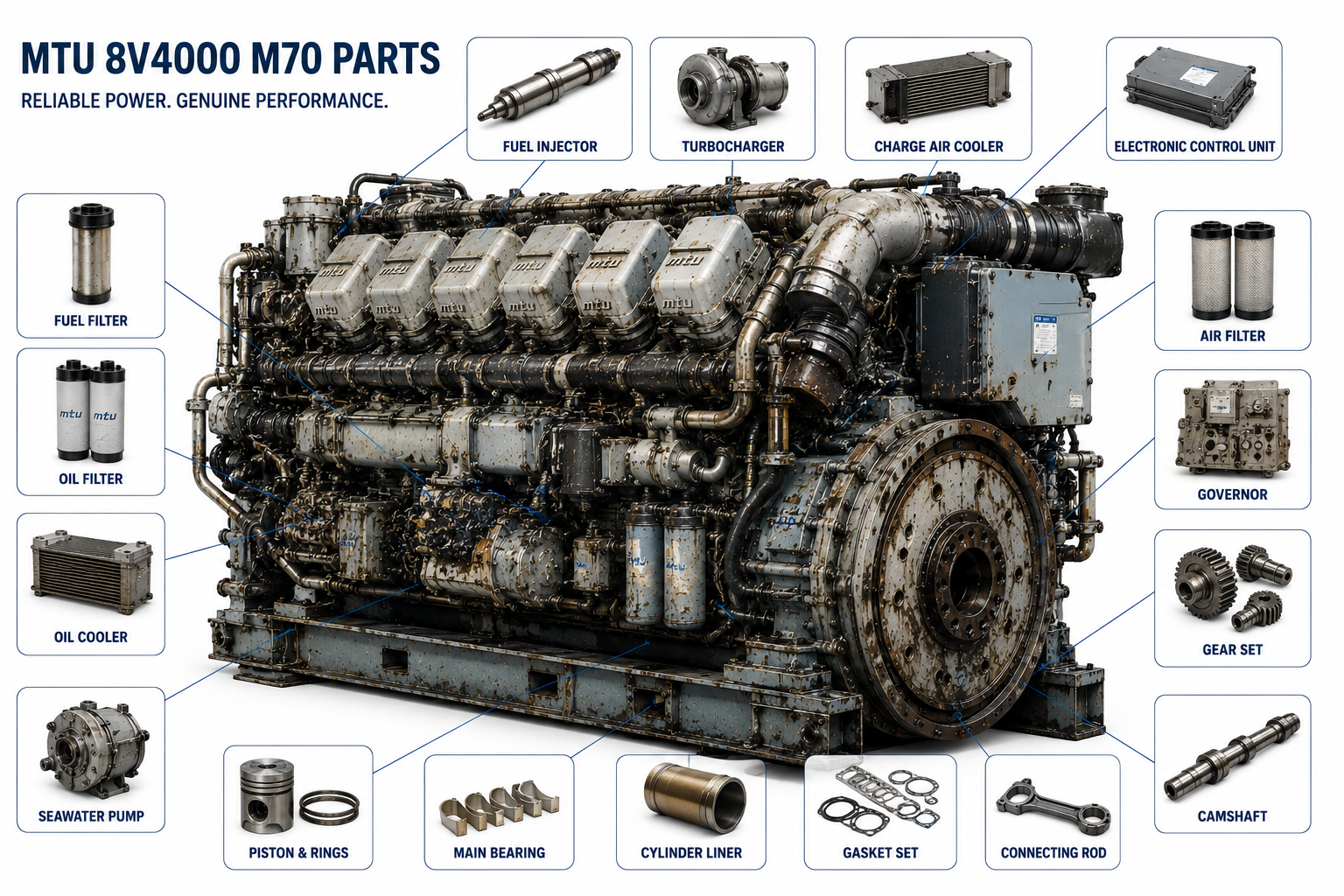
Fuel Injectors
Fuel injectors play a critical role in combustion efficiency. Poor spray patterns or injector wear can increase fuel consumption, produce excessive exhaust smoke, and affect engine performance. Regular inspection and fuel system cleanliness help maintain reliable operation.
Ask Yourself
Has fuel consumption gradually increased without an obvious explanation?
Turbochargers
Turbochargers improve combustion by supplying compressed air to the engine. Routine inspections should include checks for oil leaks, unusual noises, shaft play, and compressor cleanliness.
Did You Know?
Even a slight reduction in turbocharger efficiency can affect engine performance and fuel economy long before an alarm is triggered.
Freshwater Pumps
Freshwater pumps circulate coolant through the engine, helping maintain stable operating temperatures. Small seal leaks, unusual bearing noise, or reduced coolant flow should always be investigated promptly.
Seawater Pumps
The seawater pump is essential for removing heat from the engine's cooling system. Inspect impellers, seals, bearings, and pump housings regularly, especially when operating in saltwater environments where marine growth and corrosion can affect performance.
Heat Exchangers
Heat exchangers transfer heat from the engine coolant to seawater. Over time, fouling and mineral deposits can reduce cooling efficiency. Routine cleaning and inspection help maintain optimal operating temperatures and prevent overheating.
Oil Filters
Oil filters remove contaminants from the lubrication system, helping protect bearings, camshafts, and other moving components. Replacing filters at the recommended service intervals is a simple but essential maintenance task.
Fuel Filters
Fuel filters protect injectors and high-pressure fuel system components by removing dirt and water from the fuel supply. Restricted filters can reduce engine performance and increase stress on the fuel system.
Real Marine Maintenance Scenario
A Small Temperature Increase That Prevented a Major Repair
During a scheduled maintenance period, an offshore support vessel powered by twin MTU 8V4000 M70 engines underwent routine inspections before its next deployment.
Nothing appeared unusual.
No alarms had been recorded.
Engine performance remained within specification.
Fuel consumption was consistent.
However, while reviewing the engine logbook, the Chief Engineer noticed something many people would have overlooked.
Average coolant temperature had increased by approximately 2°C over the previous three months.
The increase wasn't enough to trigger an alarm.
But it was enough to raise a question.
Further inspection revealed:
- Light fouling beginning inside the heat exchanger
- Early wear on a freshwater pump seal
- A partially restricted seawater strainer
- Minor corrosion around one cooling pipe connection
None of these MTU 8V4000 M70 Parts had failed.
Together, however, they were gradually reducing cooling efficiency.
The maintenance team cleaned the cooling circuit, replaced the worn seal, serviced the seawater strainer, and restored the system before the vessel returned to service.
The result?
The engines completed the next offshore campaign without a single cooling-related issue.
The lesson is simple:
Small trends often reveal large problems before they become expensive repairs.
Oil Analysis: What Your Engine Is Trying to Tell You
One of the most valuable maintenance tools available for the MTU 8V4000 M70 is routine oil analysis.
Unlike a visual inspection, oil analysis provides insight into internal engine condition without dismantling major components.
Each oil sample tells part of the engine's story.
Experienced engineers compare reports over time rather than relying on a single result.
Key indicators include:
Iron
May indicate wear from cylinder liners, gears, camshafts, or rotating assemblies.
Copper
Often associated with bearing or bushing wear.
Aluminium
Can suggest piston or housing wear.
Silicon
Frequently indicates dirt entering the engine through the air intake system.
Fuel Dilution
Reduces lubrication quality and may point to injector or combustion issues.
Water Contamination
Even small amounts of water can reduce lubrication effectiveness and should always be investigated.
Oxidation
Shows lubricant ageing and the need for oil replacement.
Viscosity
Changes in viscosity may indicate contamination or lubricant degradation.
Oil analysis is most valuable when used as a trend-monitoring tool, helping engineers make informed maintenance decisions before wear becomes damage.
Engineer's Toolbox
Today's MTU 8V4000 M70 Inspection
✔ Check for oil, coolant, and fuel leaks.
✔ Compare coolant temperatures with previous engine logs.
✔ Inspect freshwater and seawater pump areas.
✔ Check turbochargers for oil traces or unusual sounds.
✔ Review oil pressure during normal operation.
✔ Inspect belts, hoses, and clamps.
✔ Verify fuel filter condition.
✔ Listen carefully during idle for changes in engine sound.
✔ Record all observations in the engine logbook.
Consistent inspections often identify developing issues before alarms activate.
Preventive Maintenance Checklist
Daily
- Inspect for leaks.
- Check oil and coolant levels.
- Observe exhaust colour.
- Monitor engine instruments.
- Listen for unusual sounds.
Weekly
- Inspect belts and hoses.
- Check cooling system connections.
- Inspect pump seals.
- Clean around the engine.
Every 250–500 Hours
- Replace engine oil and oil filters according to the maintenance schedule.
- Replace fuel filters if required.
- Inspect turbochargers.
- Review oil analysis results.
Every 1,000 Hours
- Inspect heat exchangers.
- Check thermostats.
- Inspect injectors.
- Examine engine mounts.
- Review cooling system performance.
Long-Term Maintenance
- Trend engine data.
- Keep accurate maintenance records.
- Investigate even small operating changes.
- Replace wear components during planned maintenance whenever appropriate.
Marine Engineer Tip
Never compare today's engine with yesterday's. Compare it with six months ago.
A gradual increase in operating temperature or a slight reduction in oil pressure often provides more useful information than a single abnormal reading.
Trend monitoring is one of the most effective ways to extend the service life of MTU 8V4000 M70 Parts.
Marine Engineer Quote
"The engine speaks quietly long before it ever sounds an alarm."
The engineers who learn to recognise those quiet signals are usually the ones who prevent costly failures.
Common Maintenance Mistakes
Even reliable engines can suffer unnecessary wear when routine practices are overlooked.
Avoid these common mistakes:
- Waiting for alarms before investigating.
- Ignoring minor coolant or oil leaks.
- Skipping oil analysis.
- Delaying heat exchanger cleaning.
- Overlooking seawater pump inspections.
- Replacing only the failed component instead of checking related systems.
- Failing to record engine operating trends.
- Using incorrect lubricants or coolant specifications.
Good maintenance is built on consistency rather than reacting to failures.
Frequently Asked Questions
Which MTU 8V4000 M70 Parts should be inspected most frequently?
Cooling system components, fuel injectors, turbochargers, oil filters, fuel filters, freshwater pumps, seawater pumps, heat exchangers, sensors, and engine mounts should all be inspected as part of a structured maintenance programme.
Why is trend monitoring more valuable than a single inspection?
A single inspection shows the engine's condition at one moment in time. Trend monitoring reveals gradual changes that often indicate developing wear long before alarms activate.
Does oil analysis replace physical inspections?
No. Oil analysis complements visual inspections by revealing internal wear and contamination that cannot be seen during routine checks.
How can I extend the service life of MTU 8V4000 M70 Parts?
Following preventive maintenance schedules, keeping the cooling and lubrication systems clean, monitoring operating trends, and using quality replacement parts all contribute to longer component life.
Worldwide Marine Engine Spare Parts Supply
Alfa Marine Spare Parts supplies genuine, OEM, aftermarket, remanufactured, and reconditioned MTU 8V4000 M70 Parts to customers worldwide.
We support:
- Shipyards
- Marine engineers
- Chief engineers
- Technical superintendents
- Fleet operators
- Offshore companies
- Government fleets
- Commercial shipping companies
- Fishing vessel operators
- Yacht owners and service companies
We ship to major maritime regions including the United Kingdom, the United States, Canada, Italy, Spain, France, Germany, the Netherlands, Norway, Greece, Monaco, Dubai (UAE), Nigeria, Singapore, and Australia.
Browse Our Complete Catalog
Explore our complete range of marine engine spare parts for MTU and many other leading engine manufacturers:
https://alfamarinespareparts.com/spareparts
Related Engine Pages
- MTU Series 4000 Marine Engine Spare Parts
- MTU 12V4000 M70 Parts
- MTU 16V4000 M70 Parts
- MTU 20V4000 M73L Parts
- MTU Series 2000 Marine Engine Spare Parts
- MTU 1163 Marine Engine Spare Parts
Related Products
- Fuel Injectors
- Turbochargers
- Freshwater Pumps
- Seawater Pumps
- Heat Exchangers
- Oil Filters
- Fuel Filters
- Thermostats
- Engine Mounts
- Gaskets and Seal Kits
- Sensors
Further Reading
Continue expanding your maintenance knowledge with these topics:
- Oil Analysis for Marine Diesel Engines
- Preventive Cooling System Maintenance
- Understanding Marine Turbocharger Health
- Fuel System Best Practices
- Building an Effective Preventive Maintenance Programme
Why Choose Alfa Marine Spare Parts?
At Alfa Marine Spare Parts, we believe reliable vessels start with reliable maintenance. Alongside supplying genuine, OEM, aftermarket, remanufactured, and reconditioned marine engine spare parts, we aim to provide practical engineering knowledge that helps crews reduce downtime and extend engine life.
Whether you need technical assistance identifying the correct component or sourcing parts for planned maintenance, our team is ready to help with responsive support and worldwide shipping.
Contact Alfa Marine Spare Parts
Website: https://alfamarinespareparts.com
Browse Our Catalog: https://alfamarinespareparts.com/spareparts
Email: request@alfamarinespareparts.com
If you're looking for MTU 8V4000 M70 Parts, contact our team for assistance with part identification, maintenance planning, and global spare parts supply.
One Final Thought
The MTU 8V4000 M70 has earned its reputation through engineering excellence, but long-term reliability depends on the decisions made in the engine room every day.
Every inspection, every maintenance record, every oil sample, and every small observation contributes to the engine's future performance.
Understanding MTU 8V4000 M70 Parts is not simply about replacing worn components. It is about recognising change early, protecting critical systems, and making maintenance decisions based on knowledge rather than reacting to failures.
The best marine engineers know that reliability is built one careful inspection at a time.