
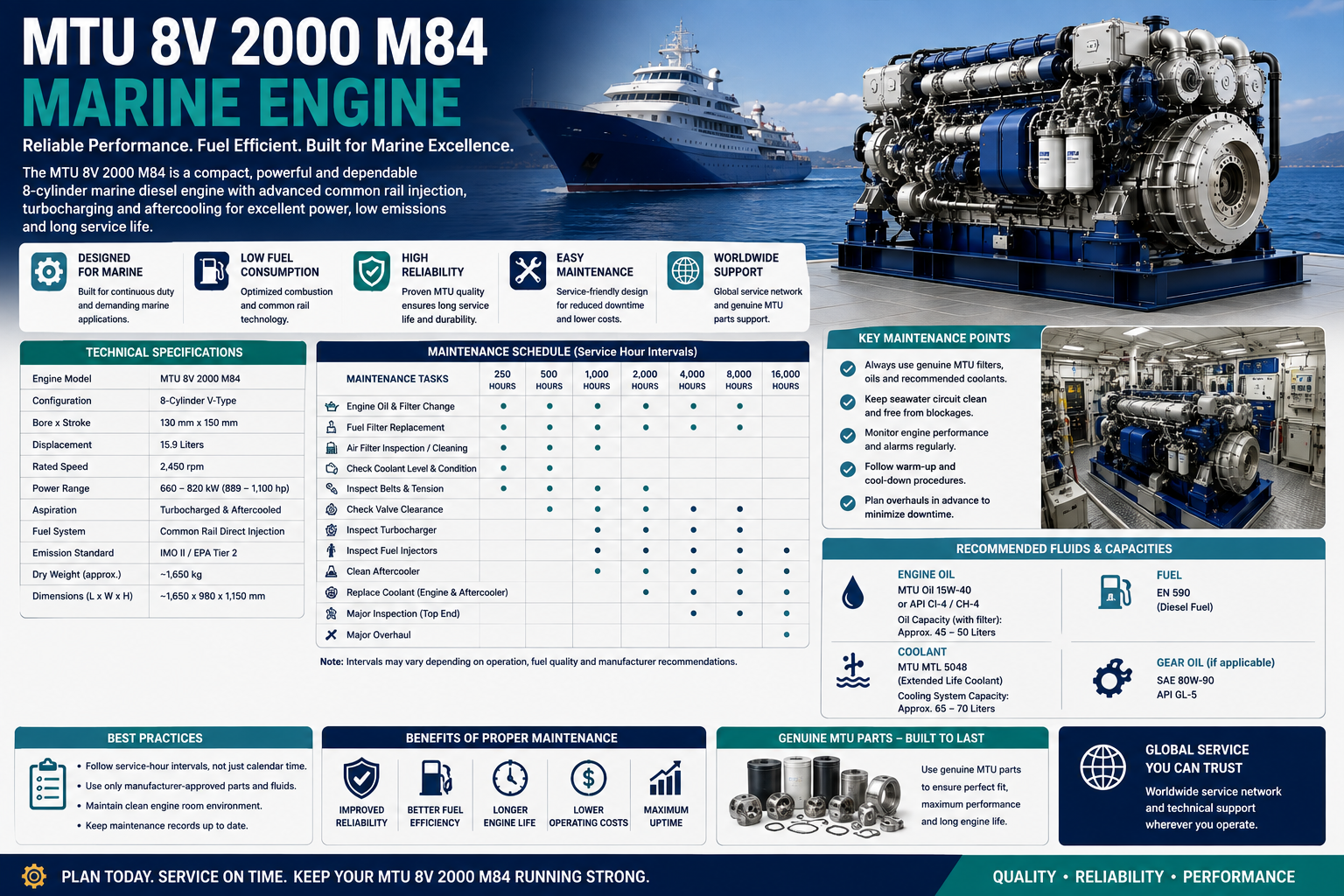

MTU 8V 2000 M84 Marine Engine Maintenance Schedule: Turning Service Hours Into a Practical Fleet Plan
The MTU 8V 2000 M84 marine engine belongs to the MTU Series 2000 family and is designed for fast vessels operating with medium load factors.
MTU's published specification identifies the 8V 2000 M84 as a V8, 17.9-liter marine diesel producing 810 kW / 1,085 bhp at 2,450 rpm, with a 135 mm bore and 156 mm stroke. Typical applications include fast yachts, patrol craft, police boats and fire-fighting vessels.
More importantly for maintenance planning, MTU classifies the 8V 2000 M84 under Application Group 1D — continuous operation, variable, medium load. The current maintenance schedule MS50294/00E specifically includes the 8V 2000 M84 at 102 kW per cylinder.
For marine engineers, the schedule is expressed mainly in operating hours and calendar limits.
For fleet managers, purchasing departments and yacht managers, it is often easier to ask:
How many months until the next service?
That is why every important maintenance interval in this guide is placed inside its own block.
MTU 8V 2000 M84 at a Glance
Manufacturer: MTU
Engine Family: Series 2000
Engine Model: 8V 2000 M84
Configuration: V8
Displacement: 17.9 liters
Power: 810 kW / 1,085 bhp
Rated Speed: 2,450 rpm
Application Group: 1D
Duty Profile: Continuous operation, variable, medium load
MTU's current commercial-marine portfolio continues to list the 8V 2000 M84, confirming its position in the Series 2000 marine range.
An Important Difference From the MTU 8V 2000 M72
Although both engines belong to the Series 2000 family, you should not copy the M72 maintenance schedule directly to the M84.
The M84 uses a different application classification, and MTU's 2020 maintenance schedule uses a load-profile allocation matrix to determine some of the larger maintenance intervals.
For the 8V 2000 M84's 101–106 kW-per-cylinder group, the maintenance cycle can vary substantially according to actual engine load profile. MTU's allocation matrix shows different cycle values depending on how heavily the vessel operates the engine.
That is why:
engine hours + load profile + calendar limits
all matter.
How We Convert Operating Hours Into Months
For fleet planning, we will use:
Low Usage: 3,000 hours per year
High Usage: 5,000 hours per year
Formula:
Service hours ÷ annual operating hours × 12 = approximate months
⚙️ MTU 8V 2000 M84 Hour-to-Month Planning
| Operating Hours3,000 h/year5,000 h/year | ||
| 500 h | 2 months | 1.2 months |
| 1,000 h | 4 months | 2.4 months |
| 1,500 h | 6 months | 3.6 months |
| 2,000 h | 8 months | 4.8 months |
| 3,000 h | 12 months | 7.2 months |
| 4,000 h | 16 months | 9.6 months |
| 6,000 h | 24 months | 14.4 months |
| 8,500 h | 34 months | 20.4 months |
| 10,000 h | 40 months | 24 months |
These calculations help with planning. They do not override the applicable MTU maintenance schedule.
MTU also states that maintenance tasks carry both operating-hour and time limits, and whichever is reached first applies.
Daily MTU 8V 2000 M84 Inspection
🟦 DAILY / DURING OPERATION
Interval: Every operating day
Low Usage: Daily
High Usage: Daily
MTU checks include:
- Engine oil level
- General engine condition
- Visible leakage
- Air-filter maintenance indicator
- Coolant-pump relief bore
- Abnormal running noises
- Exhaust-gas color
- Engine vibration
- Water and contamination in the fuel prefilter
- Fuel-prefilter vacuum indication
Engineer Focus: Compare today's engine with yesterday's engine.
These daily monitoring items are specified in the M84 maintenance schedule.
A small change can be valuable information.
Fresh coolant around a pump.
Different exhaust smoke.
A new vibration.
Slightly increasing oil consumption.
None of these necessarily means the engine has failed.
They mean the engine is telling you to investigate.
500-Hour Maintenance
The first major recurring service block comes at 500 operating hours.
🟩 500-HOUR SERVICE
MTU interval: 500 hours
Low Usage: approximately 2 months
High Usage: approximately 1.2 months
MTU-listed tasks include:
- Inspect automatic centrifugal oil filter
- Check oil-residue thickness
- Clean centrifugal filter
- Replace its paper element when required with oil service
- Replace fuel-prefilter element
- Replace easy-change fuel filter
- Oil-filter replacement in conjunction with engine-oil service
Engineer Focus: Look at what the filters collected before throwing them away.
MTU's M84 schedule places both low-pressure fuel filters at 500 hours and requires inspection of the centrifugal oil filter at the same interval.
At 5,000 annual operating hours, 500 hours arrive roughly every five to six weeks.
That means fuel-filter availability becomes a recurring fleet-stock issue rather than an occasional purchase.
Fuel Filters at 500 Hours
⛽ 500 HOURS — FUEL FILTRATION
Low Usage: about 2 months
High Usage: about 1.2 months
MTU maintenance:
Fuel prefilter: replace filter element
Easy-change fuel filter: replace
Engineer Focus: Contamination control protects the much more expensive high-pressure fuel system.
The verified maintenance schedule places both tasks at 500 hours with a two-year time limit.
For marine service, also pay attention to:
- Water
- Sediment
- Filter restriction
- Fuel-pressure changes
- Repeated filter contamination
If fuel filters begin becoming dirty much faster than normal, don't simply order more filters.
Investigate the fuel.
Engine Oil and Oil Filter
The MTU schedule is careful about this subject.
It does not tell us to copy a generic fixed oil-change interval from another engine.
MTU states that fluid-change intervals must follow its applicable Fluids and Lubricants Specifications, while the oil filter must be replaced whenever the engine oil is changed or at the applicable maximum time limit.
🟨 ENGINE OIL & OIL FILTER
Oil-change interval: Follow the applicable MTU fluids specification
Oil filter: Replace whenever oil is changed
Maximum time limit in referenced schedule: 2 years
Engineer Focus: Combine oil servicing with laboratory analysis and filter inspection.
Do not: Automatically copy a 250- or 500-hour oil interval from another marine diesel.
This approach is more accurate than putting an unsupported number into the maintenance table just because it looks convenient.
1,000-Hour Valve Clearance
One of the most useful recurring inspection points is the valve train.
🟦 1,000 HOURS — VALVE CLEARANCE
MTU interval: 1,000 hours
Low Usage: approximately 4 months
High Usage: approximately 2.4 months
MTU action: Check valve clearance and adjust if necessary.
Special note: MTU calls for the first adjustment after 1,000 hours on a new engine and again after 1,000 hours following cylinder-head overhaul.
Engineer Focus: Record the measurements before adjusting them.
This requirement appears explicitly in the M84 schedule.
Don't simply write:
"Valve clearance OK."
A better record looks like:
Cylinder A1 — Intake ___ / Exhaust ___
Cylinder B1 — Intake ___ / Exhaust ___
and so on.
The trend can become extremely useful later.
1,000-Hour Belt Inspection
🟦 1,000 HOURS — BELT DRIVE
Low Usage: approximately 4 months
High Usage: approximately 2.4 months
Where fitted: Auxiliary PTO belt drive
MTU action:
- Check belt condition
- Replace if necessary
- Adjust tension
Engineer Focus: Don't continuously retension a belt without finding out why it keeps becoming loose.
MTU includes this optional PTO belt-drive inspection at 1,000 hours.
Why the M84 Major Maintenance Interval Is Not One Fixed Number
This is probably the most important difference to understand.
For the 8V 2000 M84, MTU uses an allocation matrix based on actual loading.
Because the engine is rated at 102 kW per cylinder, it falls into the first power-density column of MTU's table. Depending on how the engine spends its operating time at different loads, the allocated maintenance cycle for that column can range from approximately 10,000 hours down through 8,500, 6,000, 4,000 and 3,000 hours under progressively more demanding load profiles.
That means two boats with the same engine can legitimately have different major-maintenance planning.
Light-to-Moderate Load Profile Example
🟢 UP TO 10,000-HOUR ALLOCATION
Applicable only where MTU load-profile allocation permits it
Low Usage: approximately 40 months
High Usage: approximately 24 months
Why: Lower average loading can permit a longer maintenance cycle within MTU's allocation methodology.
Engineer Focus: Do not claim the 10,000-hour cycle unless the vessel's documented operating profile supports it.
Higher-Load Example
🟠 6,000-HOUR ALLOCATION
Low Usage: approximately 24 months
High Usage: approximately 14.4 months
Meaning: More demanding operating profiles can bring major component work significantly closer.
Engineer Focus: Load history matters almost as much as the hour meter.
Severe High-Load Example
🔴 3,000–4,000-HOUR ALLOCATION
3,000 h at low usage: about 12 months
3,000 h at high usage: about 7.2 months
4,000 h at low usage: about 16 months
4,000 h at high usage: about 9.6 months
Meaning: A heavily loaded engine can require major maintenance much sooner than a lightly utilized installation.
Engineer Focus: Don't base overhaul planning on another yacht that happens to have the same M84.
MTU's allocation matrix is precisely why maintenance planning should include actual load history.
What Happens in a 6,000-Hour Maintenance Matrix?
One of MTU's documented maintenance matrices uses a 6,000-hour cycle, so it provides a useful example of what deeper M84 maintenance can involve.
At that allocation, MTU schedules several important tasks earlier within the cycle.
3,000-Hour Injector Replacement in the 6,000-Hour Matrix
🟥 3,000 HOURS — FUEL INJECTORS
For: Referenced 6,000-hour maintenance matrix
Low Usage: approximately 12 months
High Usage: approximately 7.2 months
MTU task: Replace fuel injection valves / injectors.
Engineer Focus: Review cylinder-temperature history and combustion condition before removing the old injectors.
The 6,000-hour matrix assigns injector replacement at 3,000 hours.
This does not mean every M84 must universally receive injectors at 3,000 hours.
It means that under this particular MTU load-profile allocation, this is the specified interval.
That's an important distinction.
3,000-Hour Cylinder-Liner Endoscopy
🟥 3,000 HOURS — CYLINDER INSPECTION
For: Referenced 6,000-hour matrix
Low Usage: approximately 12 months
High Usage: approximately 7.2 months
MTU action: Inspect cylinder liner with an endoscope.
Engineer Focus: Compare all eight cylinders.
MTU places the liner endoscopy at 3,000 hours in this matrix.
Look for differences in:
- Running surface
- Scoring
- Deposits
- Oil traces
- Combustion appearance
The question shouldn't be only:
"Does this liner look acceptable?"
Also ask:
"Why does this liner look different from the other seven?"
3,000-Hour Hose and Rubber-Sleeve Replacement
🟥 3,000 HOURS — HOSES & RUBBER SLEEVES
For: 6,000-hour maintenance matrix
Low Usage: approximately 12 months
High Usage: approximately 7.2 months
MTU action:
- Replace specified hose lines
- Replace specified rubber sleeves
Calendar limit: 6 years
Engineer Focus: Rubber components can age even when operating hours are low.
These items appear at 3,000 hours in the referenced matrix.
This is an excellent example of why low-hour yachts still need calendar-based maintenance.
6,000-Hour Turbocharger Overhaul
🟥 6,000 HOURS — TURBOCHARGER
For: Referenced 6,000-hour maintenance matrix
Low Usage: approximately 24 months
High Usage: approximately 14.4 months
MTU tasks include:
- Overhaul or replace exhaust turbocharger
- Replace applicable compressor wheel
Engineer Focus: Trend boost, oil leakage and exhaust-temperature behavior before the overhaul point.
MTU's 6,000-hour matrix specifically lists turbocharger overhaul/replacement and applicable compressor-wheel replacement.
6,000-Hour High-Pressure Fuel System Work
🟥 6,000 HOURS — HIGH-PRESSURE FUEL SYSTEM
MTU tasks in referenced matrix include:
- Replace high-pressure fuel line
- Replace high-pressure fuel sensor
- Replace high-pressure pump
- Replace low-pressure fuel pump
Low Usage: approximately 24 months
High Usage: approximately 14.4 months
Engineer Focus: Plan fuel-system components well before vessel downtime begins.
These requirements are included in MTU's 6,000-hour maintenance matrix.
6,000-Hour Cooling System
💧 6,000 HOURS — COOLING SYSTEM
MTU-listed work includes:
- Inspect HT thermostat housing
- Replace thermal actuator
- Clean seawater cooler
- Replace sealing material associated with coolant pump and thermostats
- Overhaul or replace HT coolant pump
Low Usage: approximately 24 months
High Usage: approximately 14.4 months
Engineer Focus: Cooling-system deterioration can damage components far more expensive than the pump itself.
MTU specifies these cooling-system tasks in the 6,000-hour matrix.
6,000-Hour Oil Cooler
🛢️ 6,000 HOURS — OIL COOLER
MTU action: Clean oil cooler and check for leaks.
Low Usage: approximately 24 months
High Usage: approximately 14.4 months
Engineer Focus: Monitor oil temperature under comparable engine loads.
The oil cooler appears as a scheduled component-maintenance item in the 6,000-hour matrix.
Poor oil cooling can affect:
- Viscosity
- Bearing protection
- Turbocharger lubrication
- Overall oil life
6,000-Hour Valve Train and Camshaft Inspection
🔧 6,000 HOURS — VALVE TRAIN
MTU tasks include:
- Check rocker arms
- Check valve bridges for wear
- Inspect swing follower through pushrod bore
- Inspect camshaft running surfaces with an endoscope
Engineer Focus: A maintenance opening is an opportunity to understand wear—not simply replace parts.
These inspections are specifically listed in the 6,000-hour matrix.
What About the Cylinder Head and Raw-Water Pump?
This is where using the correct load-profile matrix becomes particularly important.
MTU's schedule shows that cylinder-head overhaul/replacement and raw-water pump overhaul/replacement move with the selected maintenance cycle rather than always occurring at one universal M84 hour value.
For example, the document contains matrices where those tasks occur at 6,500, 6,000, 5,000, 4,000, 3,500, 3,000, 2,000 or 1,500 hours, depending on the selected maintenance allocation.
Therefore:
⚠️ CYLINDER HEAD & RAW-WATER PUMP
There is no single universal hour value to publish for every MTU 8V 2000 M84 installation.
The correct interval depends on:
Engine load profile
Selected MTU maintenance matrix
Operating conditions
Serial/configuration
Applicable calendar limits
Engineer Focus: Determine the matrix first. Order the expensive parts second.
This is much safer than telling every M84 owner:
"Replace the cylinder heads at X hours."
MTU 8V 2000 M84 Maintenance Summary
⚙️ QUICK M84 MAINTENANCE BLOCK
| MaintenanceTypical Verified Interval3,000 h/year5,000 h/year | |||
| Daily engine checks | Daily | Daily | Daily |
| Centrifugal oil-filter inspection | 500 h | 2 mo | 1.2 mo |
| Fuel prefilter | 500 h | 2 mo | 1.2 mo |
| Main easy-change fuel filter | 500 h | 2 mo | 1.2 mo |
| Valve clearance | 1,000 h | 4 mo | 2.4 mo |
| PTO belt drive where fitted | 1,000 h | 4 mo | 2.4 mo |
| Injectors | Load-profile/matrix dependent | Variable | Variable |
| Cylinder-liner endoscopy | Matrix dependent | Variable | Variable |
| Turbocharger overhaul | Matrix dependent | Variable | Variable |
| Cylinder-head overhaul | Matrix dependent | Variable | Variable |
| Raw-water pump overhaul | Matrix dependent | Variable | Variable |
| Major engine maintenance | Load-profile dependent | Variable | Variable |
This is the key difference between an accurate M84 article and a generic internet maintenance table.
Real Marine Maintenance Scenario
Imagine two fast yachts fitted with the same MTU 8V 2000 M84.
Yacht A
Operates relatively lightly and spends significant time at moderate load.
Yacht B
Runs much more aggressively, with a larger percentage of operating time near high power.
Both engines reach:
3,000 operating hours.
Does that automatically mean they should have identical major maintenance?
Not necessarily.
MTU's allocation system explicitly considers engine load profile when selecting the maintenance cycle.
This means the engineer should not simply ask:
"How many hours?"
They should also ask:
"How were those hours accumulated?"
That is a much better maintenance question.
Engineer's Toolbox
MTU 8V 2000 M84 FLEET MAINTENANCE RECORD
Vessel: __________________
Engine: MTU 8V 2000 M84
Engine Family: MTU Series 2000
Application Group: 1D
Serial Number: __________________
Rated Power: 810 kW
Current Hours: __________________
Expected Annual Hours: __________________
Verified Load Profile: __________________
Applicable MTU Maintenance Matrix: __________________
Next 500-Hour Service: __________________
Next 1,000-Hour Valve Check: __________________
Next Injector Maintenance: __________________
Next Turbocharger Maintenance: __________________
Next Cylinder-Head Maintenance: __________________
Next Raw-Water Pump Maintenance: __________________
Last Oil Analysis: __________________
Parts Ordered: __________________
Outstanding Technical Findings: __________________
Marine Engineer Tip
For an MTU 8V 2000 M84, add “load profile” to the maintenance record.
That one field can be as important as operating hours when planning the larger maintenance events.
Two engines can both show 4,000 hours on the display and still have experienced very different working lives.
Common MTU 8V 2000 M84 Maintenance Mistakes
Avoid:
- Copying the M72 schedule directly to the M84.
- Ignoring Application Group 1D.
- Using only operating hours without considering load profile.
- Assuming every M84 has the same cylinder-head interval.
- Assuming every M84 has the same turbocharger interval.
- Inventing a universal engine-oil interval.
- Ignoring calendar limits.
- Waiting until the maintenance point to source injectors.
- Changing filters without examining contamination.
- Adjusting valves without recording measurements.
- Ignoring fuel quality.
- Ordering major parts without the engine serial number.
Frequently Asked Questions
Is the MTU 8V 2000 M84 part of the Series 2000?
Yes. The 8V 2000 M84 belongs to the MTU Series 2000 marine engine family. MTU continues to list the model in its marine product portfolio.
How much power does the MTU 8V 2000 M84 produce?
MTU's marine specification lists 810 kW / 1,085 bhp at 2,450 rpm.
What is the displacement?
The 8V 2000 M84 has a displacement of 17.9 liters.
What application group does the M84 use?
The referenced current maintenance schedule identifies the 8V 2000 M84 as Application Group 1D — continuous operation, variable, medium load.
When are the fuel filters changed?
The referenced M84 maintenance schedule specifies 500 hours for both the fuel prefilter element and easy-change fuel filter.
When is valve clearance checked?
MTU specifies a 1,000-hour valve-clearance check, including the first check on a new engine and following cylinder-head overhaul.
When are injectors replaced?
The interval depends on the applicable maintenance matrix and load profile. In MTU's documented 6,000-hour matrix, injector replacement occurs at 3,000 hours. Other matrices use different intervals.
When is the turbocharger overhauled?
Again, this depends on the maintenance matrix. For the referenced 6,000-hour matrix, turbocharger overhaul/replacement occurs at 6,000 hours. Other load-profile allocations can move that interval.
When is the cylinder head overhauled?
There is no single universal M84 value. MTU's maintenance document shows cylinder-head overhaul/replacement at different intervals according to the selected maintenance matrix.
When is the raw-water pump overhauled?
The raw-water-pump overhaul interval also moves with the selected maintenance matrix rather than being one fixed hour value for every M84.
MTU 8V 2000 M84 Marine Spare Parts
For planned service and overhaul, relevant components can include:
- Oil filters
- Fuel prefilters
- Fuel filters
- Air filters
- Fuel injectors
- High-pressure fuel pumps
- High-pressure fuel lines
- Fuel sensors
- Turbocharger components
- Raw-water pumps
- Coolant pumps
- Seawater coolers
- Oil coolers
- Fuel coolers
- Thermostat components
- Cylinder heads
- Intake and exhaust valves
- Rocker components
- Camshaft-related components
- Pistons
- Piston rings
- Cylinder liners
- Main bearings
- Connecting-rod bearings
- Gaskets
- O-rings
- Hose sets
- Rubber sleeves
- Complete overhaul components
For expensive components, always verify the engine serial number and applicable MTU maintenance matrix before ordering.
Related MTU Series 2000 Engine Pages
- MTU 8V 2000 M72 Marine Engine Spare Parts
- MTU 8V 2000 M84 Marine Engine Spare Parts
- MTU 8V 2000 M94 Marine Engine Spare Parts
- MTU 10V 2000 M72 Marine Engine Spare Parts
- MTU 10V 2000 M84 Marine Engine Spare Parts
- MTU 10V 2000 M86 Marine Engine Spare Parts
- MTU 10V 2000 M94 Marine Engine Spare Parts
- MTU 12V 2000 M72 Marine Engine Spare Parts
- MTU 12V 2000 M86 Marine Engine Spare Parts
- MTU 16V 2000 M91 Marine Engine Spare Parts
- MTU 16V 2000 M94 Marine Engine Spare Parts
Why Choose Alfa Marine Spare Parts?
When somebody asks:
"I need an overhaul kit for an MTU 8V 2000 M84."
the first response shouldn't simply be a price.
Useful questions come first:
What is the engine serial number?
How many hours does it have?
What is its operating profile?
Which MTU maintenance matrix applies?
Is the work routine maintenance or a developing failure?
Alfa Marine Spare Parts supports marine engineers, shipyards, yacht managers and fleet operators sourcing genuine, OEM, aftermarket, remanufactured and reconditioned MTU marine components, depending on application and availability.
The goal is to identify the correct parts for the actual engine and maintenance event rather than simply selling a generic "Series 2000 kit."
Contact Alfa Marine Spare Parts
Email: request@alfamarinespareparts.com
For MTU engines and Series 2000 spare parts, customers can also browse the dedicated MTU engine section at Alfa Marine Spare Parts.
One Final Thought
The MTU 8V 2000 M84 Marine Engine Maintenance Schedule teaches an important lesson about marine maintenance.
For routine work, some intervals are straightforward:
500 hours → fuel filters and centrifugal oil-filter attention
1,000 hours → valve-clearance inspection
But once you move into injectors, turbochargers, cylinder heads, pumps and major engine work, load profile becomes critical. MTU's own allocation matrix changes the maintenance cycle according to how heavily the engine is actually operated.
So for an M84, don't ask only:
"How many hours does the engine have?"
Ask:
"How did it accumulate those hours?"
That question can make the difference between a generic service schedule and a genuinely useful maintenance plan.