
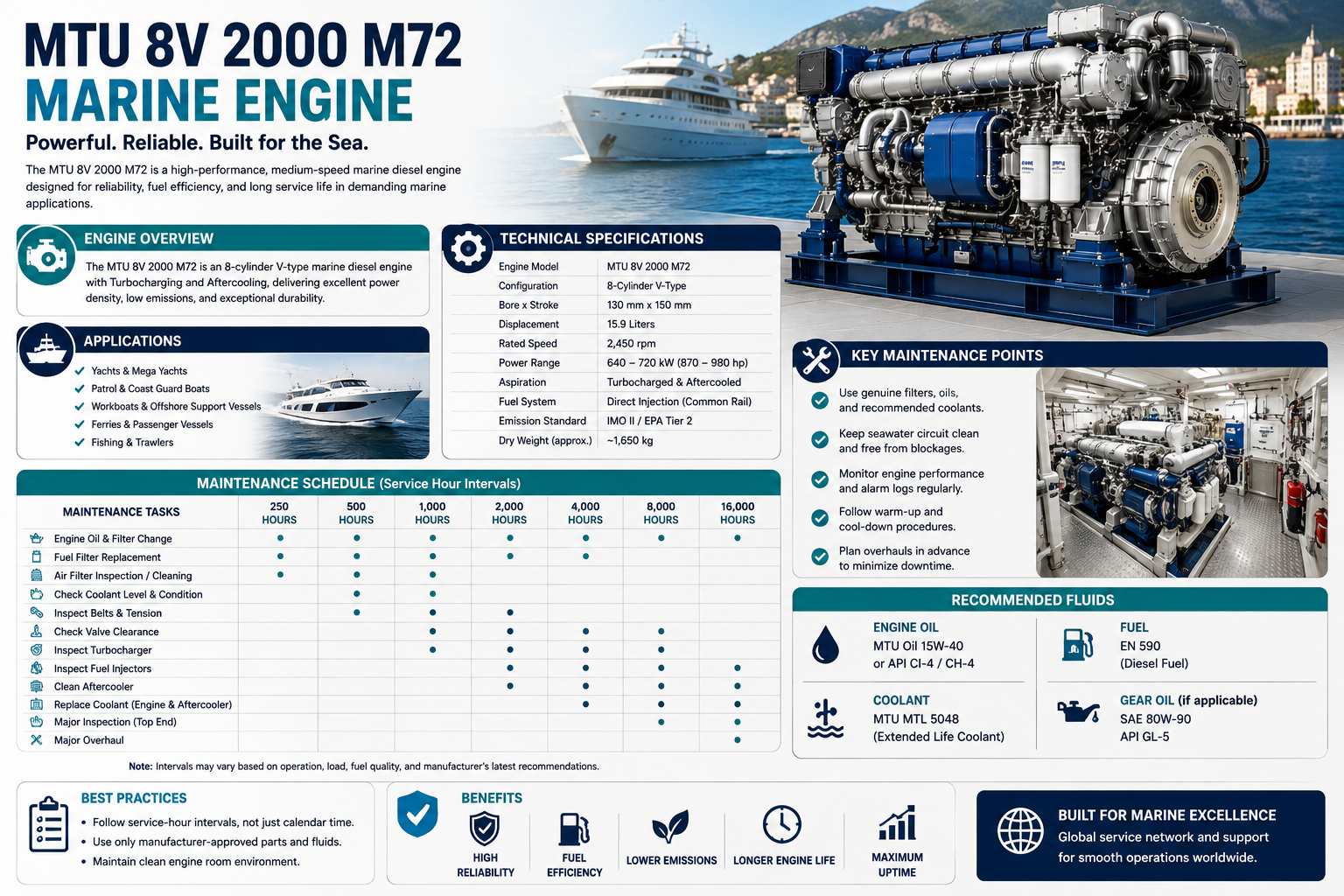

MTU 8V 2000 M72 Marine Engine Maintenance Schedule: Turning Service Hours Into a Practical Fleet Plan
The MTU 8V 2000 M72 marine engine belongs to the MTU Series 2000 engine family and is designed for fast marine vessels operating with high load factors.
MTU's published marine specification rates the 8V 2000 M72 at 720 kW (965 bhp) at 2,250 rpm. It is an eight-cylinder V-engine with a 135 mm bore, 156 mm stroke and 17.9-liter displacement. MTU identifies typical applications including ferries and displacement yachts.
For an engineer, maintenance is normally discussed in operating hours.
But a fleet manager may be thinking:
“How many months until the next service?”
“When should I order the injectors?”
“When is the raw-water pump overhaul approaching?”
“When should cylinder-head work enter the budget?”
That is why we are going to take the actual MTU V 2000 M72 Application Group 1B maintenance schedule and turn the important hour intervals into easy-to-read planning blocks.
The schedule specifically applies to the 8V 2000 M72, as well as related 10V, 12V and 16V M72 versions, under Application Group 1B. MTU describes 1B as continuous operation, variable, high load.
Where Does the MTU 8V 2000 M72 Belong?
Manufacturer: MTU
Engine Family: MTU Series 2000
Engine Model: MTU 8V 2000 M72
Configuration: V8 marine diesel
Displacement: 17.9 liters
Rated Power: 720 kW / 965 bhp
Rated Speed: 2,250 rpm
Application Group: 1B
Typical Applications: Fast ferries, catamarans, hydrofoils, surface-effect vessels and displacement yachts
MTU still lists the 8V 2000 M72 within its commercial-marine portfolio, so this is not simply a historical engine designation.
Before Using the Maintenance Hours
The detailed schedule used here is MTU Maintenance Schedule M050685/03E for V 2000 M72, Application Group 1B, dated 2010.
That is important.
Your specific engine may be subject to later maintenance revisions, serial-number-specific changes, optional equipment or different operating requirements.
MTU's schedule also notes that certain listed components may not actually be installed on every engine.
Therefore:
⚠️ IMPORTANT
Use the hour intervals in this article as a technically grounded planning guide for the referenced M72 1B schedule.
Before ordering expensive overhaul components, verify:
Engine serial number + current MTU maintenance schedule + installed configuration.
How We Convert Hours Into Months
To make the maintenance schedule easier for fleet managers, we will use:
Low Usage: 3,000 hours per year
High Usage: 5,000 hours per year
The calculation is:
Maintenance interval ÷ annual operating hours × 12 = approximate months
Quick MTU 8V 2000 M72 Hour-to-Month Chart
⚙️ MTU 8V 2000 M72 MAINTENANCE PLANNING
| Operating Hours3,000 h/year5,000 h/year | ||
| 250 h | 1 month | 0.6 month |
| 500 h | 2 months | 1.2 months |
| 1,000 h | 4 months | 2.4 months |
| 3,000 h | 12 months | 7.2 months |
| 6,000 h | 24 months | 14.4 months |
| 12,000 h | 48 months | 28.8 months |
These month values are planning conversions. The MTU schedule itself remains the technical reference.
Daily MTU 8V 2000 M72 Inspection
🟦 DAILY / DURING ENGINE OPERATION
Interval: Every operating day
Low Usage: Daily
High Usage: Daily
MTU-listed checks include:
- Check engine oil level
- Inspect the engine for general condition and leaks
- Inspect intercooler drain system where fitted
- Check air-filter service indicator
- Check coolant-pump relief bores
- Listen for abnormal running noise
- Observe exhaust-gas color
- Monitor vibration
- Drain water and contamination from fuel prefilter where fitted
- Check fuel-prefilter service indicator
Engineer Focus: Look for what has changed since the previous inspection.
These daily items are specifically identified in the M72 1B schedule.
This is something experienced engine-room crews already understand:
A leak does not have to be large to be useful.
A little coolant appearing from a relief bore or a slight change in exhaust color can provide an early warning before an alarm appears.
250-Hour Maintenance
The first major recurring hour block is particularly straightforward.
🟩 250-HOUR SERVICE
MTU interval: 250 hours
Low Usage — 3,000 h/year: approximately 1 month
High Usage — 5,000 h/year: approximately 0.6 month
MTU task:
Crankcase breather fine separator — renew paper or woven insert where fitted
Engineer Focus: Crankcase ventilation condition can affect pressure, oil mist control and sealing behavior.
MTU places this crankcase-breather task at 250 operating hours in the referenced maintenance schedule.
At 5,000 annual hours, 250 hours arrive approximately every 18 days.
For a heavily used fast vessel, even a modest maintenance item quickly becomes a regular inventory requirement.
500-Hour Maintenance
Several important items come together at 500 operating hours.
🟩 500-HOUR SERVICE
Low Usage: approximately 2 months
High Usage: approximately 1.2 months
MTU-listed tasks include:
- Clean crankcase-breather wire meshes
- Inspect and clean centrifugal oil filter
- Renew sleeve where fitted
- Replace fuel filter / fuel-filter insert
Engineer Focus: Treat the filter contents as information—not just waste.
The referenced MTU schedule places crankcase-breather cleaning, centrifugal oil-filter maintenance and fuel-filter replacement at the 500-hour level.
What Can the Centrifugal Oil Filter Tell You?
MTU instructs technicians to inspect the thickness of the oil residue layer and clean the centrifugal filter at this interval.
That makes the filter more than a component to clean.
Compare:
- Deposit amount
- Deposit consistency
- Metallic appearance
- Changes from previous services
If residue suddenly increases, ask why.
Possible areas for further investigation include:
- Combustion condition
- Oil deterioration
- Internal wear
- Contamination
- Operating profile
A filter can sometimes tell you the engine is changing before an alarm does.
Fuel Filter at 500 Hours
⛽ 500 HOURS — FUEL FILTER
Low Usage: approximately 2 months
High Usage: approximately 1.2 months
MTU action: Fit new fuel filter or filter insert.
Engineer Focus: Protect the high-pressure fuel system by controlling contamination upstream.
The M72 schedule specifically places the main fuel filter at 500 hours, with a time limit also indicated.
MTU separately notes that the fuel prefilter interval depends on fuel contamination, and its paper inserts must be replaced no later than the stated time limit.
This is a good example of why operating hours cannot be the only trigger.
Dirty fuel can demand attention sooner.
What About Engine Oil and the Oil Filter?
Unlike a generic marine-maintenance chart, the referenced MTU M72 schedule does not simply assign one fixed oil-change hour in this maintenance task list.
MTU directs the operator to the applicable Fluids and Lubricants Specifications for oil-change requirements. It states that the engine oil filter should be replaced every time the engine oil is changed, or no later than the applicable time limit.
So the technically safer way to present this is:
🟨 ENGINE OIL & OIL FILTER
Oil-change interval: Follow the applicable MTU Fluids and Lubricants Specification for your engine and operating conditions.
Oil filter: Replace each time the engine oil is changed, or by the applicable time limit.
Do not: Copy a generic 250- or 500-hour oil interval from another diesel engine.
Engineer Focus: Combine oil service with oil analysis and filter inspection.
This is much more accurate than inventing an oil interval just to complete a table.
1,000-Hour Valve Gear Inspection
🟦 1,000-HOUR SERVICE
Low Usage — 3,000 h/year: approximately 4 months
High Usage — 5,000 h/year: approximately 2.4 months
MTU task:
Check valve clearance
Engineer Focus: Record the actual measurements before adjustment.
MTU places valve-clearance inspection at 1,000 operating hours for the M72 1B schedule.
Don't write only:
“Valve clearance checked.”
A better engine record shows:
Cylinder 1 intake: ____
Cylinder 1 exhaust: ____
Cylinder 2 intake: ____
Cylinder 2 exhaust: ____
and so on through all eight cylinders.
Why Recording Valve Clearance Matters
Suppose seven cylinders remain relatively stable.
But the exhaust-valve clearance on one cylinder repeatedly changes.
That difference may justify further investigation.
Possible areas include:
- Valve condition
- Valve seat
- Rocker components
- Valve bridge
- Pushrod
- Combustion condition
The maintenance measurement becomes far more valuable when it is treated as trend data.
3,000-Hour Belt Drive Inspection
🟧 3,000 HOURS — BELT DRIVE
MTU interval: 3,000 hours / 2-year limit in referenced schedule
Low Usage: approximately 12 months by operating hours
High Usage: approximately 7.2 months by operating hours
MTU task:
- Check belt condition
- Check belt tension
- Renew belts when necessary
Engineer Focus: Inspect the complete belt drive rather than just tightening a loose belt.
The M72 schedule places belt inspection at 3,000 hours with a time limit.
Check:
- Cracking
- Glazing
- Fraying
- Tension
- Pulley alignment
- Contamination
A belt repeatedly losing tension may be telling you something about the drive system.
3,000-Hour Air Filter Replacement
🟧 3,000 HOURS — AIR FILTERS
Low Usage: approximately 12 months
High Usage: approximately 7.2 months
MTU task: Fit new air filters.
Time limit in referenced schedule: 3 years
Engineer Focus: Intake restriction directly affects turbocharger and combustion performance.
MTU specifies new air filters at 3,000 hours in this schedule.
Between replacements, the daily service-indicator inspection still matters.
A restricted air supply may contribute to:
- Higher exhaust temperature
- Smoke
- Increased fuel consumption
- Reduced power
- Turbocharger stress
6,000-Hour Fuel Injector Replacement
This is where the maintenance schedule becomes considerably more serious.
🟥 6,000 HOURS — FUEL INJECTORS
MTU interval: 6,000 hours
Low Usage — 3,000 h/year: approximately 24 months
High Usage — 5,000 h/year: approximately 14.4 months
MTU task:
Fit new fuel injectors
Engineer Focus: Compare cylinder condition and exhaust-temperature history before removing the old injectors.
The referenced M72 maintenance schedule specifies injector replacement at 6,000 hours.
This is not the time to begin sourcing them.
For a high-use vessel, 6,000 hours arrive in only around 14½ months.
Plan ahead.
6,000-Hour Combustion-Chamber Inspection
🟥 6,000 HOURS — COMBUSTION CHAMBERS
Low Usage: approximately 24 months
High Usage: approximately 14.4 months
MTU task:
Inspect cylinder chambers with an endoscope.
Engineer Focus: Compare all eight cylinders before deciding what is “normal.”
MTU places endoscopic combustion-chamber inspection at the same 6,000-hour interval.
This is valuable because engineers can inspect:
- Piston crown condition
- Deposits
- Possible scoring
- Combustion differences
- Oil-related contamination
without immediately dismantling the engine.
6,000-Hour Major Component Maintenance
A large group of engine systems comes together at this interval.
🟥 6,000-HOUR COMPONENT MAINTENANCE
Low Usage: approximately 24 months
High Usage: approximately 14.4 months
MTU tasks include:
- Drain coolant and flush cooling systems
- Clean air ducting
- Clean intercooler and inspect for leaks
- Inspect thermostat and renew thermal actuator
- Inspect centrifugal oil filter for wear where fitted
- Inspect vibration damper
- Renew crankcase-breather diaphragms
- Clean engine coolant cooler
- Inspect coolant cooler for leaks where possible
- Clean engine oil cooler and leak-test
- Check engine alignment
- Clean fuel cooler
- Inspect rocker arms
- Inspect valve bridges
- Inspect pushrods and ball joints
- Renew seals and sealing materials on dismantled components
- Overhaul engine coolant pump
- Overhaul raw-water pump
Engineer Focus: Treat this as a planned maintenance project—not a normal filter service.
These tasks are explicitly grouped in the M72 component-maintenance section.
Raw-Water Pump at 6,000 Hours
🌊 6,000 HOURS — RAW-WATER PUMP
Low Usage: approximately 24 months
High Usage: approximately 14.4 months
MTU action: Overhaul raw-water pump where fitted.
Inspect:
- Pump housing
- Shaft
- Bearings
- Seals
- Corrosion
- Pumping components
- Suction-side condition
- Cooling-water flow
Engineer Focus: Never inspect the pump in isolation from the whole seawater circuit.
MTU specifically includes raw-water pump overhaul in the 6,000-hour component-maintenance scope.
A rebuilt pump cannot compensate for:
- Blocked strainer
- Collapsed hose
- Fouled cooler
- Restricted sea inlet
Engine Coolant Pump at 6,000 Hours
💧 6,000 HOURS — ENGINE COOLANT PUMP
MTU action: Overhaul engine coolant pump.
Low Usage: approximately 24 months
High Usage: approximately 14.4 months
Engineer Focus: Don't confuse the engine coolant circuit with the raw-water circuit.
MTU lists coolant-pump overhaul alongside the other 6,000-hour component work.
These two pumps serve different sides of the overall heat-rejection system.
Turbocharger Overhaul at 6,000 Hours
🌀 6,000 HOURS — TURBOCHARGER
Low Usage: approximately 24 months
High Usage: approximately 14.4 months
MTU task:
- Overhaul turbocharger(s)
- Install new compressor wheels on applicable MTU-ZR turbochargers
Engineer Focus: Trend turbocharger behavior before the scheduled overhaul arrives.
The schedule specifically assigns turbocharger overhaul to the 6,000-hour maintenance point.
Between overhauls, monitor:
- Boost performance
- Oil leakage
- Compressor cleanliness
- Exhaust-temperature trends
- Noise
- Vibration
A turbocharger usually gives information before it gives up completely.
12,000-Hour Cylinder Head Overhaul
🟥 12,000 HOURS — CYLINDER HEADS
MTU interval: 12,000 hours
Low Usage — 3,000 h/year: approximately 48 months / 4 years
High Usage — 5,000 h/year: approximately 28.8 months / 2.4 years
MTU tasks:
- Overhaul cylinder heads
- Visually inspect piston crowns
- Inspect cylinder-liner running patterns
Engineer Focus: Use the removed cylinder head as diagnostic evidence.
The referenced MTU M72 1B schedule places cylinder-head overhaul at 12,000 hours.
Before cleaning the components, photograph:
- Exhaust valves
- Intake valves
- Combustion faces
- Deposits
- Gasket patterns
- Liner running surfaces
If seven cylinders look similar and one does not, the different cylinder deserves an explanation.
12,000-Hour Extended Component Maintenance
The same 12,000-hour point also carries the most extensive engine work in the referenced maintenance schedule.
🟥 12,000-HOUR EXTENDED COMPONENT MAINTENANCE
Low Usage: approximately 48 months
High Usage: approximately 28.8 months
Time limit: 18 years in the referenced schedule
MTU tasks include:
- Completely disassemble engine
- Inspect engine components
- Repair or replace components as required
- Renew all elastomeric parts and seals
- Fit new piston rings
- Fit new connecting-rod bearings
- Fit new crankshaft bearings
- Fit new cylinder liners
- Renew auxiliary PTO antifriction bearings where fitted
- Fit new high-pressure fuel pump
- Renew applicable air/exhaust actuator components
- Overhaul starter
- Overhaul battery-charging generator
- Fit new fuel-pressure relief valve
- Fit new crankcase-ventilation wire meshes
- Fit new high-pressure fuel sensor
- Fit new water filter
Engineer Focus: This is a true major engine-maintenance event.
These tasks are specified in the MTU M72 maintenance schedule's extended component-maintenance section.
Why 12,000 Hours Is Closer Than It Sounds
For a vessel operating only 1,000 hours per year, 12,000 hours can seem very distant.
But consider a hard-working marine operation accumulating 5,000 hours per year.
⏱️ 12,000 HOURS AT 5,000 HOURS/YEAR
Approximate time: 28.8 months
That's only about 2.4 years.
For purchasing and technical management, that means cylinder heads, bearings, liners, piston rings and other major overhaul components can become a near-term budget issue surprisingly quickly.
MTU 8V 2000 M72 Maintenance Summary
⚙️ QUICK MAINTENANCE BLOCK
| Interval3,000 h/year5,000 h/yearMain Maintenance | |||
| Daily | Daily | Daily | Oil, leaks, filters, noise, smoke, vibration |
| 250 h | 1 mo | 0.6 mo | Crankcase breather fine-separator insert |
| 500 h | 2 mo | 1.2 mo | Breathers, centrifugal oil filter, fuel filter |
| 1,000 h | 4 mo | 2.4 mo | Valve-clearance inspection |
| 3,000 h | 12 mo | 7.2 mo | Belt drive and air-filter replacement |
| 6,000 h | 24 mo | 14.4 mo | Injectors, borescope inspection, coolers, pumps, turbocharger |
| 12,000 h | 48 mo | 28.8 mo | Cylinder heads + extended component maintenance |
The intervals and task groups above come from the MTU V 2000 M72 Application Group 1B maintenance schedule applicable to the 8V 2000 M72.
Real Marine Maintenance Scenario
Imagine a fast commercial vessel powered by twin MTU 8V 2000 M72 marine engines.
The vessel accumulates around 5,000 hours annually.
The maintenance department sees:
6,000-hour component maintenance
and initially thinks:
“That's more than a year away.”
Correct—but only slightly.
At that utilization:
6,000 hours = approximately 14.4 months
That one maintenance event can involve:
- Fuel injectors
- Turbocharger overhaul
- Intercooler cleaning
- Oil cooler cleaning
- Coolant cooler inspection
- Engine alignment
- Coolant pump overhaul
- Raw-water pump overhaul
- Rocker and valve-train inspection
- Vibration-damper inspection
- Combustion-chamber endoscopy
- Multiple seals and gaskets
That is not something to start planning at 5,950 hours.
Engineer's Toolbox
MTU 8V 2000 M72 FLEET MAINTENANCE RECORD
Vessel: __________________
Engine: MTU 8V 2000 M72
Series: MTU Series 2000
Application Group: 1B / Verify
Engine Serial Number: __________________
Current Hours: __________________
Annual Operating Hours: __________________
Next 250-Hour Service: __________________
Next 500-Hour Service: __________________
Next 1,000-Hour Valve Check: __________________
Next 3,000-Hour Service: __________________
Next 6,000-Hour Component Maintenance: __________________
Next 12,000-Hour Major Maintenance: __________________
Last Oil Analysis: __________________
Turbocharger Status: __________________
Raw-Water Pump Status: __________________
Parts Ordered: __________________
Open Technical Observations: __________________
Marine Engineer Tip
For the MTU 8V 2000 M72, don't treat the 6,000-hour maintenance as one line in the logbook.
It is a collection of systems coming due together.
Start planning:
injectors + turbocharger + cooling pumps + coolers + seals + inspection labor
well before the engine reaches the hour.
That can turn a long vessel stoppage into scheduled maintenance.
Common MTU 8V 2000 M72 Maintenance Mistakes
Avoid:
- Applying another Series 2000 model's maintenance schedule automatically.
- Forgetting to verify Application Group 1B.
- Ignoring serial-number-specific revisions.
- Inventing a fixed oil-change interval rather than using the applicable MTU fluids specification.
- Ignoring the fuel prefilter because the main fuel filter has been replaced.
- Adjusting valve clearance without recording measurements.
- Waiting until 6,000 hours to source injectors and pump parts.
- Rebuilding the raw-water pump without checking the complete seawater circuit.
- Cleaning piston crowns before documenting deposits.
- Throwing bearings away before examining wear patterns.
- Assuming every optional component listed in the schedule is installed on the engine.
Frequently Asked Questions
Is the MTU 8V 2000 M72 part of the MTU Series 2000?
Yes. The 8V 2000 M72 belongs to MTU's Series 2000 marine-engine family. MTU currently lists it for commercial marine applications.
How much power does the MTU 8V 2000 M72 produce?
MTU's marine specification lists 720 kW / 965 bhp at 2,250 rpm for the 8V 2000 M72.
What is the engine displacement?
The 8V 2000 M72 has a published total displacement of 17.9 liters.
When is the fuel filter replaced?
The referenced Application Group 1B schedule specifies 500 hours, with an applicable time limit.
When should valve clearance be checked?
The referenced schedule specifies a 1,000-hour valve-clearance inspection.
When are the air filters replaced?
The schedule calls for new air filters at 3,000 operating hours, subject to its applicable time limit.
When are the MTU 8V 2000 M72 injectors replaced?
For the referenced M72 Application Group 1B schedule, fuel injectors are replaced at 6,000 operating hours.
When is the raw-water pump overhauled?
The raw-water pump is included in the 6,000-hour component-maintenance scope, where fitted.
When is the turbocharger overhauled?
The referenced M72 schedule specifies turbocharger overhaul at 6,000 hours.
When are the cylinder heads overhauled?
The schedule places cylinder-head overhaul at 12,000 operating hours and includes inspection of the piston crowns and cylinder-liner running patterns.
When is major extended component maintenance performed?
For this referenced Application Group 1B schedule, extended component maintenance is listed at 12,000 hours, with an 18-year time limit.
MTU 8V 2000 M72 Marine Spare Parts
Alfa Marine Spare Parts can assist with sourcing maintenance and overhaul components including:
- Engine oil filters
- Fuel filters
- Air filters
- Fuel injectors
- High-pressure fuel-system components
- Turbocharger components
- Raw-water pumps
- Engine coolant pumps
- Intercooler components
- Engine oil coolers
- Coolant coolers
- Fuel coolers
- Thermostats
- Cylinder heads
- Intake and exhaust valves
- Rocker components
- Pushrods
- Valve-train components
- Pistons
- Piston rings
- Cylinder liners
- Connecting-rod bearings
- Main / crankshaft bearings
- Gaskets
- O-rings
- Elastomeric seals
- Starter components
- Charging-generator components
- Complete overhaul components
For correct identification, supply the engine serial number and existing part number wherever possible.
Related MTU Series 2000 Engine Pages
- MTU 8V 2000 M72 Marine Engine Spare Parts
- MTU 8V 2000 M84 Marine Engine Spare Parts
- MTU 8V 2000 M94 Marine Engine Spare Parts
- MTU 10V 2000 M72 Marine Engine Spare Parts
- MTU 10V 2000 M84 Marine Engine Spare Parts
- MTU 10V 2000 M86 Marine Engine Spare Parts
- MTU 12V 2000 M72 Marine Engine Spare Parts
- MTU 12V 2000 M86 Marine Engine Spare Parts
- MTU 16V 2000 M72 Marine Engine Spare Parts
- MTU 16V 2000 M91 Marine Engine Spare Parts
- MTU 16V 2000 M94 Marine Engine Spare Parts
Explore MTU Marine Engines
Because the MTU 8V 2000 M72 belongs to the Series 2000 family, customers can explore additional MTU marine engine information and spare parts through Alfa Marine Spare Parts:
MTU Marine Engines & Spare Parts:
https://alfamarinespareparts.com/engines/mtu
Complete Marine Spare Parts Catalog:
https://alfamarinespareparts.com/spareparts
Worldwide MTU Marine Spare Parts Supply
Alfa Marine Spare Parts supports:
- Shipyards
- Ship repair companies
- Marine engineers
- Chief engineers
- Technical superintendents
- Fleet operators
- Ferry operators
- Yacht operators
- Commercial vessel operators
- Offshore operators
- Government fleets
- Maritime contractors
- Boat builders
- Marine service companies
- Marine equipment distributors
For a quotation, provide:
MTU 8V 2000 M72 + engine serial number + current part number + quantity + photographs where available.
Why Choose Alfa Marine Spare Parts?
If a customer writes:
“Need parts for MTU 8V2000.”
that is only the beginning.
We also want to know:
M72, M84 or M94?
Which serial number?
Which component?
Which maintenance interval are you approaching?
Is this scheduled work or an engine breakdown?
Alfa Marine Spare Parts helps customers source genuine, OEM, aftermarket, remanufactured and reconditioned MTU marine engine components, depending on application and availability.
For an MTU 8V 2000 M72, planning the correct components ahead of the 6,000- or 12,000-hour maintenance point can make a significant difference to vessel downtime.
Contact Alfa Marine Spare Parts
Email: request@alfamarinespareparts.com
MTU Engines:
https://alfamarinespareparts.com/engines/mtu
Complete Catalog:
https://alfamarinespareparts.com/spareparts
Contact Alfa Marine Spare Parts for MTU 8V 2000 M72 filters, injectors, turbocharger parts, raw-water pumps, coolant pumps, cylinder heads, pistons, liners, bearings, gasket sets and overhaul components with worldwide supply.
One Final Thought
The MTU 8V 2000 M72 Marine Engine Maintenance Schedule becomes much easier to manage when the hours are converted into real calendar planning.
For a vessel operating 5,000 hours per year:
250 hours = approximately 0.6 month
500 hours = approximately 1.2 months
1,000 hours = approximately 2.4 months
3,000 hours = approximately 7.2 months
6,000 hours = approximately 14.4 months
12,000 hours = approximately 28.8 months
The important lesson is not simply to wait until each number appears on the hour meter.
For a hard-working MTU M72, the better question is:
“What service event is approaching, what has the engine been telling us between services, and are the correct parts already available before the vessel has to stop?”