
MTU 8V 2000 M72 Charge Air Cooler Maintenance: Why a Clean Cooler Means More Power and Lower Fuel Consumption
The MTU 8V 2000 M72 marine engine is a trusted propulsion engine for luxury yachts, patrol vessels, pilot boats, and commercial marine applications. Known for its reliability and high power output, this engine depends on several systems working together efficiently. One of the most overlooked—but essential—components is the charge air cooler.
Many operators immediately suspect the turbocharger or fuel injectors when they notice reduced engine performance or increased fuel consumption. However, a dirty or partially blocked charge air cooler can produce very similar symptoms.
Routine maintenance of the charge air cooler helps maintain engine power, improve fuel efficiency, reduce exhaust temperatures, and protect internal engine components from unnecessary stress.
What Is a Charge Air Cooler?
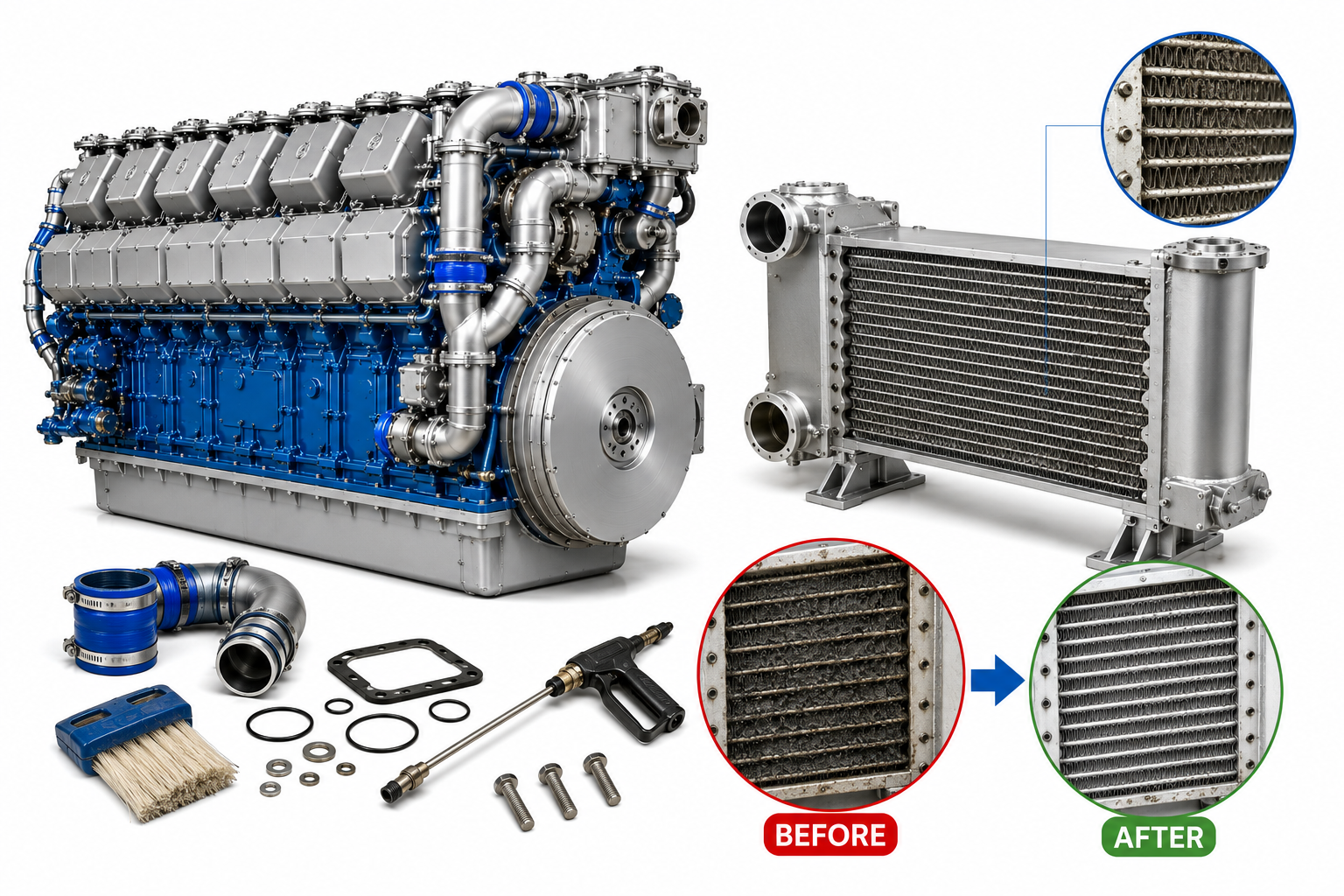
The charge air cooler, sometimes called an aftercooler, cools the compressed air leaving the turbocharger before it enters the engine cylinders.
When air is compressed by the turbocharger, its temperature increases significantly. Hot air is less dense and contains less oxygen. By cooling the compressed air, the charge air cooler increases air density, allowing more oxygen into the cylinders.
This improves:
- Engine power
- Fuel efficiency
- Combustion quality
- Exhaust emissions
- Engine reliability
Without an efficient charge air cooler, the MTU 8V 2000 M72 cannot perform at its designed output.
Why Is the Charge Air Cooler Important?
The engine's electronic fuel system calculates fuel delivery based on available air.
If the charge air cooler cannot lower the intake air temperature effectively:
- Combustion efficiency decreases.
- Fuel consumption increases.
- Exhaust temperatures rise.
- Engine power drops.
- Turbocharger workload increases.
Over time, excessive intake temperatures place additional stress on pistons, valves, cylinder heads, and turbochargers.
Common Causes of Charge Air Cooler Problems
Salt Deposits
Marine environments naturally introduce salt into the cooling system. Salt deposits reduce heat transfer efficiency.
Marine Growth
Small organisms, algae, and shell growth may restrict seawater passages.
Oil Contamination
Small amounts of turbocharger oil may coat internal air passages, reducing cooling performance.
Corrosion
Continuous exposure to seawater can gradually corrode cooling surfaces.
Blocked Cooling Tubes
Debris and mineral deposits reduce seawater flow through the cooler.
Warning Signs of a Dirty Charge Air Cooler
The MTU 8V 2000 M72 may show several symptoms, including:
- Reduced engine power
- Higher fuel consumption
- Increased exhaust temperatures
- Black exhaust smoke
- Poor acceleration
- Higher intake air temperature
- Turbocharger working harder than normal
- Engine overheating under heavy load
- Reduced maximum RPM
Many of these symptoms develop gradually, making regular inspections essential.
How Does It Affect the Turbocharger?
A restricted charge air cooler forces the turbocharger to work harder to achieve the required boost pressure.
This may result in:
- Higher turbocharger temperatures
- Increased bearing wear
- Reduced turbocharger efficiency
- Shorter turbocharger service life
Maintaining the charge air cooler also protects one of the engine's most expensive components.
Components to Inspect During Service
Whenever the charge air cooler is serviced, inspect:
- Turbocharger
- Heat exchanger
- Seawater pump
- Freshwater pump
- Oil cooler
- Thermostats
- Air filters
- Intake piping
- Cooling hoses
- Temperature sensors
- Seawater strainers
The complete cooling and air intake systems should always be evaluated together.
Can Oil Analysis Help?
Although oil analysis cannot directly measure charge air cooler efficiency, it may identify problems caused by overheating.
Oil analysis can detect:
- Oxidation
- Reduced oil quality
- Increased wear metals
- Fuel dilution
- Coolant contamination
These trends often help engineers identify developing cooling problems before major engine damage occurs.
Preventive Maintenance Checklist
To maximize charge air cooler performance:
✔ Inspect the cooler during scheduled maintenance.
✔ Clean seawater passages regularly.
✔ Monitor intake air temperatures.
✔ Check for external corrosion.
✔ Inspect cooling hoses.
✔ Maintain the seawater pump.
✔ Replace damaged gaskets during servicing.
✔ Monitor turbocharger boost pressure.
✔ Record maintenance history.
✔ Investigate rising exhaust temperatures immediately.
Marine Engineer Tip
A gradual increase in exhaust temperature combined with slightly higher fuel consumption often points to reduced charge air cooler efficiency. Because these changes develop slowly, comparing engine performance records over time is one of the best ways to identify a cooling problem before alarms appear.
Common Mistakes
Avoid:
- Cleaning only the outside of the cooler.
- Ignoring rising intake air temperatures.
- Reusing damaged seals after servicing.
- Replacing the turbocharger without inspecting the charge air cooler.
- Continuing operation with repeated overheating alarms.
- Neglecting seawater system maintenance.
Frequently Asked Questions
What is the difference between a heat exchanger and a charge air cooler?
The heat exchanger cools engine coolant, while the charge air cooler cools compressed air from the turbocharger before it enters the engine cylinders.
Can a dirty charge air cooler reduce engine power?
Yes. Reduced cooling increases intake air temperature, decreasing combustion efficiency and engine performance.
Does the charge air cooler affect fuel consumption?
Yes. Warmer intake air requires more fuel to achieve the same power output, increasing operating costs.
Should the turbocharger be inspected at the same time?
Yes. The turbocharger and charge air cooler operate together and should always be evaluated as part of the same system.
Can overheating damage the charge air cooler?
Overheating usually indicates a cooling system issue rather than causing direct damage to the charge air cooler, but prolonged high temperatures can accelerate wear throughout the engine.
Worldwide Marine Engine Spare Parts Supply
Alfa Marine Spare Parts supplies genuine, OEM, aftermarket, remanufactured, and reconditioned spare parts for the MTU 8V 2000 M72 and the complete MTU Series 2000 engine family.
We ship worldwide, supporting commercial shipping companies, shipyards, offshore operators, yacht builders, marine service companies, government fleets, and fleet operators.
We regularly supply customers in the United Kingdom, United States, Dubai (UAE), Monaco, Nigeria, the Netherlands, Italy, Spain, France, Germany, Norway, Greece, and many other maritime regions.
Our customers operate around leading maritime facilities, including Harland & Wolff, A&P Group, Cammell Laird, Huntington Ingalls Industries (HII), General Dynamics NASSCO, Bollinger Shipyards, Damen Shipyards, Fincantieri, Meyer Werft, Drydocks World Dubai, and offshore operators in Lagos, Port Harcourt, Onne, and Warri, Nigeria.
Browse Our Complete Spare Parts Catalog
Alfa Marine Spare Parts supplies:
- Charge air coolers
- Heat exchangers
- Seawater pumps
- Freshwater pumps
- Oil coolers
- Turbochargers
- Fuel injectors
- Camshafts
- Crankshafts
- Cylinder heads
- Bearings
- Gaskets
- Complete overhaul kits
Browse our complete inventory:
https://alfamarinespareparts.com/spareparts
Why Choose Alfa Marine Spare Parts?
Marine professionals worldwide rely on Alfa Marine Spare Parts because we provide:
- Genuine, OEM, aftermarket, remanufactured, and reconditioned parts
- Worldwide shipping with fast logistics support
- Technical assistance for accurate part identification
- Support for commercial vessels, luxury yachts, offshore fleets, patrol boats, and workboats
- Trusted service for shipyards, marine engineers, chief engineers, technical superintendents, and fleet managers
Contact Alfa Marine Spare Parts
Need assistance with your MTU 8V 2000 M72 or help sourcing charge air coolers and cooling system components?
🌐 Website: https://alfamarinespareparts.com
📧 Email: request@alfamarinespareparts.com
Our experienced technical team is ready to help you identify the correct parts and keep your MTU engine operating at maximum efficiency wherever your vessel is located.
Conclusion
The charge air cooler is a key component in the performance and efficiency of the MTU 8V 2000 M72 marine engine. Keeping it clean and well maintained helps deliver cooler intake air, better combustion, lower fuel consumption, and longer engine life. Combined with regular inspections of the turbocharger, seawater pump, heat exchanger, and cooling system, proactive charge air cooler maintenance can significantly reduce downtime and help your MTU engine perform reliably in demanding marine environments around the world.