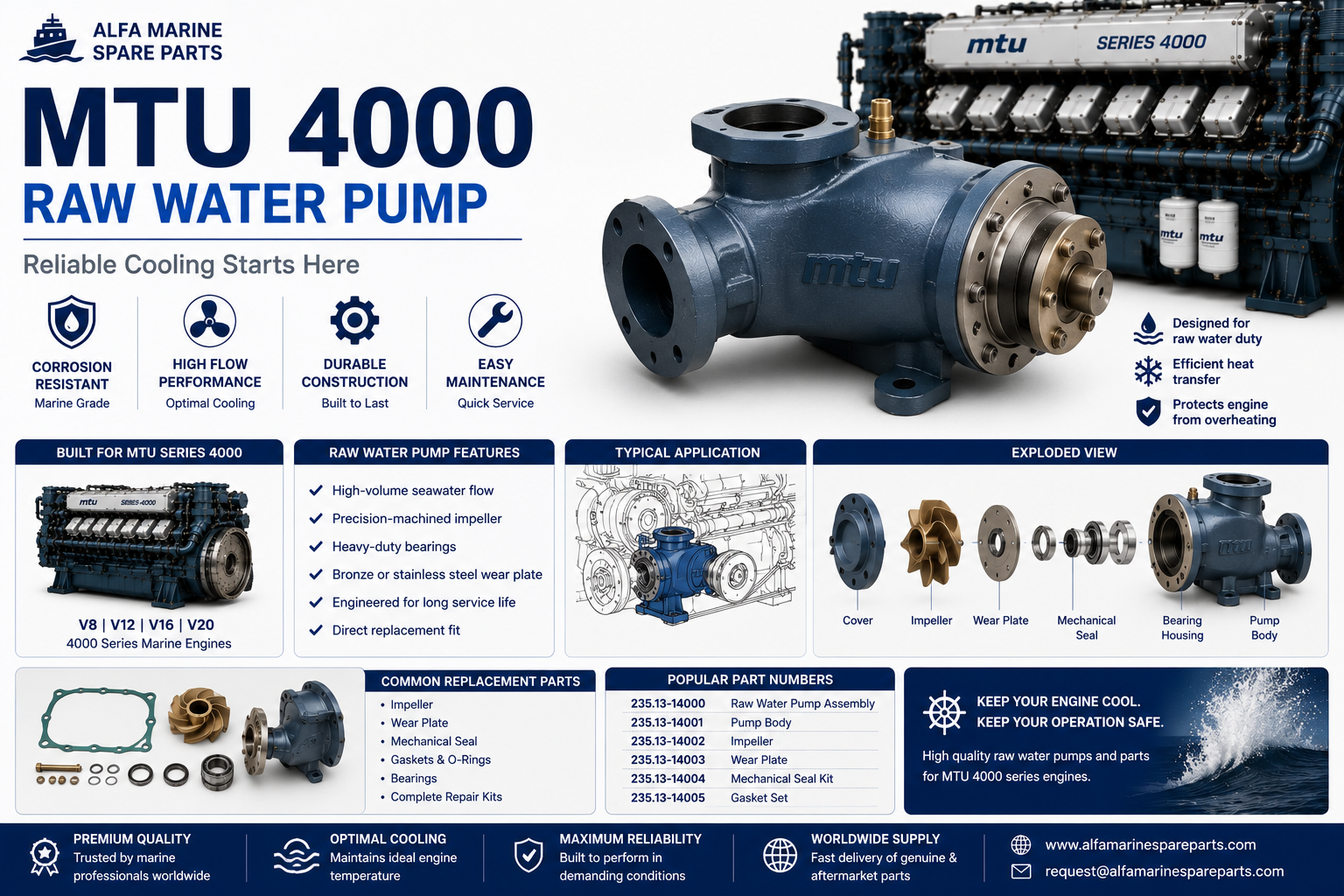
MTU Series 4000 Raw Water Pump: Seawater Flow, Cooling Problems, Inspection & Repair Guide
The raw water pump on an MTU Series 4000 marine engine is one of the most important components in the vessel’s cooling system.
Its job sounds simple:
move seawater through the marine cooling circuit.
But on a large MTU 4000 engine, that seawater helps remove an enormous amount of heat.
When raw water flow begins to decrease, the first symptom is not always an immediate overheating alarm.
Sometimes the change is much smaller.
The engine normally runs at a familiar temperature, but lately it operates a little hotter at cruise.
At idle, everything looks normal.
At high load, however, coolant temperature slowly begins climbing.
Or one engine in a twin installation starts running several degrees warmer than the other.
Those small differences matter.
A raw water pump can continue operating while gradually losing efficiency because of wear, damaged seals, internal corrosion, pump-drive problems or restrictions elsewhere in the seawater circuit.
The important question therefore is not simply:
“Is the raw water pump turning?”
It is:
“Is the complete seawater system still delivering enough cooling water when the MTU 4000 is under load?”
1. MTU Series 4000 Marine Engine Types
The MTU Series 4000 marine family includes several V8, V12, V16 and V20 configurations.
Common engine types include:
MTU 8V 4000
- MTU 8V 4000 M53
- MTU 8V 4000 M53R
- MTU 8V 4000 M54
- MTU 8V 4000 M63
MTU 12V 4000
- MTU 12V 4000 M53
- MTU 12V 4000 M63
- MTU 12V 4000 M64
- MTU 12V 4000 M65
- MTU 12V 4000 M65L
- MTU 12V 4000 M73
- MTU 12V 4000 M73L
- MTU 12V 4000 M93
- MTU 12V 4000 M93L
MTU 16V 4000
- MTU 16V 4000 M53
- MTU 16V 4000 M63
- MTU 16V 4000 M63L
- MTU 16V 4000 M64
- MTU 16V 4000 M65
- MTU 16V 4000 M65L
- MTU 16V 4000 M73
- MTU 16V 4000 M73L
- MTU 16V 4000 M93
- MTU 16V 4000 M93L
MTU 20V 4000
- MTU 20V 4000 M65L
- MTU 20V 4000 M73
- MTU 20V 4000 M73L
- MTU 20V 4000 M93
- MTU 20V 4000 M93L
The exact raw water pump and cooling arrangement can vary by engine model, generation, serial number and vessel installation.
For that reason:
“MTU 4000 raw water pump”
is generally not enough information for accurate parts identification.
2. What Does the MTU 4000 Raw Water Pump Do?
The raw water pump moves seawater from outside the vessel through the marine cooling circuit.
A simplified flow path may look like:
Sea intake
↓
Seacock
↓
Sea strainer
↓
Raw water pump
↓
Heat exchangers and coolers
↓
Discharge
The actual routing depends on the vessel.
The seawater circuit may help remove heat from systems including:
- Engine coolant
- Charge air
- Lubricating oil
- Marine transmission oil
- Other vessel cooling equipment
This means one raw water flow problem can influence several temperatures at once.
3. Raw Water Pump vs. Coolant Pump
These two pumps should not be confused.
Raw Water / Seawater Pump
Moves seawater through the marine cooling circuit.
Freshwater / Coolant Pump
Circulates treated coolant inside the closed engine cooling system.
Both are essential.
But they perform different jobs.
When requesting parts, do not simply write:
“MTU 4000 water pump.”
Specify whether you need the raw water pump or the engine coolant pump.
4. Why Raw Water Flow Becomes More Important Under Load
A Series 4000 engine produces far more heat at high load than at idle.
That is why cooling problems often first appear underway.
Imagine an MTU 16V 4000 M73 idling in port.
Coolant temperature is stable.
The vessel leaves the marina.
Engine load increases.
Twenty minutes later:
temperature starts creeping upward.
The cooling system may still be working.
It simply may no longer have enough capacity to remove the heat being produced.
Possible causes include:
- Reduced raw water pump output
- Restricted sea strainer
- Blocked intake
- Fouled heat exchanger
- Restricted hose
- Cooler contamination
- Excessive engine loading
5. Situation: Engine Is Normal at Idle but Hot at Cruise
This is one of the most useful symptoms.
At idle, the engine needs less cooling.
A partially restricted system may still cope.
At cruise or high load, the weakness becomes visible.
Before replacing the raw water pump, inspect the complete flow path:
Is the sea intake clear?
Is the seacock fully open?
Is the sea strainer clean?
Are the suction hoses sound?
Is the raw water pump producing proper flow?
Are the heat exchangers clean?
Always follow the water.
6. Raw Water Pumps Can Lose Efficiency Gradually
A pump does not always fail suddenly.
It may continue operating while its output slowly decreases.
Possible causes include:
- Internal wear
- Shaft wear
- Bearing wear
- Seal deterioration
- Corrosion
- Drive wear
- Housing damage
That is why visible water movement does not automatically prove that the pump is healthy.
The real question is:
Is enough water moving?
7. Pump Housing Wear
Internal pump clearances matter.
As pump components and housing surfaces wear, efficiency can decrease.
The pump may still:
- Rotate normally
- Make no unusual noise
- Show no major external leak
but move less water than before.
This can be especially noticeable when the engine requires maximum cooling capacity.
8. Shaft Wear
The raw water pump shaft should be inspected during overhaul.
Look particularly at areas where:
- Bearings support the shaft
- Mechanical seals run
- Drive components connect
A worn shaft can contribute to:
- Seal leakage
- Bearing problems
- Misalignment
- Repeated pump failure
Replacing only a leaking seal may not provide a long-term repair if the shaft itself is damaged.
9. Pump Bearings
Raw water pump bearings can deteriorate over time.
Possible warning signs include:
- Rumble
- Grinding
- Rough rotation
- Shaft play
- Abnormal heat
- Seal leakage
A failing bearing may allow the shaft to move away from its intended position.
That can then damage the sealing system.
One problem can create another.
10. Mechanical Seal Leakage
The shaft must rotate while the pump remains sealed.
A mechanical seal helps make that possible.
When the seal begins deteriorating, you may notice:
- Water droplets
- Moisture around the shaft
- Salt buildup
- Corrosion
Do not assume a small leak is harmless.
Seawater can eventually reach nearby bearings, mounting surfaces and other engine-room equipment.
11. Salt Deposits Are Early Warning Signs
A seawater leak does not need to be actively dripping when you inspect the engine.
Water evaporates.
Salt remains.
Look for:
- White crystalline deposits
- Green corrosion
- Rust staining
around:
- Pump shaft
- Pump housing
- Pipe connections
- Flanges
- Cooler connections
These deposits can reveal leaks that otherwise appear intermittent.
12. Why Seawater Leakage Is More Serious Than It Looks
Seawater is highly corrosive.
A small raw water pump leak can eventually damage:
- Pump bearings
- Mounting hardware
- Nearby electrical connectors
- Engine brackets
- Pipes
- Fasteners
A small seal problem left unattended can therefore become a much larger repair.
13. Sea Strainer Restriction
Before removing the raw water pump, inspect the sea strainer.
You may find:
- Seaweed
- Plastic
- Shells
- Sand
- Marine growth
- General debris
A partially blocked strainer may provide enough water at low RPM but become restrictive at higher flow demand.
This can create exactly the same symptom as a weak pump.
14. Raw Water Intake Blockage
Sometimes the pump and strainer are perfectly healthy.
The restriction is outside the vessel.
Possible causes include:
- Plastic bag
- Marine growth
- Blocked intake screen
- Debris
- Partially closed seacock
Cooling-system troubleshooting should therefore begin at the seawater source.
15. A Suction Hose Can Collapse Internally
A raw water suction hose may look perfectly normal when the engine is stopped.
Under high pump suction, however, an old or weakened hose can partially collapse.
Possible causes include:
- Age
- Softening
- Internal delamination
- Structural deterioration
This can create:
normal cooling at idle
but:
reduced cooling at high RPM.
It is an easy fault to overlook.
16. Suction-Side Air Leaks
The pump needs a solid supply of seawater.
A poor seal on the suction side can allow air to enter.
Possible areas include:
- Strainer lid seal
- Hose clamps
- Pump inlet connection
- Seacock connections
- Pipe joints
A suction leak may not leak water outward.
Instead, it may pull air inward.
That can reduce pump performance significantly.
17. Heat Exchanger Fouling
A perfectly healthy raw water pump cannot compensate for a badly restricted heat exchanger.
Cooling passages may accumulate:
- Salt deposits
- Scale
- Marine growth
- Corrosion products
- Debris
The engine may slowly begin running hotter season after season.
That gradual trend is important.
Do not wait for a high-temperature alarm before investigating.
18. Raw Water Flow and Charge-Air Cooling
MTU Series 4000 engines are turbocharged and operate with substantial charge-air cooling demands.
If cooling performance deteriorates, possible symptoms can include:
- Higher charge-air temperature
- Higher exhaust temperature
- Reduced performance
- Increased smoke
This can make a cooling-system problem look like a turbocharger or combustion problem.
Always consider the systems together.
19. Raw Water Flow and Oil Temperature
Cooling performance can also influence lubricating-oil temperature depending on the system arrangement.
Reduced cooling can contribute to:
- Higher oil temperature
- Lower hot oil pressure
- Increased thermal stress
If coolant and oil temperatures start increasing together, ask what cooling systems they may have in common.
20. Raw Water Flow and Marine Gear Temperature
Depending on the vessel installation, raw water may also help cool the marine transmission.
Now imagine:
engine coolant temperature rises
and:
gearbox oil temperature rises.
That combination should make you look for a common cooling-water problem.
It may be more likely than two unrelated failures happening at the same time.
21. Twin MTU 4000 Engines Make Troubleshooting Easier
Twin-engine installations provide an excellent reference.
Imagine a yacht fitted with twin MTU 16V 4000 M73 engines.
Under similar RPM and load:
Port engine: normal temperature
Starboard engine: consistently hotter
Now compare:
- Raw water pumps
- Sea strainers
- Suction hoses
- Heat exchangers
- Charge-air temperatures
- Oil temperatures
- Seawater discharge
The healthy engine helps show what normal should look like.
22. Compare the Engines Under Similar Conditions
The comparison only works when operating conditions are similar.
Compare at approximately the same:
- Engine RPM
- Engine load
- Vessel speed
- Seawater temperature
A heavily loaded engine should not automatically be expected to show exactly the same readings as one operating at light load.
23. Seawater Temperature Also Matters
Cooling performance changes with seawater temperature.
Warm seawater provides less temperature difference for rejecting engine heat than colder seawater.
This means a Series 4000 may behave differently in:
- Northern European waters
- Mediterranean summer
- Tropical waters
Do not automatically condemn the pump because temperatures are slightly higher under significantly warmer seawater conditions.
Look at the complete operating picture.
24. MTU 8V 4000 Raw Water Pumps
For engines including:
- MTU 8V 4000 M53
- MTU 8V 4000 M53R
- MTU 8V 4000 M63
inspect the raw water system for:
- Pump leakage
- Shaft condition
- Bearing noise
- Intake restriction
- Strainer fouling
- Cooler condition
The exact pump should always be identified using the engine and pump information.
25. MTU 12V 4000 Raw Water Pumps
For engines including:
- MTU 12V 4000 M53
- MTU 12V 4000 M63
- MTU 12V 4000 M65
- MTU 12V 4000 M73
- MTU 12V 4000 M93
the raw water circuit must handle substantial cooling demand under load.
Pay particular attention to:
- Pump leakage
- Pump bearings
- Cooler restriction
- Hose deterioration
- Cooling temperature trends
26. MTU 16V 4000 Raw Water Pumps
The V16 family includes high-output engines such as:
- MTU 16V 4000 M63
- MTU 16V 4000 M65
- MTU 16V 4000 M73
- MTU 16V 4000 M73L
- MTU 16V 4000 M93
- MTU 16V 4000 M93L
At high load, these engines produce substantial heat.
A relatively small reduction in raw water flow can therefore become increasingly important during sustained high-speed operation.
27. MTU 20V 4000 Raw Water Pumps
Examples include:
- MTU 20V 4000 M65L
- MTU 20V 4000 M73
- MTU 20V 4000 M73L
- MTU 20V 4000 M93
- MTU 20V 4000 M93L
The V20 configuration places even greater demands on cooling-system performance.
Pump output, heat exchanger condition, raw water flow and cooler cleanliness all have to work together.
28. Raw Water Pump Inspection During Routine Engine-Room Rounds
A daily inspection can tell you a lot.
Look for:
☐ Seawater leakage
☐ Salt deposits
☐ Green corrosion
☐ Pump bearing noise
☐ Loose connections
☐ Damaged hoses
☐ Dirty sea strainer
☐ Changes in engine temperature
☐ Changes in oil or gear temperature
The goal is not to dismantle the pump every day.
It is to notice when something changes.
29. Listen to the Pump
Engine-room inspections should involve more than visual checks.
A new:
- Rumble
- Grinding noise
- Mechanical whine
around the pump deserves investigation.
You often hear bearing deterioration before the pump fails completely.
30. Raw Water Pump Overhaul
Depending on pump design and condition, a pump overhaul may involve:
- Pump disassembly
- Cleaning
- Housing inspection
- Shaft inspection
- Bearing inspection or replacement
- Mechanical seal replacement
- Gasket replacement
- O-ring replacement
- Drive component inspection
- Reassembly
- Leak testing
Do not assume every leaking pump needs complete replacement.
But also do not call a pump “overhauled” simply because one seal was changed.
31. Inspect the Pump Housing
During overhaul, inspect internal housing surfaces for:
- Corrosion
- Pitting
- Erosion
- Mechanical damage
A new shaft and seals installed into a severely deteriorated housing may not produce a reliable pump.
The housing condition determines whether rebuilding makes sense.
32. Inspect the Drive Components
The pump needs to be driven correctly by the engine.
Depending on the exact arrangement, inspect:
- Drive gear
- Coupling
- Drive shaft
- Mounting interface
A pump with healthy internal components cannot deliver proper flow if the drive is damaged or slipping.
33. Rebuild or Replace?
A rebuild may be sensible when:
- Housing is serviceable
- Shaft can be reused or replaced
- Bearings and seals are available
- Drive components remain good
Replacement may be more appropriate when:
- Housing is badly corroded
- Shaft damage is extensive
- Drive damage is serious
- Multiple major components are worn
- Reliable repair cannot be guaranteed
The objective is dependable cooling, not simply making the pump turn again.
34. New vs. Reconditioned Raw Water Pump
A new pump is a new complete assembly.
A reconditioned pump is a used pump returned to serviceable condition.
When buying reconditioned, ask what was actually renewed.
For example:
- Shaft?
- Bearings?
- Mechanical seal?
- O-rings?
- Gaskets?
- Drive parts?
A freshly painted pump is not necessarily a fully overhauled pump.
35. Why Pump Identification Matters
The Series 4000 family covers many engines.
Raw water pumps can differ in:
- Pump housing
- Shaft
- Drive arrangement
- Connections
- Mounting
- Capacity
- Internal components
Never assume that a pump from one Series 4000 version fits another simply because both engines are called “4000.”
36. Do Not Guess Raw Water Pump Part Numbers
The correct pump should be identified from the actual engine and component information.
For an expensive assembly such as a Series 4000 raw water pump, guessing from an unverified number can create a costly mistake.
Use:
engine model + engine serial number + existing pump number + photographs.
This is much safer than ordering from engine family alone.
37. What Information Should Be Sent When Ordering?
A useful inquiry looks like:
Manufacturer: MTU
Engine: MTU 16V 4000 M73
Engine Serial Number: __________
Existing Raw Water Pump Part Number: __________
Pump Identification/Marking: __________
Complete Pump or Repair Parts: __________
Quantity: __________
Photographs: Attached
Delivery Location: __________
If the pump itself has an identification plate or stamped number, include a clear photograph.
38. Raw Water Pump vs. Pump Repair Kit
When requesting parts, clarify whether you need:
Complete Pump
The complete raw water pump assembly.
Pump Overhaul Kit
A group of parts intended for pump rebuilding.
Individual Components
These might include:
- Mechanical seal
- Bearings
- Shaft
- Gaskets
- O-rings
- Drive components
This distinction can avoid unnecessary replacement of an otherwise serviceable pump.
39. Common MTU 4000 Raw Water Pump Spare Parts
Depending on the particular pump, overhaul requirements may include:
- Complete raw water pump
- Pump housing
- Pump shaft
- Bearings
- Mechanical seal
- Shaft sealing components
- Gaskets
- O-rings
- Drive gear
- Coupling components
- Covers
- Fasteners
- Mounting seals
Correct compatibility should always be verified against the existing pump.
40. Other Cooling Components to Inspect
If raw water flow is low, also inspect:
- Sea strainer
- Seacock
- Raw water hoses
- Heat exchanger
- Charge-air cooler
- Oil cooler
- Engine coolant pump
- Thermostatic components
- Temperature sensors
Do not focus so narrowly on the pump that you miss the actual restriction.
41. Situation: Pump Is Leaking but Engine Temperature Is Normal
Do not ignore the leak.
The pump may still produce enough flow today.
But continued leakage can eventually contribute to:
- Seal deterioration
- Bearing damage
- Shaft corrosion
- Pump failure
A developing leak is often much cheaper to repair than a failed pump.
42. Situation: Engine Is Hot but Pump Is Completely Dry
A pump does not need to leak to be worn.
Possible internal problems can include:
- Housing wear
- Bearing problems
- Drive problems
- Internal corrosion
But remember to inspect the rest of the raw water system too.
A dry pump does not prove that it is healthy.
43. Situation: Pump Was Rebuilt but the Engine Still Runs Hot
Now look beyond the pump.
Possible causes include:
- Blocked intake
- Restricted sea strainer
- Collapsing suction hose
- Air entering the suction side
- Fouled heat exchanger
- Restricted cooler
- Excessive engine load
The pump overhaul may have been successful while another restriction remains elsewhere.
44. Raw Water Pump Problems After Maintenance
If cooling problems begin immediately after raw water system servicing, inspect what was disturbed.
Check:
- Seacock position
- Strainer lid seal
- Hose connections
- Pump connections
- Cooler connections
An air leak introduced during maintenance can reduce pump performance even when everything appears externally dry.
45. Before a Long Voyage
Cooling-system faults are easier to manage alongside a dock than offshore.
Before extended operation, inspect:
- Sea intake
- Seacock
- Sea strainer
- Raw water pump
- Pump leakage
- Hoses
- Coolers
- Temperature trends
If one engine has recently begun running hotter, investigate before departure rather than assuming it will remain stable.
46. Keep a Cooling-System Maintenance Record
Record:
- Raw water pump overhaul
- Seal replacement
- Bearing replacement
- Shaft replacement
- Heat exchanger cleaning
- Cooler cleaning
- Hose replacement
- Temperature changes
Maintenance history helps identify recurring problems.
If the same pump begins leaking repeatedly after short operating periods, something beyond the seal may be wrong.
47. Frequently Asked Questions
What Does the Raw Water Pump Do on an MTU Series 4000?
It circulates seawater through the marine cooling system so heat can be removed from engine and vessel cooling circuits.
Is the Raw Water Pump the Same as the Engine Coolant Pump?
No. The raw water pump moves seawater; the coolant pump circulates treated engine coolant.
Why Does My MTU 4000 Run Hot Only at High Load?
Possible causes include reduced raw water flow, restricted sea strainer, intake blockage, weakened hose, heat exchanger fouling, pump wear or excessive engine loading.
Can a Raw Water Pump Still Work if It Is Worn?
Yes. It may continue producing flow but not enough to meet full-load cooling demand.
Why Is There Salt Around My Raw Water Pump?
Salt deposits usually indicate that seawater has leaked and evaporated. Inspect pump seals, shaft areas and connections.
Can a Leaking Raw Water Pump Be Rebuilt?
Depending on housing, shaft, bearings, seals and drive condition, rebuilding may be possible.
Should I Replace Only the Pump Seal?
That depends on the failure. A worn shaft or bearing can cause a new seal to fail again.
Why Does a Rebuilt Pump Still Leak?
Possible causes include damaged shaft, worn housing, incorrect seal, poor assembly, bearing play or damaged sealing surfaces.
Can a Blocked Sea Strainer Look Like Pump Failure?
Yes. Both can reduce seawater flow and produce similar high-temperature symptoms.
Does Every MTU 4000 Use the Same Raw Water Pump?
No. Pump specifications vary according to engine model, serial number and cooling configuration.
What Information Do I Need to Order the Correct Pump?
Provide the complete engine model, engine serial number, existing pump part number and clear photographs.
MTU Series 4000 Raw Water Pump & Cooling Parts
Common requirements can include:
- Complete raw water pumps
- Seawater pump assemblies
- Pump shafts
- Bearings
- Mechanical seals
- Pump gaskets
- O-rings
- Pump housings
- Drive gears
- Coupling components
- Heat exchanger parts
- Heat exchanger gaskets
- Charge-air cooler parts
- Oil cooler components
- Coolant pumps
- Cooling hoses
- Thermostatic components
- Temperature sensors
Correct identification should always be based on the exact engine and pump configuration.
Browse Our Complete Catalog
Marine engine brands:
https://alfamarinespareparts.com/our-brand
Marine spare parts:
https://alfamarinespareparts.com/spareparts
Contact Alfa Marine Spare Parts
For MTU Series 4000 raw water pumps, seawater pumps, pump overhaul parts and marine cooling-system components:
Email: request@alfamarinespareparts.com
For faster identification, provide:
complete MTU Series 4000 engine model + engine serial number + existing raw water pump part number + pump photographs + required parts + quantity + delivery location.
Final Word
The raw water pump on an MTU Series 4000 marine engine should not be judged only by whether seawater appears to be moving.
The real question is:
Is enough seawater moving when the engine is producing serious power?
A pump with worn internal components may still circulate some water.
A partially blocked strainer may still provide enough flow at idle.
A weakened suction hose may look normal until high pump demand causes it to collapse.
A heat exchanger may still work while slowly losing efficiency because of fouling.
And one engine in a twin MTU installation may begin running hotter long before an alarm appears.
That is why the best troubleshooting method is to follow the entire seawater path:
sea intake → seacock → strainer → raw water pump → heat exchangers and coolers → discharge.
Then ask:
Where is flow being lost?
If the pump is leaking, inspect more than the seal.
If the seal has failed twice, inspect the shaft and bearings.
If the pump has been rebuilt but cooling remains poor, continue looking downstream.
And when ordering a replacement, do not rely on:
“MTU 4000 raw water pump.”
Use:
complete engine model + serial number + existing pump number + photographs.
On an MTU 8V, 12V, 16V or 20V 4000, maintaining reliable raw water flow protects much more than the pump itself. It protects the entire engine from excessive heat.