MTU 4000 Marine Engine Specifications – Model Range & Technical Overview
The MTU Series 4000 marine engine is not one engine.
It is an entire high-performance diesel engine family developed for demanding marine applications, ranging from commercial workboats and ferries to patrol vessels, offshore craft and large yachts.
Within the Series 4000 family, operators may encounter 8V, 12V, 16V and 20V configurations, together with different M-designations such as M53, M63, M65, M73 and M93 families.
At first glance, two MTU 4000 engines can look closely related.
But an 8V 4000 M53 and a 20V 4000 M93L were designed for very different operating requirements.
Cylinder count is only the beginning.
To understand an MTU 4000 correctly, you need to look at:
engine model + cylinder configuration + M-designation + power rating + rated RPM + duty profile + application.
This guide explains the MTU 4000 marine engine range and the important technical differences between the major configurations.
1. What Is the MTU Series 4000 Marine Engine?
The MTU Series 4000 is a high-speed diesel engine platform available in several cylinder configurations and marine ratings.
Depending on the particular generation and model, Series 4000 engines are used for applications including:
- Commercial vessels
- Ferries
- Workboats
- Offshore vessels
- Patrol craft
- Government vessels
- Fast passenger vessels
- Large yachts
- Marine auxiliary power
- Diesel-electric propulsion applications
The wide range of applications explains why simply saying:
“MTU 4000 engine”
does not identify one exact engine.
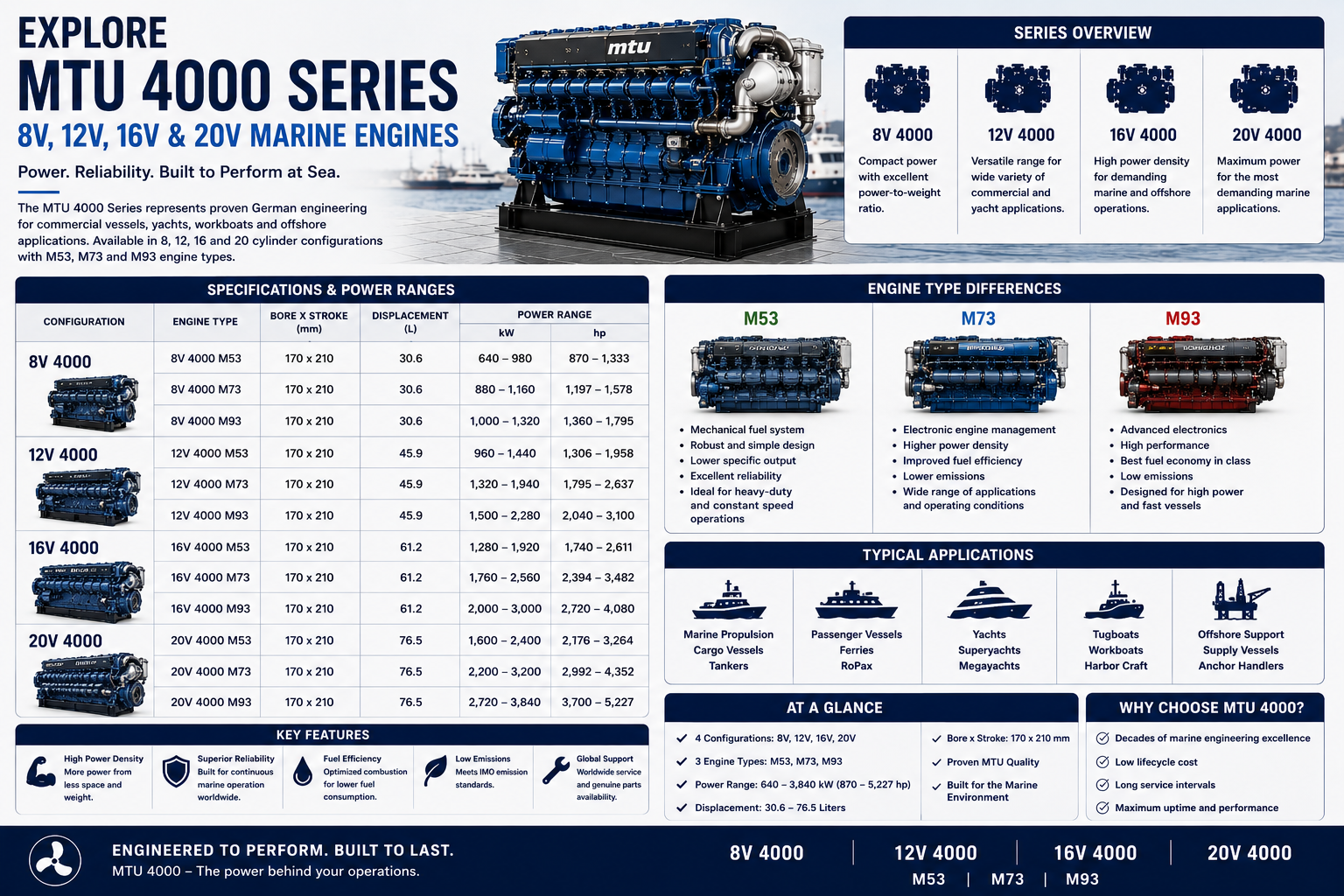
2. MTU 4000 Marine Engine Family at a Glance
The major cylinder configurations are:
| Engine FamilyCylindersConfigurationApprox. Displacement*Relative Size | ||||
| MTU 8V 4000 | 8 | V8 | 38.2 L | Compact Series 4000 |
| MTU 12V 4000 | 12 | V12 | 57.3 L | Medium |
| MTU 16V 4000 | 16 | V16 | 76.3 L | Large |
| MTU 20V 4000 | 20 | V20 | 95.4 L | Largest |
*Approximate displacement figures apply to the established Series 4000 architecture using a 170 mm bore and 210 mm stroke. Exact specifications should always be verified for the particular engine generation and M-designation.
The progression is straightforward:
8V → 12V → 16V → 20V
But the correct engine for a vessel is not determined simply by choosing the largest cylinder count.
Duty cycle and required output matter just as much.
3. MTU 4000 Bore and Stroke
A well-known characteristic of the established Series 4000 architecture is:
Bore: approximately 170 mm
Stroke: approximately 210 mm
This cylinder geometry helps explain the displacement progression across the engine family.
Adding cylinders increases total displacement while maintaining the basic Series 4000 cylinder architecture.
That gives us approximately:
8V 4000 — 38.2 liters
12V 4000 — 57.3 liters
16V 4000 — 76.3 liters
20V 4000 — 95.4 liters
However, specifications should still be checked against the exact engine version before being used for engineering, repair or parts identification.
4. MTU 8V 4000 Marine Engine
The MTU 8V 4000 is the smallest standard cylinder configuration within the Series 4000 family.
That does not make it a small marine diesel.
With approximately 38 liters of displacement, it remains a substantial commercial-class engine.
Depending on generation and application, 8V versions can include engines from families such as:
- MTU 8V 4000 M53
- MTU 8V 4000 M53R
- MTU 8V 4000 M54
- MTU 8V 4000 M54R
- MTU 8V 4000 M55 variants
- MTU 8V 4000 M63 variants
The exact available designation depends on generation and application.
5. Where Does the 8V 4000 Fit?
The V8 configuration can make sense where a vessel requires:
- Series 4000 construction
- Commercial operating capability
- Substantial torque
- Lower output than V12/V16/V20 versions
- A more compact engine package
Typical applications can include commercial vessels, workboats and specialized marine installations.
The important point is that fewer cylinders do not necessarily mean:
lighter-duty engine.
A commercial 8V 4000 can be selected specifically because its rating matches a demanding operating profile.
6. MTU 12V 4000 Marine Engine
Moving from V8 to V12 increases displacement substantially.
The MTU 12V 4000 has an approximate displacement of 57.3 liters in the established architecture.
Marine variants across Series 4000 generations include designations such as:
- MTU 12V 4000 M53
- MTU 12V 4000 M53R
- MTU 12V 4000 M54
- MTU 12V 4000 M55 variants
- MTU 12V 4000 M63
- MTU 12V 4000 M64
- MTU 12V 4000 M65 variants
- MTU 12V 4000 M73
- MTU 12V 4000 M73L
- MTU 12V 4000 M93
- MTU 12V 4000 M93L
Not every designation applies to every market, generation or marine application.
7. Where Is the MTU 12V 4000 Used?
The V12 configuration occupies an important position in the Series 4000 range.
Applications can include:
- Ferries
- Workboats
- Offshore vessels
- Passenger craft
- Patrol vessels
- Government craft
- Commercial propulsion
- Large yacht installations
It offers considerably more displacement than the V8 without moving to the physical size and output potential of the V16 or V20.
8. Why Choose a 12V Instead of a 16V?
More power is not always better.
Suppose the vessel only requires an output that can be comfortably supplied by a properly rated 12V 4000.
Installing a larger V16 can potentially mean:
- More engine weight
- More installation space
- More cylinders to maintain
- More associated components
Engine selection should match the vessel's actual propulsion requirement.
The objective is not:
“Install the largest engine possible.”
It is:
“Install the correct engine for the duty.”
9. MTU 16V 4000 Marine Engine
The MTU 16V 4000 is one of the most recognizable members of the Series 4000 family.
The established architecture gives it approximately 76.3 liters of displacement.
Depending on generation and application, marine versions can include:
- MTU 16V 4000 M53
- MTU 16V 4000 M53R
- MTU 16V 4000 M54
- MTU 16V 4000 M55 variants
- MTU 16V 4000 M63
- MTU 16V 4000 M63L
- MTU 16V 4000 M63R
- MTU 16V 4000 M64
- MTU 16V 4000 M65
- MTU 16V 4000 M65L
- MTU 16V 4000 M65R
- MTU 16V 4000 M73
- MTU 16V 4000 M73L
- MTU 16V 4000 M93
- MTU 16V 4000 M93L
The exact model designation is extremely important when sourcing parts.
10. Where Is the MTU 16V 4000 Used?
The V16 configuration is suitable for demanding propulsion applications requiring substantially more output.
Examples can include:
- Fast ferries
- Offshore craft
- Patrol vessels
- Government vessels
- Large commercial vessels
- High-speed workboats
- Large yachts
This is where Series 4000 power density becomes particularly valuable.
11. MTU 20V 4000 Marine Engine
At the top of the established cylinder-count range sits the MTU 20V 4000.
With approximately 95.4 liters of displacement, this V20 configuration provides very high output from a high-speed diesel platform.
Marine designations can include versions from families such as:
- MTU 20V 4000 M65L
- MTU 20V 4000 M73
- MTU 20V 4000 M73L
- MTU 20V 4000 M93
- MTU 20V 4000 M93L
Depending on generation and rating, these engines can deliver several megawatts of propulsion power.
12. Where Is the MTU 20V 4000 Used?
The V20 configuration becomes relevant where very high power density is required.
Applications can include:
- Fast patrol vessels
- Government craft
- High-speed ferries
- Large commercial craft
- Offshore vessels
- Specialized high-performance marine applications
The V20 provides substantially more displacement than the V8 while remaining part of the same broad Series 4000 engine family.
13. MTU 4000 Engine Size Overview
A simple way to understand the progression is:
8V 4000
8 cylinders — approximately 38.2 L
12V 4000
12 cylinders — approximately 57.3 L
16V 4000
16 cylinders — approximately 76.3 L
20V 4000
20 cylinders — approximately 95.4 L
Each step increases the number of cylinders, total displacement and potential output.
But this still does not tell us the complete engine specification.
For that, we need the M-designation.
14. What Does the M-Designation Tell You?
This is where Series 4000 identification becomes more interesting.
Consider:
MTU 16V 4000 M53
and:
MTU 16V 4000 M93L
Both are:
- Series 4000
- V16
- Marine engines
But they should not be treated as the same engine.
The M-designation helps distinguish specific engine developments, ratings and application configurations.
Depending on the engine generation, differences can involve:
- Power output
- Rated RPM
- Duty profile
- Turbocharging
- Fuel injection
- Cooling configuration
- Emissions equipment
- Engine electronics
- Component design
That is why the full model designation matters.
15. MTU 4000 M53
The M53 family is strongly associated with commercial marine service.
These engines can be found in applications where:
- High annual operating hours
- Reliability
- Commercial duty
- Long operating periods
are major considerations.
A lower specific output does not mean an inferior engine.
It may mean the engine has been rated specifically for a demanding operating profile.
16. MTU 4000 M63
The M63 family is another important Series 4000 marine designation.
Depending on cylinder configuration and rating, M63 engines can serve demanding commercial propulsion applications.
When identifying an M63 engine, always include the cylinder count.
For example:
16V 4000 M63
is much more useful than simply:
4000 M63.
17. MTU 4000 M65 and M65L
M65-family engines appear in commercial marine applications and represent another development within the Series 4000 platform.
Possible designations include variants such as:
- 12V 4000 M65
- 12V 4000 M65L
- 16V 4000 M65
- 16V 4000 M65L
- 20V 4000 M65L
Availability depends on engine generation and application.
These engines should always be identified by their complete model designation before technical specifications or parts are selected.
18. MTU 4000 M73
The M73 is one of the best-known Series 4000 marine designations.
You may encounter:
- MTU 12V 4000 M73
- MTU 16V 4000 M73
- MTU 20V 4000 M73
There are also M73L variants.
These engines have been used in high-output marine propulsion applications where power density is particularly important.
19. MTU 4000 M73L
The L matters.
Do not assume:
M73 = M73L
for parts identification.
Even closely related engine designations can have differences involving:
- Turbochargers
- Fuel components
- Cooling parts
- Sensors
- Engine electronics
- Gaskets
- Other components
Always use the complete designation.
20. MTU 4000 M93
The M93 family moves toward the high-performance side of the Series 4000 range.
Depending on configuration, engines include:
- 12V 4000 M93
- 16V 4000 M93
- 20V 4000 M93
These engines are relevant where high propulsion output is required from a relatively compact high-speed diesel package.
21. MTU 4000 M93L
The M93L family includes some of the highest-output established Series 4000 marine configurations.
Examples include:
- MTU 12V 4000 M93L
- MTU 16V 4000 M93L
- MTU 20V 4000 M93L
The 20V version sits at the upper end of Series 4000 marine propulsion output.
These engines can be particularly relevant to fast vessels where:
power-to-weight ratio matters.
22. MTU 4000 Power Range Overview
The easiest way to understand the family is not by memorizing one horsepower figure.
Power varies significantly according to the exact M-designation and duty rating.
Broadly:
| ConfigurationPosition in Series 4000 RangeTypical Marine Role | ||
| 8V 4000 | Lower output range | Commercial / workboat |
| 12V 4000 | Medium output range | Commercial / ferry / offshore |
| 16V 4000 | High output range | Commercial / patrol / yacht |
| 20V 4000 | Highest output range | Fast commercial / patrol / specialized |
Specific rated power should always be checked for the exact engine model.
23. Why Two MTU 4000 Engines With the Same Cylinder Count Can Have Different Power
Suppose you have two V16 engines.
One is:
16V 4000 M53
and another is:
16V 4000 M93L.
Why can their output differ significantly?
Because output depends on more than displacement.
Factors can include:
- Turbocharger configuration
- Injection strategy
- Rated RPM
- Engine calibration
- Duty rating
- Cooling capacity
- Application requirements
The engine block architecture may be related, but the complete engine package and intended duty can be very different.
24. Rated RPM Matters
Engine output should never be considered without RPM.
For example, one Series 4000 commercial engine may be optimized around lower rated speed and long operating periods.
Another high-performance version may operate at a higher rated speed to produce significantly more power.
Therefore:
Power without RPM tells only half the story.
When identifying an engine, record both.
25. Duty Rating Matters Even More
This is one of the most important things to understand about marine diesel engines.
Imagine two engines:
Engine A: lower maximum horsepower but designed for very high annual operating hours.
Engine B: significantly higher horsepower but intended for a different operating profile.
Which engine is stronger?
That question is too simple.
The correct question is:
Which engine is correctly rated for the vessel's duty cycle?
26. Commercial Vessel vs. High-Speed Vessel
Consider two very different vessels.
Vessel A
A commercial workboat operates:
- Every day
- Long hours
- Moderate speed
- High annual engine hours
Vessel B
A fast patrol craft operates:
- Shorter missions
- High speed
- High power demand
- Different annual operating profile
Both may use Series 4000 engines.
But they may require completely different ratings.
27. MTU 4000 Fuel System
Series 4000 engines across relevant generations use electronically controlled fuel-injection technology, including common-rail systems.
Common-rail injection allows precise control of fuel delivery.
Major fuel-system components can include:
- High-pressure pumps
- Fuel rails
- Injectors
- Pressure sensors
- Fuel filters
- Electronic control components
Exact design varies by engine generation.
28. Why Fuel-System Identification Matters
Do not order an injector simply for:
“MTU 4000.”
There are too many variants.
Correct identification may require:
- Full engine model
- Engine serial number
- Existing injector number
- Engine rating
This is especially important across different Series 4000 generations.
29. MTU 4000 Turbocharging
Turbocharging is fundamental to the high power density of Series 4000 engines.
Depending on engine configuration, turbocharger arrangements differ.
The turbocharging system works together with:
- Exhaust manifolds
- Charge-air coolers
- Air intake
- Fuel injection
- Engine controls
A turbocharger should therefore never be treated as an isolated component.
30. Charge-Air Cooling
Compressed air leaving a turbocharger becomes hot.
Cooling that air increases density before it enters the cylinders.
More oxygen can then be delivered in the same volume.
This is important for:
- Combustion
- Power
- Exhaust temperature
- Efficiency
Charge-air cooler condition is therefore an important part of Series 4000 performance.
31. MTU 4000 Cooling System
Series 4000 marine engines use sophisticated cooling arrangements that can involve separate temperature circuits depending on the version and installation.
Components can include:
- Coolant pumps
- Heat exchangers
- Charge-air coolers
- Oil coolers
- Thermostatic components
- Expansion tanks
- Piping
- Sensors
Marine cooling-system condition becomes especially important at high engine load.
32. MTU 4000 Lubrication System
The lubrication system protects highly loaded internal components.
Major areas include:
- Oil pump
- Oil filters
- Oil cooler
- Main bearings
- Connecting-rod bearings
- Camshaft lubrication
- Turbocharger lubrication
- Oil pressure monitoring
Oil condition and pressure trends can provide valuable information about engine health.
33. MTU 4000 Cylinder Heads
Cylinder heads are major Series 4000 service components.
They contain or support critical combustion-related components including:
- Valves
- Valve seats
- Valve guides
- Injector location
- Cooling passages
Cylinder-head requirements must be matched to the exact engine version.
34. Pistons and Cylinder Liners
Series 4000 engines use replaceable internal components designed for major engine servicing.
Typical overhaul requirements can include:
- Pistons
- Piston rings
- Cylinder liners
- Connecting rods
- Bearings
- Gaskets
- Seals
Correct dimensions and part numbers depend on the engine version.
35. Crankshaft and Bearings
The crankshaft converts combustion force into usable rotational power.
As cylinder count increases, the crankshaft becomes substantially longer.
A V20 crankshaft therefore has very different physical characteristics from a V8 crankshaft even though both belong to the Series 4000 family.
Bearing identification must also be exact.
36. MTU 4000 Exhaust System
Exhaust-system components can include:
- Exhaust manifolds
- Turbocharger turbine housings
- Exhaust connections
- Expansion joints
- Insulation
- Vessel exhaust piping
Large Series 4000 engines move enormous quantities of exhaust gas.
Backpressure and exhaust-system condition therefore matter considerably.
37. MTU 4000 Engine Monitoring
Depending on generation and vessel configuration, operators can monitor information such as:
- RPM
- Oil pressure
- Oil temperature
- Coolant temperature
- Engine load
- Charge-air pressure
- Charge-air temperature
- Fuel-related parameters
- Exhaust information
- Fault codes
- Operating hours
Trend monitoring can be particularly valuable.
38. Why Engine Trends Matter
Imagine your 16V 4000 normally operates at a stable coolant temperature at cruising load.
Over several months:
temperature slowly increases.
The engine has not yet triggered an alarm.
But something is changing.
Possible causes include:
- Cooler fouling
- Reduced seawater flow
- Increased engine load
- Cooling-system deterioration
Trend information can identify developing problems before shutdown occurs.
39. MTU 8V vs. 12V vs. 16V vs. 20V 4000
Instead of asking:
“Which is the best MTU 4000?”
ask:
“Which configuration matches the vessel?”
8V 4000
Best suited where lower Series 4000 output and compact installation are priorities.
12V 4000
Provides a substantial increase in displacement and output while remaining smaller than the V16.
16V 4000
Offers high propulsion output for demanding commercial and high-performance applications.
20V 4000
Provides the largest standard cylinder configuration and highest output potential within the established family.
40. MTU 4000 Specification Breakdown
| Feature8V 400012V 400016V 400020V 4000 | ||||
| Cylinders | 8 | 12 | 16 | 20 |
| Arrangement | V8 | V12 | V16 | V20 |
| Approx. Displacement | 38.2 L | 57.3 L | 76.3 L | 95.4 L |
| Turbocharged | Yes | Yes | Yes | Yes |
| Charge-Air Cooled | Yes | Yes | Yes | Yes |
| Electronic Fuel Management | Depending on generation | Yes on relevant generations | Yes on relevant generations | Yes on relevant generations |
| Relative Output | Lower | Medium | High | Very High |
| Relative Engine Size | Smallest | Medium | Large | Largest |
| Typical Application | Commercial | Commercial / ferry | High-output marine | Highest-output marine |
Exact specifications depend on the particular M-designation and rating.
41. Which MTU 4000 Is Best for a Workboat?
There is no universal answer.
A workboat operating continuously may benefit more from an appropriately rated commercial engine than from the highest horsepower available.
Important considerations include:
- Vessel displacement
- Propeller demand
- Operating hours
- Cruising speed
- Maximum required speed
- Engine-room space
- Duty cycle
The correct engine is the one properly matched to the vessel.
42. Which MTU 4000 Is Best for a Fast Ferry?
Fast ferries typically prioritize:
- High power density
- Acceleration
- Vessel speed
- Reliability
- Weight
This can make higher-output V16 or V20 configurations attractive depending on vessel size and operating profile.
But final selection still depends on naval architecture and duty requirements.
43. Which MTU 4000 Is Used in Yachts?
High-output Series 4000 variants have been used in large yacht and performance-yacht applications.
Yacht propulsion often places emphasis on:
- High output
- Compact power density
- Smooth operation
- Acceleration
- High cruising speed
The exact engine depends heavily on yacht size and performance requirements.
44. Which MTU 4000 Is Used in Patrol Vessels?
Patrol and government craft can require:
- Rapid acceleration
- High maximum speed
- High power-to-weight ratio
- Reliable operation
This makes high-output Series 4000 configurations particularly relevant.
V16 and V20 engines are commonly associated with this side of the range.
45. Why Engine Serial Numbers Matter
Even the complete model does not always provide enough information for parts identification.
For example:
MTU 16V 4000 M73
is much better than:
MTU 4000.
But the engine serial number is better still.
Production changes can affect components.
The serial number helps identify the exact engine build.
46. Do Not Order Parts by Appearance Alone
Two components may look almost identical.
That does not mean they are interchangeable.
Differences can involve:
- Dimensions
- Internal calibration
- Connector design
- Material
- Pressure rating
- Engine generation
Always verify part numbers.
47. Information Needed for MTU 4000 Parts Identification
For accurate identification, provide:
Manufacturer: MTU
Complete Engine Model: __________
Example: 16V 4000 M73L
Engine Serial Number: __________
Rated Power: __________
Rated RPM: __________
Existing Part Number: __________
Part Description: __________
Quantity: __________
Photographs: Attached
Delivery Location: __________
This greatly reduces the chance of receiving the wrong component.
48. Common MTU Series 4000 Spare Parts
Typical requirements include:
- Cylinder heads
- Injectors
- Fuel pumps
- Fuel-system components
- Turbochargers
- Oil pumps
- Coolant pumps
- Seawater pumps
- Heat exchangers
- Charge-air cooler components
- Oil coolers
- Pistons
- Piston rings
- Cylinder liners
- Connecting rods
- Main bearings
- Connecting-rod bearings
- Crankshaft components
- Camshaft components
- Valves
- Valve guides
- Gaskets
- O-rings
- Seals
- Sensors
- Wiring harnesses
- Filters
- Overhaul parts
Parts availability and interchangeability depend on the exact engine.
49. Frequently Asked Questions
Is the MTU Series 4000 One Engine?
No. Series 4000 is an engine family containing multiple cylinder configurations, generations, ratings and marine applications.
What Cylinder Configurations Are Available?
The established marine family includes 8V, 12V, 16V and 20V configurations.
What Is the Displacement of an MTU 8V 4000?
Approximately 38.2 liters for the established 170 × 210 mm Series 4000 architecture.
What Is the Displacement of an MTU 12V 4000?
Approximately 57.3 liters.
What Is the Displacement of an MTU 16V 4000?
Approximately 76.3 liters.
What Is the Displacement of an MTU 20V 4000?
Approximately 95.4 liters.
Does a 20V 4000 Always Produce More Power Than a 16V?
Generally the V20 provides greater output potential, but actual rated power depends on the exact engine model and duty rating.
What Is the Difference Between M73 and M93?
They represent different Series 4000 marine engine versions and performance/application configurations. Exact differences depend on the specific cylinder count, rating and generation.
Is M73 the Same as M73L?
Do not assume they are identical. Always use the complete engine designation for technical information and parts identification.
Are All MTU 4000 Parts Interchangeable?
No. Parts can vary substantially between cylinder configurations, M-designations, generations and ratings.
What Information Should I Provide When Ordering Parts?
The most useful information is the complete engine model, serial number and existing part number.
50. MTU 4000 Model Range – The Simple Way to Remember It
Think of the family in four levels:
MTU 8V 4000
Compact end of the Series 4000 marine family.
MTU 12V 4000
More displacement and power for medium-to-high-output applications.
MTU 16V 4000
High-output configuration for demanding commercial, yacht and fast-vessel applications.
MTU 20V 4000
Largest established cylinder configuration for very high-output marine propulsion.
Then look at the M-designation to understand which version of that cylinder configuration you actually have.
Browse Our Complete Catalog
Marine engine brands:
https://alfamarinespareparts.com/our-brand
Marine spare parts:
https://alfamarinespareparts.com/spareparts
Contact Alfa Marine Spare Parts
For MTU Series 4000 marine engine spare parts:
Email: request@alfamarinespareparts.com
For faster parts identification, provide:
complete MTU engine model + serial number + rated power + rated RPM + existing part number + quantity + photographs + delivery location.
Final Word
The MTU Series 4000 marine engine range becomes much easier to understand once you stop treating “4000” as a single engine model.
Start with the cylinder count:
8V, 12V, 16V or 20V.
Then identify the exact M-designation:
M53, M63, M65, M73, M93 or another applicable version.
Then look at:
rated power, rated RPM and duty profile.
Finally, confirm the:
engine serial number.
That complete identification tells you far more than the Series 4000 name alone.
An 8V 4000 M53 may be selected because a commercial vessel requires dependable long-running operation.
A 16V 4000 M73 may be selected where considerably more propulsion power is required.
A 20V 4000 M93L sits at a very different end of the family, where extremely high power density becomes the priority.
None is automatically the “better” engine.
They were developed for different jobs.
That is the key to understanding the MTU 4000 family:
Do not look only at horsepower. Look at what the engine was designed to do.