MTU Series 4000 High-Pressure Fuel Pump: Common-Rail Pressure, Problems, Testing & Replacement Guide
The MTU Series 4000 high-pressure fuel pump is one of the key components behind the engine’s common-rail injection system.
The injectors may be responsible for delivering fuel into each cylinder, but they cannot do their job properly unless the fuel system first produces and maintains the required pressure.
That is where the high-pressure fuel pump comes in.
Its basic job is:
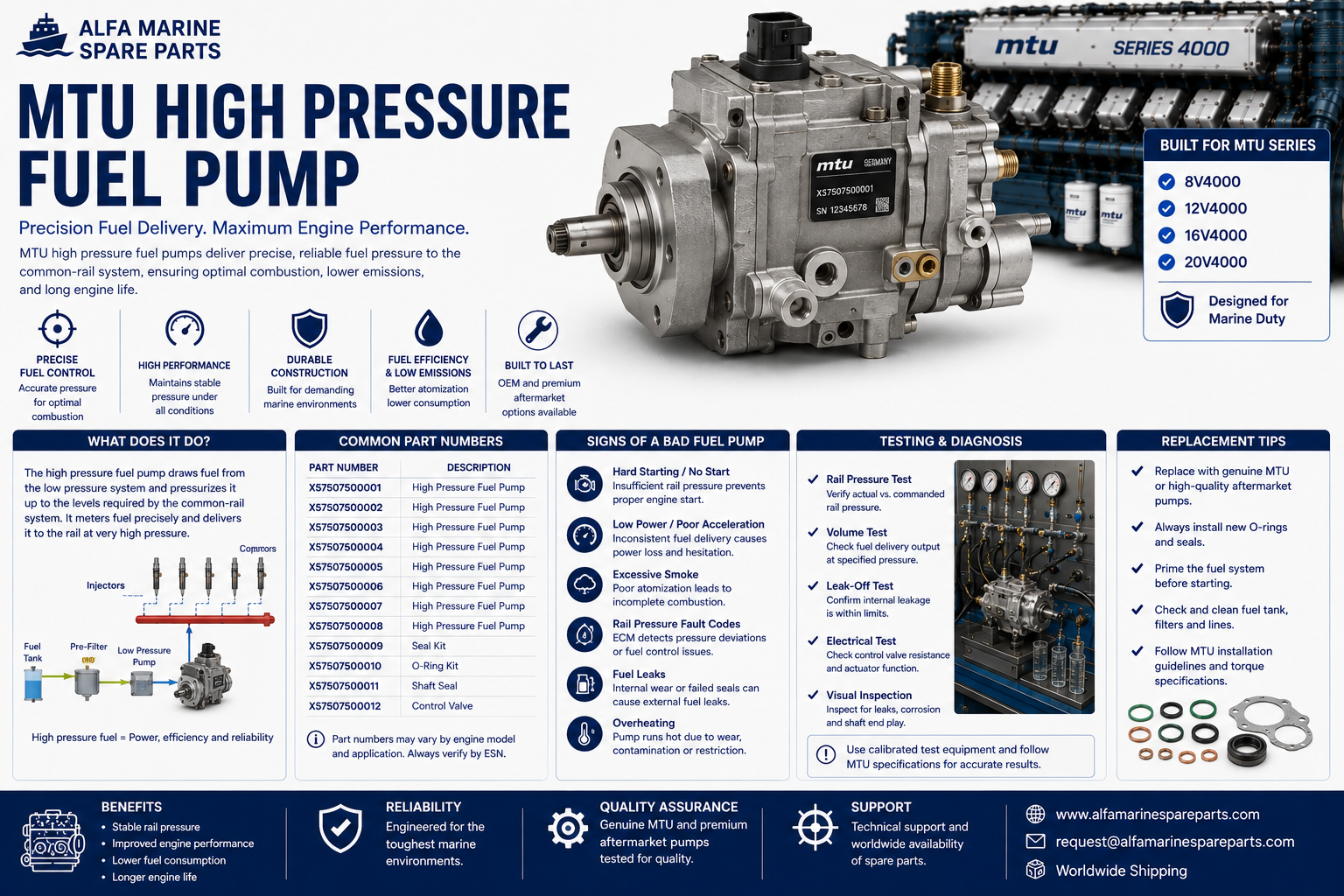
receive fuel from the low-pressure supply system → raise it to very high pressure → supply the common rail → provide pressurized fuel for the injectors.
When the pump is healthy, the engine-management system can precisely control injection.
When pump performance starts deteriorating, the symptoms can look surprisingly similar to injector problems.
The engine may become harder to start.
Power may decrease.
Rail pressure may become unstable.
Faults may appear under acceleration or heavy load.
In a more serious failure, metallic contamination from a damaged pump can potentially spread into other parts of the high-pressure fuel system.
That is why a suspected MTU high-pressure fuel pump problem should not be approached as simply:
“Replace the pump.”
A better question is:
“Why is the common-rail system not achieving or maintaining the fuel pressure the engine requires?”
1. MTU Series 4000 Marine Engine Types
The MTU Series 4000 marine family includes numerous V8, V12, V16 and V20 configurations.
Examples include:
MTU 8V 4000
- MTU 8V 4000 M53
- MTU 8V 4000 M53R
- MTU 8V 4000 M54
- MTU 8V 4000 M63
MTU 12V 4000
- MTU 12V 4000 M53
- MTU 12V 4000 M63
- MTU 12V 4000 M64
- MTU 12V 4000 M65
- MTU 12V 4000 M65L
- MTU 12V 4000 M73
- MTU 12V 4000 M73L
- MTU 12V 4000 M93
- MTU 12V 4000 M93L
MTU 16V 4000
- MTU 16V 4000 M53
- MTU 16V 4000 M63
- MTU 16V 4000 M63L
- MTU 16V 4000 M65
- MTU 16V 4000 M65L
- MTU 16V 4000 M73
- MTU 16V 4000 M73L
- MTU 16V 4000 M93
- MTU 16V 4000 M93L
MTU 20V 4000
- MTU 20V 4000 M65L
- MTU 20V 4000 M73
- MTU 20V 4000 M73L
- MTU 20V 4000 M93
- MTU 20V 4000 M93L
The exact MTU high-pressure fuel pump depends on the engine model, generation, rating, fuel-system configuration and serial number.
2. Where Does the High-Pressure Pump Fit Into the Fuel System?
A simplified MTU common-rail fuel path can be viewed like this:
Fuel tank
↓
Water separator / primary filtration
↓
Fuel filters
↓
Low-pressure fuel supply
↓
High-pressure fuel pump
↓
Common rail
↓
Common-rail injectors
↓
Combustion chambers
This is important for troubleshooting.
A high-pressure pump cannot operate correctly if the fuel arriving at its inlet is already restricted, contaminated or full of air.
3. What Does the High-Pressure Fuel Pump Actually Do?
The pump raises fuel from the supply pressure to the much higher pressure required by the common-rail injection system.
The common rail then acts as a high-pressure accumulator supplying the injectors.
The pump therefore has to provide enough fuel pressure for different operating conditions, including:
- Starting
- Idle
- Acceleration
- Cruising
- High-load operation
A pump may appear satisfactory at idle but struggle when fuel demand increases.
This distinction becomes extremely useful during troubleshooting.
4. Why Rail Pressure Matters
The injectors depend on sufficient rail pressure.
If pressure is too low or unstable, injection cannot be controlled as intended.
Possible symptoms include:
- Difficult starting
- Reduced power
- Poor acceleration
- Rough running
- Engine derating
- Fuel-pressure faults
- Unstable operation under load
However, a low rail-pressure fault does not automatically prove that the high-pressure pump has failed.
Several other problems can create similar symptoms.
5. Hard Starting Can Be an Early Warning
Imagine an MTU 16V 4000 that historically starts quickly.
Recently it needs noticeably more cranking.
Once started, however, it appears reasonably normal.
Possible causes can include:
- High-pressure pump wear
- Excessive injector return leakage
- Restricted fuel supply
- Air entering the fuel system
- Pressure-control problems
- Sensor problems
The question becomes:
Is rail pressure building quickly enough during cranking?
That information can help separate a high-pressure fuel problem from an electrical starting problem.
6. Engine Starts Normally but Loses Power Under Load
This is another useful situation.
At idle:
everything appears normal.
At moderate load:
still normal.
At high load:
rail pressure becomes unstable or engine power decreases.
The fuel system may be capable of supplying low demand but unable to maintain the required pressure when demand increases.
Possible causes include:
- Weak high-pressure pump
- Restricted filters
- Low-pressure supply problem
- Pressure-control issue
- Excessive injector leakage
Do not judge the pump only by idle operation.
7. Low-Pressure Supply Problems Can Look Like Pump Failure
The high-pressure pump cannot create adequate output if it is being starved of fuel.
Before condemning the pump, inspect the upstream system.
Look at:
Fuel tank
Fuel shut-off valves
Water separator
Primary filter
Final fuel filters
Supply pump
Fuel hoses and pipes
Air leaks
Sometimes the expensive high-pressure pump is perfectly healthy.
It simply is not receiving enough fuel.
8. Dirty Fuel Filters
A restricted filter can reduce fuel supply.
The engine may still run at low load because fuel demand remains relatively small.
Then the vessel accelerates.
Fuel demand rises.
The restricted system cannot keep up.
Symptoms may appear as:
- Power reduction
- Rail-pressure faults
- Poor acceleration
Always check the basic filtration system before replacing high-pressure components.
9. Water Is a Major Enemy of Precision Fuel Components
The high-pressure pump depends on clean fuel.
Water contamination can contribute to:
- Internal corrosion
- Reduced lubricity
- Precision-component wear
- Pump damage
If water is regularly discovered in the fuel separator, do not consider repeated draining a complete solution.
Find the source.
10. Dirty Fuel Can Damage the Pump
Marine fuel tanks can accumulate contamination over time.
Possible contaminants include:
- Rust
- Sediment
- Dirt
- Water
- Microbial material
The filters provide protection, but filtration has limits.
Severe or repeated contamination can eventually affect the high-pressure system.
11. Why Pump Lubrication Matters
Precision diesel fuel-system components rely on the fuel itself for important lubrication functions.
Contaminated or unsuitable fuel can reduce this protection.
That means fuel quality affects more than combustion.
It can directly influence the mechanical life of high-pressure fuel components.
12. Metallic Particles Are a Serious Warning
One of the most important situations occurs when metallic material is discovered in the fuel system.
If internal high-pressure pump components begin wearing severely, metallic contamination may potentially move downstream.
The next components in the system can include:
common rail → pressure-control components → injectors.
At this point, simply fitting another high-pressure pump may not be enough.
13. What Happens If Metal Reaches the Injectors?
Common-rail injectors contain precision internal components.
Metal contamination can damage them.
Now a single pump failure can become:
pump + rail + injector problem.
On a V16 or V20 Series 4000 engine, that can turn into an extremely expensive repair.
This is why contamination control matters so much.
14. Do Not Install a New Pump Into a Contaminated System
Suppose the old high-pressure pump failed internally.
A replacement pump is installed.
But the fuel rail and lines were not properly inspected.
Metallic contamination remains.
The replacement system can immediately be exposed to the debris from the previous failure.
The correct repair therefore begins by understanding how the original pump failed.
15. High-Pressure Pump vs. Injector Leakage
Low rail pressure can also result from excessive injector internal leakage.
Imagine the pump is producing fuel pressure correctly.
But one or more injectors allow too much fuel to return internally.
The system may struggle to maintain rail pressure.
Replacing the high-pressure pump would not solve the problem.
Injector return-flow testing can therefore be useful when diagnosing certain rail-pressure complaints.
16. Pressure-Control Components
Common-rail pressure must also be controlled.
Depending on the exact engine configuration, pressure-control components and sensors help the engine-management system regulate fuel pressure.
A problem here can produce symptoms similar to pump failure.
Possible areas include:
- Rail-pressure sensor
- Pressure-control valve
- Metering/control components
- Wiring
Electronic diagnosis should therefore accompany mechanical inspection.
17. Rail-Pressure Sensor Problems
A sensor reports fuel pressure to the engine-management system.
If the signal is incorrect, the engine may react to information that does not accurately represent actual system pressure.
Possible symptoms can include:
- Fault codes
- Derating
- Unstable operation
- Starting problems
Do not replace the high-pressure pump solely because the displayed rail pressure looks wrong.
Confirm whether the measurement itself is reliable.
18. Wiring Can Mimic Fuel-System Failure
The Series 4000 is electronically controlled.
That means electrical problems can sometimes appear to be mechanical fuel problems.
Inspect:
- Sensor wiring
- Connectors
- Engine harness
- Grounds
- Control connections
Marine engine rooms expose electrical components to:
- Heat
- Vibration
- Moisture
- Oil
- Salt
Diagnosis should include both mechanical and electrical sides of the system.
19. Air Entering the Fuel System
Air entering the low-pressure fuel supply can interfere with high-pressure generation.
Possible leak points include:
- Filter seals
- Water-separator seals
- Hose connections
- Pipe fittings
An important detail:
A suction-side connection may allow air inward without visibly leaking diesel outward.
Everything may look dry.
The fuel system can still be drawing air.
20. Fuel Problems Immediately After Filter Replacement
Suppose the MTU 4000 operated normally before fuel-filter maintenance.
After replacing the filters:
- Starting becomes difficult
- Engine runs unevenly
- Rail-pressure faults appear
Before blaming the high-pressure pump, inspect what changed.
Possible causes include:
- Incorrect filter installation
- Damaged filter seal
- Air trapped in the system
- Loose connection
- Contamination introduced during servicing
Timing matters.
21. High-Pressure Pump Problems After Fuel Contamination
Suppose the vessel receives contaminated fuel.
Soon afterward:
- Filters require frequent replacement
- Water appears in separators
- Starting deteriorates
- Rail-pressure problems develop
Now the high-pressure pump deserves closer inspection.
The history of the fuel system can be as important as the current fault code.
22. Common Signs of MTU High-Pressure Fuel Pump Problems
Possible warning signs include:
☐ Difficult starting
☐ Extended cranking
☐ Low rail pressure
☐ Unstable rail pressure
☐ Reduced engine power
☐ Poor acceleration
☐ Engine derating
☐ Rough running
☐ Fuel-pressure fault codes
☐ Problems appearing mainly at high load
☐ Metallic contamination in the fuel system
None of these symptoms alone proves pump failure.
They indicate where diagnosis should begin.
23. Situation: Engine Will Not Start
If the engine cranks normally but does not start, consider whether sufficient rail pressure is being established.
Possible causes include:
- Fuel supply interruption
- Air in fuel
- Restricted filters
- High-pressure pump problem
- Excessive injector leakage
- Pressure-control fault
- Sensor problem
Do not begin by replacing the most expensive component.
Follow the fuel path.
24. Situation: Engine Runs Normally at Idle
This does not automatically prove the high-pressure pump is healthy.
A worn pump may still provide enough fuel at idle.
High-load operation requires considerably more fuel delivery.
A weakness can therefore become visible only when:
RPM + engine load + fuel demand increase.
25. Situation: Rail Pressure Drops During Acceleration
This is particularly interesting.
Possible causes include:
- High-pressure pump unable to meet demand
- Fuel-supply restriction
- Excessive injector leakage
- Pressure-control problem
Compare requested rail pressure versus actual rail pressure using appropriate diagnostic information.
The difference can provide valuable direction.
26. Situation: Rail Pressure Is Unstable
Fluctuating pressure may involve:
- Pump condition
- Pressure-control components
- Fuel supply
- Injector leakage
- Sensor signal
Do not diagnose the pump from one pressure reading.
Look at how the system behaves over time and under different loads.
27. MTU 8V 4000 High-Pressure Fuel Pump
For engines including:
- MTU 8V 4000 M53
- MTU 8V 4000 M63
pump identification should be based on the complete engine information.
Do not assume a pump from another Series 4000 configuration is interchangeable.
28. MTU 12V 4000 High-Pressure Fuel Pump
Relevant marine engines include:
- MTU 12V 4000 M53
- MTU 12V 4000 M63
- MTU 12V 4000 M65
- MTU 12V 4000 M73
- MTU 12V 4000 M93
If low rail pressure occurs, investigate:
- Low-pressure supply
- Filters
- High-pressure pump
- Rail-pressure control
- Injector return leakage
Diagnosis should consider the complete fuel circuit.
29. MTU 16V 4000 High-Pressure Fuel Pump
Common marine configurations include:
- MTU 16V 4000 M63
- MTU 16V 4000 M65
- MTU 16V 4000 M73
- MTU 16V 4000 M73L
- MTU 16V 4000 M93
- MTU 16V 4000 M93L
A V16 engine has significant fuel demand under high load.
A fuel system that performs adequately at idle may reveal restrictions or pressure-generation problems once the engine is heavily loaded.
30. MTU 20V 4000 High-Pressure Fuel Pump
Examples include:
- MTU 20V 4000 M65L
- MTU 20V 4000 M73
- MTU 20V 4000 M73L
- MTU 20V 4000 M93
- MTU 20V 4000 M93L
On a V20 engine, fuel-system cleanliness becomes especially important because contamination can expose many expensive common-rail components.
A pump failure should therefore trigger a careful contamination assessment.
31. High-Pressure Fuel Pump Testing
Diagnosis may involve evaluating:
- Low-pressure fuel supply
- Rail-pressure buildup during cranking
- Actual rail pressure
- Requested rail pressure
- Pressure stability
- Injector return flow
- Pressure-control behavior
- Fault information
The objective is to prove whether the pump is actually failing.
32. High-Pressure Pump Inspection
If the pump is removed, inspect the surrounding fuel system for evidence of:
- Contamination
- Water
- Corrosion
- Metallic debris
- Abnormal wear
What you find can determine whether the repair remains a pump replacement or becomes a larger fuel-system cleaning and inspection job.
33. New, Used or Reconditioned High-Pressure Pump
These conditions should be clearly distinguished.
New Pump
A new complete replacement assembly.
Used Pump
Removed from another engine and supplied in its existing condition.
Reconditioned Pump
A used pump that has undergone inspection, repair and testing.
For a high-pressure common-rail component, internal condition and test results are much more important than external appearance.
34. What Should a Reconditioned Pump Involve?
Depending on the specific pump and repair capability, reconditioning may involve:
- Disassembly
- Precision cleaning
- Internal inspection
- Measurement of wear components
- Replacement of applicable components
- New sealing components
- Reassembly
- Bench testing
A cleaned and painted used pump should not automatically be considered fully reconditioned.
35. High-Pressure Pump Part Numbers
The MTU Series 4000 covers many configurations and generations, so there is not one universal MTU 4000 high-pressure fuel pump part number.
A number found on one 16V 4000 should not automatically be assumed correct for another 16V 4000 M73, M93 or different generation.
For high-value fuel-system components, part-number verification should be based on:
complete engine type + serial number + existing pump identification.
This is especially important because pumps can differ in configuration even within the same broad engine family.
36. How to Identify the Correct MTU High-Pressure Pump
When requesting a pump, provide:
Manufacturer: MTU
Complete Engine Model: __________
Example: MTU 16V 4000 M73
Engine Serial Number: __________
Existing Pump Part Number: __________
Pump Identification/Markings: __________
Rated Power: __________
Rated RPM: __________
Quantity: __________
Condition Required: New / Remanufactured / Other
Photographs: Attached
A clear photograph of the pump identification markings can be extremely useful.
37. Do Not Order From Appearance Alone
Two high-pressure pumps may look very similar externally.
That does not mean they have the same:
- Output characteristics
- Drive arrangement
- Connections
- Internal specification
- Engine application
Physical similarity does not prove compatibility.
38. Parts Related to the MTU High-Pressure Fuel Pump
A high-pressure fuel-system repair may require more than the pump itself.
Related components can include:
- High-pressure fuel pump
- Common-rail injectors
- Common rail
- High-pressure fuel pipes
- Fuel-pressure sensors
- Pressure-control components
- Fuel supply pump
- Fuel filters
- Water-separator components
- Pump seals
- O-rings
- Fuel-system gaskets
- Fuel hoses
- Wiring harnesses
The actual parts required depend on what caused the failure.
39. Why Filters Should Be Considered During Pump Replacement
Installing a replacement high-pressure pump while leaving contaminated filters in service makes little sense.
Whenever significant high-pressure fuel-system work is performed, filtration condition deserves attention.
Remember:
the new pump will immediately receive whatever comes through those filters.
40. Fuel Tank Condition Matters Too
If filters repeatedly become contaminated, inspect the source.
Possible tank problems include:
- Water
- Rust
- Sediment
- Microbial growth
Replacing pumps and injectors will not solve a dirty fuel tank.
Sometimes the most important part of an injector or pump repair happens far away from the engine.
41. High-Pressure Fuel Safety
Common-rail fuel systems operate at extremely high pressure.
Never loosen a high-pressure fuel connection while the engine is running to check whether fuel is present.
Never use your hand to search for a high-pressure diesel leak.
High-pressure fuel can penetrate skin and cause serious injury.
The fuel system must be safely depressurized before high-pressure components are opened.
42. MTU 4000 High-Pressure Fuel Pump Troubleshooting Checklist
When a high-pressure pump problem is suspected:
☐ Check fuel level
☐ Check fuel shut-off valves
☐ Inspect water separator
☐ Check fuel filters
☐ Inspect for air entering the supply side
☐ Verify low-pressure fuel supply
☐ Check rail-pressure buildup during starting
☐ Compare requested and actual rail pressure
☐ Check injector return flow
☐ Inspect pressure-control components
☐ Check rail-pressure sensor and wiring
☐ Inspect fuel for metallic contamination
☐ Investigate high-pressure pump condition
This sequence helps prevent unnecessary pump replacement.
43. What If the High-Pressure Pump Has Failed?
The repair should answer two questions.
Question 1: Why did the pump fail?
Possible causes may include:
- Contamination
- Water
- Poor fuel quality
- Fuel starvation
- Normal wear
Question 2: Where did the failure material go?
If internal metallic damage occurred, inspect downstream components.
That second question can protect the replacement pump and injectors.
44. Frequently Asked Questions
What Does the MTU High-Pressure Fuel Pump Do?
It raises fuel pressure for the common-rail system so the injectors have the pressurized fuel required for electronically controlled injection.
Can a Bad High-Pressure Pump Cause Hard Starting?
Yes. If the system cannot build sufficient rail pressure during cranking, starting can become difficult.
Can a Weak Pump Work at Idle?
Yes. A deteriorating pump may provide enough fuel at low demand but struggle under heavy engine load.
Does Low Rail Pressure Always Mean the Pump Is Bad?
No. Restricted filters, supply problems, excessive injector leakage, pressure-control faults and sensor problems can produce similar symptoms.
Can Water Damage the High-Pressure Pump?
Water contamination can contribute to corrosion, reduced lubrication and internal wear.
Can a Failed Pump Damage MTU 4000 Injectors?
If a pump suffers an internal failure that releases metallic contamination, downstream fuel-system components can potentially be affected.
Should Injectors Be Checked After a Major Pump Failure?
If contamination is found in the high-pressure circuit, the injectors and other downstream components deserve inspection.
Can an MTU High-Pressure Pump Be Reconditioned?
Depending on the pump type and condition, professional reconditioning and bench testing may be possible.
Does Every MTU Series 4000 Use the Same High-Pressure Pump?
No. Pump specification varies according to engine type, generation, rating and serial number.
What Information Is Needed to Identify the Correct Pump?
Use the complete MTU engine model, engine serial number and existing high-pressure pump part number or identification markings.
MTU Series 4000 High-Pressure Fuel Pump & Common-Rail Parts
Common fuel-system requirements can include:
- High-pressure fuel pumps
- Common-rail injectors
- Fuel rails
- High-pressure fuel pipes
- Pressure-control valves
- Rail-pressure sensors
- Fuel supply pumps
- Fuel filters
- Water-separator components
- Pump seals
- O-rings
- Fuel-system gaskets
- Injector seals
- Injector wiring harnesses
- Fuel-system sensors
Correct identification should always be based on the exact MTU engine configuration.
Browse Our Complete Catalog
Marine engine brands:
https://alfamarinespareparts.com/our-brand
Marine spare parts:
https://alfamarinespareparts.com/spareparts
Contact Alfa Marine Spare Parts
For MTU Series 4000 high-pressure fuel pumps, common-rail injectors, fuel rails, fuel-pressure components and marine engine fuel-system parts:
Email: request@alfamarinespareparts.com
For accurate identification, provide:
MTU engine model + engine serial number + existing high-pressure pump part number + pump markings + photographs + quantity + delivery location.
Final Word
When an MTU Series 4000 high-pressure fuel pump appears to be failing, the most expensive mistake can be replacing it before understanding what the fuel system is actually doing.
Low rail pressure does not automatically mean:
bad pump.
It can also mean:
restricted filter.
insufficient low-pressure supply.
air entering the fuel system.
excessive injector leakage.
pressure-control problem.
Or a genuine high-pressure pump failure.
The best approach is therefore to follow the fuel:
tank → water separator → filters → low-pressure supply → high-pressure pump → common rail → injectors.
If the pump has suffered an internal failure, go one step further.
Ask:
“Did contamination travel downstream?”
That question matters because a failed pump can become much more expensive if contamination reaches the rail and common-rail injectors.
For an MTU 8V, 12V, 16V or 20V 4000, correct diagnosis and correct parts identification should come before replacement.
Always confirm:
engine model + engine serial number + existing pump part number.