
MTU Series 4000 Fuel Injector Nozzle: Spray Pattern, Wear, Carbon Deposits & Replacement Guide
The MTU Series 4000 fuel injector nozzle is a small component with a very large responsibility. By the time diesel reaches the nozzle, the fuel has already passed through the filtration and high-pressure common-rail system, while the engine-control system has determined when injection should take place. The nozzle has the final job: delivering that fuel into the combustion chamber as a precisely controlled, finely atomized spray.
When the nozzle is in good condition, the fuel mixes efficiently with the compressed air in the cylinder and combustion remains controlled. When nozzle wear, contamination or carbon deposits begin affecting the spray pattern, the engine may continue running normally enough that the problem is easy to miss. One cylinder may slowly develop a higher exhaust temperature, black smoke may become more noticeable during acceleration, or fuel consumption may begin increasing without an obvious loss of power.
For a marine engineer, this creates an important diagnostic question. Instead of asking only “Is the injector nozzle blocked?”, it is more useful to ask “Is this injector still delivering the correct quantity of fuel with the spray pattern this cylinder requires?” A nozzle does not have to be completely blocked or visibly damaged before its performance begins affecting combustion.
For fleet managers, shipyards and vessel operators working with MTU Series 4000 engines, recognizing these changes early can make the difference between an injector repair and a much more expensive piston, liner or power-assembly repair.
1. MTU Series 4000 Marine Engines and Injector Applications
The MTU Series 4000 covers a broad range of V8, V12, V16 and V20 marine engines used in commercial vessels, yachts and other demanding marine applications. Depending on the engine generation and duty profile, commonly encountered models include the MTU 8V 4000 M53 and M63, MTU 12V 4000 M65 and M73, MTU 16V 4000 M73 and M93, and MTU 20V 4000 M73L and M93L.
Although these engines belong to the same Series 4000 family, their fuel-system components should not automatically be treated as interchangeable. Injector specifications can vary according to engine model, rating, production generation and serial number. This becomes especially important when sourcing high-value common-rail components because a generic request for an “MTU 4000 injector nozzle” may not provide enough information to identify the correct replacement.
For this reason, parts identification should begin with the complete engine model and engine serial number, together with the existing injector or component number whenever it can be read. Buyers maintaining these engines can also use the MTU Series 4000 Marine Engine Spare Parts page to find the relevant Alfa Marine Spare Parts engine family and continue into the parts catalog.
2. What Does an MTU 4000 Fuel Injector Nozzle Actually Do?
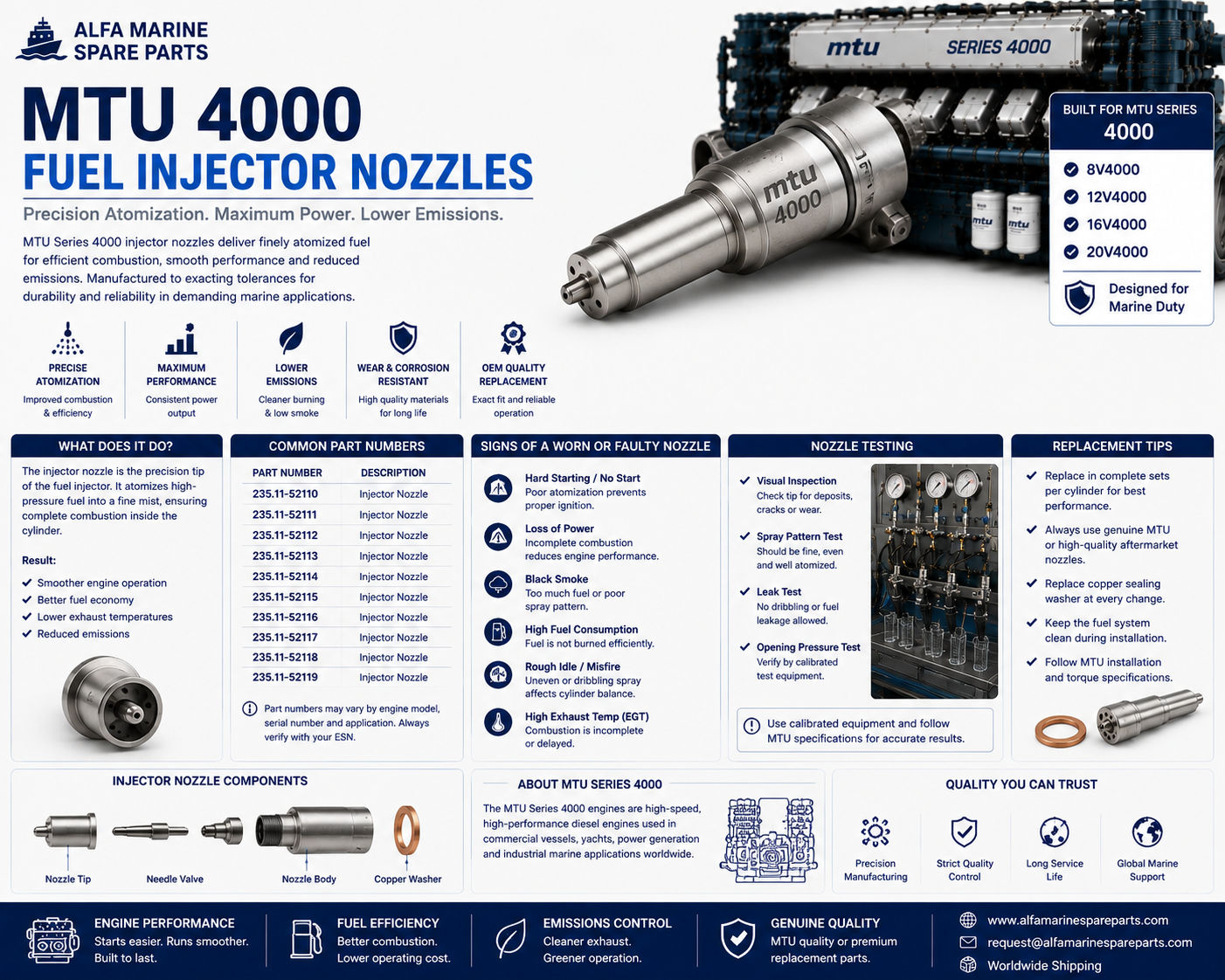
The injector nozzle forms the final connection between the common-rail fuel system and the combustion chamber. Its precision openings determine how high-pressure diesel leaves the injector and enters the cylinder. The objective is not simply to introduce fuel; the nozzle must break the diesel into very fine droplets and distribute them in a controlled pattern so that the fuel can mix rapidly with the compressed air.
This process is known as atomization, and its quality has a major influence on combustion. Fine, correctly distributed droplets provide far more surface area for mixing with air than a heavy stream of liquid diesel. When atomization is correct, the combustion process can develop as intended. When it deteriorates, some areas of the cylinder may receive too much fuel while others receive too little, and larger droplets may not burn as efficiently.
This explains why an injector can still be supplying fuel while no longer doing its job correctly. The engine may continue producing power, yet poor atomization can already be influencing exhaust gas temperature, smoke, carbon formation and fuel consumption. Over time, severe spray deterioration can also expose piston and cylinder components to abnormal operating conditions.
3. Why Is the MTU 4000 Injector Spray Pattern So Important?
The MTU 4000 injector spray pattern determines how fuel is distributed inside the combustion chamber. A healthy nozzle should produce a repeatable pattern suited to the geometry and operating characteristics of that engine. If the nozzle openings become worn, restricted or contaminated, the pattern can gradually change even though the injector continues operating.
Instead of a finely distributed spray, a deteriorating nozzle may begin producing uneven fuel distribution, larger droplets or a distorted spray direction. In other cases, the injector may fail to end the injection event cleanly and allow small quantities of fuel to continue entering the cylinder. This is commonly described as fuel dribbling.
These changes matter because combustion depends on both fuel quantity and fuel distribution. Delivering approximately the correct quantity of diesel does not guarantee good combustion if that fuel is being delivered in the wrong pattern. This is why injector diagnosis should consider spray quality and cylinder behavior rather than relying only on whether fuel is reaching the cylinder.
On an MTU 16V 4000 M73, for example, one cylinder can begin behaving differently while the remaining fifteen continue producing normal power. Overall engine performance may still appear acceptable, but the abnormal cylinder can already be showing the first signs of an injector or combustion problem.
4. What Causes MTU Series 4000 Injector Nozzle Wear?
Injector nozzles operate under severe conditions. They are exposed to repeated injection cycles, high fuel pressure, combustion heat and continuous thermal changes. These operating conditions naturally place demands on the nozzle and other precision components inside the injector, but fuel condition can have an equally important effect on service life.
Fine abrasive particles that pass through the fuel system can accelerate internal wear, while water contamination may contribute to corrosion and deterioration of precision surfaces. Carbon deposits can affect the exposed nozzle tip, and contamination generated by another failing high-pressure component may circulate through the common-rail system and damage several injectors rather than only one.
This is particularly important when a vessel experiences repeated injector problems. If several injectors begin deteriorating within a relatively short period, simply replacing them one after another may not address the cause. Fuel cleanliness, filter condition, water contamination and the condition of the high-pressure fuel system should all be considered before new injectors are returned to service.
Fleet operators sourcing fuel filters, injector components, seals and other maintenance parts can browse the Alfa Marine Spare Parts catalog alongside the dedicated MTU Series 4000 engine page.
5. What Are the Symptoms of a Worn or Fouled Injector Nozzle?
Injector nozzle deterioration rarely announces itself with one unmistakable symptom. More often, the engineer notices a combination of smaller changes. A cylinder that historically followed the others may begin running hotter or cooler, the engine may smoke more during acceleration, fuel consumption may increase, or one injector removed during maintenance may show noticeably different deposits from the rest.
These observations help narrow the investigation, but they should not be treated as automatic proof of injector failure.
| What You NoticePossible Cause to Investigate | |
| One cylinder EGT higher than neighboring cylinders | Poor atomization, excessive fuel delivery or distorted spray |
| One cylinder EGT lower than neighboring cylinders | Restricted nozzle, reduced fuel delivery or another cylinder fault |
| Black smoke during acceleration | Poor atomization, over-fueling or insufficient combustion air |
| White or pale smoke | Poor combustion, fuel dribbling or low cylinder temperature |
| Increasing fuel consumption | Deteriorating injection or combustion efficiency |
| Heavy carbon on one nozzle | Localized injector or cylinder problem |
| Rougher engine operation | Uneven cylinder contribution |
| Longer starting time | Injector leakage, fuel-pressure loss or another fuel-system problem |
The important word is possible. Black smoke can also be caused by turbocharger or charge-air problems, while abnormal exhaust temperature can involve compression, valves or airflow. Good troubleshooting uses these symptoms to determine where further testing should begin rather than immediately ordering an injector.
6. What Do Carbon Deposits on an MTU 4000 Injector Nozzle Mean?
Some carbon around an injector tip is understandable because the nozzle is directly exposed to the combustion environment. The more useful diagnostic clue is often not the presence of carbon itself, but whether one injector looks substantially different from the others.
Consider an MTU 16V 4000 M73 during scheduled maintenance. All sixteen injectors are removed, and fifteen nozzle tips show broadly similar deposits while one is heavily covered with darker or wetter carbon. Cleaning that injector until it looks like the others may make it visually acceptable, but it does not explain why the deposit formed.
The cylinder's operating history should now become part of the investigation. Was its exhaust temperature different? Did the injector show abnormal delivery or leakage during testing? Is cylinder compression normal? Are the valves sealing correctly? Heavy carbon may be associated with poor atomization or dribbling, but it can also be evidence of another combustion problem.
This is why carbon should be treated as diagnostic evidence rather than a diagnosis by itself. If testing confirms that the injector requires replacement, the relevant injector, seals and installation components can be sourced alongside other MTU Series 4000 marine engine spare parts.
7. What Is Fuel Dribbling and Why Should It Be Taken Seriously?
A correctly functioning injector should control both the beginning and end of fuel delivery. When wear or an internal problem prevents the injector from closing correctly, a small quantity of diesel may continue entering the combustion chamber after the intended injection event. Instead of being delivered as a controlled mist, this fuel can enter as larger droplets or liquid fuel.
Initially, the symptoms may appear relatively minor. The engine may produce additional smoke, the injector tip may accumulate carbon more quickly, or one cylinder's temperature may begin changing. However, continued liquid-fuel exposure can create more serious problems because diesel may reach areas of the piston crown or cylinder wall where the combustion system was not designed to concentrate it.
This is the point where an injector problem can develop into a mechanical engine problem. For commercial vessels, that distinction matters considerably because replacing an injector is very different from opening an engine to repair piston or liner damage.
8. Can a Faulty MTU 4000 Injector Nozzle Damage a Piston?
A severely distorted injector spray can contribute to abnormal thermal loading on the piston crown. When the fuel is no longer distributed correctly, combustion can become concentrated in areas that experience significantly different temperatures from the rest of the piston surface. Continued operation under these conditions can contribute to heavy deposits, localized overheating, erosion or more serious piston crown distress.
This is especially important during failure analysis. If one piston is found with unusual damage while neighboring cylinders appear normal, the injector serving that cylinder should be tested before being returned to service. Replacing the piston without investigating the injection system could repair the consequence while leaving a possible cause untouched.
For planned Series 4000 overhaul work, Alfa Marine Spare Parts can assist with inquiries covering fuel injectors, pistons, cylinder liners, cylinder-head components, gaskets and other engine parts through the MTU Series 4000 parts section.
9. How Can Injector Nozzle Problems Lead to Cylinder Washing?
Cylinder liners depend on a controlled lubricating-oil film between the liner surface and piston rings. When excessive liquid diesel repeatedly reaches the cylinder wall, it can reduce or dilute this protective film. This condition is commonly referred to as cylinder washing.
If the problem continues, the reduction in lubrication can contribute to accelerated ring and liner wear, scuffing, increased blow-by and declining compression. Fuel may also dilute the engine oil, affecting its lubricating properties elsewhere in the engine. A problem that began at the injector nozzle can therefore become a much larger power-assembly issue.
For a fleet manager, this is one of the strongest reasons to investigate persistent injector symptoms early. The engine does not need to stop running before damage begins. Catching poor injection while the problem remains confined to the fuel system can prevent considerably more expensive repair work later.
10. What Can High or Low Exhaust Temperature Tell You?
Cylinder-to-cylinder exhaust temperature comparison is particularly valuable on large V16 and V20 marine engines. The important information is often not the absolute temperature but the trend. If one cylinder that normally follows its neighbors begins consistently moving higher or lower, something has changed.
A higher EGT can be associated with poor atomization, excessive fuel delivery or another combustion abnormality. A lower EGT may point toward reduced fuel delivery, an injector fault or poor compression. Because both conditions can have causes unrelated to the nozzle, temperature should be combined with other information rather than used as a standalone injector diagnosis.
This approach becomes especially useful on an MTU 20V 4000 M93L. Nineteen healthy cylinders can mask the contribution loss of one weaker cylinder surprisingly well, meaning the engine may still feel powerful while the cylinder data is already showing that a problem is developing.
11. Can a Worn MTU Injector Nozzle Cause Black Smoke?
A worn or contaminated nozzle can contribute to black smoke if poor atomization prevents fuel from mixing efficiently with the available air. Larger droplets and uneven fuel distribution can produce incomplete combustion, particularly during acceleration when fuel demand increases rapidly.
However, black smoke is not exclusively a fuel-injection symptom. Turbocharger condition, charge-air cooler cleanliness, intake restriction and excessive engine load can all reduce the air available for combustion. If all cylinders appear to be affected similarly, shared air-system problems deserve attention. If one cylinder stands out in EGT or other data, the injector becomes a stronger suspect.
The useful diagnostic question is therefore not simply “Why is the engine smoking?” but “Does the available evidence point toward one cylinder, several cylinders or a system that affects the complete engine?”
12. How Should an MTU Series 4000 Injector Be Inspected and Tested?
Visual inspection can reveal useful information such as heavy carbon, visible tip damage or major differences between injectors, but appearance alone cannot confirm correct performance. An injector that looks clean externally may still suffer from internal wear, excessive leakage or poor fuel delivery.
Professional testing can provide a much clearer picture of injector condition by evaluating relevant characteristics such as delivery behavior, internal leakage, return flow and other performance parameters appropriate to the injector design. This is particularly valuable when engine data identifies an abnormal cylinder but the removed injector looks perfectly normal.
Aggressive mechanical cleaning of the nozzle should also be avoided. The nozzle openings are precision features, and altering them with inappropriate tools can affect fuel flow and spray direction. The objective is not to make the nozzle look new; it is to determine whether the injector can still perform correctly.
13. Should the Injector Be Cleaned, Reconditioned or Replaced?
The correct decision depends on the actual condition of the injector. External carbon deposits alone do not automatically mean that replacement is necessary if proper testing confirms acceptable operation. On the other hand, a visually clean injector may still require repair or replacement because of internal wear that cannot be seen from the nozzle tip.
Professional reconditioning may be an option when the injector can be correctly disassembled, inspected, repaired, calibrated and tested. Complete replacement may be more appropriate when internal wear is excessive, electrical components are damaged, contamination has caused serious deterioration or correct performance cannot be restored.
Commercial operating requirements should also be considered. A fleet manager may reasonably choose a different repair strategy when another injector failure could result in an unscheduled vessel stoppage, emergency freight and additional shipyard costs.
14. Don't Forget Injector Seals and Installation Components
A common purchasing mistake is to concentrate on the injector and forget the components needed to install it correctly. Depending on the exact Series 4000 engine configuration, an injector replacement may also require new sealing components, O-rings, installation hardware or associated return-system parts.
This becomes particularly important during multi-cylinder work. Imagine a shipyard preparing to replace sixteen injectors on an MTU 16V 4000. The injectors arrive on time, the engine is opened, and only then does the workshop discover that a required set of injector seals was not included in the order. A comparatively inexpensive missing component can now delay a very expensive repair.
For planned maintenance and overhaul work, buyers can combine injector requirements with associated sealing and installation components through the MTU Series 4000 Marine Engine Spare Parts catalog rather than treating each item as a separate emergency purchase.
15. How Can Premature Injector Nozzle Wear Be Reduced?
Good injector life begins upstream of the injector. Effective fuel filtration, water separation and clean fuel handling protect the precision surfaces inside the common-rail system. If filters repeatedly become contaminated, water continues appearing in the separator or metallic debris is discovered, the underlying problem should be investigated rather than simply replacing the affected consumable.
Engine trends are equally valuable. A gradual change in exhaust temperature, smoke, fuel consumption, starting behavior or injector return characteristics can reveal deterioration before a complete failure occurs. Establishing what is normal for the engine makes those changes much easier to recognize.
The objective is not to replace injectors unnecessarily. It is to identify an abnormal combustion condition while the repair still involves the fuel system, rather than waiting until prolonged poor injection begins affecting the piston, rings, liner or cylinder head.
16. MTU 4000 Injector Nozzle Troubleshooting Guide
| SituationWhat to InvestigatePossible Parts Requirement | ||
| One cylinder consistently runs hot | Injector delivery, spray quality, compression and valves | Injector and seals after diagnosis |
| One cylinder consistently runs cool | Fuel delivery, injector operation and compression | Injector or related fuel components |
| One nozzle has unusually heavy carbon | Dribbling, poor atomization and cylinder condition | Injector/nozzle and installation parts |
| Black smoke appears under load | Injectors, turbocharger, charge-air system and load | Fuel or air-system components |
| Engine becomes difficult to start | Injector leakage, rail pressure and fuel supply | Injector or common-rail components |
| Several injectors deteriorate together | Fuel quality, filtration, water and high-pressure system | Filters, injectors and related components |
| Metal is discovered in the fuel circuit | Source of contamination and downstream fuel components | Broader high-pressure system repair may be required |
The value of troubleshooting is not simply identifying the component that no longer works. A better repair also asks why it failed, particularly when contamination or another system problem could damage the replacement part.
17. Ordering the Correct MTU Series 4000 Injector Parts
The Series 4000 family contains many engine configurations, so accurate identification is essential when sourcing injectors and other common-rail components. A request saying “MTU 4000 injector required” will often require additional information before the correct part can be identified.
A useful B2B inquiry should include the complete engine model, engine serial number, existing injector or component number, quantity required, photographs and delivery location. For example: MTU 16V 4000 M73, engine serial number XXXXXXXX, injector number XXXXXXXX, quantity 16, delivery Rotterdam, photos attached. This provides considerably more information for accurate parts matching.
Alfa Marine Spare Parts supplies marine engine components for maintenance, repair and overhaul. Buyers can start with the MTU Series 4000 Marine Engine Spare Parts page, browse the wider marine spare parts catalog or visit Alfa Marine Spare Parts for other engine brands and parts categories.
Frequently Asked Questions About MTU Series 4000 Injector Nozzles
What does an MTU Series 4000 fuel injector nozzle do?
The nozzle atomizes high-pressure diesel and distributes it into the combustion chamber in a controlled spray pattern. Correct atomization helps the fuel mix efficiently with compressed air and supports proper combustion.
What are common signs of MTU 4000 injector nozzle wear?
Possible warning signs include abnormal cylinder EGT, increased smoke, rising fuel consumption, unusual carbon deposits, rougher operation and poor injector test results. Because these symptoms can have other causes, injector condition should be evaluated together with cylinder and fuel-system information.
What causes carbon deposits on an injector nozzle?
Carbon can develop because the nozzle operates directly in the combustion environment, but unusually heavy deposits may also be associated with poor atomization, fuel dribbling or another cylinder-specific combustion problem.
Can an MTU 4000 injector nozzle damage the piston?
A severely distorted spray pattern can contribute to abnormal thermal loading on the piston crown. When unusual piston damage is discovered in one cylinder, the associated injector should therefore be included in the failure investigation.
Can injector failure cause cylinder liner wear?
Excess liquid fuel reaching the liner can reduce or dilute its lubricating-oil film. Continued cylinder washing can contribute to ring wear, liner scuffing, blow-by and reduced compression.
Does black smoke mean the injectors need replacing?
Not necessarily. Black smoke can also result from turbocharger, charge-air, intake or engine-loading problems. Injector replacement should follow diagnosis rather than smoke color alone.
Should a dirty injector nozzle simply be cleaned?
Not automatically. Cleaning removes deposits but does not confirm correct injection quantity, internal condition or spray behavior. An injector with unusual deposits should be evaluated before being returned to service.
Should every injector be replaced when one fails?
Not always. The decision depends on operating hours, test results, maintenance history, the condition of the remaining injectors and the vessel's operating requirements.
What information is needed to identify the correct MTU 4000 injector?
Provide the complete engine model, engine serial number, existing injector or component number, quantity, clear photographs and delivery location whenever possible.
MTU Series 4000 Injectors & Fuel-System Spare Parts
Once diagnosis confirms the problem, Alfa Marine Spare Parts can assist with inquiries for MTU Series 4000 common-rail injectors, injector installation components, high-pressure fuel pumps, common rails, pressure-control components, fuel filters, seals and other engine spare parts.
The best way to reduce parts-identification delays is to send the complete engine information with the existing component number. This is particularly important for shipyards and fleet operators working against a vessel repair schedule, where receiving an incorrect component can cost far more in downtime than the part itself.
MTU Series 4000 Marine Engine Spare Parts
Marine Spare Parts Catalog
Parts requests: request@alfamarinespareparts.com
Final Thoughts: Read the Cylinder Before Replacing the Part
An MTU Series 4000 fuel injector nozzle does not have to stop working completely before it becomes harmful. The injector can continue supplying fuel while nozzle wear, carbon deposits, poor atomization or dribbling gradually change the way combustion develops inside one cylinder. This is why cylinder trends are so valuable: a changing EGT, unusual carbon pattern, increasing smoke or gradual rise in fuel consumption may reveal deterioration long before a complete injector failure.
When one cylinder begins behaving differently, investigate the reason rather than waiting for the engine to force the decision. Compare the cylinder with its neighbors, inspect the injector, review the fuel system and use proper testing to determine whether the injector can remain in service. If replacement is necessary, check the surrounding seals and installation components at the same time and verify every part against the exact engine model and serial number.
For commercial vessels, the economics are straightforward. Diagnosing and correcting a deteriorating injector is a manageable maintenance job; allowing poor injection to continue until it damages a piston or cylinder liner can turn that same problem into an overhaul and extended vessel downtime.
For MTU 8V, 12V, 16V and 20V 4000 engine components, visit MTU Series 4000 Marine Engine Spare Parts – Alfa Marine Spare Parts or send your engine model, serial number, required part number and quantity to request@alfamarinespareparts.com.