
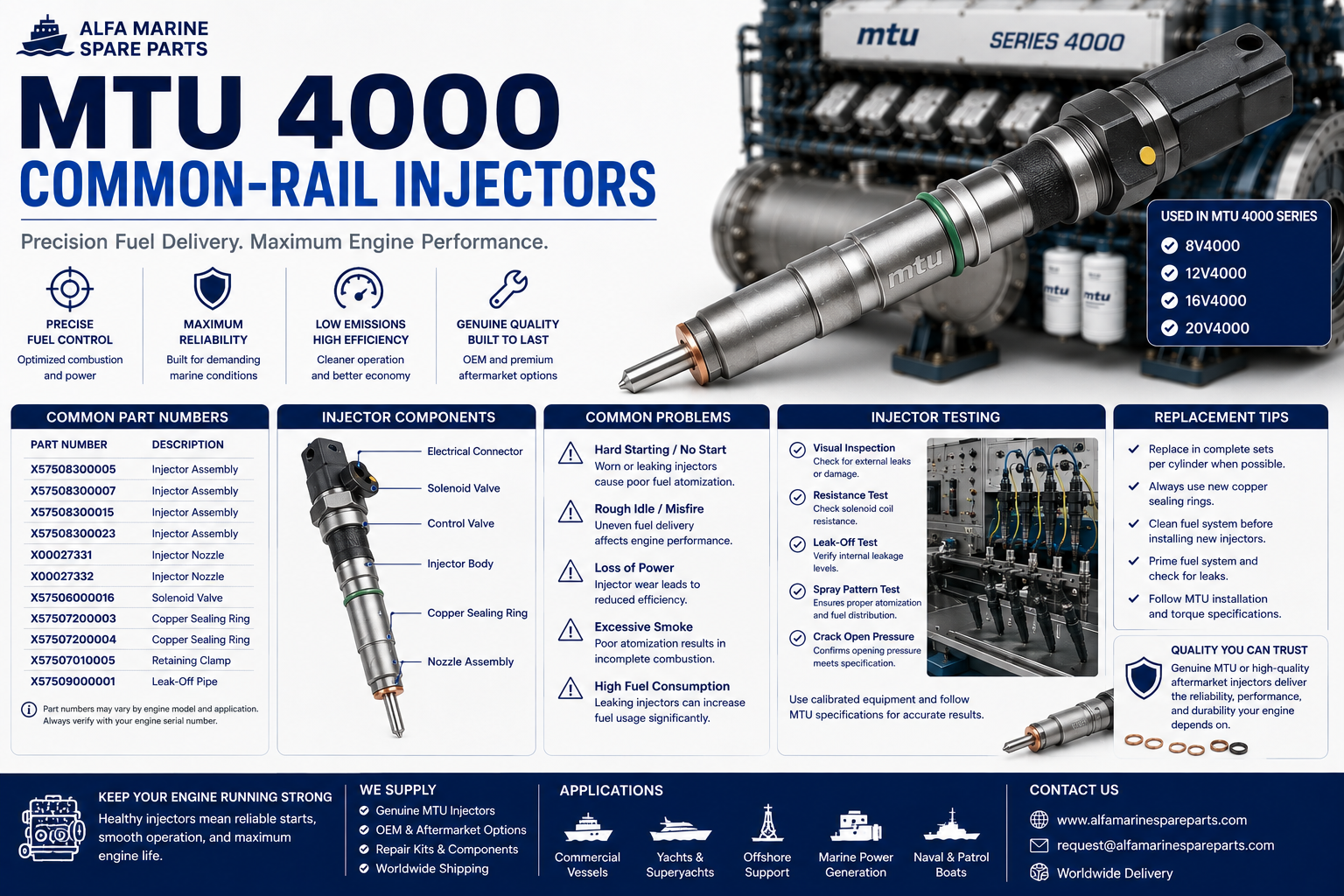

MTU Series 4000 Common-Rail Injectors: Part Numbers, Problems, Testing & Replacement Guide
The MTU Series 4000 common-rail injector is one of the most precise and important components in the engine’s fuel system.
Its job is straightforward to describe:
deliver the correct quantity of fuel into each cylinder at precisely the right moment.
In practice, this happens under extremely demanding conditions. The injector operates with high fuel pressure, very small internal tolerances, combustion heat and electronic engine management.
When everything is working correctly, fuel is finely atomized and combustion remains controlled and balanced.
When an injector starts to deteriorate, however, the first warning is not always an engine shutdown or obvious fault.
You may notice:
- One cylinder running hotter than the others
- One cylinder running unusually cool
- More black smoke during acceleration
- Rougher running
- Increased fuel consumption
- Longer starting time
- Uneven exhaust temperatures
- Fuel-pressure faults
That is why injector condition should be considered as part of the complete MTU 4000 fuel system, rather than treating the injector as an isolated component.
1. Which MTU Series 4000 Marine Engines Use Common-Rail Injection?
The MTU Series 4000 marine family covers several V8, V12, V16 and V20 configurations.
Common marine engine types include:
MTU 8V 4000
- MTU 8V 4000 M53
- MTU 8V 4000 M53R
- MTU 8V 4000 M54
- MTU 8V 4000 M63
MTU 12V 4000
- MTU 12V 4000 M53
- MTU 12V 4000 M63
- MTU 12V 4000 M64
- MTU 12V 4000 M65
- MTU 12V 4000 M65L
- MTU 12V 4000 M73
- MTU 12V 4000 M73L
- MTU 12V 4000 M93
- MTU 12V 4000 M93L
MTU 16V 4000
- MTU 16V 4000 M53
- MTU 16V 4000 M63
- MTU 16V 4000 M63L
- MTU 16V 4000 M64
- MTU 16V 4000 M65
- MTU 16V 4000 M65L
- MTU 16V 4000 M73
- MTU 16V 4000 M73L
- MTU 16V 4000 M93
- MTU 16V 4000 M93L
MTU 20V 4000
- MTU 20V 4000 M65L
- MTU 20V 4000 M73
- MTU 20V 4000 M73L
- MTU 20V 4000 M93
- MTU 20V 4000 M93L
Not every Series 4000 engine uses the same injector.
The exact injector can depend on the engine model, generation, power rating, fuel-system version and engine serial number.
2. How Does the MTU 4000 Common-Rail System Work?
A simplified fuel path looks like this:
Fuel tank
↓
Water separation and filtration
↓
Fuel supply system
↓
High-pressure fuel pump
↓
Common rail
↓
Common-rail injectors
↓
Combustion chambers
The high-pressure pump generates the required fuel pressure.
Fuel is then available in the common rail for the individual injectors.
The engine-management system controls the injection events electronically.
This allows very precise control over:
- Injection timing
- Fuel quantity
- Injection duration
- Combustion
- Engine response
The injector is therefore the final precision component between the high-pressure fuel system and the combustion chamber.
3. MTU Series 4000 Injector Part Numbers
Several injector part numbers can be encountered within the wider MTU Series 4000 family.
Examples include:
| Part NumberComponentSeries 4000 Reference | ||
| 0010104251 | Fuel injector | Found in Series 4000 applications |
| X52407500021 | Common-rail injector | Found in 16V 4000 applications |
| X52407500023 | Common-rail injector | Found in Series 4000 applications |
| X52407500028 | Common-rail injector | Found in 16V 4000 applications |
| EX52407500064 | Fuel injector | Series 4000 injector reference |
| EX59407500020 | Fuel injector | Found in 16V 4000 applications |
These numbers are useful for identification and cross-referencing, but they should not be treated as interchangeable.
For example, finding an X52407500021 injector advertised for an MTU 16V 4000 does not automatically mean it is suitable for every 16V 4000 M73, M93 or other Series 4000 configuration.
Always verify against the specific engine.
4. Injector-Related MTU 4000 Part Numbers
The injector installation also contains smaller components that can be just as important during repair.
Examples of Series 4000 injector-related numbers encountered in parts documentation include:
| Part NumberDescription | |
| 5240780535 | Injector hold-down clamp |
| 5249902101 | Injector hold-down screw |
| 23540260 | Injector sealing ring in applicable configurations |
| 5240160153 | Injector tube in applicable configurations |
| 700429039000 | O-ring used in applicable injector/injector-tube arrangements |
These parts also vary according to engine configuration.
A seal, injector tube or clamp should therefore be verified in the same way as the injector itself.
5. Why You Should Never Order Only an “MTU 4000 Injector”
Imagine you need an injector for an:
MTU 16V 4000 M73.
You search for:
MTU 16V 4000 injector
and find several different numbers.
Which one is correct?
The answer should come from the actual engine and existing component.
A proper identification request should include:
Engine: MTU 16V 4000 M73
Engine serial number: __________
Existing injector part number: __________
Injector markings: __________
Rated power: __________
Rated RPM: __________
Quantity: __________
Photographs of the existing injector can provide additional confirmation.
6. Why Fuel Cleanliness Is So Important
Common-rail injectors contain extremely precise internal components.
Contamination can include:
- Dirt
- Rust
- Water
- Tank sediment
- Metallic particles
- Microbial contamination
These contaminants can damage much more than the injector.
They can also affect:
- High-pressure pump
- Common rail
- Pressure-control components
- Fuel lines
This is why fuel filtration should be viewed as protection for the entire injection system.
7. Water Can Be Especially Damaging
Water contamination can contribute to:
- Internal corrosion
- Reduced lubricity
- Injector wear
- High-pressure pump damage
If water repeatedly appears in the vessel's fuel separator, draining it is only part of the solution.
Ask:
Where is the water coming from?
Possible sources can include tank condensation, contaminated bunkered fuel or water entering the fuel-storage system.
8. One Cylinder Is Running Hot
Consider an MTU 16V 4000 M73 where fifteen cylinders show similar exhaust temperatures but one cylinder is consistently hotter.
The injector deserves attention.
Possible causes include:
- Injector over-fueling
- Poor spray pattern
- Nozzle problems
But do not immediately replace it.
A hot cylinder can also involve:
- Valve condition
- Compression
- Air distribution
- Other combustion problems
The injector is a suspect—not automatically the culprit.
9. What If One Cylinder Is Colder?
A colder cylinder can be equally useful diagnostically.
Possible causes include:
- Insufficient fuel delivery
- Injector malfunction
- Electrical injector fault
- Poor compression
A weak injector can result in the cylinder contributing less power than its neighbors.
On a V16 or V20 engine, this may initially be difficult to hear.
Cylinder data can reveal the difference first.
10. Black Smoke and MTU 4000 Injectors
Black smoke can be associated with excessive fuel or insufficient air.
Injector-related possibilities include:
- Excessive fuel delivery
- Poor fuel atomization
- Nozzle deterioration
But black smoke can also result from:
- Turbocharger problems
- Charge-air cooler fouling
- Air restriction
- Excessive engine load
Always look at both sides:
fuel + air.
11. White Smoke and Poor Combustion
White or pale smoke can point toward incomplete combustion.
Possible causes include:
- Poor injector atomization
- Injector malfunction
- Low cylinder temperature
- Compression problems
- Poor fuel quality
Smoke color helps guide the investigation, but it should not be used alone to condemn an injector.
12. Poor Injector Spray Pattern
A worn injector does not have to stop delivering fuel completely.
It may still inject fuel but no longer atomize it correctly.
Instead of a fine controlled spray, the nozzle may produce an uneven pattern.
Possible consequences include:
- Poor combustion
- Carbon formation
- Increased smoke
- Increased fuel consumption
- Abnormal cylinder temperature
This is why an injector can look perfectly normal externally while performing badly internally.
13. Injector Nozzle Wear
The nozzle operates in one of the harshest areas of the engine.
It is exposed to:
- Combustion heat
- High fuel pressure
- Deposits
- Repeated injection cycles
Over time, wear or deposits can change fuel delivery.
An injector test can help determine whether the nozzle is still operating correctly.
14. Rough Running
An injector problem can contribute to:
- Uneven idle
- Vibration
- Cylinder imbalance
- Irregular combustion
On an MTU 20V 4000, one cylinder represents only a portion of total engine output.
The engine may therefore continue running even though one cylinder is no longer performing correctly.
Do not assume that a powerful engine running reasonably smoothly means every cylinder is healthy.
15. Increased Fuel Consumption
If the vessel begins consuming more fuel under similar operating conditions, investigate the reason.
Injector deterioration is one possibility.
Also compare:
- Vessel speed
- Engine load
- Boost pressure
- Hull condition
- Propeller condition
- Exhaust temperatures
Fuel consumption becomes especially interesting when the increase occurs together with smoke or cylinder imbalance.
16. Difficult Starting
Injector problems can contribute to:
- Longer cranking
- Uneven startup
- Smoke during starting
- Cylinders firing irregularly
However, starting also depends on:
- Cranking speed
- Batteries
- Fuel supply
- Rail pressure
- Sensors
- High-pressure pump
Do not replace injectors until the complete starting system has been considered.
17. Excessive Injector Return Flow
An injector can develop excessive internal leakage.
This can influence the high-pressure system and may contribute to:
- Difficult starting
- Poor performance
- Rail-pressure problems
Depending on the engine and diagnostic procedure, injector return-flow testing can help identify a problem injector.
18. Low Rail Pressure Does Not Automatically Mean Bad Injectors
The common rail needs sufficient pressure for the injectors to operate correctly.
Low rail pressure can involve:
- Excessive injector leakage
- High-pressure pump wear
- Pressure-control problems
- Fuel-supply restriction
- Sensor problems
Replacing all injectors because of a low rail-pressure fault can become a very expensive mistake.
Find the cause first.
19. High-Pressure Pump Problems Can Damage More Than the Pump
If a high-pressure pump suffers internal wear, metallic contamination may enter the fuel system.
That contamination can potentially reach:
- Common rail
- Injectors
- Pressure-control components
If metal is discovered, the repair should not automatically stop with the failed pump.
The rest of the high-pressure system deserves inspection.
20. Several Injector Failures Should Raise Questions
One injector fails.
You replace it.
Then another fails.
A few hundred operating hours later, another injector develops problems.
At this point, stop asking:
“Which injector is bad?”
Start asking:
“Why are the injectors failing?”
Possible causes include:
- Water contamination
- Dirty fuel
- Poor filtration
- High-pressure pump wear
- Incorrect repair procedures
Repeated failures often indicate a larger system problem.
21. Injector Sealing Components
The injector installation can include:
- Sealing rings
- O-rings
- Washers
- Injector tubes
- Hold-down components
A perfectly healthy injector can still develop problems if it is installed with:
- Incorrect seal
- Damaged O-ring
- Poor seating surface
- Incorrectly installed clamp
The complete installation should therefore be inspected during injector replacement.
22. Carbon Around the Injector
Carbon around the injector area may indicate a sealing or combustion problem.
Do not simply clean it away.
Inspect:
- Injector seat
- Sealing ring
- Injector tube
- Cylinder-head seating area
Carbon is evidence.
Use it before removing it.
23. Injector Wiring and Electrical Connections
Series 4000 common-rail injectors are electronically controlled.
That means an apparent injector fault can sometimes originate from:
- Wiring harness
- Connector
- Electrical supply
- Engine-control system
Marine engine rooms are difficult environments for electrical systems because of:
- Heat
- Vibration
- Moisture
- Oil
- Salt
Inspect the electrical side before automatically removing the injector.
24. Injector Fault Immediately After Maintenance
If an injector fault appears immediately after:
- Cylinder-head work
- Injector replacement
- Wiring-harness work
- Fuel-system maintenance
start by checking what was disturbed.
Inspect:
- Injector connector
- Harness routing
- Injector installation
- Sealing components
- Fuel connections
The timing of a fault is often a useful diagnostic clue.
25. Injector Testing
Depending on the injector and available equipment, testing may evaluate:
- Electrical function
- Internal leakage
- Return flow
- Injection quantity
- Spray performance
- Calibration
Testing is preferable to judging an injector by appearance.
A common-rail injector can be spotless externally and still be worn internally.
26. Used vs. Reconditioned MTU 4000 Injectors
These terms should not be confused.
Used Injector
An injector removed from another engine and sold in its existing condition.
Reconditioned Injector
An injector that has undergone a defined inspection, repair and testing process.
A proper reconditioning process may include:
- Disassembly
- Cleaning
- Inspection
- Replacement of applicable wear components
- Reassembly
- Testing
- Calibration
For a common-rail injector, test results matter much more than fresh paint or external appearance.
27. MTU 12V 4000 Injector Identification
For engines such as:
- MTU 12V 4000 M53
- MTU 12V 4000 M63
- MTU 12V 4000 M65
- MTU 12V 4000 M73
- MTU 12V 4000 M93
use the existing injector number and engine serial number when identifying replacements.
Do not assume a part number found on one 12V 4000 applies to every other 12V 4000.
28. MTU 16V 4000 Injector Identification
For engines including:
- MTU 16V 4000 M63
- MTU 16V 4000 M65
- MTU 16V 4000 M73
- MTU 16V 4000 M73L
- MTU 16V 4000 M93
- MTU 16V 4000 M93L
part numbers encountered in Series 4000 injector searches can include:
- X52407500021
- X52407500023
- X52407500028
- EX52407500064
- EX59407500020
These are reference examples, not a statement that all five fit every 16V 4000.
Compatibility must be confirmed for the individual engine.
29. MTU 20V 4000 Injector Identification
The same principle applies to engines including:
- MTU 20V 4000 M65L
- MTU 20V 4000 M73
- MTU 20V 4000 M73L
- MTU 20V 4000 M93
- MTU 20V 4000 M93L
Do not assume an injector from a V16 application is automatically correct for a V20 simply because both engines belong to Series 4000.
Verify the actual engine configuration.
30. Twin MTU 4000 Engines Can Help With Diagnosis
Twin-engine installations provide an excellent comparison.
Imagine a vessel with twin MTU 16V 4000 M93 engines.
At similar RPM and load:
Port engine: smooth, normal exhaust temperatures.
Starboard engine: more smoke and one cylinder noticeably hotter.
Compare:
- Exhaust temperatures
- Engine load
- Boost pressure
- Rail pressure
- Fuel consumption
- Injector-related faults
The healthy engine gives you a useful reference.
31. Record Injector Cylinder Positions
When removing multiple injectors, identify their original cylinder positions.
This is especially important on V16 and V20 engines.
If testing later shows that one injector has excessive leakage, you can connect that result with the cylinder's:
- Exhaust-temperature history
- Fault information
- Compression results
- Previous repairs
Do not remove twenty injectors and then lose track of where they came from.
32. Keep Injector Maintenance Records
Record:
- Engine hours
- Cylinder position
- Injector part number
- Date removed
- Reason for removal
- Test results
- Replacement part number
This information can reveal patterns.
If the same cylinder repeatedly develops injector problems, investigate the cylinder and surrounding systems rather than simply installing another injector.
33. Common Signs of MTU 4000 Injector Problems
Watch for:
☐ Difficult starting
☐ Rough running
☐ Black smoke
☐ White smoke
☐ Higher fuel consumption
☐ One cylinder running hot
☐ One cylinder running cool
☐ Rail-pressure problems
☐ Injector electrical faults
☐ Excessive return flow
☐ Unusual combustion noise
These symptoms justify investigation.
They do not automatically prove injector failure.
34. MTU 4000 Injector Troubleshooting Checklist
When injector trouble is suspected:
☐ Check fuel quality
☐ Check for water contamination
☐ Inspect fuel filters
☐ Check low-pressure fuel supply
☐ Check rail pressure
☐ Review engine fault information
☐ Compare cylinder exhaust temperatures
☐ Inspect injector wiring
☐ Inspect electrical connectors
☐ Check injector seals
☐ Test suspect injectors
☐ Inspect the high-pressure pump if metal contamination is discovered
This provides a much stronger diagnosis than simply replacing the injector indicated by the first symptom.
35. Common MTU 4000 Injector and Fuel-System Parts
Depending on engine configuration, fuel-system requirements can include:
- Common-rail injectors
- Injector sealing rings
- Injector O-rings
- Injector tubes
- Injector hold-down clamps
- Injector hold-down screws
- High-pressure fuel pumps
- Common rails
- High-pressure fuel lines
- Rail-pressure sensors
- Pressure-control components
- Fuel supply pumps
- Fuel filters
- Water-separator components
- Injector wiring harnesses
- Fuel-system gaskets
Part-number examples encountered within Series 4000 applications include:
0010104251
X52407500021
X52407500023
X52407500028
EX52407500064
EX59407500020
5240780535
5249902101
23540260
5240160153
700429039000
All numbers should be verified against the individual engine before ordering.
36. What Information Should You Provide When Ordering?
For accurate identification, provide:
MTU engine type: __________
Example: MTU 16V 4000 M73
Engine serial number: __________
Existing injector part number: __________
Injector markings: __________
Rated power: __________
Rated RPM: __________
Quantity: __________
Condition required: New / Remanufactured / Other
Delivery location: __________
Clear photographs of the existing injector and identification markings are also useful.
37. Frequently Asked Questions
Does Every MTU Series 4000 Use the Same Injector?
No. Injector specifications vary according to engine type, generation, rating, fuel-system configuration and serial number.
What Are Some MTU 4000 Injector Part Numbers?
Examples encountered in Series 4000 applications include 0010104251, X52407500021, X52407500023, X52407500028, EX52407500064 and EX59407500020. These numbers are not interchangeable and require application verification.
Can One Bad Injector Cause Black Smoke?
Yes, but black smoke can also result from turbocharger, airflow, charge-air cooling or excessive-load problems.
Can a Bad Injector Cause High Exhaust Temperature?
Yes. Incorrect injection quantity or poor atomization can affect combustion temperature.
Can an Injector Cause Low Rail Pressure?
Excessive internal injector leakage can contribute to rail-pressure problems. The high-pressure pump, supply system and pressure-control components should also be checked.
Why Do MTU 4000 Injectors Need Clean Fuel?
Their precision internal components operate with extremely small tolerances. Dirt, water and metallic contamination can accelerate wear.
Should All Injectors Be Replaced When One Fails?
Not automatically. The cause of failure and condition of the remaining injectors and fuel system should first be evaluated.
Can MTU Series 4000 Injectors Be Reconditioned?
Depending on injector type and condition, professional testing and reconditioning may be possible.
What Is the Best Way to Identify the Correct Injector?
Use the complete engine model, engine serial number and existing injector part number.
Browse Our Complete Catalog
Marine engine brands:
https://alfamarinespareparts.com/our-brand
Marine spare parts:
https://alfamarinespareparts.com/spareparts
Contact Alfa Marine Spare Parts
For MTU Series 4000 common-rail injectors, injector seals, fuel pumps, fuel rails and fuel-system spare parts:
Email: request@alfamarinespareparts.com
For accurate identification, send:
engine model + engine serial number + existing injector part number + injector markings + quantity + photographs + delivery location.
Final Word
When an MTU Series 4000 common-rail injector develops a problem, replacing the injector may solve the symptom—but it does not necessarily solve the cause.
If one injector fails, test and investigate it.
If several injectors fail, investigate the fuel system.
If metallic contamination appears, look at the high-pressure pump and the rest of the common-rail circuit.
If one cylinder runs hot, consider the injector—but also consider airflow, valves and compression.
The most useful troubleshooting path is:
fuel tank → water separation → filters → fuel supply → high-pressure pump → common rail → injector → combustion.
And when it is time to order a replacement, part numbers such as X52407500021, X52407500023, X52407500028, EX52407500064 or EX59407500020 can be valuable references, but they should never replace proper engine identification.
For an MTU 8V, 12V, 16V or 20V 4000, always confirm:
engine type + serial number + existing injector number.
That small verification step can prevent a very expensive wrong-parts order.