
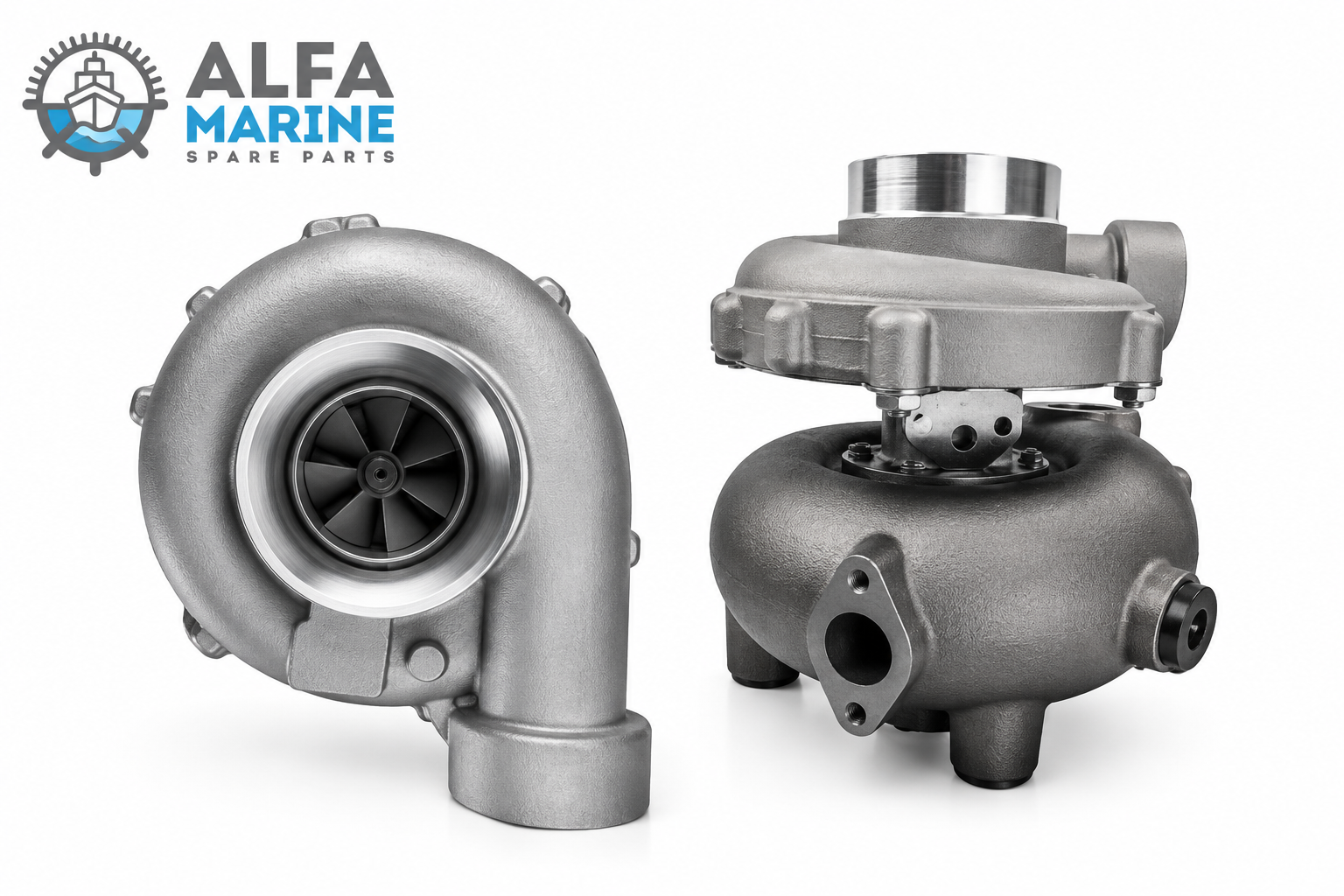

Let's Talk Engine Room: Troubleshooting MTU Series 2000 Sequential Turbochargers
If you run, maintain, or manage vessels powered by the MTU Series 2000, you already know these engines are pure high-performance engineering. But that massive power density comes with a highly sophisticated air-management system. When a vessel experiences power loss, black smoke, or spiking exhaust gas temperatures (EGT), the turbochargers are usually the first place a Chief Engineer looks.
To help you troubleshoot your intake loop and navigate part procurement, we sat down with our technical team to answer the most common questions about MTU Series 2000 marine turbochargers—and how to decode those confusing OEM part numbers.
Q: Why does my MTU Series 2000 use multiple turbochargers instead of one large one?
A: It all comes down to eliminating turbo lag while maintaining massive top-end power. MTU solves this by using sequential turbocharging (especially on V12 and V16 models like the M90 and M91 series).
At lower RPMs, exhaust gas is directed into just one primary turbocharger, like the widely used MTU 0070960299 Turbocharger base group. This builds quick boost pressure early so a heavy hull can get up on plane without hesitation. As engine load and RPM climb, the ADEC or MDEC engine control unit opens pneumatic flap valves, bringing the secondary turbochargers—often a heavy-duty assembly like the 53429886913—online to deliver the massive volume of compressed air needed at full throttle.
Q: What happens when the sequential charging system gets out of balance?
A: Because it is a precisely balanced pressure loop, even a minor issue can disrupt the whole engine mapping. If a pneumatic control line leaks or an exhaust flap valve sticks, your secondary turbos won't engage smoothly. You will instantly notice a lag in acceleration, heavy black smoke (too much fuel, not enough air), irregular combustion, and the electronic control system will likely trigger an engine derate to protect the cylinders.
Q: Can I just order an "MTU 2000 Turbo" based on the engine model alone?
A: Absolutely not. Sourcing parts for these engines requires precision. Depending on your vessel's hull layout, power rating, and manufacturing year, the turbochargers vary significantly. You have to account for different housing sizes, raw-water jacket cooling configurations, and physical mounting geometry—such as Left-Side versus Right-Side assemblies.
This is why ordering a generic unit instead of checking a dedicated supplier for specific MTU Series 2000 Parts and verifying your Engine Serial Number (ESN) usually ends with the wrong part arriving at the shipyard.
Q: What are the primary OEM part numbers I should look for on the turbo data plate?
A: When cleaning off the data plate in the machine room, you will typically find official MTU numbers or 11-digit BorgWarner manufacturing codes. Here are the most common cross-references you will encounter:
- 0070960299 (or E0070960299): This is the foundational K29 base group turbocharger used extensively across 23.9-liter MTU 12V 2000 M40, M50, and M60 lines. You can check the specific details for this component on the MTU 70960299 Exhaust Turbocharger Page.
- E 524 010 35 20: This represents a factory-certified MTU Reman component—an excellent, cost-effective alternative for dry-dock overhauls without sacrificing original factory warranty and tolerances.
- 0070969099 / X00036208: Standard OEM part numbers found on the larger 32-liter MTU 16V 2000 M91 marine propulsion configurations.
- 53429886913 / 53429886912: The official BorgWarner production numbers for their high-performance K42 series turbochargers, built specifically to handle the extreme thermal loads of the 16V 2000 setups.
For broader replacement needs across other legacy or modern setups, you can explore the complete catalog of MTU Marine Engine Parts.
Q: What are the early warning signs that my MTU turbocharger is failing?
A: Don't wait for a complete mechanical lockup or an explosion in the engine room. Watch for these diagnostic symptoms during your watch:
- Sluggish Boost Response: The boat hesitates right at the RPM threshold where the secondary turbochargers (like the 53429886912 or 0070969099 groups) are supposed to kick in.
- Rising EGTs: A drop in turbocharger compressor efficiency alters the air-to-fuel ratio, causing exhaust stack temperatures to climb rapidly.
- The "Siren" Sound: A high-pitched whine or acoustic change under load usually means your internal journal bearings are worn and the compressor blades are making microscopic contact with the housing.
- Oil in the Intercoolers: If the internal labyrinth oil seals blow, engine oil will weep directly into the charge air coolers or down the exhaust manifold, producing blue smoke.
Q: What is the number one mistake engineers make that ruins these turbochargers?
A: Shutting down the engines hot. Coming back into port after a high-load run and immediately turning off the keys causes a phenomenon called "heat-soaking." Without oil circulating to cool down a glowing turbine shaft on a unit like the MTU 0070960299 Turbo, the residual heat bakes the static engine oil inside the bearing housing, leading to carbon coking. Over time, these hard carbon deposits score the bearings and cause premature turbo failure. Always idle your MTU engines for 3 to 5 minutes before shutdown.
Need Tech Support or a Fast Quote?
Navigating sequential turbo arrays can be tricky, whether you are trying to match an E 524 010 35 20 reman unit or looking for a brand new 53429886913 core assembly. If you are preparing for a dry-dock cycle or fighting a boost pressure drop, don't guess the specs. Reach out directly through the official Alfa Marine Spare Parts Request Form.