
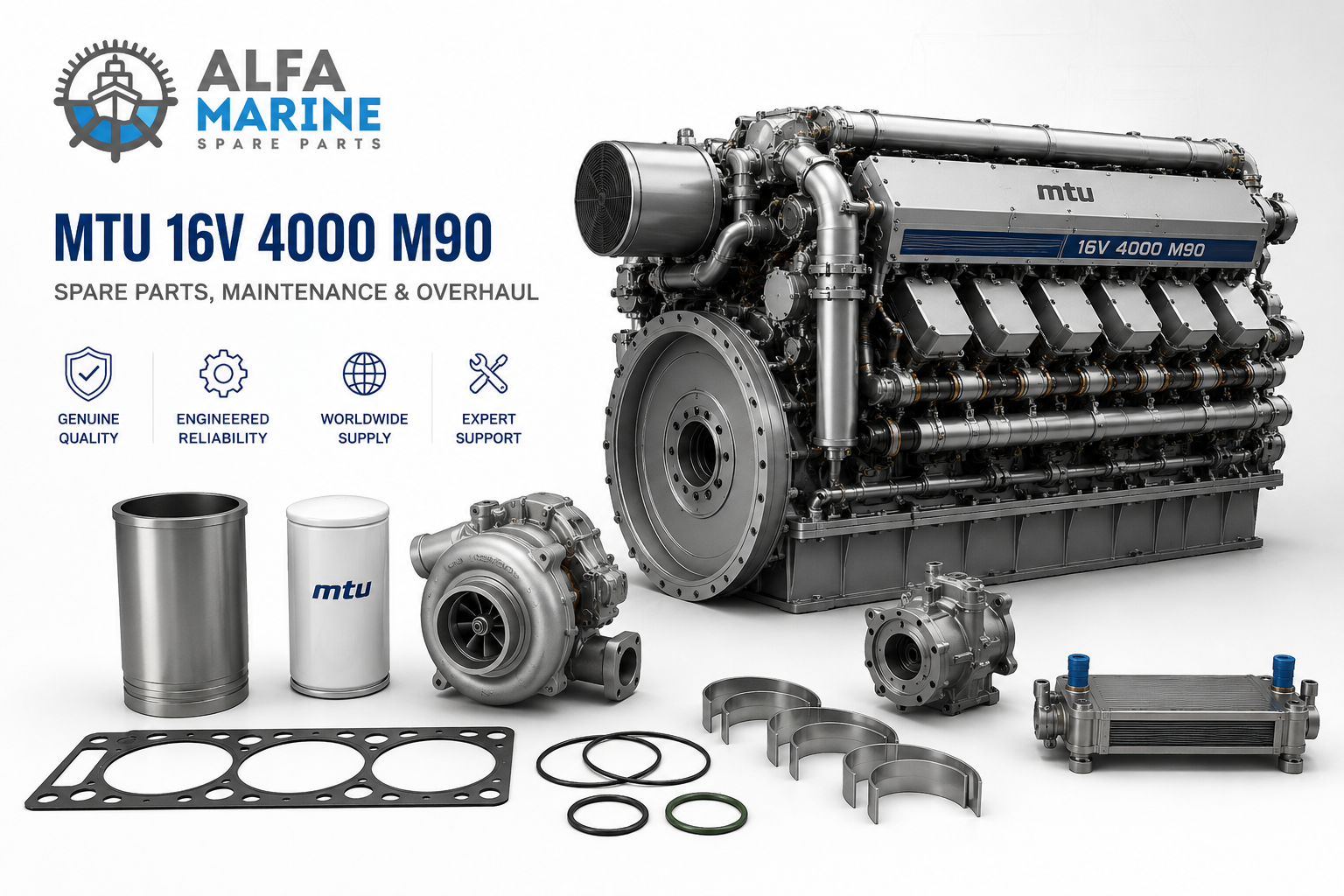

MTU 16V 4000 M90 Marine Engine Spare Parts, Maintenance & Troubleshooting Guide
The MTU 16V 4000 M90 is a 16-cylinder V-engine from the MTU Series 4000 marine diesel family. The documented 1DS configuration was developed for fast vessels operating with relatively low load factors, including fast yachts, fast patrol boats, police craft and firefighting vessels.
The 16V 4000 M90 combines common-rail fuel injection, sequential turbocharging, charge-air cooling, split-circuit cooling and electronic engine management in a high-output marine propulsion package.
For engineers, vessel operators and purchasing departments, accurate engine identification is essential. Ordering a component simply as an “MTU Series 4000 part” is not sufficient because individual Series 4000 models and configurations can use different components.
For reliable parts identification, provide:
Complete engine model + engine serial number + existing part number + required quantity
Browse MTU Series 4000 Marine Engine Parts
MTU 16V 4000 M90 Technical Specifications
The documented MTU 16V 4000 M90 1DS marine configuration has the following principal specifications:
| SpecificationMTU 16V 4000 M90 | |
| Engine family | MTU Series 4000 |
| Engine model | 16V 4000 M90 |
| Configuration | 16-cylinder V-engine |
| V-angle | 90° |
| Bore | 165 mm |
| Stroke | 190 mm |
| Displacement per cylinder | 4.06 litres |
| Total displacement | 65.0 litres |
| Rated power | 2,720 kW / 3,650 bhp |
| Rated speed | 2,100 rpm |
| Fuel injection | Common rail with electronic control |
| Application group | 1DS |
| Starting system | 24 V electric |
| Typical applications | Fast yachts, fast patrol boats, police craft, firefighting vessels |
These specifications apply to the documented 16V 4000 M90 1DS configuration. The engine identification and serial number should still be checked before specifications are used for parts identification, repair or overhaul planning.
Specifications from other Series 4000 engines should not automatically be applied to the M90.
MTU 16V 4000 M90 Common-Rail Fuel System
The MTU 16V 4000 M90 uses an electronically controlled common-rail fuel-injection system.
The documented fuel system includes a fuel delivery pump, duplex fuel filter, high-pressure pump, pressure accumulator/common rail and electronically controlled fuel injection.
This makes fuel cleanliness, correct filtration and accurate component identification particularly important.
Depending on the maintenance or repair requirement, fuel-system components can include:
- Fuel filters
- Fuel delivery components
- High-pressure fuel-system components
- Common-rail components
- Fuel injectors
- Fuel-pressure components
- High-pressure fuel lines
- Fuel seals and O-rings
- Electronic fuel-control components
An injector, pump, sensor or other fuel-system component used on another Series 4000 model should not automatically be assumed compatible with the 16V 4000 M90.
Correct compatibility should be established using the engine serial number and component part number.
MTU 16V 4000 M90 Turbocharging System
The documented 16V 4000 M90 configuration uses sequential turbocharging with two water-cooled turbochargers.
The engine also incorporates charge-air cooling as part of the combustion-air system.
This is important when diagnosing a reduction in engine performance.
Low boost does not automatically mean that a turbocharger has failed.
Boost performance depends on the complete air and exhaust path:
Air intake → turbocharger compressor → charge-air system → engine cylinders → exhaust system → turbocharger turbine
Possible causes of reduced boost can include:
- Restricted combustion-air filters
- Intake restriction
- Charge-air leakage
- Reduced charge-air cooling performance
- Turbocharger deterioration or damage
- Exhaust restriction
- Combustion problems
- Abnormal engine loading
When troubleshooting, compare:
Boost pressure + engine RPM + engine load + exhaust temperatures + smoke condition
Looking at several operating parameters together provides a better diagnostic picture than boost pressure alone.
MTU 16V 4000 M90 Cooling System
The documented M90 configuration uses an MTU split-circuit cooling system.
Its standard cooling arrangement includes a coolant-to-raw-water heat exchanger, raw-water pump and gear-driven coolant circulation pump.
Cooling-system performance becomes particularly important as engine load increases.
At idle or low load, the engine produces less heat. A cooling system that has lost part of its original heat-transfer capacity may therefore still maintain apparently normal temperature.
Under higher load, considerably more heat must be removed.
If engine temperature begins rising primarily under load, areas for investigation can include:
- Raw-water flow
- Raw-water pump condition
- Coolant circulation
- Coolant pump condition
- Heat-exchanger condition
- Cooling passages
- Charge-air cooling
- Thermostatic or regulating components
- Vessel operating load
The timing of the temperature increase is diagnostically important.
Normal temperature at light load + rising temperature under heavy load
presents a different diagnostic pattern from an engine that overheats shortly after starting.
MTU 16V 4000 M90 Lubrication System
The documented lubrication arrangement includes a gear-driven lubricating-oil pump, duplex lubricating-oil filter, centrifugal oil filter and lubricating-oil heat exchanger.
Oil pressure should be monitored as an operating trend, not simply by waiting for an alarm.
Factors that can influence oil pressure include:
- Oil temperature
- Oil viscosity
- Oil-filter condition
- Lubricating-oil pump condition
- Pressure-regulating components
- Internal engine clearances
Operating conditions must also be considered.
A cold-start oil-pressure reading should not be directly compared with a reading taken when the engine is fully warm and operating under load.
Instead, compare current readings with the engine's previous known-good operating values under similar conditions.
A gradual change from historically stable values deserves investigation even when an alarm threshold has not been reached.
Common MTU 16V 4000 M90 Spare Parts
Parts requirements depend on operating hours, maintenance history, engine condition and repair scope.
Routine service requirements can include:
- Fuel filters
- Lubricating-oil filters
- Gaskets
- O-rings
- Seals
- Other scheduled service components
More extensive maintenance or repair can involve components from several engine systems.
Fuel-System Parts
- Fuel injectors
- Fuel-system pump components
- Fuel filters
- Common-rail components
- Pressure-related components
- Seals and O-rings
Cooling-System Parts
- Raw-water pump components
- Coolant-pump components
- Heat-exchanger components
- Cooling-system gaskets
- Seals
- Regulating components
Turbocharger & Air-System Parts
- Turbocharger components
- Charge-air components
- Combustion-air components
- Air-system seals and gaskets
- Exhaust-system components
Lubrication-System Parts
- Lubricating-oil filters
- Oil-pump components
- Oil-system gaskets
- Seals
- Pressure-regulating components
- Sensors
Major Engine Components
Depending on inspection findings and overhaul scope:
- Cylinder liners
- Pistons
- Piston rings
- Main bearings
- Connecting-rod bearings
- Cylinder-head components
- Valves
- Valve-train components
- Gaskets
- O-rings
- Seals
The exact replacement part number should always be confirmed for the specific engine.
Browse MTU Series 4000 Marine Engine Parts
Diagnose the Engine Before Ordering Parts
When an MTU 16V 4000 M90 develops a performance problem, immediately replacing expensive components is rarely the best diagnostic starting point.
First determine:
What changed?
and:
Under which operating conditions does the problem occur?
Useful operating parameters include:
Engine RPM • engine load • boost pressure • coolant temperature • lubricating-oil pressure • exhaust temperatures • smoke condition
These values become more useful when compared with previous known-good operating data from the same engine and vessel.
For example:
Reduced boost + increased smoke + reduced power
points toward a different diagnostic direction from:
Normal boost + increasing coolant temperature under load
Looking at relationships between operating parameters can help narrow the investigation before major components are replaced.
Why Can Fuel Problems Appear Only Under Load?
Fuel demand increases substantially as engine output increases.
A developing fuel-supply restriction may therefore have little noticeable effect at idle or light load.
The operating pattern can appear as:
Normal idle → normal low load → increasing load → reduced performance
This does not automatically prove that the injectors are defective.
Depending on the symptoms, investigate applicable areas such as:
- Fuel quality
- Fuel filters
- Fuel supply
- Fuel pressure
- Fuel-system restrictions
- Fuel-system connections
- Injection-system performance
Because the M90 uses common-rail injection, cleanliness is especially important whenever the fuel system is opened or serviced.
Engineer Tip: Diagnose Systems, Not Individual Components
A useful troubleshooting principle with the MTU 16V 4000 M90 is:
Do not diagnose one component from one abnormal reading.
Look at relationships.
For example:
Low boost + increased smoke + reduced power
can direct attention toward airflow, charge-air, combustion or turbocharging.
Meanwhile:
Normal boost + rising coolant temperature under increasing load
directs the investigation more toward cooling-system capacity and operating conditions.
Likewise:
Normal operation at light load + abnormal performance only at high load
suggests examining systems whose demands increase substantially with engine output.
Recording normal operating parameters before problems develop gives engineers a valuable baseline for future troubleshooting.
MTU 16V 4000 M90 Maintenance
Maintenance should follow the schedule applicable to the specific engine serial number, configuration and installation.
Do not apply a generic Series 4000 maintenance interval to every engine.
Maintenance planning can depend on:
- Operating hours
- Calendar time
- Application
- Operating profile
- Fuel quality
- Environmental conditions
- Engine condition
- Maintenance history
Good engine records should contain more than service dates.
Useful operating trends to record include:
- Oil consumption
- Coolant consumption
- Lubricating-oil pressure
- Coolant temperature
- Boost pressure
- Exhaust temperatures
- Starting behaviour
- Smoke condition
- Engine alarms
- Unusual operating events
These records create a baseline that can make developing problems easier to recognize.
Genuine, OEM-Sourced, Aftermarket & Remanufactured MTU Parts
These terms should not be treated as interchangeable.
Genuine MTU Parts
Components supplied through the genuine MTU parts supply chain.
OEM-Sourced Parts
Components sourced from an original equipment manufacturer where the manufacturer, specification and application can be properly established.
Aftermarket Parts
New replacement components manufactured outside the genuine MTU parts supply chain.
Remanufactured Parts
Previously used components restored through a defined remanufacturing process for further service.
The appropriate option depends heavily on the component.
For precision fuel-system equipment, highly loaded internal engine components and other critical parts, important considerations include:
Material specification + dimensions + tolerances + performance requirements + confirmed engine application
Physical appearance alone does not establish compatibility.
A replacement component can look virtually identical while having different dimensions, materials, calibration or operating characteristics.
How to Identify the Correct MTU 16V 4000 M90 Part Number
Start with the engine identification, not simply the component description.
A request such as:
“I need an MTU Series 4000 water pump.”
does not provide enough information for reliable identification.
A better inquiry is:
Engine model: MTU 16V 4000 M90
Engine serial number: XXXXXXXX
Existing part number: XXXXXXXX
Quantity: 1
Delivery destination: Rotterdam, Netherlands
The engine serial number is particularly important because component references can differ between configurations.
Older part numbers may also have been replaced or superseded during the engine's service life.
If the existing part number is unreadable or unavailable, provide clear photographs of:
- Engine identification plate
- Complete component
- Component identification markings
- Connections
- Mounting arrangement
Browse MTU Series 4000 Marine Engine Parts
Preparing for an MTU 16V 4000 M90 Overhaul
An overhaul should be approached as an engine-system repair, rather than simply ordering a generic overhaul kit.
If abnormal bearing wear is discovered, investigate why it occurred.
Possible contributing areas can include:
- Lubrication condition
- Oil condition
- Internal clearances
- Mating surfaces
- Related component condition
Likewise, if a turbocharger has failed, investigate possible contributing factors such as:
- Lubricating-oil supply
- Air-intake condition
- Foreign-object damage
- Exhaust condition
- Operating history
Installing a replacement component without identifying why the previous component failed can leave the underlying problem unresolved.
Depending on inspection findings and overhaul scope, requirements can include:
- Cylinder liners
- Pistons
- Piston rings
- Main bearings
- Connecting-rod bearings
- Cylinder-head components
- Valves
- Valve-train components
- Gaskets
- Seals
- O-rings
- Fuel-system components
- Pumps
- Turbocharger components
- Cooling-system components
- Lubrication-system components
The final overhaul parts requirement should be established from the engine serial number, inspection results and actual overhaul scope.
Frequently Asked Questions
What Is the MTU 16V 4000 M90 Power Rating?
For the documented 1DS marine configuration, the MTU 16V 4000 M90 is rated at 2,720 kW (3,650 bhp) at 2,100 rpm.
The exact engine identification should still be confirmed before applying this specification to an individual installation.
What Is the MTU 16V 4000 M90 Displacement?
The documented MTU 16V 4000 M90 has a 65.0-litre total displacement, with a 165 mm bore and 190 mm stroke.
How Many Cylinders Does the MTU 16V 4000 M90 Have?
The engine has 16 cylinders arranged in a 90° V configuration.
Does the MTU 16V 4000 M90 Use Common-Rail Injection?
Yes. The documented configuration uses electronically controlled common-rail fuel injection.
How Many Turbochargers Does the MTU 16V 4000 M90 Have?
The documented M90 configuration uses two water-cooled turbochargers in a sequential turbocharging system.
What Types of Vessels Use the MTU 16V 4000 M90?
Documented typical applications for the 1DS configuration include:
- Fast yachts
- Fast patrol boats
- Police craft
- Firefighting vessels
This does not mean that every 16V 4000 M90 installation is limited to these vessel types.
Can Aftermarket Parts Be Used on the MTU 16V 4000 M90?
Aftermarket replacement components may be available for certain applications.
Compatibility should be confirmed using the correct part identification and technical requirements rather than physical appearance alone.
Aftermarket components should also be clearly identified as aftermarket rather than genuine MTU parts.
Are Remanufactured MTU Series 4000 Parts Available?
Remanufactured components may be available for certain Series 4000 applications.
The applicable Reman part number and engine compatibility should be verified against the original component and exact engine identification.
A Reman number used on another Series 4000 model should not automatically be assumed compatible with the 16V 4000 M90.
Why Does an MTU 16V 4000 M90 Lose Power Under Load?
There is no single cause.
Depending on the symptoms, investigate areas such as:
- Fuel delivery
- Air intake
- Charge-air system
- Turbocharging
- Exhaust condition
- Cooling performance
- Engine condition
- Vessel load
Compare several operating parameters before deciding which component requires replacement.
How Do I Find the Correct MTU Part Number?
Provide:
Complete engine model + engine serial number + existing part number + quantity
If the existing part number is uncertain, clear photographs of the engine identification plate and component can assist with identification.
Request MTU 16V 4000 M90 Spare Parts
Alfa Marine Spare Parts can assist with inquiries for MTU 16V 4000 M90 service parts, fuel-system components, cooling-system parts, turbocharger components, repair parts and overhaul components, subject to correct identification and availability.
For faster identification, provide:
Engine model: MTU 16V 4000 M90
Engine serial number:
Existing part number:
Required quantity:
Delivery destination:
Photos: Where available
Browse MTU Series 4000 Marine Engine Parts
Request MTU Marine Engine Parts
Visit Alfa Marine Spare Parts
Email: request@alfamarinespareparts.com