
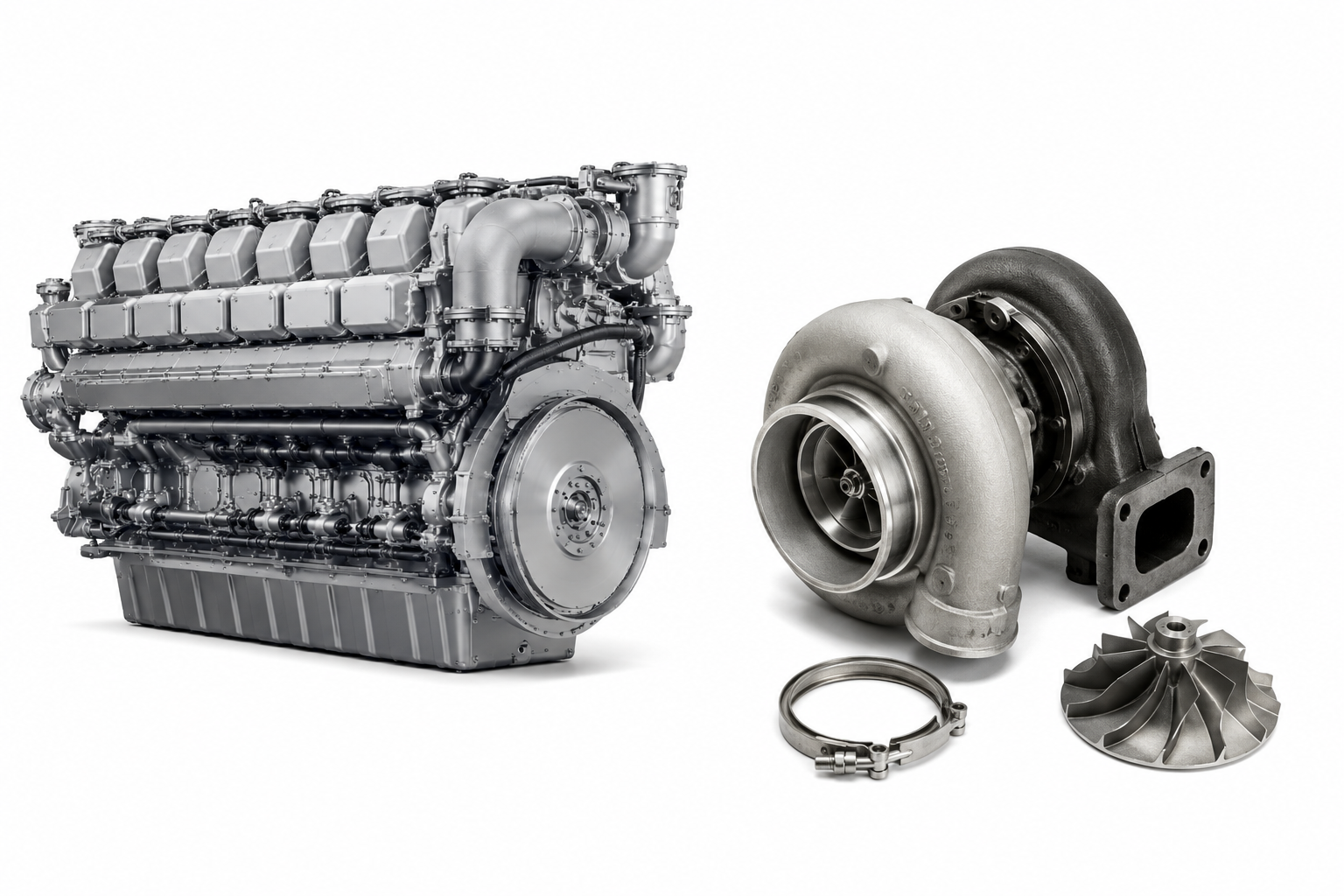
MTU 16V 2000 M97 Turbocharger Problems: Warning Signs, Causes and Preventive Maintenance
The MTU 16V 2000 M97 marine engine is a high-performance diesel engine trusted in fast patrol vessels, offshore support vessels, pilot boats, commercial workboats, and luxury yachts. Designed to deliver exceptional power and efficiency, the engine relies heavily on its turbocharging system to achieve optimal combustion and performance.
A turbocharger failure is more than just a loss of power. It can lead to increased fuel consumption, excessive exhaust smoke, overheating, engine contamination, and, if ignored, severe engine damage. Fortunately, turbochargers often provide warning signs before a complete failure occurs.
In this guide, we'll explain how the turbocharger works on the MTU 16V 2000 M97, what causes it to fail, how to recognize early symptoms, and what preventive maintenance can help extend its service life.
What Does the Turbocharger Do on the MTU 16V 2000 M97?
The turbocharger uses exhaust gas energy to compress fresh air before it enters the engine cylinders. This compressed air allows more oxygen into the combustion chamber, enabling the engine to burn fuel more efficiently and produce greater power without increasing engine size.
Benefits of a properly functioning turbocharger include:
- Higher engine power output
- Improved fuel efficiency
- Cleaner combustion
- Reduced exhaust emissions
- Better acceleration under load
- Stable engine performance
Without a healthy turbocharger, the MTU 16V 2000 M97 cannot deliver its designed performance.
Why Do Turbochargers Fail?
Although turbochargers are built for demanding marine environments, they operate under extreme conditions. The turbine can rotate at well over 100,000 RPM while being exposed to very high exhaust temperatures.
The most common causes of failure include:
- Poor lubrication
- Contaminated engine oil
- Restricted oil supply
- Dirty air filters
- Foreign object damage
- Excessive exhaust temperatures
- Blocked charge air cooler
- Improper engine shutdown procedures
- Extended maintenance intervals
Most turbocharger failures are linked to lubrication or cooling issues rather than defects in the turbocharger itself.
Early Warning Signs of Turbocharger Problems
Marine engineers should investigate immediately if they notice:
- Loss of engine power
- Black exhaust smoke
- Blue exhaust smoke
- Whistling or unusual turbo noise
- Increased engine oil consumption
- Oil leaks around the turbocharger
- High exhaust gas temperatures
- Slow engine acceleration
- Increased fuel consumption
- Engine alarms related to boost pressure
Ignoring these symptoms may result in significant engine damage.
How Poor Lubrication Affects the Turbocharger
The turbocharger shaft is supported by precision bearings that rely on a continuous supply of clean engine oil.
If oil flow is interrupted or contaminated, the bearings begin to wear rapidly.
Possible causes include:
- Dirty oil
- Blocked oil filters
- Low oil pressure
- Incorrect oil viscosity
- Delayed oil changes
- Carbon deposits in oil passages
Once bearing wear begins, shaft movement increases, eventually allowing the compressor or turbine wheels to contact the housing.
The Importance of Clean Air
The compressor wheel draws a large volume of air into the engine.
Dirty or damaged air filters can allow abrasive particles to enter the turbocharger.
Dust and debris gradually erode compressor blades, reducing efficiency and upsetting rotor balance.
Routine inspection of air filters is a simple but essential maintenance task.
Charge Air Cooler Maintenance
A blocked or dirty charge air cooler reduces the density of the compressed air supplied to the engine.
This can lead to:
- Higher intake temperatures
- Reduced engine efficiency
- Increased exhaust temperatures
- Additional turbocharger stress
- Higher fuel consumption
Regular cleaning of the charge air cooler helps maintain proper turbocharger performance.
Engine Oil Analysis Can Reveal Turbocharger Problems
Routine oil analysis is an excellent predictive maintenance tool.
Laboratory testing may identify:
- Bearing wear metals
- Oil contamination
- Fuel dilution
- Coolant contamination
- Oxidation
- Reduced oil quality
Increasing wear metals may indicate early turbocharger bearing deterioration before noticeable performance problems occur.
What Else Should Be Inspected?
Whenever the turbocharger is inspected, marine engineers should also examine:
- Engine oil pump
- Oil filters
- Oil cooler
- Air filters
- Charge air cooler
- Exhaust manifold
- Exhaust temperature sensors
- Fuel injectors
- Cooling system
- Crankcase breather
These components all influence turbocharger reliability and overall engine performance.
Preventive Maintenance Checklist
To maximize the service life of the MTU 16V 2000 M97 turbocharger:
✔ Change engine oil according to the recommended maintenance schedule.
✔ Replace oil filters during every oil service.
✔ Use only approved lubricants.
✔ Inspect air filters regularly.
✔ Clean the charge air cooler.
✔ Monitor exhaust temperatures.
✔ Perform routine oil analysis.
✔ Check boost pressure during engine inspections.
✔ Allow the engine to cool after heavy operation before shutdown.
✔ Investigate unusual noises immediately.
Marine Engineer Tip
One of the most common causes of premature turbocharger failure is shutting the engine down immediately after prolonged high-load operation. Allowing the MTU 16V 2000 M97 to idle for a short period before shutdown helps stabilize temperatures and ensures the turbocharger continues to receive adequate lubrication while it slows down. This simple practice can significantly extend turbocharger bearing life.
Common Mistakes
Avoid these common mistakes:
- Ignoring unusual turbocharger noises.
- Delaying oil changes.
- Reusing dirty air filters.
- Overlooking charge air cooler maintenance.
- Continuing to operate with excessive exhaust smoke.
- Ignoring high exhaust temperature alarms.
- Failing to investigate low boost pressure.
- Replacing the turbocharger without identifying the root cause of the failure.
Frequently Asked Questions
What is the first sign of a failing turbocharger?
A noticeable loss of engine power, increased exhaust smoke, or an unusual whistling noise are often the earliest indicators.
Can dirty engine oil damage the turbocharger?
Yes. Dirty or degraded oil accelerates bearing wear and can eventually lead to complete turbocharger failure.
Why is my MTU 16V 2000 M97 producing black smoke?
Black smoke may indicate insufficient air supply caused by a turbocharger problem, dirty air filters, or a blocked charge air cooler.
Should I replace the turbocharger cartridge or the complete unit?
The correct repair depends on the condition of the housing, shaft, bearings, and wheels. A thorough inspection should be carried out before deciding.
Can oil analysis detect turbocharger problems?
Yes. Increasing wear metals and oil contamination can indicate developing turbocharger bearing wear before serious damage occurs.
Worldwide Marine Engine Spare Parts Supply
Alfa Marine Spare Parts supplies genuine, OEM, aftermarket, remanufactured, and reconditioned spare parts for the MTU 16V 2000 M97 and other MTU marine engines to customers worldwide.
We support:
- Commercial shipping companies
- Shipyards
- Ship repair facilities
- Offshore operators
- Yacht builders
- Yacht management companies
- Fleet operators
- Marine engineers
- Chief engineers
- Technical superintendents
- Government and naval fleets
We regularly supply marine engine spare parts to customers in:
- United Kingdom
- United States
- Dubai, United Arab Emirates
- Monaco
- Nigeria
- Netherlands
- Italy
- Spain
- France
- Germany
- Norway
- Greece
- And many other maritime regions worldwide.
Our customers include companies operating in major maritime hubs such as Harland & Wolff, A&P Group, Huntington Ingalls Industries (HII), General Dynamics NASSCO, Damen Shipyards, Fincantieri, Drydocks World Dubai, and offshore operators serving Lagos, Port Harcourt, Onne, and Warri in Nigeria.
Browse Our Complete Spare Parts Catalog
Looking for more than just turbocharger advice?
Alfa Marine Spare Parts supplies genuine, OEM, aftermarket, remanufactured, and reconditioned marine engine spare parts for MTU, Caterpillar, Wärtsilä, MAN, Cummins, Volvo Penta, Scania, Perkins, Detroit Diesel, Deutz, Doosan, Mitsubishi, John Deere, and Yanmar.
Our inventory includes:
- Turbochargers
- Turbocharger cartridges (CHRA)
- Fuel injectors
- Camshafts
- Crankshafts
- Heat exchangers
- Seawater pumps
- Freshwater pumps
- Oil pumps
- Oil coolers
- Cylinder heads
- Bearings
- Gaskets
- Complete overhaul kits
Browse our complete inventory:
https://alfamarinespareparts.com/spareparts
Why Choose Alfa Marine Spare Parts?
We are committed to supporting marine professionals with high-quality engine solutions, including:
- Genuine, OEM, aftermarket, remanufactured, and reconditioned parts
- Worldwide shipping
- Technical assistance to identify the correct components
- Support for commercial vessels, offshore fleets, patrol boats, workboats, and luxury yachts
- Reliable service for shipyards, marine engineers, chief engineers, and fleet managers
Contact Alfa Marine Spare Parts
Need assistance with your MTU 16V 2000 M97 or help sourcing the correct turbocharger and related spare parts?
🌐 Website: https://alfamarinespareparts.com
📧 Email: request@alfamarinespareparts.com
Our technical team is ready to help you identify the right components and keep your MTU engine operating reliably wherever your vessel is located.
Conclusion
The turbocharger is one of the most important systems on the MTU 16V 2000 M97 marine engine, directly affecting power output, fuel efficiency, and engine reliability. Regular inspections, clean lubrication, proper air filtration, charge air cooler maintenance, and routine oil analysis can identify developing issues before they become expensive failures. By combining preventive maintenance with timely replacement of worn components, operators can reduce downtime, extend turbocharger life, and keep their MTU engines performing efficiently in demanding marine environments around the world.