MTU 16V 2000 M93 Lubrication System Maintenance: The One System Every Marine Engineer Should Never Take for Granted
If someone asked you which system keeps every moving part inside an MTU engine alive, what would your answer be?
Some people might say the cooling system.
Others would point to the fuel system.
Both are essential—but ask an experienced chief engineer, and many will tell you the same thing:
"Without proper lubrication, nothing else matters."
The MTU 16V 2000 M93 is a powerful marine diesel engine built to operate under demanding conditions aboard patrol boats, luxury yachts, commercial vessels, and offshore support craft. Every second it runs, hundreds of components move at high speed under enormous pressure.
The only thing preventing these metal surfaces from grinding against each other is a thin film of engine oil.
That makes the lubrication system one of the most important—and most underestimated—systems on the engine.
Let's explore why maintaining this system is critical, how problems develop, and what warning signs every marine engineer should recognize before expensive damage occurs.
Why Is the Lubrication System So Important?
Imagine rowing a boat without water beneath it.
No matter how hard you pull, friction would stop you almost immediately.
Inside a marine diesel engine, lubrication works in much the same way.
Engine oil creates a protective film between moving parts, reducing friction while carrying away heat and contaminants.
The lubrication system protects:
- Crankshaft journals
- Main bearings
- Connecting rod bearings
- Camshaft
- Rocker arms
- Valve train
- Turbocharger bearings
- Pistons
- Cylinder liners
- Timing gears
Without continuous oil flow, engine damage begins within seconds.
How Does the Lubrication System Work?
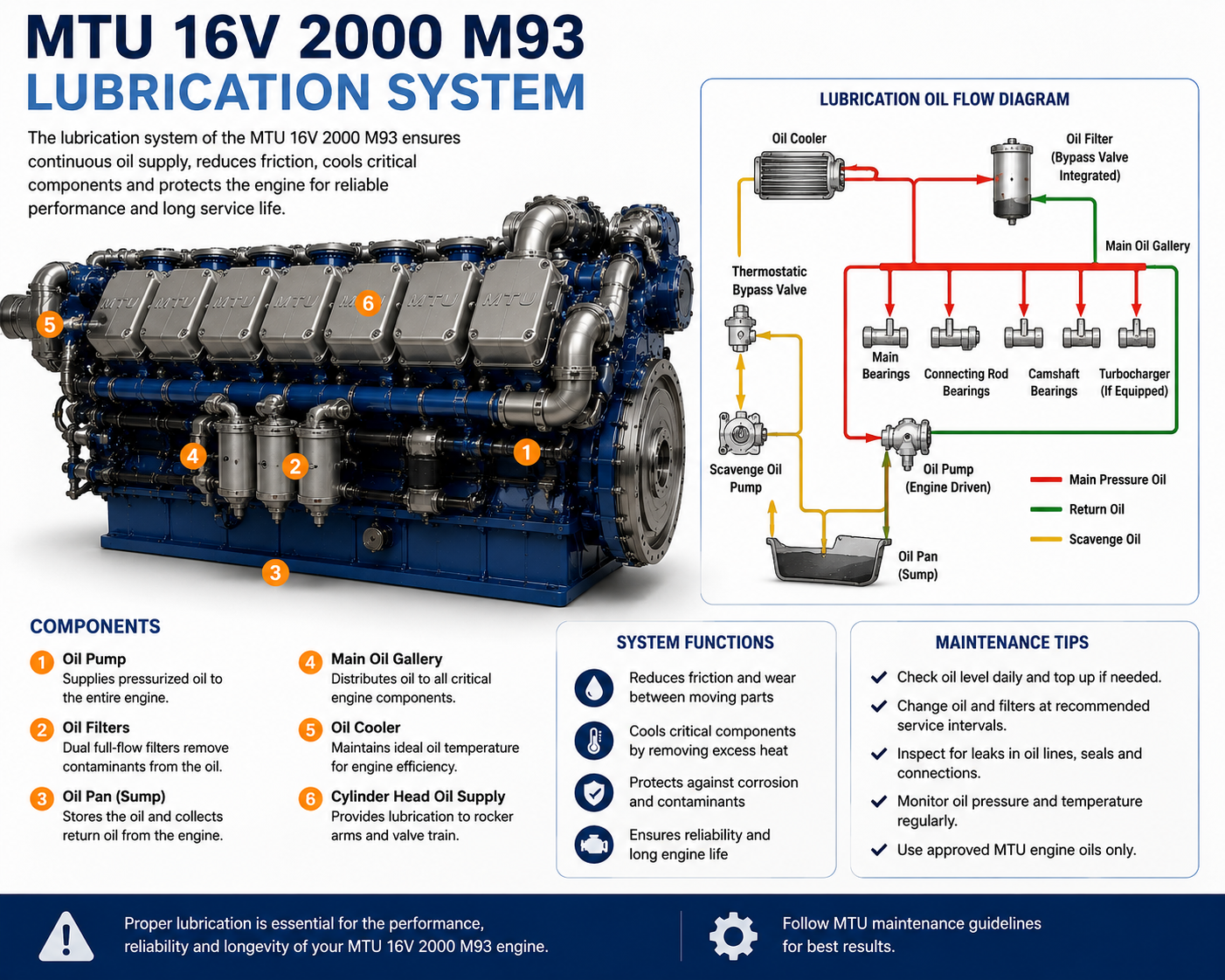
As soon as the engine starts, the oil pump draws lubricating oil from the sump.
The oil then passes through:
- Oil strainer
- Oil pump
- Oil cooler
- Oil filters
- Main oil galleries
From there, it is distributed throughout the engine before returning to the sump to begin the cycle again.
This circulation continues thousands of times every hour.
Every component depends on uninterrupted oil flow.
A Real Marine Maintenance Story
A large motor yacht powered by MTU 16V 2000 M93 engines arrived at a shipyard after the crew noticed slightly lower oil pressure during extended cruising.
The pressure drop was small.
No warning alarm appeared.
Because engine performance remained normal, the issue could easily have been ignored.
Instead, engineers performed an oil analysis.
The laboratory report revealed elevated copper and lead levels.
Further inspection showed early wear on one main bearing caused by a partially restricted oil filter.
The bearing was replaced during scheduled maintenance.
The crankshaft remained undamaged.
A repair that might have cost hundreds of thousands of euros became a routine maintenance job simply because the warning signs were taken seriously.
What Causes Lubrication Problems?
The lubrication system is reliable, but several conditions can reduce its effectiveness.
Dirty Engine Oil
Over time, engine oil collects:
- Carbon particles
- Dust
- Combustion by-products
- Fuel contamination
- Moisture
- Metal particles
Eventually, the oil can no longer provide the protection it was designed for.
Delayed Oil Changes
Fresh oil contains additives that reduce wear, prevent corrosion, and suspend contaminants.
As these additives become depleted, engine protection decreases.
Blocked Oil Filters
Oil filters trap contaminants before they reach critical components.
If filters become restricted, oil flow may decrease.
Even temporary reductions in lubrication can accelerate bearing wear.
Low Oil Level
A surprisingly common cause of engine damage is simply operating with insufficient oil.
Always investigate unexplained oil loss immediately.
Oil Pump Wear
Although uncommon, worn oil pumps may gradually reduce oil pressure.
Monitoring pressure trends helps identify this problem before serious engine damage develops.
Early Warning Signs
Most lubrication problems develop gradually.
Watch for:
- Lower oil pressure
- Rising oil temperature
- Metallic particles during oil changes
- Increased engine noise
- Bearing knock
- Turbocharger noise
- Increased oil consumption
- Oil leaks
- Higher vibration
- Abnormal oil analysis reports
These symptoms rarely appear all at once.
Small changes often provide the earliest warning.
Why Oil Pressure Trends Matter
Many operators focus only on alarms.
Experienced engineers focus on trends.
If your engine normally operates at a certain oil pressure and that pressure gradually decreases over several months, the engine is telling you something.
The cause may be:
- Bearing wear
- Oil pump wear
- Oil dilution
- Filter restriction
- Internal leakage
Identifying the reason early prevents far more expensive repairs later.
Components That Should Be Inspected Together
Whenever the lubrication system is serviced, engineers should also inspect:
- Oil pump
- Oil cooler
- Oil filters
- Oil pressure sensor
- Crankshaft bearings
- Camshaft bearings
- Turbocharger oil supply
- Oil return lines
- Oil seals
- Breather system
Looking at the complete lubrication system helps identify the true cause of any developing issue.
Why Oil Analysis Should Be Routine
Oil analysis is like a blood test for your engine.
Without dismantling anything, laboratory testing can reveal:
- Iron
- Copper
- Lead
- Tin
- Aluminium
- Silicon
- Sodium
- Potassium
- Fuel dilution
- Water contamination
- Oxidation
- Soot levels
These results allow engineers to monitor wear long before failures become visible.
For many commercial operators, oil analysis is one of the most valuable maintenance tools available.
Preventive Maintenance Checklist
A consistent maintenance routine greatly extends engine life.
✔ Check engine oil level before every voyage.
✔ Monitor oil pressure daily.
✔ Replace engine oil according to MTU maintenance recommendations.
✔ Replace oil filters during every scheduled service.
✔ Perform routine laboratory oil analysis.
✔ Inspect for oil leaks.
✔ Record oil pressure and temperature trends.
✔ Investigate abnormal engine noises immediately.
✔ Service the oil cooler.
✔ Use only approved lubricants.
Marine Engineer Tip
Never judge engine oil by its colour alone.
Diesel engine oil naturally becomes darker during operation because it suspends soot particles.
The true condition of the oil can only be confirmed through laboratory analysis, operating hours, and the manufacturer's maintenance schedule.
Common Maintenance Mistakes
Avoid these common errors:
- Extending oil change intervals.
- Mixing different oil grades.
- Ignoring gradual pressure loss.
- Replacing oil without changing the filter.
- Ignoring small oil leaks.
- Waiting for warning alarms before investigating.
Frequently Asked Questions
How often should engine oil be replaced?
Always follow the MTU maintenance schedule for your operating conditions and approved lubricant.
Why is oil analysis important?
Oil analysis detects wear, contamination, and lubrication problems long before mechanical failure occurs.
Can low oil pressure damage the turbocharger?
Yes. The turbocharger depends on a constant supply of clean engine oil for bearing lubrication.
What happens if the oil filter becomes blocked?
Restricted filters may reduce oil flow, increasing wear throughout the engine.
Is changing oil enough to protect the engine?
No. The entire lubrication system—including filters, pump, cooler, and oil quality—must be maintained together.
Worldwide Marine Engine Spare Parts Supply
Alfa Marine Spare Parts supplies genuine, OEM, aftermarket, remanufactured, and reconditioned spare parts for the MTU 16V 2000 M93 and the complete MTU Series 2000 engine family.
We proudly support:
- Commercial shipping companies
- Shipyards
- Luxury yacht operators
- Offshore operators
- Marine engineers
- Chief engineers
- Technical superintendents
- Government fleets
- Fishing fleets
- Marine maintenance companies
We regularly ship marine engine spare parts to customers throughout the United Kingdom, United States, Dubai (UAE), Monaco, Nigeria, the Netherlands, Italy, Spain, France, Germany, Norway, and Greece, helping keep vessels operating efficiently worldwide.
Browse Our Complete Spare Parts Catalog
Alfa Marine Spare Parts offers a complete range of MTU Series 2000 engine components, including:
- Oil pumps
- Oil coolers
- Oil filters
- Turbochargers
- Crankshafts
- Main bearings
- Connecting rod bearings
- Camshafts
- Cylinder heads
- Fuel injectors
- Heat exchangers
- Water pumps
- Complete overhaul kits
Browse our complete catalog:
https://alfamarinespareparts.com/spareparts
Why Choose Alfa Marine Spare Parts?
Marine engines are major investments, and reliable maintenance starts with the right components. At Alfa Marine Spare Parts, we work closely with marine engineers, fleet managers, shipyards, and vessel owners to provide dependable solutions for routine servicing and major overhauls.
We offer:
- Genuine, OEM, aftermarket, remanufactured, and reconditioned spare parts
- Worldwide shipping
- Fast quotations
- Technical assistance for part identification
- Support for MTU, Caterpillar, Wärtsilä, MAN, Cummins, Volvo Penta, Scania, Detroit Diesel, Perkins, Yanmar, and many other leading marine engine brands
Our goal is to help reduce downtime while extending the life of your marine engines.
Contact Alfa Marine Spare Parts
Looking for lubrication system components for your MTU 16V 2000 M93?
Website: https://alfamarinespareparts.com
Email: request@alfamarinespareparts.com
Our experienced marine parts specialists are ready to help you identify the correct components for preventive maintenance, repairs, and complete engine overhauls.
Conclusion
The lubrication system is the lifeblood of the MTU 16V 2000 M93. Every rotating and moving component depends on a continuous supply of clean, properly filtered engine oil to reduce friction, control temperatures, and prevent wear. Most lubrication-related failures don't happen overnight—they develop gradually through contaminated oil, restricted filters, declining oil pressure, or neglected maintenance. By monitoring oil condition, tracking pressure trends, performing regular oil analysis, and servicing the complete lubrication system rather than just changing the oil, marine engineers can prevent costly repairs and help ensure their MTU engine delivers reliable performance for thousands of operating hours.