
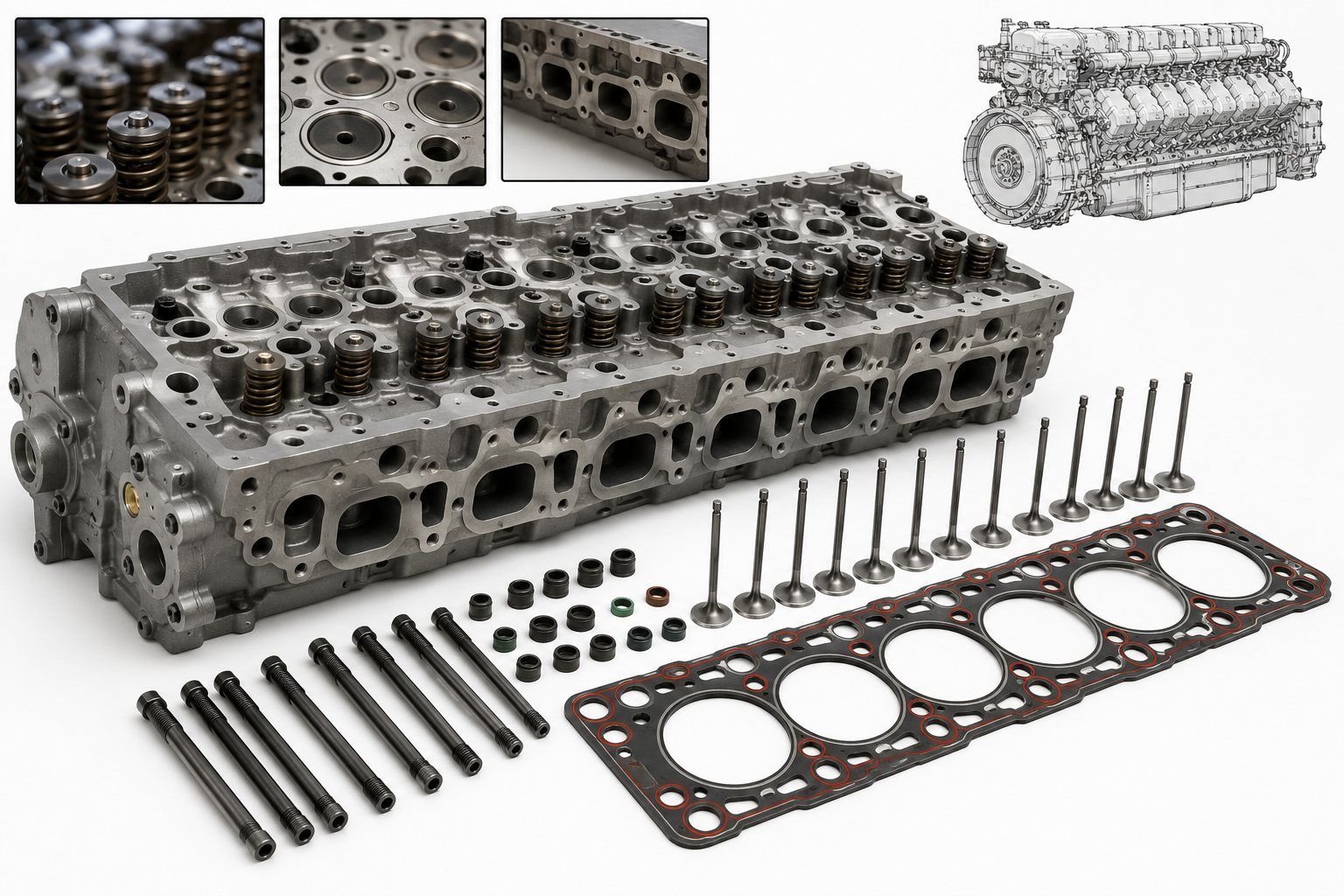

MTU 16V 2000 M91 Cylinder Head: What Marine Engineers Can Learn Before a Failure
The MTU 16V 2000 M91 marine engine belongs to the MTU Series 2000 engine family, a family of high-speed diesel engines developed for demanding marine applications.
Inside this V16 engine, the MTU 16V 2000 M91 Cylinder Head operates in one of the harshest environments anywhere in the engine.
Every time a cylinder fires, the cylinder head must deal with combustion pressure, heat, intake air, exhaust gases, valve movement and cooling—all while maintaining an effective seal.
But for a marine engineer, the interesting question isn't simply:
"What does the cylinder head do?"
A more useful question is:
"What can the cylinder head tell us about what's happening inside the engine?"
A changing exhaust temperature, unusual valve condition, abnormal deposits or deterioration around a sealing surface can provide valuable information long before a serious failure develops.
That makes the cylinder head more than a replacement component.
It can become a valuable diagnostic tool.
Where Does the MTU 16V 2000 M91 Belong?
Understanding the engine designation is important when identifying replacement parts.
The MTU 16V 2000 M91 is part of the MTU Series 2000.
In simple terms:
Manufacturer: MTU
Engine family: MTU Series 2000
Engine model: MTU 16V 2000 M91
Configuration: V16 marine diesel engine
Component discussed: Cylinder head
The 2000 identifies the engine family.
The 16V identifies the V16 cylinder configuration.
The M91 identifies the particular marine engine variant.
This distinction becomes extremely important when ordering parts because simply asking for an "MTU Series 2000 cylinder head" isn't specific enough.
Different engines within the Series 2000 family can use different components.
Why Is the Cylinder Head So Important?
The cylinder head closes the upper section of each cylinder's combustion chamber.
But describing it simply as a cover doesn't come close to explaining its importance.
The cylinder head supports or interfaces with:
- Intake valves
- Exhaust valves
- Valve seats
- Valve guides
- Valve springs
- Valve stem seals
- Rocker components
- Fuel-system components
- Cooling passages
- Intake passages
- Exhaust passages
- Cylinder-head gasket
All these systems meet in a relatively compact area.
That means a problem involving one component can influence several others.
Engineering Lesson: Compare Cylinders, Not Just Alarm Limits
One of the most useful diagnostic techniques on a V16 marine diesel engine is surprisingly simple:
Compare cylinders.
Imagine your MTU 16V 2000 M91 is operating normally.
All sixteen cylinders remain inside the acceptable operating range.
No alarms.
No obvious loss of power.
But fifteen cylinders behave similarly while one cylinder consistently shows a different exhaust-temperature trend.
Should you ignore it because it's still within limits?
Not necessarily.
Ask:
Why is that cylinder behaving differently?
The cause might involve:
- Injector performance
- Intake airflow
- Exhaust valve condition
- Valve clearance
- Compression
- Cooling
- Valve-seat condition
The difference between cylinders can sometimes reveal more than the absolute temperature itself.
Chief Engineer's Notebook
"A cylinder doesn't need to trigger an alarm before it starts telling you something."
Trend changes deserve attention.
MTU 16V 2000 M91 Cylinder Head Part Number
One MTU parts catalog for a specific 16V 2000 M91 configuration identifies:
5410103820 – Cylinder Head
The same documentation shows one cylinder head for each cylinder in the referenced V16 arrangement.
This is an important reminder that the MTU 16V 2000 M91 uses individual cylinder-head assemblies rather than one large cylinder head covering an entire bank.
However, 5410103820 should not automatically be assumed correct for every 16V 2000 M91.
Engine configuration and parts revisions matter.
Always verify against the engine serial number and applicable parts documentation before ordering.
Important MTU 16V 2000 M91 Cylinder Head Part Numbers
Parts associated with the referenced cylinder-head configuration include:
| Part NumberComponent | |
| 5410103820 | Cylinder Head |
| 5410160920 | Cylinder Head Gasket |
| 4570530001 | Inlet Valve |
| 5410500227 | Valve |
| 5410530020 | Valve Spring |
| 0000533558 | Valve Stem Gasket / Seal |
| 5410532131 | Inlet Valve Seat Insert |
| 5410532531 | Inlet Valve Seat Ring |
| 5410530532 | Exhaust Valve Seat Insert |
| 5410530632 | Valve Seat Insert |
| 5410501336 | Rocker Shaft Support with Rocker Arm |
| 5410501236 | Rocker Shaft Support |
| 5410500834 | Exhaust Rocker Arm |
| 5410500933 | Inlet Rocker Arm |
| 5410550620 | Adjusting Screw |
These numbers are useful references, but they should always be checked against the specific engine serial number and configuration.
Don't Order an MTU Cylinder Head From "Series 2000" Alone
This is one of the most important lessons for buyers and engineers.
Imagine a vessel sends this inquiry:
"Need cylinder head MTU Series 2000."
That's not enough information.
Even:
"Need cylinder head MTU 16V 2000."
still leaves room for error.
And even after identifying the engine as an MTU 16V 2000 M91, verification is recommended.
A good spare-parts inquiry should contain:
Engine: MTU 16V 2000 M91
Engine Serial Number: ______
Existing Part Number: ______
Component Required: Cylinder Head
Quantity: ______
Photos: Recommended
This becomes especially important with expensive components such as cylinder heads.
What Can an Old Cylinder Head Tell You?
When a cylinder head is removed during an overhaul, don't immediately send it for cleaning.
First, inspect it.
The condition of the cylinder head can provide clues about how that particular cylinder has been operating.
Look at the Exhaust Valve
Compare it with exhaust valves from neighbouring cylinders.
Look for:
- Burning
- Deposits
- Uneven coloration
- Face deterioration
- Stem wear
- Abnormal seat contact
If one valve looks dramatically different, investigate why.
Look at the Intake Valve
Check for:
- Deposits
- Stem condition
- Valve-face wear
- Seat contact
- Unusual contamination
Again, comparison matters.
Sixteen cylinders give the engineer sixteen opportunities for comparison.
Look at the Valve Seats
A valve can only seal correctly when it works properly with its seat.
Inspect for:
- Pitting
- Burning
- Uneven contact
- Erosion
- Deposits
- Mechanical damage
Don't replace a damaged valve without examining the seat that it was sealing against.
Inspect the Valve Guides
Valve guides control valve movement.
Excessive clearance can influence:
- Valve seating
- Oil consumption
- Stem wear
- Valve temperature
- Long-term reliability
A new valve installed into a badly worn guide does not solve the complete problem.
Inspect the Valve Stem Seals
The referenced MTU cylinder-head parts documentation identifies 0000533558 as a valve-stem sealing component.
These small seals help control oil around the valve stems.
When inspecting them, look for:
- Hardening
- Cracking
- Deformation
- Heat deterioration
- Loss of elasticity
If the cylinder head is already dismantled, it makes sense to carefully inspect all associated sealing components.
Inspect the Cylinder Head Gasket
The referenced parts documentation identifies:
5410160920 – Cylinder Head Gasket
When the gasket is removed, don't immediately throw it away.
Look at it first.
A used head gasket can reveal:
- Combustion tracking
- Coolant leakage
- Oil leakage
- Uneven loading
- Surface problems
- Localized overheating
The old gasket may contain useful evidence about what happened before disassembly.
A New Head Gasket Cannot Repair a Damaged Surface
This principle applies across marine diesel engines.
If the sealing surface has:
- Corrosion
- Pitting
- Distortion
- Scratches
- Erosion
- Remaining gasket material
simply installing a new gasket may not solve the problem.
Inspect both mating surfaces before reassembly.
The goal isn't simply to install new parts.
The goal is to restore the sealing system.
Cooling Passages Deserve Attention
The cylinder head operates under high thermal loading.
Its cooling passages therefore deserve careful inspection during overhaul.
Look for:
- Deposits
- Corrosion
- Restrictions
- Contamination
- Evidence of leakage
A restricted cooling passage can create a local hot area even when overall engine coolant temperature appears acceptable.
That's another reason cylinder-to-cylinder comparison is valuable.
Engine Room Reality: The Cylinder Head May Be the Victim, Not the Cause
Suppose an exhaust valve burns.
The easy conclusion is:
"Bad valve."
But why did it burn?
Possible causes may include:
- Injector problems
- Poor combustion
- Incorrect valve clearance
- Cooling problems
- Valve-seat deterioration
- Airflow problems
- Excessive exhaust temperature
- Incorrect assembly
Replacing the damaged cylinder-head components without identifying the root cause can allow the same problem to return.
Real Marine Maintenance Scenario
Consider a yacht powered by twin MTU 16V 2000 M91 Series 2000 marine engines.
The engines appear healthy.
Oil pressure is stable.
Coolant temperatures are normal.
No alarms are active.
During routine trend analysis, however, the engineer notices something interesting.
Cylinder No. X consistently operates differently from the remaining cylinders.
The difference isn't large enough to trigger an alarm.
But over several weeks, the trend becomes more noticeable.
Instead of waiting, the engineering team investigates.
They check:
- Injector condition
- Valve clearance
- Exhaust temperature
- Compression
- Cooling
- Intake airflow
During the next planned maintenance period, the individual cylinder head is removed.
Inspection reveals developing deterioration around the exhaust valve and seat.
Because the problem was identified early, the repair can be performed during scheduled downtime.
No emergency cylinder-head failure.
No secondary piston damage.
No unexpected voyage interruption.
The lesson is simple:
Trend monitoring can turn an emergency repair into planned maintenance.
Engineer's Toolbox
MTU 16V 2000 M91 Cylinder Head Inspection Checklist
When a cylinder head is removed, inspect:
✔ Cylinder-head casting
✔ Cylinder-head gasket
✔ Intake valves
✔ Exhaust valves
✔ Valve guides
✔ Valve seats
✔ Valve-seat inserts
✔ Valve stem seals
✔ Valve springs
✔ Rocker arms
✔ Adjusting components
✔ Cooling passages
✔ Sealing surfaces
✔ Combustion deposits
✔ Injector-related condition
✔ Fasteners
And document which cylinder every component came from.
Marine Engineer Tip
Photograph the cylinder head before cleaning it.
Take pictures of:
- Combustion face
- Intake valve
- Exhaust valve
- Valve seats
- Head gasket
- Deposits
- Any unusual damage
Label every photograph with the cylinder number.
After cleaning, some of the evidence disappears.
Those photographs can become valuable maintenance records when another cylinder develops a similar condition months or years later.
Don't Mix Components Between Cylinders Without Identification
During a large overhaul, many similar components may be removed simultaneously.
Good workshop organization matters.
Label:
- Cylinder heads
- Valves
- Rocker components
- Springs
- Associated hardware
Keeping components associated with their original cylinder allows engineers to compare wear patterns.
That information can help identify whether a problem is:
Local to one cylinder
or
Developing throughout the engine.
Common Cylinder Head Maintenance Mistakes
Avoid:
- Replacing a burnt valve without investigating the cause.
- Installing a new gasket on damaged surfaces.
- Ignoring cooling-passage deposits.
- Reusing questionable seals.
- Mixing components between cylinders.
- Cleaning components before documenting deposits.
- Looking only at alarm limits.
- Ignoring cylinder-to-cylinder trends.
- Ordering a cylinder head without serial-number verification.
- Assuming every MTU Series 2000 cylinder head is interchangeable.
Frequently Asked Questions
Is the MTU 16V 2000 M91 part of the MTU Series 2000?
Yes. The MTU 16V 2000 M91 belongs to the MTU Series 2000 engine family.
The designation identifies a V16 configuration within the Series 2000 family and an M91 marine variant.
Are all MTU Series 2000 cylinder heads the same?
No.
The MTU Series 2000 includes different engine configurations and marine variants. Parts should never be assumed interchangeable simply because two engines belong to the same Series 2000 family.
What is the MTU 16V 2000 M91 cylinder head part number?
For the specific 16V 2000 M91 configuration referenced in the parts documentation, 5410103820 is identified as the cylinder head.
Compatibility should always be confirmed using the engine serial number.
What is the cylinder-head gasket part number?
The referenced configuration identifies:
5410160920 – Cylinder Head Gasket
Again, confirm compatibility before ordering.
What is part number 4570530001?
The referenced MTU parts documentation identifies 4570530001 as an inlet valve associated with the cylinder-head arrangement.
What is part number 0000533558?
It is identified as a valve-stem gasket/sealing component in the referenced cylinder-head arrangement.
Should a damaged cylinder head always be replaced?
Not necessarily.
Depending on the damage and manufacturer limits, some cylinder heads may be professionally inspected and remanufactured. Other heads may require replacement.
The condition should be assessed before deciding between repair, remanufacturing and replacement.
Can Alfa Marine Spare Parts supply MTU 16V 2000 M91 cylinder heads?
Yes. Alfa Marine Spare Parts can assist with sourcing genuine, OEM, aftermarket, remanufactured and reconditioned MTU Series 2000 components, depending on the specific application and availability.
Part-number and engine-serial-number verification is recommended before ordering.
Related MTU 16V 2000 M91 Parts
During cylinder-head maintenance, engineers may also require:
- Cylinder-head gaskets
- Intake valves
- Exhaust valves
- Valve guides
- Valve-seat inserts
- Valve springs
- Valve stem seals
- Rocker arms
- Cylinder-head-cover gaskets
- O-rings
- Fuel injectors
- Cooling-system components
- Complete gasket kits
- Overhaul components
Explore the MTU Series 2000 Engine Family
Because the MTU 16V 2000 M91 belongs to the MTU Series 2000, engineers and purchasing departments can also explore related MTU Series 2000 marine engines and spare parts.
Browse MTU Marine Engines & Spare Parts
This section covers MTU marine engine families and helps customers navigate related engines and replacement components.
Related MTU Series 2000 Engine Pages
Related engines include:
- MTU 8V 2000 M72 Marine Engine
- MTU 8V 2000 M84 Marine Engine
- MTU 8V 2000 M94 Marine Engine
- MTU 10V 2000 M72 Marine Engine
- MTU 10V 2000 M84 Marine Engine
- MTU 10V 2000 M86 Marine Engine
- MTU 10V 2000 M94 Marine Engine
- MTU 10V 2000 M96L Marine Engine
- MTU 12V 2000 M72 Marine Engine
- MTU 12V 2000 M86 Marine Engine
- MTU 12V 2000 M96L Marine Engine
- MTU 12V 2000 M96X Marine Engine
- MTU 16V 2000 M91 Marine Engine
- MTU 16V 2000 M93 Marine Engine
- MTU 16V 2000 M94 Marine Engine
- MTU 16V 2000 M96L Marine Engine
- MTU 16V 2000 M97 Marine Engine
- MTU 16V 2000 M97L Marine Engine
Worldwide MTU Series 2000 Spare Parts Supply
Alfa Marine Spare Parts supports:
- Shipyards
- Ship repairers
- Marine engineers
- Chief engineers
- Technical superintendents
- Fleet operators
- Yacht management companies
- Marine service companies
- Commercial vessel operators
- Offshore operators
- Government fleets
- Maritime contractors
- Boat builders
- Marine equipment distributors
We support customers requiring MTU marine engine components across major marine locations including Spain, Italy, Monaco, the Netherlands, United Kingdom, Dubai/UAE, Nigeria, Miami, Texas, Toronto, Brazil, and other international ports.
Browse Our Complete MTU Catalog
Looking for a cylinder head or another component for an MTU Series 2000 engine?
Explore MTU Marine Engines and Spare Parts
For accurate identification, send:
Engine model + serial number + existing part number + quantity + photographs where available.
Why Choose Alfa Marine Spare Parts?
A cylinder head is too important and expensive to identify from "MTU Series 2000" alone.
Alfa Marine Spare Parts helps marine engineers, shipyards, repair companies and purchasing departments identify and source components for specific MTU engine configurations.
For an MTU 16V 2000 M91 Cylinder Head, providing the engine serial number and existing component number helps ensure that the correct part is identified before international shipping is arranged.
Depending on requirements and availability, Alfa Marine Spare Parts can assist with:
- Genuine parts
- OEM components
- Aftermarket parts
- Remanufactured components
- Reconditioned components
The objective isn't simply to supply an MTU cylinder head.
It's to help identify the correct cylinder head for the correct MTU Series 2000 engine.
Contact Alfa Marine Spare Parts
Email: request@alfamarinespareparts.com
MTU Marine Engines & Spare Parts – Alfa Marine Spare Parts
Contact Alfa Marine Spare Parts for MTU 16V 2000 M91 Cylinder Heads, cylinder-head gaskets, valves, valve seats, valve stem seals, rocker components and other MTU Series 2000 marine engine spare parts.
One Final Thought
The MTU 16V 2000 M91 is part of the MTU Series 2000 engine family, and its individual cylinder heads provide engineers with an excellent opportunity to understand what is happening inside each cylinder.
When a cylinder head is removed, don't see only a component waiting to be repaired.
Look at the valve.
Look at the seat.
Look at the deposits.
Look at the gasket.
Look at the cooling passages.
Then compare everything with the other cylinders.
The most valuable question often isn't:
"Which part failed?"
It's:
"Why did this cylinder become different from the other fifteen?"
Answering that question can help prevent the replacement MTU 16V 2000 M91 Cylinder Head from developing exactly the same problem.