
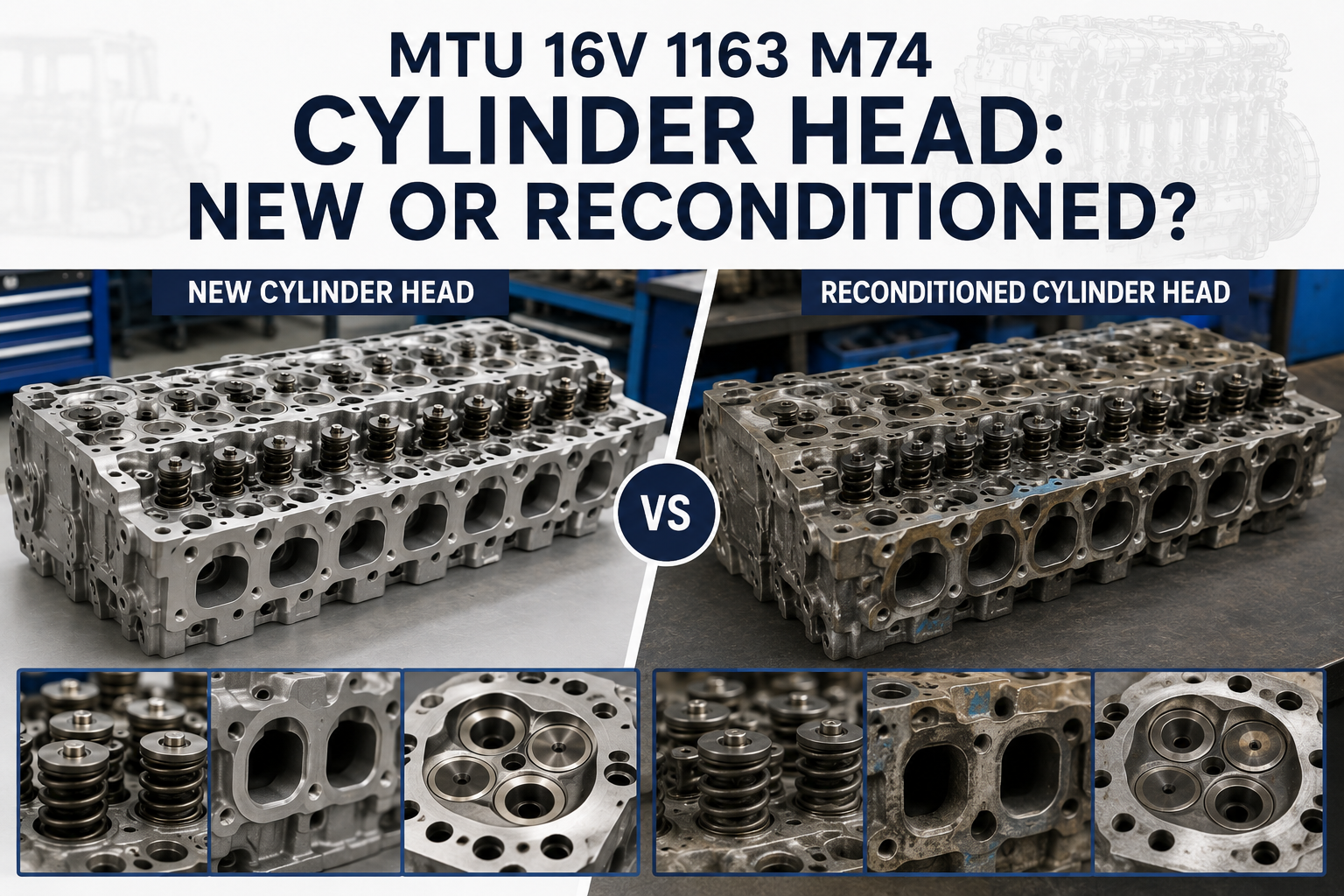

Why Buying a New MTU 16V 1163 M74 Cylinder Head Is Sometimes Better Than Sending It to the Machine Shop
A damaged cylinder head creates a decision that nearly every experienced marine engineer eventually has to make:
Do we repair this head—or replace it?
On a smaller diesel engine, sending the cylinder head to a machine shop may seem like the obvious answer. But on an MTU 16V 1163 M74 marine engine, the decision deserves considerably more thought.
The 16V 1163 M74 belongs to the MTU Series 1163 engine family, a large high-output marine engine platform used for applications such as frigates, corvettes, patrol vessels, fast ferries and displacement yachts. MTU continues to list the 16V 1163 M74 in its commercial-marine portfolio.
When reliability and vessel availability matter, saving money on a cylinder-head repair does not necessarily mean saving money for the vessel.
Sometimes machining makes perfect engineering sense.
Sometimes buying a replacement cylinder head is the better decision.
The skill lies in knowing the difference.
Where Does the MTU 16V 1163 M74 Belong?
Before discussing the cylinder head, it helps to place the engine correctly.
Manufacturer: MTU
Engine Family: MTU Series 1163
Engine Model: MTU 16V 1163 M74
Configuration: V16 marine diesel engine
Component: Individual cylinder-head assembly
MTU's Series 1163 documentation covers 16V and 20V configurations, while specifications for the 16V 1163 M74 describe it as a high-performance marine propulsion engine intended for vessels operating with substantial load factors.
That operating environment is important.
A cylinder head on such an engine doesn't have an easy life.
It repeatedly experiences combustion pressure, thermal cycling, cooling flow, exhaust heat and mechanical valve loading.
The First Question Shouldn't Be: "Can the Machine Shop Repair It?"
It should be:
"Should we repair it?"
There is a difference.
A machine shop may technically be able to:
- Pressure-test the cylinder head
- Clean it
- Machine sealing surfaces
- Replace valve seats
- Replace valve guides
- Service valves
- Repair certain damaged areas
- Reassemble and test the head
That does not automatically mean repairing the existing head provides the best lifecycle value.
An engineer should consider:
How much material has already been removed?
Has this cylinder head been machined before?
Was the engine severely overheated?
Are there cracks?
How much corrosion exists internally?
Are valve-seat areas still reliable?
What is the vessel's required availability?
How confident are we in the history of this particular head?
Those questions change the decision completely.
Engineering Lesson: Serviceable Does Not Always Mean Desirable
Imagine a cylinder head comes back from the workshop with this message:
"Repairable."
That sounds reassuring.
But an experienced Chief Engineer may ask another question:
"Repairable for how long?"
A repaired component has to be evaluated against the operating expectations of the vessel.
For a vessel operating occasionally near home port, a professionally reconditioned cylinder head may be perfectly reasonable.
For a high-speed vessel operating commercially or on government service where an engine failure can affect an entire mission or schedule, the risk calculation can be very different.
Chief Engineer's Notebook
"The cheapest repair today can become the most expensive repair if you have to open the engine twice."
That principle is especially important with components that require considerable labor to remove and reinstall.
When Reconditioning an MTU 16V 1163 M74 Cylinder Head Makes Sense
There are plenty of situations where sending the cylinder head to a competent specialist is entirely reasonable.
For example, the casting may be fundamentally sound and require only normal overhaul work.
A candidate for reconditioning may have:
- Acceptable sealing surfaces
- No structural cracking
- Manageable corrosion
- Serviceable cooling passages
- Replaceable valve guides
- Replaceable valve seats
- Repairable valves
- No serious thermal distortion
In that situation, professional cylinder-head reconditioning can provide good value.
The important word is professional.
This isn't simply about cleaning the cylinder head and grinding a few valves.
When Buying a New Cylinder Head Can Be the Better Decision
1. The Cylinder Head Has Been Overheated
Severe overheating should change the way the head is evaluated.
Heat can influence:
- Flatness
- Material integrity
- Valve-seat retention
- Guide alignment
- Sealing surfaces
- Internal cooling passages
Even when obvious damage is repairable, the engineer must decide whether enough confidence remains in the casting for continued demanding service.
2. Cracking Is Found
Visible cracking immediately raises concern.
But the more difficult situation is often hidden cracking.
A cylinder head may look perfectly acceptable before proper cleaning and inspection.
Testing becomes important because cracks can develop around highly stressed areas.
If significant structural cracking is present, continually investing labor into an uncertain casting may make little economic sense.
3. Corrosion Has Reached the Cooling Passages
Marine engines depend heavily on correct cooling.
Cylinder-head cooling passages deserve careful attention because internal corrosion can continue developing long before anything becomes visible externally.
Check for:
- Pitting
- Restricted passages
- Deposits
- Erosion
- Coolant-side corrosion
If significant material deterioration exists internally, simply rebuilding the valves does not restore the entire cylinder head.
4. The Sealing Surface Has Already Been Machined Before
This is one of the most important questions to ask the workshop:
"Has this head been resurfaced previously?"
Every machining operation removes material.
There are manufacturer-defined dimensional limits that must be respected.
The engineer should not allow repeated resurfacing simply because the machine can physically remove more metal.
Once a component reaches or approaches its permitted dimensional limits, replacement may become the better decision.
5. Valve-Seat Areas Have Significant Damage
The exhaust side of a high-output diesel cylinder head operates under particularly demanding conditions.
Inspect:
- Exhaust valve faces
- Seat contact
- Seat inserts
- Local cracking
- Burning
- Recession
- Heat discoloration
If several seat areas require extensive repair, the economics can begin moving toward complete cylinder-head replacement.
6. The Valve Guides Are Heavily Worn
Valve guide wear can affect:
- Valve alignment
- Valve seating
- Oil control
- Heat transfer
- Valve life
Installing new valves into an extensively worn cylinder head without properly correcting the guide and seat geometry isn't a complete repair.
7. You Don't Know the Cylinder Head's History
This issue often appears with older marine engines.
The head may already have been:
- Resurfaced
- Weld repaired
- Pressure tested
- Re-seated
- Re-guided
- Installed on another engine
- Exposed to overheating
But there may be no reliable documentation.
A head with an unknown overhaul history can introduce uncertainty into an expensive engine.
Sometimes paying more for a known-condition replacement is worth eliminating that uncertainty.
Engine Room Reality: Labor Changes the Economics
This is frequently overlooked.
Suppose:
Machine-shop repair = lower component cost
while
New cylinder head = higher component cost
At first glance, repairing wins.
But that isn't the full calculation.
Consider:
- Cylinder-head removal labor
- Transport to machine shop
- Cleaning
- Inspection
- Pressure testing
- Machining
- Replacement valves
- Seats
- Guides
- Seals
- Gaskets
- Reassembly
- Installation
- Engine testing
- Vessel downtime
Then consider what happens if the repaired cylinder head develops another problem.
You pay much of that labor again.
Now the cheaper head isn't necessarily cheaper.
The Real Calculation Is Cost Per Reliable Operating Hour
Marine engineers shouldn't evaluate cylinder-head repair only by invoice amount.
A more useful question is:
How many reliable operating hours do I expect from each option?
Imagine these two choices:
Option A: Lower-cost repair with uncertainty.
Option B: Higher-cost new cylinder head with significantly greater confidence.
For a commercial vessel earning money every day it operates, Option B can produce the lower overall lifecycle cost even though its purchase price is higher.
Machine-Shop Downtime Matters Too
Sometimes the component isn't the biggest cost.
Time is.
A cylinder head sent away may require:
- Transportation
- Cleaning
- Initial inspection
- Crack testing
- Pressure testing
- Machining
- Parts sourcing
- Reassembly
- Final testing
- Return shipping
If a suitable replacement head is available immediately, the vessel could potentially return to service sooner.
For:
- Ferries
- Patrol vessels
- Offshore vessels
- Government fleets
- Commercial ships
downtime can easily become more expensive than the cylinder head.
Don't Automatically Replace All 16 Cylinder Heads
The opposite mistake should also be avoided.
The MTU 16V 1163 M74 is a V16 engine, but finding damage on one head doesn't automatically mean every head requires replacement.
Inspection should drive the decision.
Compare:
- Cylinder-to-cylinder condition
- Exhaust temperature history
- Valve condition
- Cooling condition
- Combustion deposits
- Operating hours
- Previous maintenance records
A good overhaul strategy is based on evidence rather than assumptions.
What Can the Old Cylinder Head Tell You?
Before cleaning everything until it looks new, inspect the removed head.
It contains evidence.
Look at the Exhaust Valve
Compare it with neighbouring cylinders.
Does it show:
- More deposits?
- Burning?
- Different coloration?
- Seat deterioration?
- Unusual wear?
If yes, ask why.
Look at the Intake Valve
Inspect:
- Stem condition
- Valve face
- Deposits
- Seat pattern
- Guide condition
A cylinder operating differently from its neighbours deserves investigation.
Look at the Combustion Face
Before cleaning, photograph it.
Deposit patterns may provide useful clues about combustion differences.
Once the cylinder head has been chemically cleaned or blasted, that information disappears.
Look at the Head Gasket
Don't throw it away immediately.
Inspect for:
- Combustion tracking
- Coolant leakage
- Oil leakage
- Uneven loading
- Localized discoloration
The old gasket can contain valuable evidence about what was happening between the cylinder head and engine.
Look at the Cooling Passages
Cylinder-head problems can sometimes be symptoms of cooling problems.
Inspect for:
- Deposits
- Corrosion
- Obstruction
- Poor coolant condition
Installing a brand-new cylinder head without correcting a cooling-system problem can damage the new head too.
Why Did the Cylinder Head Fail?
This should be the central question.
Possible causes can include:
- Cooling-system problems
- Injector problems
- Incorrect combustion
- Exhaust-valve deterioration
- Valve-clearance problems
- Excessive thermal loading
- Sealing failure
- Incorrect previous assembly
- Poor coolant condition
MTU's operating documentation for the 16V/20V 1163 family includes structured maintenance and operating procedures, reinforcing the importance of treating engine condition as a system rather than isolated parts.
Real Marine Maintenance Scenario
Imagine an MTU 16V 1163 M74-powered fast vessel.
One cylinder begins showing an exhaust-temperature trend different from the other fifteen.
There is no alarm.
Power remains normal.
Oil pressure is stable.
The engine continues operating.
During planned maintenance, the engineering crew removes the cylinder head.
Inspection reveals:
- Deterioration around the exhaust-valve seat
- Local heat damage
- Cooling-side corrosion
- Evidence that the head was previously resurfaced
The machine shop says:
"We can probably repair it."
The engineering department now has two options.
Option 1 — Repair
Machine the surfaces, renew guides and seats, replace valves and seals, pressure-test it and reinstall.
Option 2 — Replace
Install a new or correctly specified replacement cylinder head and keep the damaged head for detailed evaluation or potential future reconditioning.
For a vessel with a tight operating schedule, Option 2 may offer greater value simply because it reduces uncertainty and potentially shortens downtime.
That doesn't mean a machine-shop repair is bad.
It means the operational circumstances change the economics.
Engineer's Toolbox: Repair or Replace?
Before deciding, ask:
- Is the casting cracked?
- Has it overheated?
- Is internal corrosion present?
- Has the sealing surface been machined previously?
- Are dimensions within permitted limits?
- Are valve seats heavily damaged?
- Are guides extensively worn?
- Is the head's maintenance history known?
- How expensive is workshop repair?
- How long will machining take?
- Is a replacement cylinder head available?
- What does one day of vessel downtime cost?
- How critical is engine reliability to the vessel's operation?
Those answers usually make the decision much clearer.
Marine Engineer Tip
Ask the machine shop for measurements, not just the words "good" or "repairable."
A professional cylinder-head report should give the engineering team enough information to understand the condition of the component and make an informed decision.
Keep that report with the engine's maintenance history.
Common Cylinder Head Repair Mistakes
Avoid:
- Choosing repair based only on the cheapest quotation.
- Machining without checking dimensional limits.
- Replacing valves without checking seats and guides.
- Ignoring cooling-passage corrosion.
- Installing a replacement head without diagnosing the original failure.
- Discarding old components before documenting their condition.
- Failing to label components by cylinder.
- Ordering a replacement head without verifying engine identification.
- Ignoring vessel downtime when comparing costs.
Frequently Asked Questions
Is the MTU 16V 1163 M74 part of the MTU Series 1163?
Yes. The 16V 1163 M74 belongs to MTU's Series 1163 marine engine family. MTU currently lists the model in its commercial-marine product range.
What vessels use the MTU 16V 1163 M74?
Published MTU specification material describes typical applications including frigates, corvettes, patrol boats, fast ferries and displacement yachts.
Can an MTU 16V 1163 M74 cylinder head be rebuilt?
Potentially, yes, depending on its condition and whether measurements remain within the applicable service limits. Inspection and testing should determine whether reconditioning is appropriate.
When is buying a new cylinder head better?
Replacement becomes particularly attractive when the existing head has serious thermal damage, cracking, substantial corrosion, repeated previous machining, uncertain history, or when vessel downtime makes lengthy workshop repair uneconomical.
Is a remanufactured cylinder head another option?
Yes. A professionally remanufactured or reconditioned cylinder head may provide a middle ground between repairing the vessel's existing head and purchasing a new assembly, provided its condition, specification and compatibility are properly verified.
Should I provide the engine serial number when ordering?
Yes. A cylinder head is an expensive and technically important component. Provide the MTU 16V 1163 M74 engine serial number, existing component number and any applicable engine configuration information before ordering.
Related MTU 16V 1163 M74 Cylinder Head Components
A cylinder-head overhaul or replacement may also require:
- Cylinder-head gasket
- Intake valves
- Exhaust valves
- Valve guides
- Valve seats
- Valve springs
- Valve stem seals
- Injector-related sealing components
- Rocker components
- O-rings
- Cooling-system seals
- Exhaust-manifold gaskets
- Complete cylinder-head gasket kits
Related Engine Pages
For customers maintaining MTU Series 1163 engines, related engine pages can include:
- MTU 12V 1163 M74 Marine Engine Spare Parts
- MTU 16V 1163 M74 Marine Engine Spare Parts
- MTU 20V 1163 M74 Marine Engine Spare Parts
- MTU 16V 1163 TB73L Marine Engine Spare Parts
- MTU 20V 1163 TB73L Marine Engine Spare Parts
- MTU Series 1163 Marine Engine Spare Parts
Browse Our Complete Catalog
Alfa Marine Spare Parts supplies marine diesel engine components for planned maintenance, cylinder-head overhauls and complete engine rebuilds.
For an MTU 16V 1163 M74 Cylinder Head inquiry, provide:
Engine model + engine serial number + existing cylinder-head part number + quantity + photographs where available.
This information helps reduce identification errors before international shipping.
Worldwide MTU Marine Spare Parts Supply
Alfa Marine Spare Parts supports:
- Shipyards
- Ship repairers
- Marine engineers
- Chief engineers
- Technical superintendents
- Fleet operators
- Marine service companies
- Ferry operators
- Offshore operators
- Government fleets
- Maritime contractors
- Boat builders
- Marine equipment distributors
Support is available for customers across major marine markets including Europe, the United States, Canada, the Middle East, Africa, Asia and other international shipping regions.
Why Choose Alfa Marine Spare Parts?
The most useful supplier isn't necessarily the one who immediately says:
"Yes, we have a cylinder head."
The important questions come first:
Which engine?
Which serial number?
Which cylinder-head specification?
New, OEM, aftermarket, remanufactured or reconditioned?
How urgently is the vessel returning to service?
Alfa Marine Spare Parts helps marine customers source genuine, OEM, aftermarket, remanufactured and reconditioned MTU marine engine components, depending on application and availability.
For major components such as an MTU 16V 1163 M74 Cylinder Head, correct identification and realistic assessment of downtime are as important as price.
Contact Alfa Marine Spare Parts
Email: request@alfamarinespareparts.com
Contact Alfa Marine Spare Parts for MTU 16V 1163 M74 Cylinder Heads, valves, seats, guides, cylinder-head gaskets, overhaul kits and other MTU Series 1163 marine engine spare parts with worldwide delivery.
One Final Thought
Sending an MTU 16V 1163 M74 Cylinder Head to the machine shop can be an excellent decision when the casting is sound and the repair is technically justified.
But "repairable" and "best option" aren't always the same thing.
If the cylinder head has experienced repeated overheating, extensive corrosion, cracking, previous machining or an uncertain maintenance history, a new or properly remanufactured replacement may provide greater confidence and lower lifecycle cost.
The key question for a marine engineer isn't:
"Which option has the lowest invoice today?"
It's:
"Which option gives this engine the greatest chance of completing its next operating cycle without opening the same cylinder again?"
For a commercial or mission-critical vessel, that is often the calculation that matters most.