
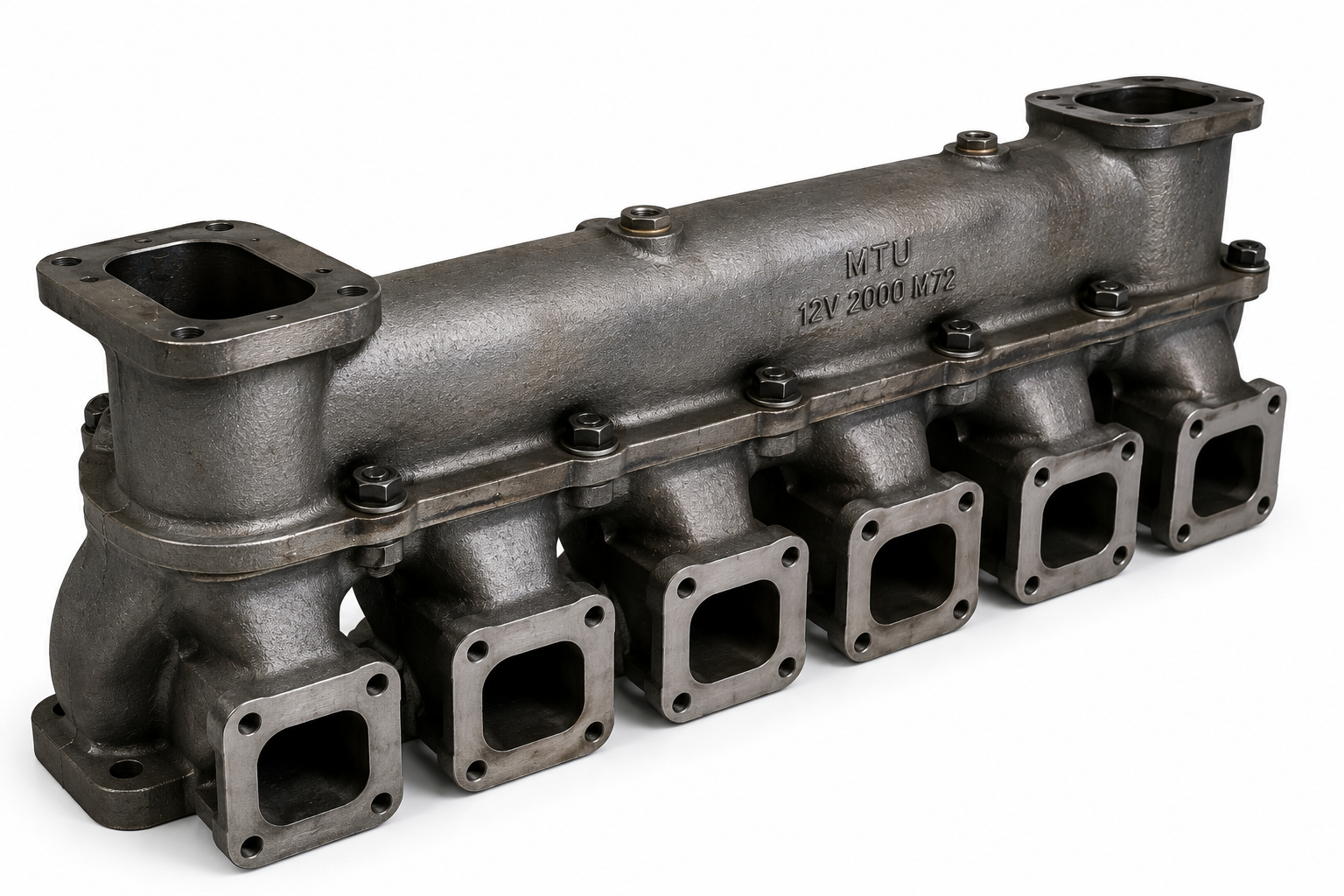

MTU 12V 2000 M72 Exhaust Manifold Inspection: The Hidden Warning Signs Every Marine Engineer Should Know
When was the last time you inspected your engine's exhaust manifold?
For many vessel owners, the answer is simple: only when there's a problem.
That's understandable. Unlike the fuel injectors, turbocharger, or water pump, the exhaust manifold isn't a component that receives much attention during routine maintenance. Yet, it quietly endures some of the harshest operating conditions anywhere on the engine.
On the MTU 12V 2000 M72, the exhaust manifold channels extremely hot exhaust gases from each cylinder toward the turbocharger. Every minute the engine is operating, it experiences rapid temperature changes, vibration, and continuous expansion and contraction.
Over thousands of operating hours, these conditions can gradually create cracks, loose fasteners, gasket leaks, and other problems that may eventually affect engine performance and turbocharger reliability.
The good news is that these issues rarely happen without warning. With regular inspections and a proactive maintenance routine, many exhaust manifold problems can be detected long before they become expensive repairs.
Let's take a closer look at why this often-overlooked component deserves a place on every marine engineer's maintenance checklist.
What Does the Exhaust Manifold Do?
The exhaust manifold has one primary job: collecting exhaust gases from each cylinder and directing them efficiently to the turbocharger.
Although the task sounds simple, it's critical to engine performance.
The manifold must:
- Collect exhaust gases evenly
- Maintain exhaust flow
- Deliver energy to the turbocharger
- Withstand extremely high temperatures
- Resist continuous vibration
- Expand and contract without failure
A restriction or leak anywhere in the manifold can affect the entire engine.
Why Does the Exhaust Manifold Become Damaged?
Many engineers assume the manifold eventually cracks simply because it's old.
Age certainly plays a role, but several operating conditions accelerate wear.
Continuous Thermal Cycling
Every engine start begins with a cold manifold.
Within minutes, exhaust temperatures increase dramatically.
When the engine cools after shutdown, the manifold contracts again.
This repeated expansion and contraction gradually places stress on the metal.
Engine Vibration
Marine engines naturally produce vibration.
Although mounting systems absorb much of it, the exhaust manifold still experiences continuous movement during operation.
Loose mounting hardware can make the problem worse.
Uneven Combustion
A faulty injector or poor combustion in one cylinder may create localized hot spots.
Over time, these higher temperatures increase stress in certain sections of the manifold.
Corrosion
Although the manifold carries exhaust gases internally, external corrosion may develop in humid engine rooms or marine environments if protective coatings deteriorate.
A Real Marine Maintenance Scenario
A high-speed passenger vessel powered by MTU 12V 2000 M72 engines began producing a faint ticking sound whenever leaving port.
At idle, the noise was barely noticeable.
As engine speed increased, it became more pronounced.
Because engine performance remained normal, the crew initially assumed the sound was harmless.
During scheduled maintenance, technicians performed a detailed inspection and discovered a small exhaust leak around one manifold gasket.
The escaping exhaust gases had started to erode nearby components and reduce the energy reaching the turbocharger.
Fortunately, the problem was repaired before it caused further damage.
The repair was relatively straightforward—but waiting another few months could have resulted in a cracked manifold and turbocharger efficiency losses.
Warning Signs That Should Never Be Ignored
An exhaust manifold usually provides several clues before serious failure develops.
Watch for:
- Ticking noises during acceleration
- Black soot around manifold joints
- Exhaust smell inside the engine room
- Higher exhaust temperatures
- Reduced turbocharger response
- Slight loss of engine power
- Increased fuel consumption
- Visible cracks
- Loose manifold bolts
- Abnormal exhaust gas readings
Even one of these symptoms deserves investigation.
Why Small Exhaust Leaks Matter
Some operators believe a minor exhaust leak is only a noise issue.
Unfortunately, that's rarely true.
Escaping exhaust gases can exceed several hundred degrees Celsius.
These hot gases may:
- Damage nearby hoses
- Affect electrical wiring
- Reduce turbocharger efficiency
- Increase engine room temperatures
- Accelerate corrosion
- Create safety hazards for maintenance personnel
Repairing a small leak early is almost always less expensive than dealing with the damage it causes later.
Components to Inspect During Exhaust Manifold Maintenance
Whenever the exhaust manifold is inspected, engineers should also examine:
- Turbocharger
- Exhaust gaskets
- Mounting studs
- Mounting nuts
- Exhaust temperature sensors
- Cylinder head sealing surfaces
- Fuel injectors
- Charge air cooler
- Air filters
- Engine mounts
Inspecting related components often reveals why the manifold experienced abnormal stress.
How Injector Performance Affects the Exhaust Manifold
Many people don't realize that injectors and the exhaust manifold are closely connected.
Poor injector spray patterns create uneven combustion.
Uneven combustion produces uneven exhaust temperatures.
Over time, these localized hot spots increase thermal stress within the manifold.
That's why many experienced engineers investigate injectors whenever repeated exhaust manifold problems occur.
Can Oil Analysis Help?
Oil analysis won't directly detect an exhaust manifold crack.
However, it helps identify related engine conditions.
Laboratory testing may reveal:
- Increased soot
- Fuel dilution
- Abnormal combustion products
- Accelerated wear metals
Combined with exhaust temperature monitoring, oil analysis provides a clearer understanding of overall engine health.
Preventive Maintenance Checklist
Routine inspections greatly reduce the likelihood of unexpected exhaust manifold failures.
Recommended practices include:
✔ Inspect the manifold visually during routine engine room checks.
✔ Monitor exhaust temperature trends.
✔ Tighten fasteners according to manufacturer specifications during scheduled maintenance.
✔ Check for soot deposits.
✔ Listen for unusual ticking sounds.
✔ Inspect turbocharger mounting areas.
✔ Monitor injector performance.
✔ Replace damaged gaskets immediately.
✔ Perform regular oil analysis.
✔ Keep accurate maintenance records.
Marine Engineer Tip
One of the simplest ways to detect an exhaust leak is immediately after a cold engine start.
As the manifold begins to heat up, small gasket leaks often produce a distinct ticking sound before the metal expands and temporarily seals the gap.
Many experienced engineers intentionally listen for these sounds during morning engine inspections.
Common Maintenance Mistakes
Avoid these common errors:
- Ignoring small exhaust leaks.
- Delaying gasket replacement.
- Assuming all ticking noises originate from valve clearances.
- Failing to inspect turbocharger connections.
- Overlooking soot deposits.
- Ignoring uneven exhaust temperatures.
Frequently Asked Questions
How often should the exhaust manifold be inspected?
Visual inspections should be part of routine engine room checks, while more detailed inspections should follow the manufacturer's maintenance schedule.
Can an exhaust leak reduce turbocharger performance?
Yes. Escaping exhaust gases reduce the energy available to drive the turbocharger.
Why do exhaust manifolds crack?
Repeated heating, cooling, vibration, and localized hot spots gradually fatigue the metal.
Can faulty injectors damage the manifold?
Indirectly, yes. Uneven combustion creates higher exhaust temperatures that increase thermal stress.
Is a small exhaust leak dangerous?
Yes. Hot exhaust gases can damage nearby components and create safety risks if ignored.
Worldwide Marine Engine Spare Parts Supply
Alfa Marine Spare Parts supplies genuine, OEM, aftermarket, remanufactured, and reconditioned spare parts for the MTU 12V 2000 M72 and the complete MTU Series 2000 engine family.
We proudly support:
- Commercial shipping companies
- Shipyards
- Luxury yacht operators
- Offshore operators
- Marine engineers
- Chief engineers
- Technical superintendents
- Government fleets
- Fishing fleets
- Marine repair companies
We regularly deliver marine engine spare parts to customers throughout the United Kingdom, United States, Dubai (UAE), Monaco, Nigeria, the Netherlands, Italy, Spain, France, Germany, Norway, and Greece, helping vessels stay operational wherever they sail.
Browse Our Complete Spare Parts Catalog
Alfa Marine Spare Parts supplies a complete range of MTU Series 2000 engine components, including:
- Exhaust manifolds
- Exhaust manifold gasket kits
- Turbochargers
- Charge air coolers
- Fuel injectors
- Cylinder heads
- Camshafts
- Heat exchangers
- Water pumps
- Oil pumps
- Exhaust temperature sensors
- Complete overhaul kits
Browse our complete catalog:
https://alfamarinespareparts.com/spareparts
Why Choose Alfa Marine Spare Parts?
At Alfa Marine Spare Parts, we know that reliable engines depend on more than replacing worn parts—they depend on understanding how every system works together. Our experienced team helps marine engineers, shipowners, and fleet operators identify the correct components quickly, whether they're carrying out routine maintenance or planning a major overhaul.
We provide:
- Genuine, OEM, aftermarket, remanufactured, and reconditioned marine engine spare parts
- Worldwide shipping
- Expert technical assistance
- Fast quotations
- Support for MTU, Caterpillar, Wärtsilä, MAN, Cummins, Volvo Penta, Scania, Perkins, Detroit Diesel, Yanmar, and many other leading marine engine brands
Contact Alfa Marine Spare Parts
Looking for an MTU 12V 2000 M72 exhaust manifold, gasket kit, or related engine components?
Website: https://alfamarinespareparts.com
Email: request@alfamarinespareparts.com
Our experienced marine parts specialists are ready to help you identify the correct components for maintenance, repairs, or complete engine overhauls.
Conclusion
The exhaust manifold on the MTU 12V 2000 M72 may not be as visible as the turbocharger or fuel system, but it plays a crucial role in engine performance and reliability. By safely directing exhaust gases to the turbocharger, it helps maintain efficient combustion and power output. Most manifold problems develop gradually through thermal cycling, vibration, or gasket wear, giving attentive engineers plenty of warning before serious damage occurs. Regular inspections, temperature monitoring, and prompt attention to small leaks can prevent expensive repairs, reduce downtime, and help your MTU engine continue delivering dependable performance throughout its service life.