
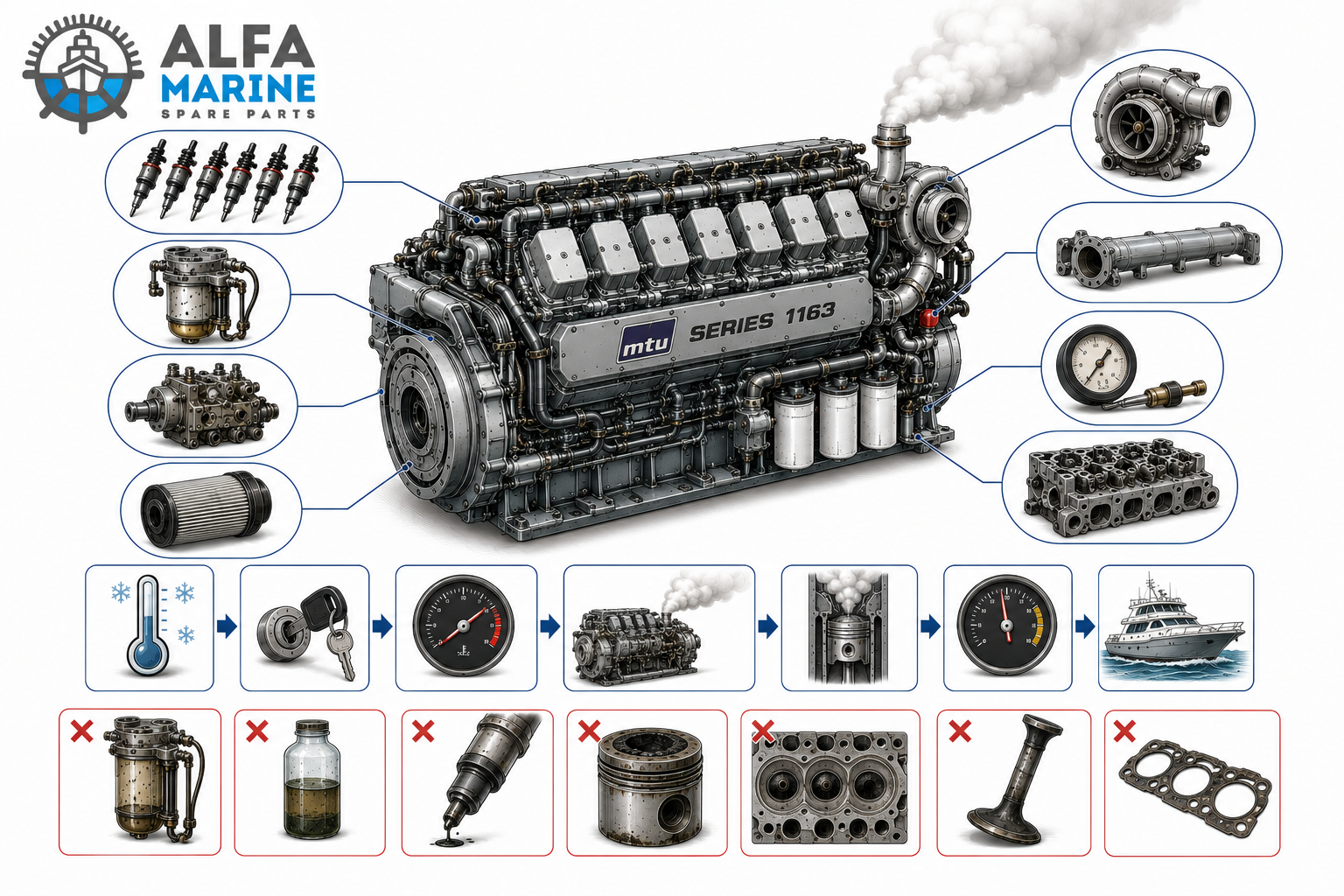

Why Does My MTU Series 1163 Marine Produce White Smoke When Cold?
An MTU Series 1163 marine engine that produces white or pale exhaust smoke during cold starting is showing a combustion symptom that should be evaluated in context.
White diesel exhaust smoke during cold operation often points toward fuel that is not burning completely, but smoke color alone should never be used to diagnose a failed component.
Important areas to investigate include:
- Fuel quality
- Injector condition
- Fuel delivery
- Cold combustion temperature
- Cylinder compression
- Valve condition
- Starting and cranking performance
- Individual-cylinder imbalance
- Fuel-system condition
- Engine-control information where applicable
- Possible coolant or water ingress if white exhaust persists after warm-up
The most important initial question is:
Does the white smoke disappear as the engine warms up, or does it continue at normal operating temperature?
That distinction can significantly change the diagnostic direction.
MTU Series 1163 Marine Engine
The MTU Series 1163 is a large high-performance marine diesel engine family used in demanding propulsion applications.
Series 1163 engines have existed in different cylinder configurations and generations. Alfa Marine Spare Parts' current Series 1163 catalog includes 12V, 16V and 20V variants, while particular models and generations differ in configuration and equipment.
Examples encountered in marine service include:
- 12V 1163 variants
- 16V 1163 M74
- 16V 1163 M94
- 16V 1163 TB73L
- 20V 1163 M74
- 20V 1163 M84
- 20V 1163 M94
- 20V 1163 TB73
- 20V 1163 TB73L
This is not intended as a complete list of every Series 1163 configuration ever produced.
Browse MTU Series 1163 Marine Engine Parts.
Why Does White Smoke Appear When an MTU 1163 Is Cold?
Diesel combustion depends on several conditions occurring together:
Correct fuel delivery + good atomization + sufficient compression + sufficient combustion temperature
When a large diesel engine is cold, cylinder and combustion-chamber temperatures are lower.
If one or more cylinders already have marginal combustion conditions, the problem may become much more noticeable during cold starting.
The sequence can look like:
Cold cylinder → fuel injected → incomplete ignition or combustion → unburned or partially burned fuel enters exhaust → white or pale smoke
Once engine temperature increases, combustion may improve and the smoke may reduce or disappear.
That makes cold-only white smoke diagnostically different from heavy white smoke that continues when the engine is fully warm.
When Should Cold White Smoke Be Investigated?
Pay particular attention when the smoke is accompanied by:
- Difficult cold starting
- Extended cranking
- Rough running after startup
- Cylinder misfire
- Uneven exhaust temperatures
- Strong unburned-diesel smell
- Reduced power
- Increased fuel consumption
- Coolant loss
- Smoke that continues after warm-up
A brief pale exhaust plume during cold conditions does not automatically mean an injector or internal engine component has failed.
The duration, density, smell and accompanying engine behavior matter.
Start With Fuel Quality
Before replacing injectors, inspect the fuel supply.
Check:
- Fuel quality
- Water contamination
- Other contamination
- Fuel filtration
- Fuel supply condition
- Recent bunkering
- Recent fuel-system maintenance
A useful question is:
Did the white-smoke problem begin after bunkering or fuel-system work?
If several cylinders suddenly show similar combustion problems, a common fuel-related cause deserves attention before individual injectors are condemned.
Can MTU 1163 Injectors Cause White Smoke?
Yes.
An injector must deliver fuel correctly so that combustion can take place efficiently.
Injector deterioration or malfunction can contribute to:
- White or grey exhaust smoke
- Rough running
- Cylinder imbalance
- Difficult starting
- Abnormal cylinder exhaust temperature
- Increased fuel consumption
- Reduced power
But:
White Smoke Does Not Automatically Mean a Bad Injector
Other problems can produce similar symptoms, including:
- Poor fuel quality
- Insufficient compression
- Low cold-cylinder temperature
- Valve problems
- Fuel-delivery problems
- Internal cylinder condition
The injector should therefore be diagnosed as part of the complete combustion process.
Look for Individual-Cylinder Differences
This is particularly important on a large multi-cylinder Series 1163 engine.
Instead of asking only:
“Why is the engine smoking?”
ask:
“Which cylinder or cylinders are not combusting normally?”
Depending on the available engine monitoring and diagnostic procedures, compare:
- Cylinder exhaust temperatures
- Cylinder-to-cylinder behavior
- Combustion performance
- Available engine diagnostic information
- Fuel-system behavior
If one cylinder behaves significantly differently from the others, the diagnostic area becomes much smaller.
Possible causes can include:
- Injector problem
- Compression loss
- Valve problem
- Cylinder wear
- Localized fuel-delivery problem
Replacing injectors across a large Series 1163 engine without first identifying the affected cylinders can be unnecessarily expensive.
Why No Universal MTU 1163 Injector Part Number Is Listed
This is intentional.
The Series 1163 includes different:
- Cylinder configurations
- Engine models
- Production generations
- Ratings
- Fuel-system arrangements
- Electronic/control configurations
- Marine applications
Therefore, this article does not claim that one injector part number fits every Series 1163 marine engine.
Correct identification should use:
Complete engine designation + Engine Serial Number + existing MTU part number
For example:
MTU 20V 1163 M94
provides substantially more useful information than:
MTU 1163
The same rule applies to:
- Injectors
- Fuel pumps
- Turbochargers
- Water pumps
- Sensors
- Cylinder components
- Cooling-system components
- Electronic components
Exact engine identification before ordering major components is particularly important on the Series 1163 family.
Could Low Compression Cause White Smoke When Cold?
Yes.
Diesel ignition relies heavily on the temperature produced by compression.
If one cylinder has marginal compression, the compressed air may not reach ideal conditions for efficient cold ignition.
This can produce:
Fuel injected → insufficient combustion conditions → incomplete combustion → white smoke
As the engine warms, higher cylinder temperatures may improve combustion enough for the visible smoke to decrease.
This is why an engine that:
smokes when cold → clears when warm
can justify investigating compression if other simpler causes have been eliminated.
What Can Cause Reduced Compression?
Possible mechanical causes include:
- Piston-ring wear
- Cylinder-liner wear
- Valve leakage
- Valve-seat problems
- Incorrect valve condition or adjustment
- Cylinder-head sealing problems
- Internal cylinder damage
Compression-related investigation becomes more important when white smoke is accompanied by:
- Difficult cold starting
- One consistently abnormal cylinder
- Increased blow-by
- Reduced power
- Abnormal cylinder temperature
- Known high operating hours
White smoke alone, however, is not enough evidence to justify an engine overhaul.
Cold Cranking Performance Matters
Cold-start combustion also depends on the engine reaching adequate cranking conditions.
If cranking performance is abnormal, combustion conditions during starting can deteriorate.
Inspect the applicable starting system for:
- Battery condition
- Battery voltage
- Cable condition
- Connections
- Starting-system performance
- Cranking behavior
A starting-system problem can therefore sometimes appear as a combustion problem.
If the engine cranks more slowly than expected and produces white diesel-smelling smoke, starting performance deserves attention.
Check the Fuel-Injection System
If fuel quality and basic starting conditions are satisfactory, investigate the injection system appropriate to the exact Series 1163 configuration.
Areas can include:
- Injector performance
- Fuel supply
- Fuel pressure
- Fuel filtration
- Fuel-system controls
- Electrical connections
- Engine-control information where applicable
Series 1163 configurations can differ, so diagnostic procedures and component identification should be based on the specific engine model and serial number, not simply the Series 1163 name.
White Smoke With a Strong Diesel Smell
The smell of the exhaust can provide useful information.
If the pale or white smoke smells strongly of raw diesel, incomplete combustion becomes an important possibility.
Think through the combustion process:
Fuel supply → injector → atomization → compression → ignition → combustion
If fuel reaches the cylinder but does not burn properly, it can leave the cylinder as partially burned or unburned fuel.
Possible areas include:
- Injector condition
- Cold-cylinder temperature
- Compression
- Fuel quality
- Cylinder condition
White Smoke or Water Vapor?
These should not automatically be treated as the same thing.
Marine exhaust can contain visible water vapor, especially under cold or humid atmospheric conditions.
Consider:
- Ambient temperature
- Humidity
- Exhaust temperature
- Exhaust arrangement
- Plume behavior
- Exhaust smell
- Engine behavior
- Coolant consumption
A light plume that disappears rapidly in cold air may behave very differently from persistent diesel-smelling white exhaust.
Could Coolant Entering a Cylinder Cause White Exhaust?
Potentially.
Persistent white exhaust should be treated differently from temporary cold-start haze, especially if the vessel is also experiencing unexplained coolant loss.
Warning signs can include:
- Persistent dense white exhaust
- Coolant level dropping
- Abnormal cooling-system behavior
- One cylinder behaving differently
- Evidence suggesting internal leakage
Do not conclude that coolant is entering a cylinder based on smoke color alone.
Confirm the condition through proper cooling-system and engine diagnosis.
Does the Smoke Disappear After Warm-Up?
This is one of the most useful observations.
White Smoke Mainly During Cold Starting
Investigate:
- Cold combustion quality
- Fuel quality
- Injector condition
- Compression
- Cranking performance
- Individual-cylinder condition
White Smoke Continues When Warm
Expand the investigation toward:
- Persistent injector malfunction
- Fuel-system problems
- Compression problems
- Valve/cylinder condition
- Internal engine condition
- Possible internal coolant leakage
The longer heavy white smoke remains after the engine reaches normal operating condition, the less useful it is to explain the symptom simply as cold combustion.
What if Only One Engine Bank Appears Abnormal?
Series 1163 engines use V configurations, so bank-to-bank comparison can sometimes provide valuable diagnostic direction.
If operating data suggests that one bank behaves differently, determine whether the problem can be narrowed toward:
- One cylinder
- Several cylinders
- One bank
- A shared system affecting those cylinders
The goal is to move from:
“The MTU 1163 is smoking.”
to:
“These specific cylinders are behaving differently under these operating conditions.”
That is much more useful diagnostically.
White Smoke With Rough Running
White smoke accompanied by rough operation deserves more attention than a temporary pale plume with otherwise normal engine operation.
Investigate:
- Injector performance
- Cylinder misfire
- Fuel quality
- Compression
- Valve condition
- Fuel-system operation
- Individual-cylinder condition
On a large multi-cylinder engine, identifying the abnormal cylinder or group of cylinders can prevent unnecessary work on components that are operating correctly.
White Smoke With Difficult Cold Starting
When the engine also requires excessive cranking, think about the entire ignition sequence:
Cranking → compression → fuel delivery → atomization → ignition → combustion
A problem anywhere in that sequence can affect cold starting.
Once the engine becomes warm, additional cylinder temperature may partially mask the underlying condition.
This explains why some engines show a problem mainly during the first cold start but behave much better later.
White Smoke With Low Power
If white smoke continues under load and the engine also produces reduced power, the condition should no longer be treated simply as a cold-start characteristic.
Investigate:
- Individual-cylinder contribution
- Injectors
- Fuel delivery
- Compression
- Valve condition
- Engine-control information
- Internal mechanical condition
A cylinder receiving fuel but failing to burn it efficiently contributes less useful power while potentially producing visible exhaust smoke.
MTU Series 1163 Models and Variants
Series 1163 should not be treated as one single engine.
Alfa Marine Spare Parts currently catalogs 12V, 16V and 20V Series 1163 variants. Examples on the site include the 12V 1163 M74, 16V 1163 M74, 20V 1163 M74, 20V 1163 M94 and older TB73-family configurations.
Relevant engine pages include:
MTU 12V 1163 M74 Marine Engine Parts
MTU 16V 1163 M74 Marine Engine Parts
MTU 20V 1163 M74 Marine Engine Parts
MTU 20V 1163 M94 Marine Engine Parts
MTU 20V 1163 TB73 Marine Engine Parts
These links are included because they are live Alfa Marine Spare Parts pages; exact parts compatibility still needs to be established from the individual engine.
Practical MTU Series 1163 Cold White-Smoke Check
A logical diagnostic sequence is:
- Confirm the complete Series 1163 engine designation.
- Record the Engine Serial Number.
- Record ambient and engine temperature at startup.
- Observe how long the white smoke lasts.
- Determine whether the exhaust smells strongly of unburned diesel.
- Check fuel quality and contamination.
- Review recent bunkering and fuel-system work.
- Check cranking performance.
- Review available engine faults and operating data.
- Compare cylinder-to-cylinder behavior.
- Compare exhaust temperatures where appropriate.
- Evaluate injector performance when indicated.
- Investigate fuel-system operation.
- Consider compression if particular cylinders remain abnormal.
- Investigate valves and cylinder condition where evidence supports it.
- Monitor coolant level and cooling-system behavior.
- Investigate persistent white exhaust combined with coolant loss separately.
- Identify the root cause before replacing major components.
The objective is to determine whether the problem originates primarily from:
Fuel → injection → cold combustion → compression → cylinder condition → internal leakage
Why MTU 1163 Part Identification Matters
A request stating:
“I need an injector for an MTU 1163.”
does not provide enough information for reliable component identification.
Before ordering, provide:
- Complete engine designation
- Engine Serial Number
- Existing MTU part number
- Component description
- Clear component photographs
- Vessel/application information
For example:
20V 1163 M94 + serial number + existing injector number
is much safer than:
MTU 1163 injector
This is particularly important for fuel-system components, turbochargers, pumps, internal engine parts and electronic components.
MTU Series 1163 Marine Engine Parts
Alfa Marine Spare Parts supports parts enquiries for Series 1163 marine engines.
Browse MTU Series 1163 Marine Engine Parts.
Parts enquiries can include:
- Fuel injectors
- Fuel-system components
- Fuel pumps
- Turbochargers
- Turbocharger components
- Water pumps
- Seawater-system components
- Cylinder heads
- Valves
- Pistons
- Piston rings
- Cylinder liners
- Connecting rods
- Bearings
- Gaskets
- Seals
- Oil-system components
- Cooling-system components
- Overhaul components
No universal product part numbers are listed in this article intentionally. Exact MTU numbers should be verified against the complete engine designation, serial number and existing component before ordering.
Request MTU Series 1163 Marine Parts
If your MTU Series 1163 marine engine produces white smoke when cold, avoid immediately replacing multiple injectors.
First determine whether the problem originates from:
Fuel quality → injector performance → cold combustion → compression → individual-cylinder condition → possible internal leakage
For accurate parts identification, provide:
Complete MTU engine model + Engine Serial Number + existing part number + component photographs
Email: request@alfamarinespareparts.com
Request a Quote
Alfa Marine Spare Parts
Frequently Asked Questions
Why does my MTU Series 1163 produce white smoke when cold?
Incomplete combustion is an important possibility. Fuel quality, injector performance, cold-cylinder temperature, compression and starting conditions should be investigated.
Can an MTU 1163 injector cause white smoke?
Yes. An injector that does not deliver or atomize fuel correctly can contribute to incomplete combustion, white smoke and cylinder imbalance.
Can low compression cause white smoke only when cold?
Yes. Marginal compression can become more noticeable when the engine is cold because combustion conditions are less favorable. The symptom may decrease as the engine warms.
Is temporary white smoke during cold starting always serious?
Not necessarily. The duration and density of the smoke, ambient conditions, exhaust smell and engine behavior all matter.
Why does the smoke disappear after the MTU warms up?
Higher cylinder temperatures can improve fuel ignition and combustion. This can make a marginal cold-combustion problem less noticeable after warm-up.
Can coolant entering a cylinder cause white exhaust?
Potentially. Persistent white exhaust accompanied by unexplained coolant loss requires further investigation, but smoke color alone does not prove coolant ingress.
Should all MTU 1163 injectors be replaced because of white smoke?
No. First determine whether the problem affects one cylinder, several cylinders or the complete engine.
Are all MTU Series 1163 injectors the same?
Do not assume so. Series 1163 engines exist in different configurations and generations. Use the exact engine model, serial number and existing component number.
Does the MTU Series 1163 include 12V engines?
Alfa Marine Spare Parts currently catalogs 12V, 16V and 20V Series 1163 variants. Individual model availability and historical configurations vary.
What information is needed to identify MTU 1163 parts?
Provide the complete engine designation, Engine Serial Number, existing MTU part number and clear component photographs.