MTU 10V 2000 M96L Water Pump Maintenance: The Small Component That Protects Your Entire Marine Engine
Have you ever wondered why two identical MTU 10V 2000 M96L engines, operating under similar conditions, can have completely different service lives?
One engine reaches thousands of operating hours with minimal issues, while another experiences repeated overheating, worn turbochargers, leaking seals, and expensive repairs.
In many cases, the difference isn't the engine itself. It comes down to maintenance—and one of the most overlooked components in the cooling system is the water pump.
Many marine engineers focus on the turbocharger, injectors, or oil system because these are often associated with performance. Yet without a properly functioning water pump, none of those components can operate at their best. The water pump is responsible for circulating coolant throughout the engine, carrying heat away from critical parts and maintaining a stable operating temperature.
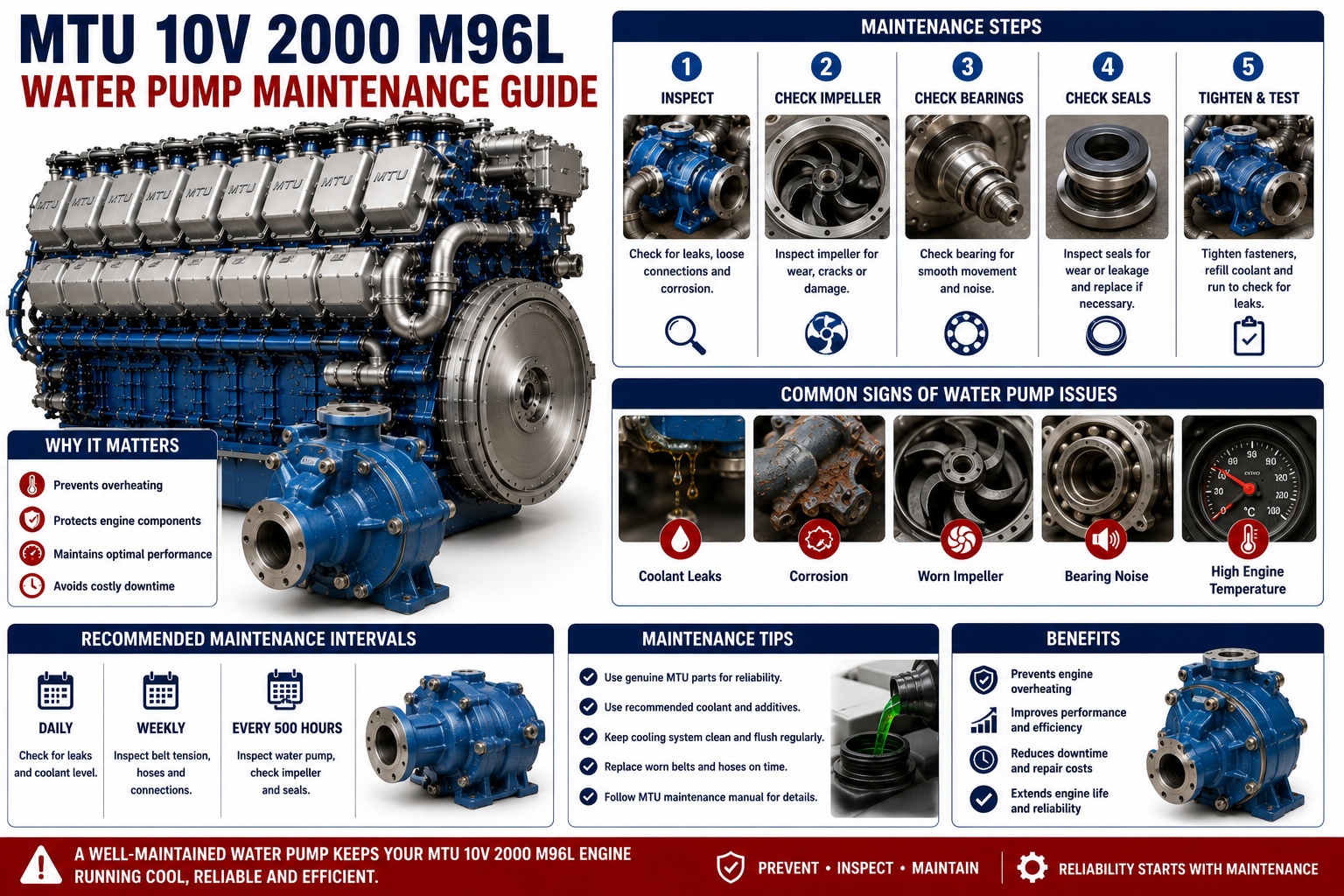
This article explains how the MTU 10V 2000 M96L water pump works, why it fails, how to recognize early warning signs, and what practical steps you can take to maximize its service life.
Why Is the Water Pump So Important?
Imagine the cooling system as the engine's circulatory system.
Instead of blood carrying oxygen through the body, coolant carries heat away from engine components.
The water pump keeps this coolant moving continuously through:
- Cylinder block
- Cylinder heads
- Heat exchanger
- Charge air cooler
- Thermostat housing
- Cooling passages
Without continuous coolant circulation, temperatures rise rapidly, placing every major engine component under thermal stress.
Even a small reduction in coolant flow can gradually affect engine performance without immediately triggering an alarm.
How Does the MTU Water Pump Work?
The MTU 10V 2000 M96L uses a mechanically driven coolant circulation pump designed to maintain constant coolant flow across a wide operating range.
As engine speed increases, coolant flow also increases to remove additional heat generated during higher power output.
Working together with the thermostat and heat exchanger, the water pump ensures that coolant remains within the correct operating temperature.
The system is carefully balanced. If any single component becomes restricted, the entire cooling system becomes less efficient.
A Real Marine Scenario
A yacht captain reported that his MTU engine occasionally reached slightly higher temperatures while cruising at high speed in the Mediterranean.
The alarms never activated.
The engine still produced full power.
Fuel consumption had only increased slightly.
Because the symptoms seemed minor, the vessel continued operating for several weeks.
During a scheduled maintenance inspection, engineers discovered that the freshwater circulation pump had developed internal wear. Coolant circulation had slowly decreased, causing the heat exchanger and turbocharger to operate at higher temperatures.
Fortunately, the problem was identified before serious engine damage occurred.
Situations like this are common because cooling problems usually develop gradually rather than suddenly.
Common Causes of Water Pump Failure
According to marine engine maintenance practices described in manufacturer service documentation, water pumps generally fail because of wear rather than sudden breakage.
The most common causes include:
Bearing Wear
Pump bearings rotate continuously whenever the engine is running.
After thousands of operating hours, normal wear can create excessive shaft movement.
Early symptoms include:
- Noise
- Vibration
- Seal leakage
Mechanical Seal Failure
The water pump seal prevents coolant from escaping.
As seals age, coolant may begin leaking through the inspection opening.
Many engineers notice only a few drops at first.
Ignoring these early leaks often results in bearing damage later.
Corrosion
Marine environments expose cooling systems to moisture and varying coolant quality.
Poor coolant maintenance allows corrosion to attack pump housings and impellers.
Coolant Contamination
Old coolant loses its corrosion protection.
Contaminated coolant may contain:
- Rust particles
- Mineral deposits
- Scale
- Oil contamination
These contaminants accelerate internal wear.
Cavitation
One problem rarely discussed outside manufacturer documentation is cavitation.
Small vapor bubbles form inside the pump when coolant flow becomes unstable.
As these bubbles collapse, they create tiny shock waves capable of damaging the impeller over time.
Although cavitation develops slowly, it significantly reduces pump efficiency.
Early Warning Signs Marine Engineers Should Never Ignore
Most water pumps provide warning signs before complete failure.
Watch for:
- Coolant leaks
- Rising engine temperature
- Higher exhaust temperatures
- Unusual bearing noise
- Reduced cabin heater performance (where fitted)
- Temperature fluctuations
- Steam around the engine
- Coolant level dropping
- White deposits around the pump housing
- Increased engine room humidity
Many engineers mistakenly assume these symptoms indicate thermostat problems.
In reality, several cooling components produce similar symptoms, making systematic diagnosis essential.
What Should Be Inspected at the Same Time?
Replacing only the water pump rarely guarantees a complete repair.
Whenever the pump is serviced, inspect:
- Heat exchanger
- Charge air cooler
- Seawater pump
- Thermostats
- Cooling hoses
- Hose clamps
- Expansion tank
- Coolant reservoir
- Temperature sensors
- Drive belts (if applicable)
The cooling system functions as one integrated unit.
Finding only one faulty component doesn't always reveal the original cause of the problem.
Can Oil Analysis Help Detect Cooling Problems?
Many people associate oil analysis only with bearings or crankshafts.
However, laboratory oil testing also provides valuable information about cooling system health.
Oil analysis may identify:
- Coolant contamination
- Sodium
- Potassium
- Water contamination
- Increased oxidation
- Reduced oil viscosity
These indicators often appear long before visible engine damage develops.
Routine oil analysis remains one of the most valuable predictive maintenance tools available to marine engineers.
Preventive Maintenance Checklist
Good maintenance habits significantly extend water pump life.
Recommended practices include:
✔ Check coolant level before every voyage.
✔ Inspect the pump for leaks during routine engine room inspections.
✔ Replace coolant according to MTU recommendations.
✔ Monitor operating temperatures during every trip.
✔ Clean the heat exchanger regularly.
✔ Service seawater strainers.
✔ Inspect cooling hoses for soft spots or cracking.
✔ Investigate unusual pump noise immediately.
✔ Perform routine oil analysis.
✔ Record temperature trends in maintenance logs.
Marine Engineer Tip
One of the easiest ways to identify a developing cooling problem is to compare engine operating temperatures over time.
If an engine that normally runs at the same temperature begins operating two or three degrees warmer under identical load conditions, don't ignore it.
Small temperature increases often provide the earliest indication that coolant circulation is beginning to decline.
Common Mistakes
Avoid these common maintenance errors:
- Ignoring small coolant leaks.
- Mixing different coolant types.
- Reusing worn seals during repairs.
- Replacing only the thermostat without inspecting the pump.
- Operating with low coolant levels.
- Waiting for overheating alarms before investigating.
Frequently Asked Questions
How long does an MTU water pump normally last?
Service life depends on operating hours, coolant quality, maintenance practices, and engine load. Regular inspections often identify wear before failure occurs.
Can a worn water pump reduce engine power?
Yes. Poor coolant circulation increases operating temperatures, which may reduce engine efficiency and performance.
Should the heat exchanger be cleaned when replacing the pump?
Yes. Servicing the complete cooling system at the same time improves reliability and helps identify related problems.
Can a leaking water pump damage other engine components?
Yes. Coolant loss can eventually lead to overheating, affecting cylinder heads, turbochargers, pistons, and lubricating oil quality.
Does coolant quality really matter?
Absolutely. Correct coolant protects against corrosion, cavitation, and internal deposits while helping maximize water pump service life.
Worldwide Marine Engine Spare Parts Supply
Alfa Marine Spare Parts supplies genuine, OEM, aftermarket, remanufactured, and reconditioned spare parts for the MTU 10V 2000 M96L and the complete MTU Series 2000 engine family.
We proudly support:
- Shipyards
- Commercial vessel operators
- Offshore companies
- Yacht management companies
- Marine engineers
- Chief engineers
- Technical superintendents
- Government fleets
- Fishing companies
- Marine maintenance providers
We regularly ship worldwide to customers in the United Kingdom, United States, Dubai (UAE), Monaco, Nigeria, the Netherlands, Italy, Spain, France, Germany, Norway, and Greece, helping vessels stay operational wherever they are based.
Browse Our Complete Spare Parts Catalog
Alfa Marine Spare Parts supplies:
- Water pumps
- Seawater pumps
- Heat exchangers
- Charge air coolers
- Thermostats
- Oil coolers
- Turbochargers
- Fuel injectors
- Oil pumps
- Camshafts
- Crankshafts
- Cylinder heads
- Bearings
- Complete overhaul kits
Browse our complete catalog:
https://alfamarinespareparts.com/spareparts
Why Choose Alfa Marine Spare Parts?
Choosing the right supplier is just as important as choosing the right replacement part.
At Alfa Marine Spare Parts, we understand that vessel downtime is expensive. Our team works with marine professionals every day to help identify the correct components quickly, reducing delays during planned maintenance and emergency repairs.
We offer:
- Genuine, OEM, aftermarket, remanufactured, and reconditioned spare parts
- Worldwide shipping
- Technical support for accurate part identification
- Support for MTU, Caterpillar, Wärtsilä, Cummins, MAN, Volvo Penta, Scania, Detroit Diesel, Perkins, Yanmar, and many other marine engine brands
- Fast responses for urgent vessel requirements
Whether you're maintaining a single yacht or managing an entire commercial fleet, our goal is to help keep your engines operating reliably.
Contact Alfa Marine Spare Parts
Need assistance finding the correct MTU 10V 2000 M96L water pump or cooling system components?
Website: https://alfamarinespareparts.com
Email: request@alfamarinespareparts.com
Our experienced marine parts specialists are ready to help you identify the right components for your maintenance or overhaul project.
Conclusion
The water pump may not be the largest component on the MTU 10V 2000 M96L marine engine, but it is one of the most important. Reliable coolant circulation protects nearly every major engine component, from the cylinder heads and turbocharger to the pistons and lubrication system. By paying attention to subtle changes in operating temperature, inspecting the complete cooling system during maintenance, and following a proactive service schedule, marine engineers can prevent overheating, reduce repair costs, and significantly extend engine life. In marine engineering, it's often the small warning signs—and the small components—that make the biggest difference.