
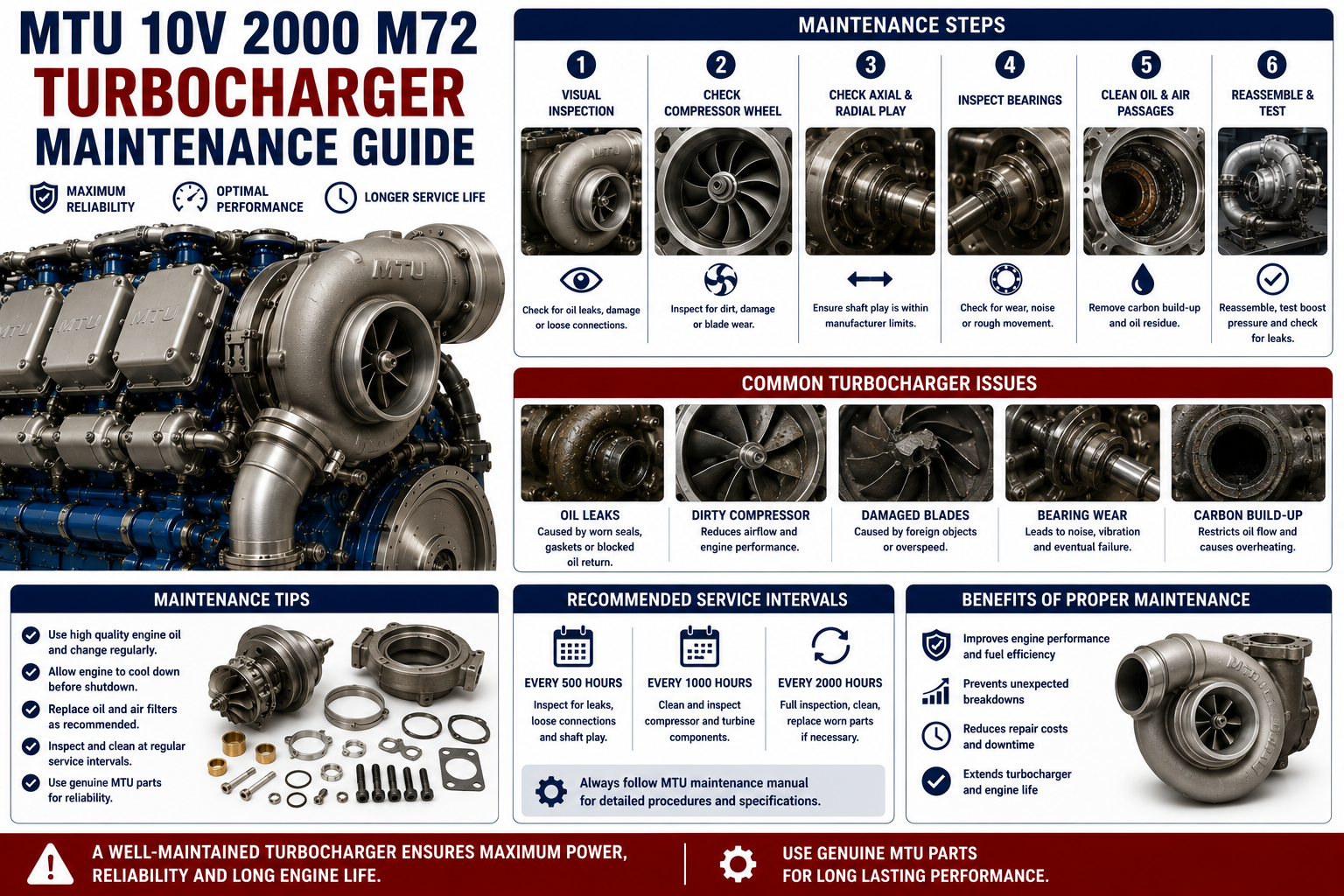

MTU 10V 2000 M72 Turbocharger Maintenance: The Power Behind Your Marine Engine
Imagine you're taking a workboat offshore on what should be a routine trip. The MTU 10V 2000 M72 has always been dependable, delivering the power needed to maintain speed even in rough seas. But today, something feels different. The vessel struggles to reach its usual cruising speed, the exhaust temperature is climbing, and fuel consumption seems higher than normal.
The engine still runs, but it's no longer performing the way it should.
Many engineers immediately suspect fuel injectors or filters. While those components certainly deserve attention, one of the first systems that should be inspected is the turbocharger.
The turbocharger is often described as the lungs of a marine diesel engine. Without it, the engine cannot produce the airflow needed for efficient combustion. A healthy turbocharger improves power, fuel economy, and emissions, while a neglected one can gradually affect almost every part of the engine.
Let's take a closer look at why turbocharger maintenance is one of the smartest investments you can make for your MTU 10V 2000 M72.
What Does a Turbocharger Actually Do?
A naturally aspirated engine relies only on atmospheric pressure to fill the cylinders with air.
A turbocharged engine works differently.
Instead of wasting energy through the exhaust system, the turbocharger captures exhaust gas energy to spin a turbine. That turbine drives a compressor wheel, forcing more fresh air into the engine.
More air means:
- Better combustion
- Higher power output
- Improved fuel efficiency
- Lower smoke emissions
- Better engine response
The MTU 10V 2000 M72 depends on this balanced airflow to achieve its designed performance.
Why Is Turbocharger Maintenance So Important?
Think of the turbocharger as a high-speed machine working under extreme conditions.
Its shaft rotates at incredibly high speeds while being exposed to:
- Hot exhaust gases
- Rapid temperature changes
- Continuous vibration
- High rotational loads
Despite these demanding conditions, it relies on a thin film of clean engine oil for lubrication.
If lubrication or airflow is compromised, wear begins much sooner than expected.
A Real Marine Scenario
A patrol vessel operating daily along the coastline began producing more black smoke during acceleration.
The crew initially believed poor-quality fuel was to blame.
Fuel filters were replaced.
Injectors were inspected.
The engine control system reported no active faults.
When technicians inspected the turbocharger, they discovered heavy carbon deposits on the turbine housing and excessive shaft play caused by contaminated lubricating oil.
The turbocharger had gradually lost efficiency, reducing airflow to the engine.
After servicing the turbocharger and replacing the affected components, engine performance returned to normal without requiring major internal engine repairs.
The lesson was simple: regular turbocharger inspections could have identified the problem much earlier.
Why Do Turbochargers Wear Out?
Turbochargers rarely fail overnight.
Most problems develop gradually through normal operation and poor maintenance practices.
Dirty Engine Oil
The turbocharger shaft rides on a thin oil film.
If engine oil becomes contaminated with soot, dirt, or metal particles, bearing wear accelerates quickly.
Clean oil is the turbocharger's best protection.
Delayed Oil Changes
Old oil loses its protective properties.
As lubrication quality declines, bearing temperatures increase, leading to premature wear.
Restricted Air Filters
The compressor side depends on unrestricted airflow.
Dirty air filters force the turbocharger to work harder, reducing efficiency.
Carbon Deposits
Repeated low-load operation allows carbon to accumulate around turbine components.
These deposits reduce turbocharger efficiency and may affect boost pressure.
Foreign Object Damage
Even a small object entering the compressor can damage the blades.
Likewise, broken engine components entering the exhaust side may damage the turbine wheel.
Early Warning Signs
Experienced engineers often detect turbocharger problems long before complete failure.
Watch for:
- Reduced engine power
- Higher fuel consumption
- Black exhaust smoke
- Whistling noises
- Excessive oil consumption
- Increased exhaust temperatures
- Slow acceleration
- Reduced boost pressure
- Oil leaks around the turbocharger
- Unusual vibration
Monitoring these symptoms helps prevent more serious engine damage.
Why Oil Quality Matters More Than Many People Realize
One common misunderstanding is that turbochargers fail because they are "old."
In reality, poor lubrication is responsible for many failures.
Every time the engine runs, the turbocharger shaft depends on a continuous supply of clean oil.
If that oil becomes contaminated or restricted, microscopic wear begins almost immediately.
Over hundreds of operating hours, this wear increases shaft movement, eventually affecting seals, compressor efficiency, and bearing life.
Components to Inspect During Turbocharger Maintenance
Whenever the turbocharger is inspected, engineers should also examine:
- Engine oil condition
- Oil filters
- Air filters
- Charge air cooler
- Exhaust manifold
- Intake piping
- Boost pressure hoses
- Exhaust system
- Fuel injectors
- Engine control data
Looking beyond the turbocharger itself often reveals the real cause of reduced performance.
Can Oil Analysis Predict Turbocharger Problems?
Yes.
Oil analysis is one of the best predictive maintenance tools available.
Laboratory testing may identify:
- Increased iron
- Increased chromium
- Soot contamination
- Oxidation
- Fuel dilution
- Reduced viscosity
These findings often indicate abnormal wear before mechanical failure becomes visible.
Combining oil analysis with regular turbocharger inspections significantly improves maintenance planning.
Preventive Maintenance Checklist
Good turbocharger maintenance doesn't require complicated procedures.
Consistency is the key.
✔ Replace engine oil at the recommended intervals.
✔ Install high-quality oil filters.
✔ Replace air filters regularly.
✔ Monitor boost pressure.
✔ Record exhaust temperatures.
✔ Perform routine oil analysis.
✔ Inspect for oil leaks.
✔ Listen for unusual turbocharger noise.
✔ Clean the charge air cooler according to the maintenance schedule.
✔ Investigate changes in fuel consumption.
Marine Engineer Tip
Never ignore a small increase in exhaust smoke.
Many engineers focus only on alarm systems, but smoke colour often provides valuable clues about combustion quality.
A gradual increase in black smoke under normal load frequently indicates reduced airflow, making the turbocharger one of the first components worth inspecting.
Common Maintenance Mistakes
Avoid these common errors:
- Ignoring oil quality.
- Delaying air filter replacement.
- Assuming every power loss is caused by injectors.
- Ignoring small oil leaks.
- Failing to monitor exhaust temperatures.
- Continuing operation despite unusual turbocharger noise.
Frequently Asked Questions
How long does an MTU turbocharger normally last?
Service life depends on oil quality, operating conditions, maintenance practices, and engine loading. Proper lubrication significantly extends turbocharger life.
Can dirty oil damage the turbocharger?
Yes. Contaminated oil accelerates bearing wear and is one of the leading causes of premature turbocharger failure.
Why does a faulty turbocharger increase fuel consumption?
Reduced airflow leads to incomplete combustion, requiring more fuel to produce the same power.
Can black smoke indicate turbocharger problems?
Yes. Reduced boost pressure often produces black exhaust smoke because insufficient air reaches the combustion chamber.
Should the charge air cooler be inspected at the same time?
Absolutely. Restricted airflow through the charge air cooler reduces turbocharger efficiency and engine performance.
Worldwide Marine Engine Spare Parts Supply
Alfa Marine Spare Parts supplies genuine, OEM, aftermarket, remanufactured, and reconditioned spare parts for the MTU 10V 2000 M72 and the complete MTU Series 2000 engine range.
We proudly support:
- Commercial shipping companies
- Shipyards
- Offshore operators
- Yacht owners
- Marine engineers
- Chief engineers
- Technical superintendents
- Government fleets
- Fishing fleets
- Marine service companies
We regularly ship marine engine spare parts to customers in the United Kingdom, United States, Dubai (UAE), Monaco, Nigeria, the Netherlands, Italy, Spain, France, Germany, Norway, and Greece.
Browse Our Complete Spare Parts Catalog
Alfa Marine Spare Parts supplies:
- Turbochargers
- Turbocharger cartridges
- Charge air coolers
- Exhaust manifolds
- Fuel injectors
- Oil pumps
- Water pumps
- Heat exchangers
- Air filters
- Oil filters
- Cylinder heads
- Camshafts
- Complete overhaul kits
Browse our complete spare parts catalog:
https://alfamarinespareparts.com/spareparts
Why Choose Alfa Marine Spare Parts?
At Alfa Marine Spare Parts, we understand that turbocharger reliability directly affects vessel performance and operating costs. Our experienced team helps shipowners, marine engineers, and repair yards identify the correct replacement parts quickly, reducing unnecessary downtime.
We provide:
- Genuine, OEM, aftermarket, remanufactured, and reconditioned components
- Worldwide shipping
- Fast quotations
- Technical assistance with part identification
- Spare parts for MTU, Caterpillar, Wärtsilä, Cummins, MAN, Volvo Penta, Scania, Detroit Diesel, Perkins, Yanmar, and many other leading marine engine brands
Whether you're carrying out preventive maintenance or planning a complete overhaul, we're here to help keep your vessel operating reliably.
Contact Alfa Marine Spare Parts
Looking for turbochargers or related components for your MTU 10V 2000 M72?
Website: https://alfamarinespareparts.com
Email: request@alfamarinespareparts.com
Our marine engine specialists are ready to help you identify the correct parts for routine maintenance, emergency repairs, or scheduled overhauls.
Conclusion
The turbocharger is one of the hardest-working components on the MTU 10V 2000 M72, quietly delivering the airflow needed for efficient combustion and dependable power. Most turbocharger failures don't happen suddenly—they develop through gradual wear, poor lubrication, contaminated air, or neglected maintenance. By monitoring exhaust temperatures, boost pressure, fuel consumption, and oil condition, marine engineers can identify developing issues early and avoid costly downtime. Consistent preventive maintenance not only protects the turbocharger itself but also helps safeguard the entire engine, ensuring reliable performance for many years of marine operation.