
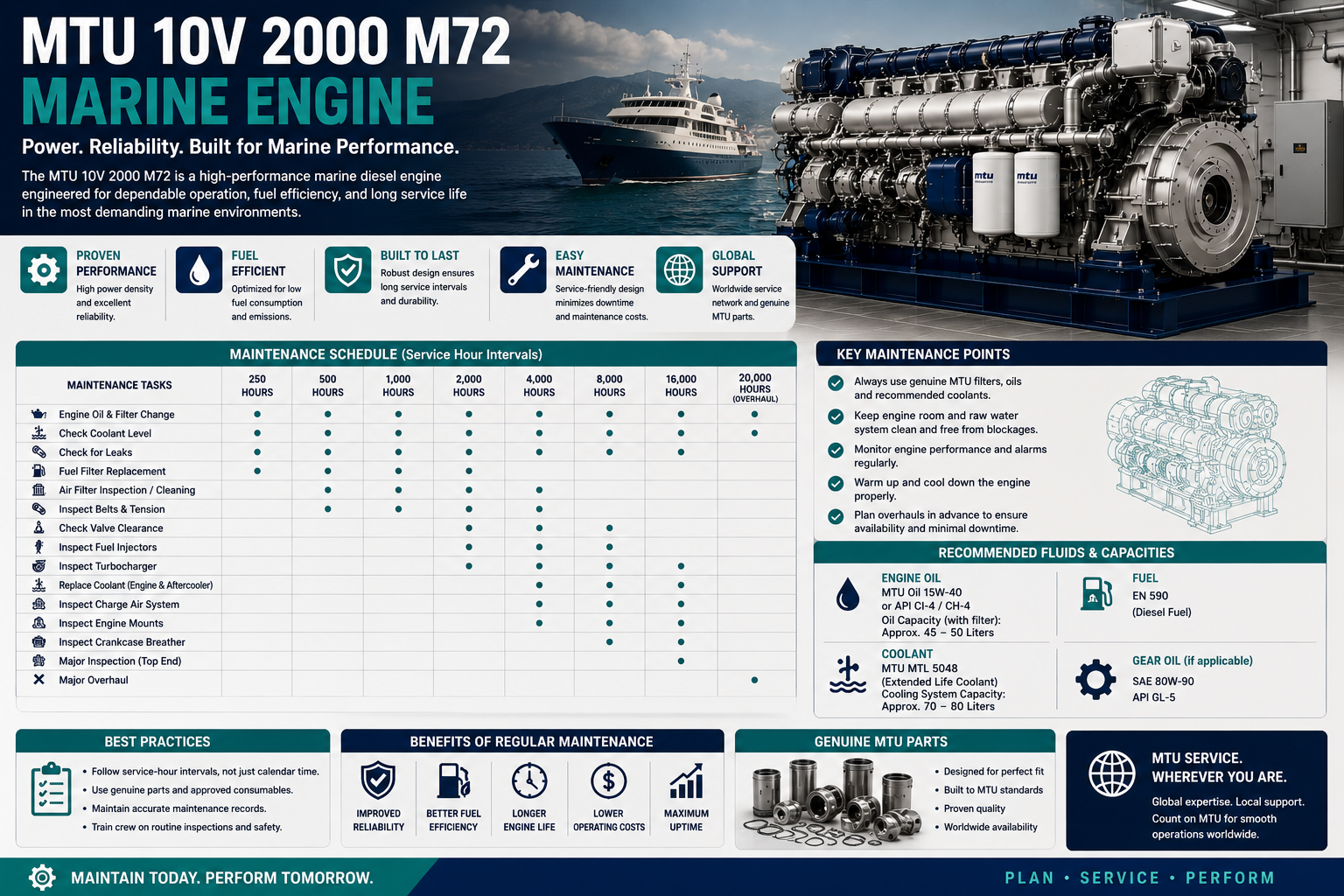

MTU 10V 2000 M72 Marine Engine Maintenance Schedule: Turning Engine Hours Into a Practical Fleet Plan
The MTU 10V 2000 M72 marine engine belongs to the MTU Series 2000 family and is designed for demanding marine propulsion where compact installation, high power density and dependable operation matter.
MTU currently lists the 10V 2000 M72 at 900 kW / 1,205 bhp at 2,250 rpm, under Application Group 1B. MTU's commercial marine portfolio still includes this engine, and the company has documented real installations using the 10V 2000 M72 in passenger, pilot, offshore-support and other fast-vessel applications.
But for a Chief Engineer or fleet manager, the most useful question usually isn't:
“How much power does it make?”
It is:
“What maintenance is coming next, how many months away is it, and which parts should already be available?”
That is what this guide is built around.
For accuracy, the maintenance information below is based on MTU maintenance schedule MS50194/01E for V 2000 M72, Application Group 1B, which explicitly includes the 10V 2000 M72 at 90 kW per cylinder. The schedule describes 1B as continuous operation with variable, high load.
MTU 10V 2000 M72 at a Glance
Manufacturer: MTU
Engine Family: Series 2000
Engine Model: MTU 10V 2000 M72
Configuration: V10 marine diesel
Rated Power: 900 kW / 1,205 bhp
Rated Speed: 2,250 rpm
Application Group: 1B
Maintenance Schedule Referenced: MS50194/01E
Power per Cylinder: 90 kW/cylinder
MTU's current commercial marine product list confirms the 10V 2000 M72 remains part of the Series 2000 propulsion range.
One Important Detail: The M72 Uses a Load-Profile Maintenance Matrix
This matters.
MTU's Application Group 1B allocation matrix does not simply give every M72 installation exactly the same major overhaul cycle.
For the standard 1B load profile, MTU's matrix assigns a 12,000-hour maintenance cycle. Lighter operating profiles can correspond to longer 14,000-, 16,000- or 18,000-hour cycles.
For this article, we will use the standard 1B 12,000-hour matrix, because that is the standard load profile shown in the referenced MTU schedule.
So when you see:
6,000 hours
or
12,000 hours
below, these figures belong specifically to that standard 1B maintenance matrix.
Converting MTU Service Hours Into Months
For easy fleet planning, we'll use:
Low Usage: 3,000 operating hours/year
High Usage: 5,000 operating hours/year
The calculation is:
Maintenance hours ÷ annual operating hours × 12 = approximate months
⚙️ MTU 10V 2000 M72 Hour-to-Month Planning
| Operating Hours3,000 h/year5,000 h/year | ||
| 500 h | 2 months | 1.2 months |
| 1,000 h | 4 months | 2.4 months |
| 2,000 h | 8 months | 4.8 months |
| 3,000 h | 12 months | 7.2 months |
| 4,000 h | 16 months | 9.6 months |
| 6,000 h | 24 months | 14.4 months |
| 12,000 h | 48 months | 28.8 months |
| 24,000 h | 96 months | 57.6 months |
These figures are calendar-planning conversions. MTU also specifies time limits, and whichever applicable limit occurs first must be followed.
Daily MTU 10V 2000 M72 Checks
🟦 DAILY / DURING OPERATION
Interval: Every operating day
Low Usage: Daily
High Usage: Daily
MTU-listed checks include:
- Check engine oil level
- Inspect general engine condition
- Check for leaks
- Inspect intercooler drainage where fitted
- Check air-filter service indicator
- Check coolant-pump relief bores
- Listen for abnormal running noise
- Observe exhaust-gas color
- Watch for unusual vibration
- Drain water and contamination from the fuel prefilter where fitted
- Check fuel-prefilter differential pressure where fitted
Engineer Focus: Look for changes, not only alarms.
These daily tasks appear directly in the M72 maintenance schedule.
An experienced engineer knows how valuable small changes can be.
A new coolant trace.
A different exhaust color.
A little more vibration.
A fuel-prefilter differential pressure that is slowly increasing.
None of these necessarily means failure.
They mean:
pay attention.
500-Hour Fuel and Oil-System Maintenance
The first major recurring service point is 500 hours.
🟩 500-HOUR SERVICE
MTU interval: 500 operating hours
Low Usage: approximately 2 months
High Usage: approximately 1.2 months
MTU-listed tasks:
- Inspect centrifugal oil filter
- Check thickness of collected oil residue
- Clean centrifugal filter
- Replace applicable sleeve with oil service
- Replace fuel filter
- Replace fuel prefilter where fitted
Engineer Focus: Inspect what the filters captured before throwing anything away.
The referenced schedule puts the centrifugal oil filter, main fuel filter and fuel prefilter at the 500-hour level.
At 5,000 operating hours per year, this service arrives roughly every five to six weeks.
That means fuel-filter stock is not an occasional purchase.
It is recurring fleet inventory.
Fuel Filters at 500 Hours
⛽ 500 HOURS — FUEL FILTERS
Low Usage: about 2 months
High Usage: about 1.2 months
MTU requirement:
- Fit new main fuel filter or filter insert
- Fit new fuel prefilter or insert where fitted
Engineer Focus: If filter contamination suddenly increases, investigate the fuel supply rather than simply replacing filters more often.
MTU lists both filters at 500-hour intervals with two-year time limits in the referenced schedule.
What About the Engine Oil Change?
This is an area where it is easy to create inaccurate internet content.
The MTU M72 maintenance schedule does not simply say:
“Change oil every 500 hours.”
Instead, MTU states that fluid-change intervals must follow the applicable MTU Fluids and Lubricants Specifications, while the engine oil filter should be renewed whenever the oil is changed or by its applicable time limit.
🟨 ENGINE OIL & OIL FILTER
Engine oil: Follow the applicable MTU Fluids and Lubricants Specification.
Oil filter: Replace whenever engine oil is changed, or by the specified maximum time limit.
Do not: Apply a generic oil interval taken from another marine diesel engine.
Engineer Focus: Combine oil servicing with laboratory analysis and filter inspection.
This is more useful than publishing a convenient but unsupported number.
Valve Clearance: Initial 1,000 Hours, Then 2,000-Hour Cycle
This deserves careful explanation.
MTU's standard 12,000-hour M72 matrix specifies the recurring valve-gear task at 2,000 hours, but the manual also specifically requires an initial valve-clearance adjustment after 1,000 operating hours and again 1,000 hours after each cylinder-head overhaul.
🟦 INITIAL 1,000 HOURS — VALVE CLEARANCE
Low Usage: approximately 4 months
High Usage: approximately 2.4 months
MTU requirement: Initial valve-clearance adjustment.
Engineer Focus: Record the actual values before adjustment.
Then:
🟦 2,000 HOURS — VALVE GEAR
Recurring interval: 2,000 hours
Low Usage: approximately 8 months
High Usage: approximately 4.8 months
MTU action: Check valve clearance and adjust where required.
Engineer Focus: Compare each cylinder with its previous measurement.
The distinction between initial 1,000 hours and recurring 2,000 hours is important.
Why Recording Valve Clearance Matters
Don't write only:
“Valve clearance adjusted.”
Record:
Cylinder 1 intake: ____
Cylinder 1 exhaust: ____
Cylinder 2 intake: ____
Cylinder 2 exhaust: ____
Continue through all ten cylinders.
If nine cylinders remain relatively stable while one repeatedly changes, investigate the different cylinder.
Possible areas include:
- Valve seat condition
- Valve wear
- Rocker components
- Pushrod condition
- Combustion behavior
- Injector condition
The measurement becomes much more useful when you turn it into history.
2,000-Hour Belt Drive Inspection
🟦 2,000 HOURS — BELT DRIVE
Low Usage: approximately 8 months
High Usage: approximately 4.8 months
Where fitted
MTU tasks:
- Inspect belt condition
- Check belt tension
- Replace belt if necessary
Engineer Focus: A belt that repeatedly loses tension deserves investigation, not endless adjustment.
The M72 standard 12,000-hour schedule assigns belt inspection at 2,000 hours.
3,000-Hour Air Filter Replacement
🟧 3,000 HOURS — AIR FILTERS
MTU interval: 3,000 hours
Low Usage: approximately 12 months
High Usage: approximately 7.2 months
MTU action: Fit new air filters.
Engineer Focus: Intake-air restriction can affect turbocharger efficiency and combustion across the engine.
The referenced 12,000-hour matrix specifies air-filter replacement at 3,000 hours, with a three-year time limit.
Between replacement intervals, the daily restriction indicator still matters.
4,000-Hour Coolant Filter Replacement
🟧 4,000 HOURS — COOLANT FILTERS
MTU interval: 4,000 hours
Low Usage: approximately 16 months
High Usage: approximately 9.6 months
MTU action: Fit new coolant filters.
Engineer Focus: Cooling-system cleanliness matters long before an overheating alarm appears.
The standard 12,000-hour M72 matrix places coolant-filter replacement at 4,000 hours.
6,000-Hour Injector Replacement
At 6,000 hours, the maintenance program becomes considerably more serious.
🟥 6,000 HOURS — FUEL INJECTORS
MTU interval: 6,000 hours
Low Usage: approximately 24 months
High Usage: approximately 14.4 months
MTU action: Replace fuel injectors.
Engineer Focus: Before removing them, review exhaust-temperature trends and cylinder performance.
The standard 12,000-hour M72 maintenance matrix specifically lists injector replacement at 6,000 hours.
For a high-use vessel operating 5,000 hours annually, that is only around 14½ months.
So injector planning should begin long before the engine reaches 5,900 hours.
6,000-Hour Combustion-Chamber Inspection
🟥 6,000 HOURS — ENDOSCOPE INSPECTION
Low Usage: approximately 24 months
High Usage: approximately 14.4 months
MTU task: Inspect cylinder chambers using an endoscope.
Engineer Focus: Compare all ten cylinders rather than judging each one in isolation.
MTU places the combustion-chamber endoscopic inspection at the same 6,000-hour point.
Look for:
- Piston-crown deposits
- Possible scoring
- Oil-related deposits
- Unusual combustion patterns
- Differences between cylinders
On a V10 engine, you have ten cylinders giving you ten useful comparison points.
6,000-Hour Crankcase Breather Service
🟥 6,000 HOURS — CRANKCASE BREATHERS
Low Usage: approximately 24 months
High Usage: approximately 14.4 months
MTU tasks:
- Fit new oil separators
- Clean crankcase-breather wire meshes
Engineer Focus: Crankcase ventilation affects oil-mist control and internal pressure behavior.
The standard 12,000-hour schedule lists these tasks at 6,000 hours.
6,000-Hour Component Maintenance
This is one of the most important service blocks in the entire article.
🟥 6,000-HOUR COMPONENT MAINTENANCE
Low Usage: approximately 24 months
High Usage: approximately 14.4 months
MTU tasks include:
- Drain coolant and flush cooling systems
- Clean air ducting
- Clean intercooler and inspect for leakage
- Check coolant thermostat and install new thermal actuator
- Inspect centrifugal oil filter for wear where fitted
- Clean engine coolant cooler and inspect for leaks
- Clean engine oil cooler and inspect for leaks
- Check engine alignment
- Clean fuel cooler
- Renew seals and sealing materials on dismantled components
- Inspect rocker arms, valve bridges, pushrods and ball joints
- Overhaul engine coolant pump
- Overhaul raw-water pump where fitted
- Overhaul bilge pump where fitted
Engineer Focus: Treat this as a maintenance project, not a simple service kit.
These tasks are all included in MTU's standard 12,000-hour M72 matrix at the 6,000-hour level.
Raw-Water Pump at 6,000 Hours
🌊 6,000 HOURS — RAW-WATER PUMP
Low Usage: about 24 months
High Usage: about 14.4 months
MTU action: Overhaul raw-water pump where fitted.
Inspect:
- Shaft
- Bearings
- Seals
- Pump housing
- Corrosion
- Wear
- Suction side
- Cooling-water flow
Engineer Focus: Don't diagnose the pump without checking the entire seawater circuit.
MTU lists the raw-water pump in the 6,000-hour component-maintenance package.
A perfectly overhauled pump cannot overcome:
- Fouled seawater inlet
- Blocked strainer
- Restricted hose
- Fouled cooler
- Marine growth
Engine Coolant Pump at 6,000 Hours
💧 6,000 HOURS — ENGINE COOLANT PUMP
MTU action: Overhaul engine coolant pump.
Low Usage: approximately 24 months
High Usage: approximately 14.4 months
Engineer Focus: Keep the raw-water circuit and engine coolant circuit separate when troubleshooting.
The coolant pump is included in the same MTU component-maintenance scope.
Turbocharger Overhaul at 6,000 Hours
🌀 6,000 HOURS — TURBOCHARGER
Low Usage: approximately 24 months
High Usage: approximately 14.4 months
MTU tasks:
- Overhaul turbocharger(s)
- Fit new compressor wheels as specified
Engineer Focus: Trend boost, exhaust temperature, leakage, noise and vibration between overhauls.
The standard 12,000-hour matrix puts turbocharger overhaul at 6,000 operating hours, with an 18-year maximum time limit.
12,000-Hour Cylinder Head Overhaul
Now we reach the major maintenance point.
🟥 12,000 HOURS — CYLINDER HEADS
MTU interval: 12,000 hours
Low Usage: approximately 48 months / 4 years
High Usage: approximately 28.8 months / 2.4 years
MTU tasks:
- Overhaul cylinder heads
- Visually inspect piston crowns
- Inspect cylinder-liner running surfaces
Engineer Focus: Photograph the cylinder condition before cleaning.
For the standard 1B load profile, the M72 schedule specifically places cylinder-head overhaul at 12,000 hours.
This is where engine history becomes extremely valuable.
Compare:
- Valve condition
- Deposits
- Sealing surfaces
- Piston crown appearance
- Liner wear pattern
- Cylinder-to-cylinder differences
12,000-Hour Extended Component Maintenance
The 12,000-hour point is much bigger than cylinder-head maintenance.
🟥 12,000-HOUR MAJOR ENGINE MAINTENANCE
Low Usage: approximately 48 months
High Usage: approximately 28.8 months
Referenced time limit: 18 years
MTU tasks include:
- Completely disassemble engine
- Inspect all relevant components
- Repair or replace components as required
- Replace elastomeric components and seals
- Fit new piston rings
- Fit new connecting-rod bearings
- Fit new crankshaft bearings
- Fit new cylinder liners
- Fit new auxiliary PTO bearings where applicable
- Fit new high-pressure fuel pump
- Renew air-flow actuator components where fitted
- Renew exhaust-flap actuator components
- Overhaul starter
- Overhaul battery-charging generator where fitted
- Fit new fuel-pressure relief valve
- Renew crankcase-ventilation wire meshes
- Fit new high-pressure fuel sensor
- Check vibration damper and replace if necessary
- Replace exhaust-pipe bellows
Engineer Focus: This is an overhaul project, not a large filter change.
These requirements come directly from the 12,000-hour MTU M72 maintenance matrix.
Piston Rings at 12,000 Hours
🔧 12,000 HOURS — PISTON RINGS
MTU action: Fit new piston rings.
Low Usage: approximately 4 years
High Usage: approximately 2.4 years
Engineer Focus: Inspect piston crown and ring-groove condition before cleaning everything.
MTU explicitly lists new piston rings during the 12,000-hour extended maintenance scope.
Connecting-Rod Bearings at 12,000 Hours
🔧 12,000 HOURS — CONNECTING-ROD BEARINGS
MTU action: Fit new conrod bearings.
Engineer Focus: Keep every removed bearing identified by cylinder position.
The old bearings contain useful information.
Look for:
- Scoring
- Wiping
- Edge loading
- Heat discoloration
- Embedded contamination
If nine bearing positions look similar and one does not, investigate the unusual one before closing the engine.
Main / Crankshaft Bearings at 12,000 Hours
🔧 12,000 HOURS — CRANKSHAFT BEARINGS
MTU action: Fit new crankshaft bearings.
Low Usage: approximately 48 months
High Usage: approximately 28.8 months
Engineer Focus: Inspect crankshaft journals before assuming new bearings solve everything.
The referenced schedule includes crankshaft-bearing replacement during the extended 12,000-hour maintenance.
Cylinder Liners at 12,000 Hours
🔧 12,000 HOURS — CYLINDER LINERS
MTU action: Fit new cylinder liners.
Engineer Focus: Document liner running surfaces before removal.
MTU includes new liners in the standard 12,000-hour extended-maintenance package.
Before removing them, compare:
- Surface wear
- Polishing
- Scoring
- Deposit patterns
- Cylinder-to-cylinder differences
24,000-Hour Engine Oil Pump
The standard 12,000-hour matrix also identifies one major component on a longer cycle.
🟥 24,000 HOURS — ENGINE OIL PUMP
MTU interval: 24,000 hours
Low Usage: approximately 96 months / 8 years
High Usage: approximately 57.6 months / 4.8 years
MTU action: Fit new engine oil pump.
Engineer Focus: Oil-pressure history should be reviewed long before this point.
The 12,000-hour maintenance schedule assigns the engine oil pump a 24,000-hour interval.
MTU 10V 2000 M72 Maintenance Summary
⚙️ QUICK M72 MAINTENANCE BLOCK — STANDARD 1B PROFILE
| MaintenanceMTU Interval3,000 h/year5,000 h/year | |||
| Daily engine checks | Daily | Daily | Daily |
| Fuel filters / centrifugal oil filter | 500 h | 2 mo | 1.2 mo |
| Initial valve adjustment | 1,000 h | 4 mo | 2.4 mo |
| Valve clearance | 2,000 h | 8 mo | 4.8 mo |
| Belt drive | 2,000 h | 8 mo | 4.8 mo |
| Air filters | 3,000 h | 12 mo | 7.2 mo |
| Coolant filters | 4,000 h | 16 mo | 9.6 mo |
| Fuel injectors | 6,000 h | 24 mo | 14.4 mo |
| Combustion-chamber endoscopy | 6,000 h | 24 mo | 14.4 mo |
| Crankcase breathers | 6,000 h | 24 mo | 14.4 mo |
| Turbocharger overhaul | 6,000 h | 24 mo | 14.4 mo |
| Coolers / pumps / component maintenance | 6,000 h | 24 mo | 14.4 mo |
| Cylinder-head overhaul | 12,000 h | 48 mo | 28.8 mo |
| Major extended maintenance | 12,000 h | 48 mo | 28.8 mo |
| Engine oil pump | 24,000 h | 96 mo | 57.6 mo |
These intervals come from the standard 12,000-hour Application Group 1B matrix in MTU maintenance schedule MS50194/01E.
Real Marine Maintenance Scenario
Imagine a passenger vessel powered by an MTU 10V 2000 M72 running around 5,000 hours per year.
At first, 6,000-hour maintenance sounds far away.
But:
⏱️ 6,000 HOURS AT 5,000 HOURS/YEAR
Approximately 14.4 months
And that maintenance point can involve:
- Injectors
- Turbochargers
- Combustion-chamber endoscopy
- Intercooler cleaning
- Coolant cooler cleaning
- Oil cooler cleaning
- Fuel cooler cleaning
- Engine coolant pump overhaul
- Raw-water pump overhaul
- Valve-train inspection
- Engine alignment
- Multiple seals and gaskets
Then:
⏱️ 12,000 HOURS AT 5,000 HOURS/YEAR
Approximately 28.8 months
At that stage, MTU's standard 1B matrix calls for major work including cylinder heads, piston rings, bearings and liners.
That is why maintenance planning cannot start when the hour meter reaches 11,900.
Engineer's Toolbox
MTU 10V 2000 M72 FLEET MAINTENANCE RECORD
Vessel: __________________
Engine: MTU 10V 2000 M72
Engine Family: MTU Series 2000
Application Group: 1B
Serial Number: __________________
Current Hours: __________________
Annual Operating Hours: __________________
Actual Load Profile: __________________
Applicable MTU Maintenance Matrix: __________________
Next 500-Hour Service: __________________
Next Valve Clearance Check: __________________
Next 3,000-Hour Service: __________________
Next 4,000-Hour Service: __________________
Next 6,000-Hour Maintenance: __________________
Next 12,000-Hour Major Maintenance: __________________
Last Oil Analysis: __________________
Injector Status: __________________
Turbocharger Status: __________________
Raw-Water Pump Status: __________________
Parts Ordered: __________________
Open Technical Findings: __________________
Marine Engineer Tip
For the MTU 10V 2000 M72, record the load profile beside the engine hours.
MTU's own allocation matrix shows why.
The standard 1B load profile corresponds to a 12,000-hour maintenance cycle, while lighter loading can support longer cycles in the referenced maintenance program.
So two M72 engines may both show 10,000 hours but not necessarily have experienced the same working life.
Common MTU 10V 2000 M72 Maintenance Mistakes
Avoid:
- Calling it simply “MTU 2000” in maintenance records.
- Copying another Series 2000 model's schedule.
- Ignoring Application Group 1B.
- Ignoring load profile.
- Treating the initial 1,000-hour valve adjustment as the normal recurring interval.
- Inventing a fixed engine-oil interval.
- Ignoring calendar limits.
- Waiting until 6,000 hours to order injectors, turbocharger parts or pump kits.
- Changing filters without inspecting contamination.
- Cleaning cylinder components before documenting deposits.
- Discarding old bearings without studying wear patterns.
- Ordering major overhaul parts without serial-number verification.
Frequently Asked Questions
Is the MTU 10V 2000 M72 part of the Series 2000?
Yes. The 10V 2000 M72 belongs to MTU's Series 2000 marine engine family and remains listed in MTU's commercial marine range.
How much power does the MTU 10V 2000 M72 produce?
MTU lists the engine at 900 kW / 1,205 bhp at 2,250 rpm.
What application group is the 10V 2000 M72?
The maintenance schedule identifies it as Application Group 1B — continuous operation, variable, high load.
When are the fuel filters replaced?
The standard referenced schedule specifies 500-hour intervals for the fuel filter and optional fuel prefilter.
When is valve clearance checked?
The normal recurring interval in the standard 12,000-hour matrix is 2,000 hours, with an initial adjustment after 1,000 hours and again 1,000 hours after cylinder-head overhaul.
When are air filters replaced?
The standard 12,000-hour matrix specifies 3,000 hours.
When are coolant filters replaced?
The standard matrix specifies 4,000 hours.
When are the injectors replaced?
For the standard 1B 12,000-hour maintenance matrix, fuel injectors are replaced at 6,000 hours.
When is the raw-water pump overhauled?
It is included in the 6,000-hour component-maintenance scope, where fitted.
When is the turbocharger overhauled?
The standard 12,000-hour matrix specifies turbocharger overhaul at 6,000 hours.
When are the cylinder heads overhauled?
Under the standard 1B load profile, cylinder-head overhaul is scheduled at 12,000 hours.
What happens at 12,000 hours?
The standard matrix calls for extended maintenance that includes complete disassembly and inspection, new piston rings, connecting-rod bearings, crankshaft bearings, cylinder liners and several fuel, starter, actuator and sealing components.
Does every MTU 10V 2000 M72 automatically use a 12,000-hour major cycle?
No. The MTU allocation matrix shows different maintenance cycles depending on actual load profile. The standard 1B profile corresponds to 12,000 hours in the referenced schedule.
MTU 10V 2000 M72 Marine Spare Parts
Alfa Marine Spare Parts can assist with sourcing maintenance and overhaul components including:
- Oil filters
- Fuel filters
- Fuel prefilters
- Air filters
- Coolant filters
- Fuel injectors
- High-pressure fuel pumps
- High-pressure fuel sensors
- Turbocharger components
- Compressor wheels
- Raw-water pumps
- Engine coolant pumps
- Intercooler components
- Engine oil coolers
- Coolant coolers
- Fuel coolers
- Thermostat components
- Cylinder heads
- Intake and exhaust valves
- Rocker components
- Pushrods
- Pistons
- Piston rings
- Cylinder liners
- Connecting-rod bearings
- Main / crankshaft bearings
- Starter components
- Charging-generator components
- Gaskets
- O-rings
- Elastomeric seals
- Complete overhaul components
For high-value items, always verify the engine serial number, installed part number and applicable maintenance matrix.
Related MTU Series 2000 Engine Pages
- MTU 8V 2000 M72 Marine Engine Spare Parts
- MTU 8V 2000 M84 Marine Engine Spare Parts
- MTU 8V 2000 M94 Marine Engine Spare Parts
- MTU 10V 2000 M72 Marine Engine Spare Parts
- MTU 10V 2000 M84 Marine Engine Spare Parts
- MTU 10V 2000 M86 Marine Engine Spare Parts
- MTU 10V 2000 M94 Marine Engine Spare Parts
- MTU 10V 2000 M96L Marine Engine Spare Parts
- MTU 12V 2000 M72 Marine Engine Spare Parts
- MTU 12V 2000 M86 Marine Engine Spare Parts
- MTU 16V 2000 M72 Marine Engine Spare Parts
- MTU 16V 2000 M91 Marine Engine Spare Parts
Explore MTU Marine Engines
MTU Marine Engines & Spare Parts:
https://alfamarinespareparts.com/engines/mtu
Complete Spare Parts Catalog:
https://alfamarinespareparts.com/spareparts
Why Choose Alfa Marine Spare Parts?
A request saying:
“Need maintenance parts for MTU 10V 2000.”
is not quite enough.
We want to know:
Is it the M72?
What is the engine serial number?
Which maintenance interval is approaching?
Which load profile applies?
Which components are already installed?
Alfa Marine Spare Parts supports shipyards, marine engineers, technical superintendents and fleet operators sourcing genuine, OEM, aftermarket, remanufactured and reconditioned MTU marine engine components, depending on application and availability.
The objective is to identify the right parts before the vessel reaches the maintenance hour.
Worldwide MTU Marine Spare Parts Supply
Alfa Marine Spare Parts supports shipyards, ship repairers, marine engineers, chief engineers, technical superintendents, fleet operators, ferry companies, yacht operators, offshore operators, government fleets, maritime contractors, commercial vessel operators and marine service companies worldwide.
For an MTU 10V 2000 M72 inquiry, send:
Engine model + serial number + existing part number + maintenance scope + quantity + photographs where available.
Contact Alfa Marine Spare Parts
Email: request@alfamarinespareparts.com
MTU Marine Engines:
https://alfamarinespareparts.com/engines/mtu
Catalog:
https://alfamarinespareparts.com/spareparts
Contact Alfa Marine Spare Parts for MTU 10V 2000 M72 filters, injectors, turbochargers, raw-water pumps, coolant pumps, cylinder heads, pistons, liners, bearings, gasket sets and complete overhaul components.
One Final Thought
The MTU 10V 2000 M72 Marine Engine Maintenance Schedule becomes much easier to manage once operating hours are translated into real calendar planning.
For a high-use vessel running 5,000 hours per year:
500 hours = about 1.2 months
2,000 hours = about 4.8 months
3,000 hours = about 7.2 months
4,000 hours = about 9.6 months
6,000 hours = about 14.4 months
12,000 hours = about 28.8 months
But the most important detail is that MTU's 1B maintenance concept also considers actual load profile.
So the best question isn't simply:
“How many hours are on our MTU 10V 2000 M72?”
It is:
“How were those hours accumulated, which maintenance event is coming next, and are the right parts already ready?”