Mitsubishi S6R2-MPTK2 Fuel System Maintenance Guide
Keeping the fuel system clean and free from water is an important part of maintaining a Mitsubishi S6R2-MPTK2 marine engine.
Marine fuel systems operate in conditions where water, sediment and other contamination can enter or accumulate in the fuel supply. If contamination reaches the engine or filters become restricted, fuel delivery can be affected and engine performance can suffer.
For engineers maintaining an S6R2-MPTK2, the important point is not simply to replace the main fuel filters. The complete fuel path—from the tank and fuel precipitator through the gauze filter, separator and main filters—needs regular attention.
For related engines and replacement components, see our Mitsubishi Marine Engine Parts section.
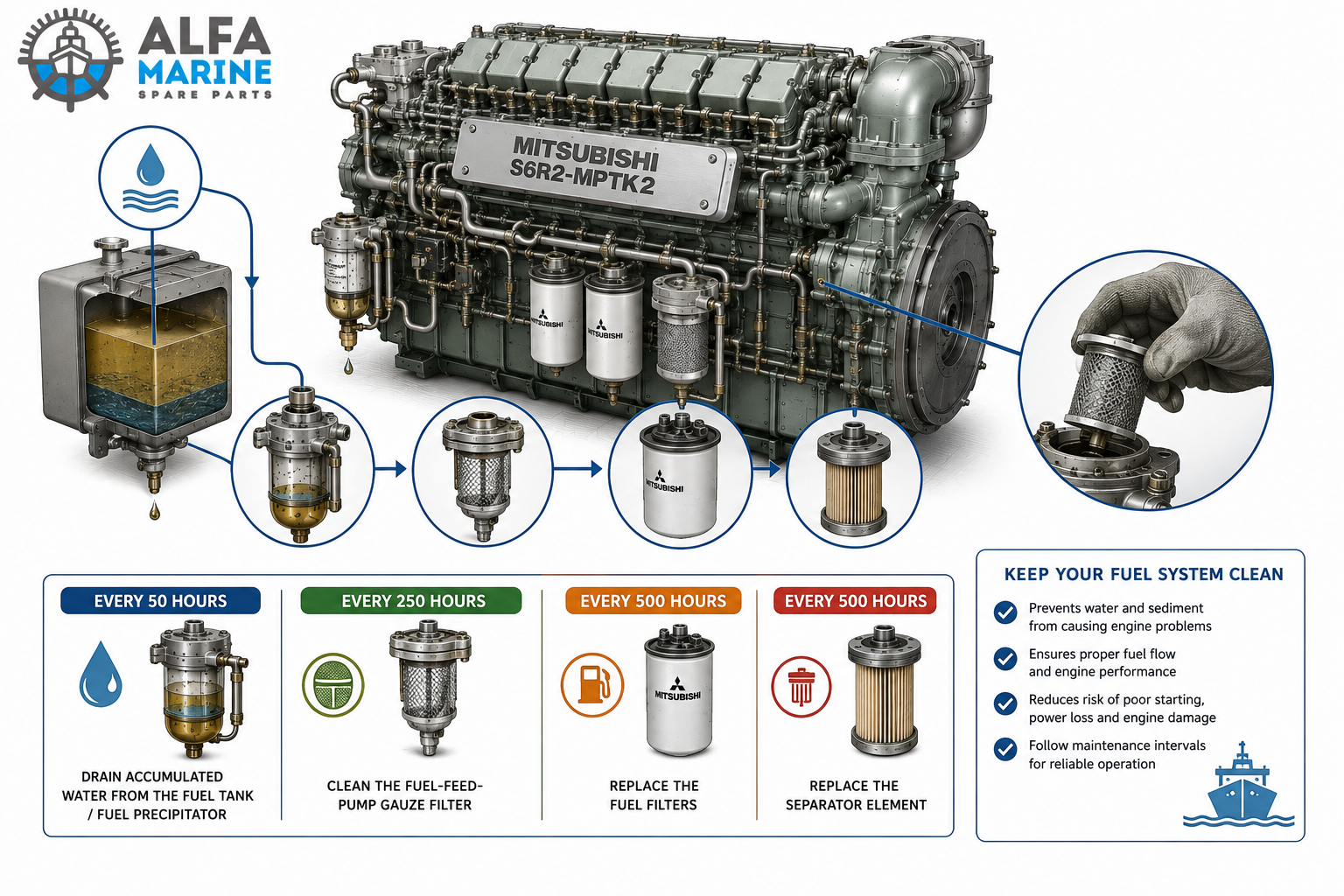
Mitsubishi S6R2-MPTK2 Fuel Maintenance Intervals
The referenced marine maintenance schedule specifies the following fuel-system maintenance:
| Service IntervalMaintenance | |
| Every 50 hours | Drain accumulated water from the fuel tank / fuel precipitator |
| Every 250 hours | Clean the fuel-feed-pump gauze filter |
| Every 500 hours | Replace the fuel filters |
| Every 500 hours | Replace the separator element |
These scheduled intervals provide a maintenance baseline. Fuel quality, contamination and vessel operating conditions should also be considered.
An engine operating with contaminated fuel or experiencing unusually high water accumulation may require attention before the normal scheduled interval.
Why Water in the S6R2-MPTK2 Fuel System Matters
Water contamination is a particular concern in marine diesel fuel systems.
Water can enter or accumulate through several routes, including contaminated bunkered fuel, condensation inside tanks and existing contamination within the vessel's fuel-storage system.
Water and dirt in the fuel can contribute to reduced engine output and fuel-system malfunctions.
This is why the referenced S6R2-MPTK2 maintenance schedule calls for accumulated water to be drained from the fuel tank / fuel precipitator every 50 operating hours.
This relatively frequent maintenance item should not be overlooked.
If significantly more water than normal begins appearing during routine drainage, investigate the source rather than simply continuing to drain it.
Possible areas to investigate include the fuel supply, tank condition and bunkering practices.
Clean the Fuel-Feed-Pump Gauze Filter Every 250 Hours
One component that can easily be overlooked is the fuel-feed-pump gauze filter.
The referenced maintenance schedule specifies cleaning this filter every 250 operating hours.
The gauze filter protects the fuel supply system from contamination, but accumulated dirt can gradually restrict fuel flow.
A restricted gauze filter can reduce the quantity of fuel available to the engine.
Possible symptoms may include:
- Reduced engine output
- Difficulty maintaining RPM
- Poor response as engine load increases
- Fuel starvation
- Engine stalling in severe cases
A restriction may be particularly noticeable under load.
At idle or low engine speed, the engine requires relatively little fuel. When propulsion load increases, fuel demand also increases. A partially restricted fuel supply that appears acceptable at idle may therefore become a problem when the vessel is underway.
This makes the gauze filter an important inspection point when troubleshooting an S6R2-MPTK2 that runs normally at low load but loses performance as load increases.
Replace the S6R2-MPTK2 Fuel Filters Every 500 Hours
The main fuel filters are scheduled for replacement every 500 operating hours in the referenced maintenance schedule.
These filters help protect the downstream fuel system from contamination.
As contamination accumulates in the filter media, resistance to fuel flow can increase. Eventually, a heavily restricted filter may prevent sufficient fuel from reaching the engine.
Possible symptoms can include:
Reduced power → RPM loss → poor acceleration → unstable operation → possible stalling
However, these symptoms do not automatically mean the fuel filters are responsible.
Low engine output can have several causes, including problems elsewhere in the fuel system as well as air-supply, turbocharger, injection, mechanical or vessel-load problems.
Fuel-filter condition should therefore form part of a systematic diagnostic process.
Replace the Fuel Separator Element Every 500 Hours
The separator is another important part of protecting the S6R2-MPTK2 fuel system from contamination.
The referenced maintenance schedule specifies replacing the separator element every 500 operating hours.
During separator service, inspect more than just the element.
Check the housing, seals and connections for signs of:
- Contamination
- Damaged sealing surfaces
- Deteriorated O-rings or seals
- Loose connections
- Fuel leakage
- Possible air entry
Correct installation is important.
A new separator element with an incorrectly installed seal can still create fuel-system problems.
Bleed the Fuel System Correctly After Maintenance
Opening the fuel system during filter or separator maintenance can allow air to enter.
Air in a diesel fuel system can interfere with fuel delivery and may cause difficult starting or unstable operation.
After applicable fuel-system maintenance, the system should therefore be bled correctly according to the procedure for the engine and installation.
Once the engine starts, allow it to run and inspect the serviced areas carefully.
Pay particular attention to the fuel-filter mounting areas and connections.
Check for:
Fuel leakage + air entry + unstable idle + abnormal engine response
The maintenance job should not be considered complete until the engine is operating normally and the serviced areas remain free from fuel leakage.
S6R2-MPTK2 Losing Power Under Load? Check the Basics First
When an S6R2-MPTK2 begins losing power, it can be tempting to immediately suspect expensive components such as the injectors or fuel-injection pump.
A better diagnostic approach starts with the basic fuel supply.
Consider the fuel path in sequence:
Fuel tank → fuel condition → water contamination → precipitator/separator → gauze filter → main fuel filters → feed system → injection equipment
Start by checking whether the engine has an adequate supply of clean fuel.
Then check for water and sediment.
Inspect the separator, gauze filter and main filters for contamination or restriction.
Also check for air entering the fuel system through loose fittings, seals or recently serviced components.
If the basic fuel supply is confirmed healthy, diagnosis can then progress to other areas such as:
- Fuel-feed-pump performance
- Fuel-injection equipment
- Injection timing
- Air intake
- Turbocharger condition
- Exhaust restriction
- Compression
- Excessive propulsion load
This systematic approach helps avoid replacing expensive components before simpler causes have been ruled out.
Fuel-System Maintenance Can Prevent Larger Problems
Fuel-system maintenance is generally much simpler than repairing precision injection equipment.
Keeping the fuel clean, removing accumulated water and preventing filters from becoming excessively restricted helps protect the fuel system and maintain reliable fuel delivery.
That does not mean scheduled maintenance will prevent every injector or fuel-pump failure.
It does mean that basic maintenance can remove several avoidable causes of poor engine operation.
A useful engine-room principle is:
Clean fuel + correct filtration + unrestricted fuel flow + proper bleeding
These fundamentals should be confirmed before moving deeper into an S6R2-MPTK2 fuel-system diagnosis.
Don't Rely Only on the Hour Meter
Scheduled maintenance intervals are important, but engine condition and operating environment matter as well.
Inspection may need to take place sooner when a vessel experiences:
- Poor or inconsistent fuel quality
- Frequent water contamination
- Heavy tank sediment
- Long storage periods
- Repeated premature filter restriction
- Severe marine operating conditions
Maintenance records can help identify changes.
For example, if very little water was previously found during the 50-hour drainage but suddenly significant quantities begin appearing, that change deserves investigation.
Likewise, if filters repeatedly become restricted before reaching their normal replacement interval, the condition of the upstream fuel supply should be investigated.
Replacing filters more frequently without addressing the source of contamination does not solve the underlying problem.
Ordering Mitsubishi S6R2-MPTK2 Fuel-System Parts
Correct identification is important when sourcing Mitsubishi marine engine parts.
The S6R2 family includes different marine engine versions and configurations. A component should therefore not be selected simply because it is advertised as an “S6R2 part.”
For accurate identification, provide:
Complete engine model + engine serial number + existing part number + part description
For example:
Mitsubishi S6R2-MPTK2 + serial number + existing component number
A clear photograph of the engine identification plate and existing component can also be useful when the original part number is difficult to read.
Typical S6R2 fuel-system requirements can include:
- Fuel filters
- Separator components
- Fuel-feed-pump components
- Fuel-injection pumps
- Fuel injectors
- Gaskets
- O-rings and seals
- Related fuel-system components
Alfa Marine Spare Parts supports Mitsubishi Marine Engine Parts requirements for maintenance, repair and overhaul, subject to exact engine identification and parts availability.
For parts identification or availability:
Email: request@alfamarinespareparts.com
Request a Quote
Frequently Asked Questions
How often should water be drained from an S6R2-MPTK2 fuel system?
The referenced marine maintenance schedule specifies draining accumulated water from the fuel tank / fuel precipitator every 50 operating hours.
How often should the fuel-feed-pump gauze filter be cleaned?
The referenced schedule specifies cleaning the gauze filter every 250 operating hours.
How often should S6R2-MPTK2 fuel filters be replaced?
The referenced maintenance schedule specifies replacing the fuel filters every 500 operating hours.
When should the separator element be replaced?
The separator element is scheduled for replacement every 500 operating hours.
Can a clogged gauze filter cause an S6R2-MPTK2 to lose power?
Yes. A sufficiently restricted gauze filter can limit fuel supply, which can contribute to reduced engine output and potentially engine stalling.
Can water in the fuel damage the fuel system?
Water and other contamination can contribute to fuel-system problems and should be removed before it progresses farther through the engine's fuel system.
Should the fuel system be bled after replacing the filters?
Yes. Air introduced during applicable fuel-system maintenance should be correctly removed. After starting the engine, the serviced areas should also be checked for fuel leakage.
What information should I provide when ordering S6R2-MPTK2 parts?
Provide the complete Mitsubishi engine model, engine serial number, existing part number and component description. Photographs of the identification plate and existing component can also help with identification.
Conclusion
Maintaining the fuel system of the Mitsubishi S6R2-MPTK2 marine engine involves more than changing the main fuel filters.
The referenced maintenance schedule provides a straightforward routine:
Every 50 hours — drain accumulated water
Every 250 hours — clean the fuel-feed-pump gauze filter
Every 500 hours — replace the fuel filters
Every 500 hours — replace the separator element
After applicable fuel-system maintenance, bleed the system correctly and inspect the serviced areas for fuel leakage.
When an S6R2-MPTK2 develops reduced output or fuel-delivery problems, checking fuel quality, water contamination, filter restriction and air entry before moving to expensive injection components provides a logical diagnostic starting point.
For Mitsubishi marine engine parts and identification assistance, visit Mitsubishi Marine Engine Parts or contact:
request@alfamarinespareparts.com