
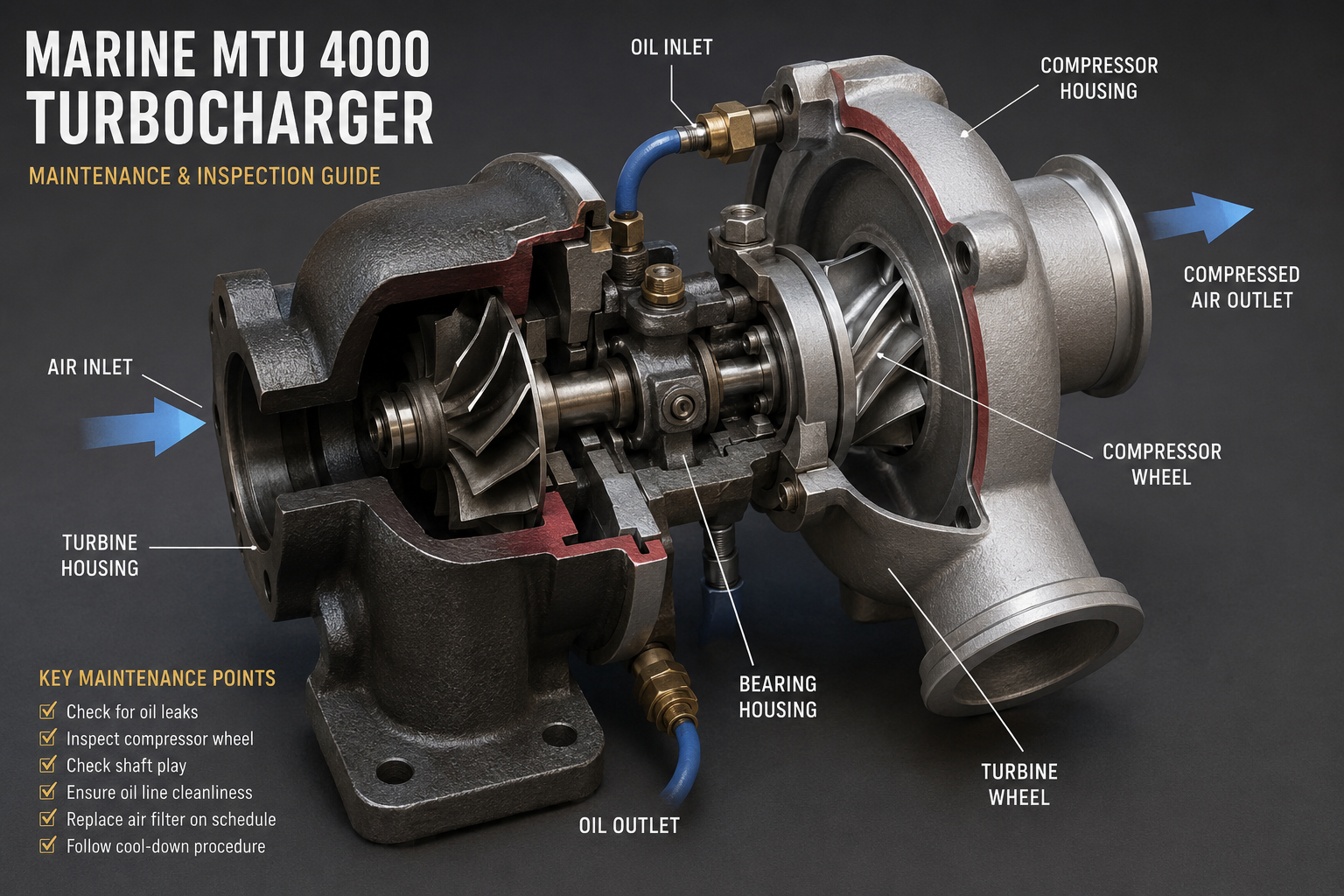

Marine MTU 4000 Turbocharger Maintenance: The Complete Guide Every Marine Engineer Should Read (Part 1)
Marine MTU 4000 Turbocharger Maintenance: Looking After the Heart of Your Engine's Performance
Imagine you're halfway through a long voyage. The engines have been running perfectly all morning, and everything seems normal. Then the captain calls the engine room.
"We're losing speed. Can you check what's going on?"
There are no alarms.
Oil pressure looks fine.
Coolant temperature is still within range.
But something doesn't feel right.
You notice the engine isn't producing its usual power, and when you look at the exhaust, there's a cloud of black smoke that wasn't there before.
So where do you start?
Many engineers immediately think about injectors or fuel quality. Those are reasonable places to look, but there's another component that deserves just as much attention—the marine MTU 4000 turbocharger.
A turbocharger problem doesn't always announce itself with a loud bang or a warning light. More often, it starts with small changes in engine performance that are easy to overlook. The earlier you recognise those signs, the better your chances of preventing an expensive repair.
That's exactly what this guide is about.
Whether you're responsible for a commercial vessel, a patrol boat, a ferry, or a luxury yacht powered by an MTU 4000 engine, understanding how the turbocharger works and how to maintain it can help you avoid unexpected downtime and keep your engine performing as it should.
So, let's start with the basics.
First Things First… What Does a Marine MTU 4000 Turbocharger Actually Do?
Let's keep this simple.
Think of your engine as an athlete.
No matter how much fuel you give that athlete, they won't perform well if they can't breathe properly.
The same applies to a marine diesel engine.
An engine doesn't run on fuel alone—it runs on a carefully balanced mixture of fuel and air.
This is where the marine MTU 4000 turbocharger comes in.
Instead of allowing hot exhaust gases to disappear through the exhaust system, the turbocharger captures that wasted energy and puts it to work.
As exhaust gases leave the engine, they spin a turbine wheel at incredibly high speeds. That turbine is connected to another wheel on the opposite side called the compressor.
As the compressor spins, it forces more fresh air into the engine.
More air means more oxygen.
More oxygen allows the engine to burn fuel more efficiently.
The result?
- More engine power
- Better fuel efficiency
- Cleaner combustion
- Faster throttle response
- Improved overall performance
It's an incredibly clever piece of engineering because it's producing extra power without needing another engine to drive it.
Instead, it simply recovers energy that would otherwise be wasted.
Have You Ever Wondered Just How Fast a Turbocharger Spins?
Most people are surprised by the answer.
When an MTU 4000 engine is working hard, the turbocharger can rotate at well over 100,000 revolutions per minute.
To put that into perspective...
Imagine the wheels on your car spinning more than one hundred thousand times every minute.
Now imagine those wheels doing that while being exposed to exhaust temperatures that can exceed several hundred degrees Celsius.
It's an incredibly demanding job.
That's why even a small lubrication problem or a tiny piece of dirt can eventually cause serious damage.
Why Do Some Turbochargers Last for Years While Others Fail Much Earlier?
This is probably one of the most common questions asked in marine workshops.
The answer usually surprises people.
It's rarely because the turbocharger was poorly built.
More often than not, the real cause is somewhere else.
Dirty engine oil.
Restricted oil flow.
A clogged air filter.
Poor maintenance.
Or simply ignoring the early warning signs.
Think about it this way.
The turbocharger doesn't have its own oil reservoir.
It relies entirely on the engine's lubrication system.
Every single time you start your MTU 4000 engine, clean engine oil flows into the turbocharger bearings, lubricating and cooling them at the same time.
If that oil isn't clean, those bearings are the first components to suffer.
That's why something as simple as delaying an oil change can eventually lead to a turbocharger overhaul.
A Workshop Story That Happens More Often Than You'd Think
A few years ago, a vessel arrived at a repair yard after losing almost twenty percent of its normal cruising speed.
The owner assumed the injectors had failed.
Another engineer suspected poor fuel quality.
After a quick inspection, both fuel filters were clean.
The injectors tested perfectly.
So what was the problem?
When the intake pipe was removed, the answer became obvious.
The compressor wheel was covered in oily deposits, and there was noticeable movement in the turbocharger shaft.
The seals hadn't failed because of age.
They had failed because worn bearings allowed the shaft to move more than it should.
Those worn bearings were the result of contaminated engine oil.
The turbocharger wasn't actually the first component to fail.
It was simply the first component to show the symptoms.
That's an important lesson.
Many turbocharger failures don't begin inside the turbocharger.
They're caused by something happening elsewhere in the engine.
Question & Answer
Can a Marine MTU 4000 Turbocharger Really Affect Fuel Consumption?
Absolutely.
Imagine trying to light a fire using very little oxygen.
The fuel doesn't burn properly.
Exactly the same thing happens inside a diesel engine.
When the turbocharger can't supply enough compressed air, combustion becomes less efficient.
The engine compensates by burning more fuel while producing less power.
That's why a failing turbocharger often leads to:
- Higher fuel consumption
- Reduced engine power
- Increased exhaust smoke
- Higher exhaust temperatures
Many operators notice the increase in fuel usage long before they realise the turbocharger is responsible.
Another Question We Hear All the Time...
"If My Engine Still Runs, Can I Ignore a Noisy Turbocharger?"
It's tempting.
After all, the engine is still running.
But that's a bit like hearing a grinding noise from your car's wheel bearing and hoping it goes away.
Turbochargers don't usually repair themselves.
If the noise is caused by bearing wear, continuing to operate the engine could allow the compressor wheel to contact the housing.
At that point, what might have been a relatively straightforward repair can quickly become a much more expensive replacement.
When your turbocharger starts talking to you, it's worth listening.
Workshop Tip
One of the easiest ways to extend the life of a marine MTU 4000 turbocharger doesn't require any special tools.
After operating the engine under heavy load, avoid shutting it down immediately.
Instead, let it idle for a few minutes.
Why?
Because although the engine has stopped working hard, the turbocharger is still extremely hot.
Allowing the engine to idle gives clean engine oil time to continue circulating through the bearings while temperatures gradually decrease.
It's a simple habit that can make a noticeable difference to turbocharger longevity.
Marine MTU 4000 Turbocharger Maintenance: The Complete Guide Every Marine Engineer Should Read (Part 2)
So... How Do You Know When Your Turbocharger Is Trying to Tell You Something?
Imagine you're doing your normal engine room rounds.
The engine starts easily.
Oil pressure looks good.
Coolant temperature is exactly where it should be.
Nothing seems out of place.
But then you notice something small.
The engine doesn't accelerate quite as quickly as it used to.
Maybe there's a little more smoke from the exhaust than yesterday.
Perhaps you hear a whistle that's louder than normal.
Individually, these changes might not seem serious.
Together, they're often your turbocharger asking for attention.
One thing I've learned over the years is this:
Turbochargers rarely fail without warning.
The warning signs are almost always there—you just need to know what you're looking for.
Let's go through the most common ones.
"My Engine Has Lost Power. Could It Be the Turbocharger?"
Yes, absolutely.
Loss of engine power is one of the earliest signs of a turbocharger that's no longer working efficiently.
Think about what the turbocharger does.
Its job is to force more air into the cylinders.
If it can't do that properly, the engine can't burn fuel efficiently.
Less air.
Less combustion.
Less power.
Simple.
Many engineers immediately suspect injectors when power drops.
That's understandable.
But before removing injectors, always ask yourself one question.
Is the engine getting enough air?
A restricted turbocharger can produce symptoms that look almost identical to a fuel system problem.
Workshop Story
A fishing vessel arrived at the dock after the skipper complained that the boat was using more fuel than ever before.
His first words were,
"The injectors must be worn out."
The workshop tested every injector.
Nothing wrong.
Fuel pressure?
Perfect.
Then one technician removed the intake hose from the turbocharger.
Immediately the problem became obvious.
The compressor wheel was heavily coated with oil residue and dirt.
The turbo was producing much less boost than normal.
After repairing the turbocharger and cleaning the intake system, engine performance returned almost immediately.
Sometimes the problem isn't the fuel.
It's the air.
Question & Answer
Can a Dirty Air Filter Really Damage a Marine MTU 4000 Turbocharger?
It certainly can.
Here's why.
Imagine trying to breathe through a pillow.
You'd still breathe.
But it would take much more effort.
Exactly the same thing happens to your engine.
A blocked air filter restricts airflow into the compressor.
The turbocharger has to work much harder to supply the engine with enough air.
Over time this extra workload increases temperatures and reduces efficiency.
Even worse...
If the air filter is damaged rather than blocked, dust and debris can pass straight through.
At over 100,000 RPM, tiny particles become like sandpaper against the compressor blades.
That gradual erosion reduces turbocharger performance long before you notice a problem.
Black Smoke Isn't Always a Fuel Problem
This is one of the biggest misconceptions in marine engineering.
Many people automatically associate black smoke with faulty injectors.
Sometimes they're right.
But not always.
Black smoke simply means the engine is burning more fuel than the available air can support.
So ask yourself another question.
Where has the air gone?
Possible causes include:
- Dirty air filters
- Boost leaks
- Damaged compressor blades
- Worn turbocharger bearings
- Sticking variable components (where fitted)
- Intake restrictions
Before replacing expensive fuel components, always inspect the complete air system.
It could save hours of unnecessary work.
What About Blue Smoke?
Blue smoke tells a different story.
Instead of incomplete combustion, blue smoke usually means engine oil is entering the combustion process.
When engineers see blue smoke together with oil around the turbocharger, their attention should immediately turn toward:
- Turbocharger oil seals
- Bearing wear
- Excessive shaft movement
- Crankcase pressure
Remember...
Replacing seals without identifying the original cause often leads to the same failure happening again.
Have You Ever Checked Turbocharger Shaft Play?
This is one inspection that tells you a lot about the condition of the turbocharger.
After removing the intake pipe (following the correct maintenance procedures), gently rotate the compressor wheel.
It should turn freely and smoothly.
Now carefully check for movement.
A small amount of movement can be perfectly normal, depending on the turbocharger design and whether it is dry or oil-filled.
What you're looking for isn't simply movement.
You're looking for excessive movement.
If the compressor wheel can touch the housing, that's a clear sign something is wrong.
Never force the shaft or use excessive pressure during inspection.
You're checking for condition—not trying to test its strength.
Here's a Simple Test Every Engineer Should Perform
Stand in front of the compressor wheel.
Now ask yourself three questions.
Does it spin freely?
Do the blades look clean?
Can I see any signs of damage?
If the answer to any of those questions is "No," it's worth investigating further.
Why Compressor Blades Matter So Much
People often underestimate the importance of the compressor wheel.
Its blades are carefully balanced to compress huge volumes of air at incredible speed.
Even small damage can upset that balance.
Look carefully for:
- Bent blades
- Cracks
- Chips
- Corrosion
- Dirt buildup
- Oil contamination
One damaged blade doesn't just reduce airflow.
It can also create vibration throughout the turbocharger.
Question & Answer
Can I Clean the Compressor Wheel Myself?
It depends.
Removing loose dust during routine inspections is one thing.
Aggressively scraping deposits from the blades is another.
Remember, the rotating assembly is precision-balanced.
Damaging even a tiny amount of material can upset that balance.
If heavy deposits are present, it's often better to have the turbocharger inspected during scheduled maintenance rather than trying to force it clean.
Oil Leaks Around the Turbocharger
Finding oil around a turbocharger doesn't automatically mean it's failed.
Small oil traces may appear under certain operating conditions.
What matters is how much oil and where it's coming from.
If you notice:
- Oil inside the compressor housing
- Oil dripping from pipe connections
- Oil entering the exhaust side
- Heavy oil deposits around the bearing housing
it's time for a closer inspection.
Remember...
Oil leaks are usually the symptom.
Not always the cause.
Another Real Workshop Story
A yacht owner replaced two turbocharger seal kits within twelve months.
Each repair solved the leak.
For a while.
Then the oil returned.
Finally, the turbocharger was stripped completely.
The real culprit?
The oil feed line was partially blocked by carbon deposits.
The seals weren't defective.
They simply weren't receiving the clean oil they needed to survive.
It was a small restriction that caused a very expensive problem.
Workshop Tip
Whenever you're inspecting a marine MTU 4000 turbocharger, don't just focus on the turbo itself.
Look at everything connected to it.
Inspect:
✔ Air filters
✔ Intake hoses
✔ Charge-air cooler connections
✔ Oil supply lines
✔ Oil return lines
✔ Exhaust joints
✔ Mounting hardware
Many turbocharger problems actually begin somewhere else in the system.
Finding the root cause is what separates a good repair from a temporary fix.
Quick Inspection Checklist
Before putting the engine back into service, ask yourself:
✅ Is the compressor wheel clean and undamaged?
✅ Does the shaft rotate smoothly?
✅ Are there any unusual noises?
✅ Are all intake clamps tight?
✅ Is there evidence of oil leakage?
✅ Is the air filter clean?
✅ Are all oil lines unrestricted?
If you've answered "yes" to every question, you're already helping your turbocharger live a longer life.
Coming Up in Part 3...
So far we've looked at how the turbocharger works and how to recognise the early warning signs of trouble.
Now it's time to answer the next big question:
How do you actually maintain a marine MTU 4000 turbocharger so it keeps performing year after year?
In Part 3, we'll cover:
- The maintenance habits that make the biggest difference
- Why clean engine oil is your turbocharger's best friend
- The importance of cool-down procedures
- Common mistakes made during maintenance
- Turbocharger overhaul: rebuild or replace?
- A real-world case study from the workshop
- Practical tips every marine engineer should know
(Part 3 continues…)
Marine MTU 4000 Turbocharger Maintenance: The Complete Guide Every Marine Engineer Should Read (Part 3)
The Secret to a Long-Lasting Marine MTU 4000 Turbocharger Isn't Luck
By now, you've learned what the marine MTU 4000 turbocharger does and how to recognize the warning signs when something isn't right.
But here's something many engineers discover only after an expensive repair.
Most turbochargers don't fail because they've reached the end of their life.
They fail because of small maintenance habits that slowly damage them over time.
The encouraging news?
Those habits are easy to change.
Let's look at what really helps a turbocharger reach thousands of reliable operating hours—and what shortens its life.
If You Could Do Just One Thing to Protect Your Turbocharger...
What would it be?
Most people immediately answer,
"Replace the air filter."
Others say,
"Inspect the compressor wheel."
Both are important.
But neither is the number one answer.
The biggest factor affecting turbocharger life is something much simpler.
Clean engine oil.
Why Does Oil Matter So Much?
Imagine running a marathon without drinking water.
Eventually, your body overheats.
The turbocharger faces a similar challenge.
While it's spinning at well over 100,000 RPM, it's also exposed to extremely hot exhaust gases.
The only thing protecting its bearings is a thin film of engine oil.
That oil performs two vital jobs at the same time.
It lubricates.
It cools.
Without clean oil, bearing wear begins surprisingly quickly.
Question & Answer
"Can Old Engine Oil Really Destroy a Turbocharger?"
Unfortunately...
Yes.
Engine oil doesn't last forever.
As hours build up, it gradually becomes contaminated with:
- Carbon particles
- Soot
- Metal particles
- Fuel dilution
- Moisture
Think of contaminated oil as liquid sandpaper.
Every time it flows through the turbocharger bearings, tiny particles slowly wear away the surfaces.
You probably won't notice the damage immediately.
But after hundreds of hours, that wear begins to add up.
This is why following the recommended oil and filter service intervals is one of the smartest investments you can make.
Workshop Story
One commercial vessel came into the workshop with a turbocharger that had failed much earlier than expected.
The owner couldn't understand why.
"We replaced the turbo only eighteen months ago."
The replacement turbocharger was inspected.
There was nothing wrong with the design.
Nothing wrong with the parts.
Instead, the bearings showed clear signs of oil contamination.
When maintenance records were checked, oil changes had regularly been postponed because the engine "was still running fine."
The engine was running.
The turbocharger wasn't.
Another Simple Habit That Makes a Big Difference
Let's talk about shutting the engine down.
Have you ever seen someone bring a vessel into the marina after a long, high-speed run...
...and immediately switch the engines off?
It happens every day.
Unfortunately, it's one of the quickest ways to reduce turbocharger life.
Why Is Immediate Shutdown a Problem?
Imagine placing a glowing piece of metal into cold water.
The sudden temperature change creates stress.
Something similar happens inside a turbocharger.
After operating under heavy load, the turbine housing can still be extremely hot.
If the engine is switched off immediately:
Oil circulation stops.
The turbocharger is left holding a tremendous amount of heat.
That heat can begin to bake the remaining oil inside the bearing housing.
Over time, carbon deposits form.
Those deposits restrict future oil flow.
Eventually...
Bearing damage begins.
Workshop Tip
After operating under heavy load, allow the engine to idle for a few minutes before shutdown.
Those few extra minutes allow:
✅ Oil to continue circulating
✅ Turbocharger temperatures to reduce gradually
✅ Bearings to cool correctly
It's one of the easiest habits you can develop, and one of the cheapest ways to protect your turbocharger.
Let's Talk About Air Filters
Here's another question.
"If My Air Filter Looks Clean, Do I Really Need to Replace It?"
Possibly.
Remember...
Not all contamination is visible.
Marine environments contain:
Salt particles.
Fine dust.
Moisture.
Oil vapour.
Over time, these contaminants slowly reduce airflow.
Even a slightly restricted air filter forces the turbocharger to work harder.
More effort means more heat.
More heat means more wear.
Replacing filters according to the maintenance schedule is always cheaper than replacing compressor wheels.
Common Maintenance Mistakes We Still See
Every workshop has stories like these.
A turbocharger is rebuilt.
Everything looks perfect.
A few months later...
It's back again.
Why?
Because the real cause was never fixed.
Some of the most common mistakes include:
Ignoring Dirty Oil
Fresh bearings cannot survive contaminated lubrication.
Replacing the Turbocharger Without Cleaning the Oil Lines
Debris from the old turbocharger can remain inside the oil feed line.
If that contamination reaches the replacement turbocharger...
The damage starts all over again.
Forgetting the Air Intake System
A damaged intake hose allows unfiltered air to enter the compressor.
Those tiny particles slowly erode the compressor blades.
Reusing Old Gaskets
It might save a few euros today.
It often creates oil or boost leaks tomorrow.
Rushing the Installation
Turbochargers are precision components.
A rushed installation usually becomes an expensive lesson.
Question & Answer
Should I Rebuild My Turbocharger or Buy a Replacement?
That's one of the most common questions we hear.
The answer depends on what failed.
If the rotating assembly, turbine housing and compressor housing remain within specification, rebuilding may be a practical option.
However...
If the compressor wheel has exploded...
If the shaft has suffered severe damage...
Or if the housings have cracked...
Replacement often becomes the more reliable solution.
The best approach is always to inspect the turbocharger properly before making that decision.
A Marine Engineer's Checklist Before Installing Any Turbocharger
Before fitting a rebuilt or replacement turbocharger, ask yourself:
✔ Have I changed the engine oil?
✔ Have I installed a new oil filter?
✔ Is the oil feed pipe clean?
✔ Is the oil return pipe unrestricted?
✔ Is the air filter new or within service limits?
✔ Have I inspected the charge-air cooler?
✔ Are all intake hoses secure?
✔ Have I checked for exhaust leaks?
If every answer is yes...
You're giving the turbocharger the best possible start.
Real-Life Case Study
A passenger vessel experienced repeated turbocharger failures over a three-year period.
Three different turbochargers.
Three expensive repairs.
Three frustrating breakdowns.
Every replacement worked...
For a while.
Finally, one experienced engineer asked a simple question.
"Has anyone inspected the oil return line?"
Nobody had.
The return pipe was partially blocked with hardened carbon deposits.
Oil couldn't drain correctly.
Pressure built up inside the bearing housing.
The seals failed repeatedly.
Replacing the turbochargers never solved the real problem.
Cleaning one oil line did.
Sometimes the smallest components create the biggest headaches.
Workshop Wisdom
One lesson seems to come up again and again.
Turbochargers rarely fail alone.
When one fails, always ask:
"What caused it?"
Was it poor lubrication?
Restricted airflow?
Contaminated oil?
High exhaust temperatures?
Foreign object damage?
Finding the answer is often far more important than replacing the turbocharger itself.
Coming Up in Part 4...
We've now covered:
✔ How the marine MTU 4000 turbocharger works
✔ The warning signs of failure
✔ Practical maintenance tips
✔ Common workshop mistakes
✔ Real-world case studies
In the final part of this guide, we'll answer the questions marine engineers ask most often.
You'll also get:
- A complete preventative maintenance checklist
- Over 20 frequently asked questions
- Troubleshooting advice
- Best practices for extending turbocharger life
- Final recommendations you can apply during every engine service
The final section is designed to become a quick-reference guide you can return to whenever you're working on an MTU 4000 marine engine turbocharger.
Next: Part 4 – Frequently Asked Questions & Complete Maintenance Checklist.
Marine MTU 4000 Turbocharger Maintenance: The Complete Guide Every Marine Engineer Should Read (Part 4)
We've Covered a Lot… But Let's Answer the Questions Engineers Ask the Most
Over the years, we've spoken with vessel owners, chief engineers, mechanics, and service technicians working on MTU 4000 engines. What's interesting is that many of them ask the same questions.
Some are working on a routine service.
Others are trying to solve a problem after noticing smoke or a loss of power.
No matter the situation, understanding the why behind a turbocharger problem usually leads to a faster and more accurate repair.
Let's answer some of the most common questions.
Frequently Asked Questions
1. How often should I inspect a marine MTU 4000 turbocharger?
A quick visual inspection should be part of every routine engine service.
Look for oil leaks, loose hose clamps, damaged intake hoses, unusual noises, and signs of excessive heat. A more detailed inspection should be carried out according to the maintenance schedule for your engine model or whenever you notice changes in engine performance.
2. Can I keep running the engine if the turbocharger is making a whining noise?
It depends on the cause.
A light whistle under load is perfectly normal. However, if the noise suddenly becomes much louder, turns into a grinding sound, or changes pitch, stop and investigate.
Continuing to operate the engine could allow internal components to make contact, leading to far more extensive damage.
3. What usually fails first inside a turbocharger?
In many cases, it's the bearings.
The bearings rely on a constant supply of clean engine oil. If lubrication is poor or contaminated, bearing wear increases. As the bearings wear, shaft movement increases, which can eventually damage the oil seals and other internal components.
4. Can dirty engine oil really shorten turbocharger life?
Yes.
The turbocharger depends entirely on clean engine oil for lubrication and cooling. Dirty oil can carry abrasive particles through the bearings, increasing wear over time.
Regular oil and filter changes remain one of the most effective ways to protect your turbocharger.
5. What causes black smoke on an MTU 4000 engine?
Black smoke usually means there's more fuel than available air during combustion.
That doesn't automatically mean the injectors are faulty.
Possible causes include:
- Restricted airflow
- Dirty air filters
- Low turbocharger boost
- Intake leaks
- Fuel system problems
Always inspect both the air and fuel systems before replacing parts.
6. Why is there oil around my turbocharger?
Small traces of oil aren't always unusual.
However, heavy oil deposits, dripping oil, or oil inside the intake system should never be ignored.
Possible causes include worn seals, excessive shaft movement, restricted oil return lines, or crankcase ventilation problems.
7. Can I clean the turbocharger without removing it?
You can clean the outside during routine maintenance, but internal cleaning should be approached carefully.
The rotating assembly is precision-balanced, and aggressive cleaning methods or abrasive tools can cause damage. If heavy carbon deposits or contamination are suspected, a more thorough inspection may be necessary.
8. What happens if I ignore a turbocharger problem?
Ignoring the early warning signs can lead to:
- Reduced engine power
- Increased fuel consumption
- Higher exhaust temperatures
- Oil leaks
- Turbocharger failure
- Engine damage
- Unexpected vessel downtime
Addressing small issues early is almost always less expensive than dealing with a major failure.
9. Can a blocked air filter affect turbocharger performance?
Absolutely.
A restricted air filter reduces the amount of air reaching the compressor. The turbocharger has to work harder to deliver the required boost pressure, increasing stress and reducing efficiency.
10. Should I replace the turbocharger or rebuild it?
That depends on its condition.
If the major components remain within specification, rebuilding may be a cost-effective option. However, severe damage to the compressor wheel, turbine wheel, shaft, or housings may make replacement the more reliable choice.
Always inspect the turbocharger thoroughly before deciding.
A Practical Maintenance Checklist
One of the easiest ways to reduce unexpected breakdowns is to follow a simple inspection routine.
Before every major voyage or scheduled service, ask yourself:
Air Intake System
✔ Is the air filter clean?
✔ Are intake hoses free from cracks?
✔ Are hose clamps secure?
✔ Is the compressor wheel clean?
Turbocharger
✔ Does the shaft rotate smoothly?
✔ Are there any unusual noises?
✔ Is there excessive shaft movement?
✔ Are there any visible oil leaks?
Lubrication System
✔ Is the engine oil at the correct level?
✔ Is the oil clean?
✔ Has the oil filter been replaced on schedule?
✔ Are the oil feed and return lines free from leaks or restrictions?
Exhaust System
✔ Are there any exhaust leaks?
✔ Are mounting bolts tight?
✔ Is the turbine housing free from visible cracks?
Engine Performance
✔ Is boost pressure within normal limits?
✔ Is exhaust smoke normal?
✔ Is fuel consumption consistent?
✔ Is engine temperature stable?
If you can confidently answer "yes" to these questions, you're already taking important steps toward keeping your turbocharger in good condition.
Five Habits That Can Add Years to Turbocharger Life
Turbocharger reliability often comes down to consistent habits rather than complicated repairs.
Here are five simple practices that can make a real difference:
- Change engine oil and filters on schedule. Clean oil protects the bearings and helps carry heat away from the turbocharger.
- Replace air filters before they become heavily restricted. Clean air protects the compressor wheel and helps maintain efficient airflow.
- Inspect for leaks regularly. Oil, intake, and exhaust leaks can all affect turbocharger performance.
- Allow the engine to cool down after heavy operation. A short idle period before shutdown helps reduce heat stress on the turbocharger.
- Investigate changes early. Unusual noises, smoke, or reduced performance are often early warning signs that deserve attention.
One Final Workshop Story
A senior engineer once shared a piece of advice that has stayed with me for years.
He said,
"Don't just replace parts—understand why they failed."
At first, it sounded simple.
But the more engines I worked on, the more I realised how true it was.
A turbocharger rarely wakes up one morning and decides to fail.
Something usually leads to it.
Maybe an overdue oil change.
Maybe a blocked oil return line.
Maybe a damaged air filter.
Maybe an intake leak that nobody noticed.
Finding the root cause doesn't just fix today's problem.
It helps prevent tomorrow's.
That's the difference between repairing an engine and truly maintaining it.
Final Thoughts
The marine MTU 4000 turbocharger is one of the most important components in your engine's air system. It plays a major role in performance, fuel efficiency, and overall reliability.
The encouraging news is that many turbocharger problems can be prevented with regular inspections, clean lubrication, proper airflow, and attention to the small changes that often appear before a major failure.
Good maintenance isn't about replacing parts unnecessarily. It's about understanding how the engine works, recognising early warning signs, and making informed decisions before a minor issue becomes an expensive repair.
Whether you're maintaining a commercial vessel, a workboat, a patrol craft, or a luxury yacht, taking the time to look after your turbocharger is an investment in the long-term reliability of your MTU 4000 engine.