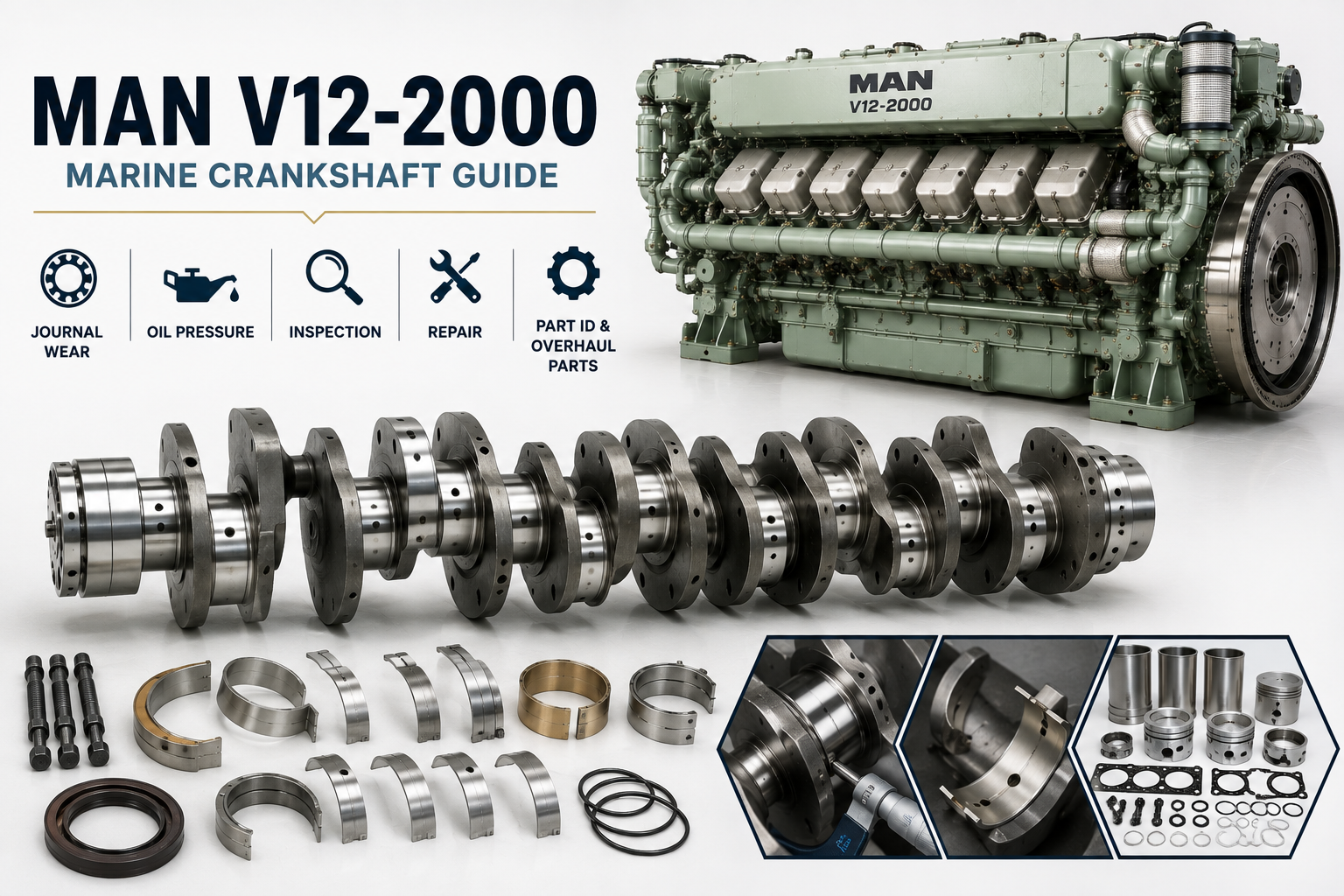
MAN V12-2000 Marine Engine Crankshaft: Inspection, Wear, Bearings, Repair & Spare Parts Guide
The crankshaft in a MAN V12-2000 marine engine is one of the most heavily loaded and important components inside the engine.
Every time combustion takes place, enormous pressure acts on the piston. That force travels through the connecting rod and reaches the crankshaft:
combustion → piston → connecting rod → crankshaft → flywheel → marine transmission
The crankshaft converts the reciprocating movement of the twelve pistons into the rotational power that ultimately drives the vessel.
Because the MAN V12-2000 is a high-output, turbocharged V12 marine diesel, crankshaft condition becomes particularly important.
Crankshaft problems do not always begin with a dramatic failure.
The first warning may instead be:
- Falling oil pressure
- Metallic particles in the oil
- Bearing material in an oil filter
- Abnormal engine vibration
- Deep knocking noises
- Higher bearing temperatures
- Uneven main-bearing wear
- Excessive crankshaft end play
- Journal damage discovered during overhaul
When crankshaft damage is discovered, replacing the crankshaft is only part of the job.
The more important question is:
Why did the crankshaft become damaged?
1. MAN V12-2000 Marine Engine
This guide focuses specifically on the:
MAN V12-2000 Marine Engine
The V12-2000 belongs to MAN's V12 marine diesel engine family and is designed for high-output marine propulsion.
The engine designation itself gives useful information:
MAN — Engine manufacturer
V12 — Twelve cylinders arranged in a V configuration
2000 — Approximately 2,000 metric horsepower class
The V12-2000 is particularly associated with performance-oriented marine applications where substantial power must be produced from a relatively compact engine package.
Applications can include:
- Motor yachts
- Performance yachts
- Fast pleasure craft
- Sportfishing vessels
- Other high-performance marine installations
The crankshaft therefore operates under significant combustion and torsional loading.
2. What Does the MAN V12-2000 Crankshaft Do?
Inside the engine, each piston travels up and down.
The connecting rod connects that piston to the crankshaft.
When combustion forces the piston downward, the connecting rod transfers that force to the crankpin.
The crankshaft then converts that movement into rotation.
This happens repeatedly across all twelve cylinders.
The crankshaft must therefore withstand:
- Combustion pressure
- Bending forces
- Torsional forces
- Bearing loads
- Rotational forces
- Propulsion-related loading
It has to do this thousands of times every minute.
3. Main Journals and Connecting-Rod Journals
Two crankshaft areas are especially important during inspection.
Main Journals
The main journals support the crankshaft inside the engine block.
They operate together with the main bearings.
Connecting-Rod Journals
These are commonly called crankpins.
They connect the crankshaft to the connecting rods through the connecting-rod bearings.
Both surfaces depend on an extremely thin but critical film of lubricating oil.
If that oil film disappears, damage can develop rapidly.
4. Why Lubrication Is Critical
The crankshaft should not simply rotate directly against the bearing shells.
Pressurized engine oil creates the lubrication conditions required between the bearing and journal surfaces.
This helps prevent direct metal-to-metal contact.
Problems can develop when there is:
- Insufficient oil pressure
- Low oil level
- Incorrect lubricant
- Contaminated oil
- Excessive oil temperature
- Blocked lubrication passages
- Excessive bearing clearance
- Oil-pump problems
A lubrication-system problem can quickly become a crankshaft problem.
5. Low Oil Pressure on a MAN V12-2000
Suppose the engine normally maintains stable oil pressure.
Then you begin noticing that pressure is slightly lower than before.
Do not immediately assume:
“The oil-pressure sensor is bad.”
And do not automatically assume:
“The oil pump needs replacing.”
Possible causes include:
- Low oil level
- High oil temperature
- Oil degradation
- Incorrect viscosity
- Oil-pump wear
- Internal leakage
- Worn main bearings
- Worn rod bearings
- Increased crankshaft journal clearance
- Sensor or instrumentation problems
The cause should be properly identified.
6. Watch Changes Rather Than Waiting for an Alarm
A useful engine-room question is not only:
“Is the oil pressure within limits?”
Ask:
“Is the oil pressure different from what this engine normally shows?”
Imagine that under similar RPM, load and temperature:
Previously: stable pressure
Later: slightly lower
Several months later: lower again
That trend deserves attention.
Gradual changes can provide early warning of internal wear.
7. Metallic Debris in the Engine Oil
Metal in the oil should never be considered normal simply because the engine is still running.
Possible sources include:
- Main bearings
- Connecting-rod bearings
- Gears
- Other lubricated internal components
If metallic debris appears, determine its source.
Early detection may protect a crankshaft that is still repairable.
8. Inspect the Oil Filters
When servicing the engine, used filters can provide valuable information.
Depending on maintenance procedures, inspection may reveal:
- Metallic particles
- Bearing material
- Unusual contamination
Do not only ask:
“When was the filter changed?”
Also ask:
“What was inside the old filter?”
The answer can reveal what is happening inside the engine.
9. Bearing Damage Can Become Crankshaft Damage
Bearings are replaceable wear components.
The crankshaft is considerably more expensive.
If a bearing begins deteriorating but the problem is detected early, the crankshaft journal may still be serviceable.
If operation continues, however, the bearing can deteriorate further.
Eventually:
bearing damage → journal scoring → heat → crankshaft damage
This is why early diagnosis matters.
10. What Does a Damaged Bearing Look Like?
During inspection, bearing shells may show:
- Scoring
- Wiping
- Pitting
- Heat discoloration
- Embedded debris
- Uneven wear
- Exposed bearing layers
Do not throw damaged bearings away before inspecting them.
Their wear patterns can provide valuable evidence about the failure.
11. Crankshaft Journal Scoring
Scoring can appear as grooves or scratches along the journal surface.
Possible causes include:
- Dirty oil
- Metallic contamination
- Bearing failure
- Oil starvation
- Incorrect clearance
- Foreign particles
Minor surface marks and severe scoring are very different conditions.
The crankshaft needs to be measured, not merely looked at.
12. Measuring the MAN V12-2000 Crankshaft
During overhaul, crankshaft journals should be measured accurately.
Important measurements can include:
- Journal diameter
- Taper
- Ovality
- Surface condition
Measurements should be taken at multiple locations.
Why?
Because one part of the journal may be acceptable while another is worn.
13. Crankshaft Taper
A crankshaft journal can wear unevenly across its width.
One side may measure differently from the other.
This is known as taper.
Excessive taper can affect:
- Bearing loading
- Oil-film formation
- Bearing life
A journal can therefore look excellent visually while still being dimensionally unsuitable.
14. Crankshaft Ovality
A journal should remain round within the specified limits.
Wear can cause it to become slightly oval.
Excessive ovality can produce:
- Uneven bearing clearance
- Changing oil-film thickness
- Increased bearing loading
- Accelerated wear
This is another reason accurate measurement matters.
15. Inspect Every Journal
Do not inspect only the visibly damaged crankpin.
Measure:
- Main journals
- Connecting-rod journals
- Relevant thrust surfaces
Then compare the results.
The wear pattern across the entire crankshaft can help reveal whether the problem is localized or widespread.
16. One Damaged Journal Can Tell a Story
Suppose eleven cylinder positions appear normal, but one connecting-rod bearing and its crankpin are badly damaged.
That is important.
Ask:
Why did this position fail while the others remained healthy?
Possible causes can include:
- Local lubrication restriction
- Connecting-rod problem
- Bearing problem
- Injector or combustion issue
- Blocked oil passage
Replacing the crankshaft without answering that question leaves the original problem inside the engine.
17. Check the Connecting Rod
If one crankpin has suffered severe damage, inspect its connecting rod carefully.
Depending on repair requirements, this can include:
- Big-end condition
- Alignment
- Bushings
- Fasteners
- Surface condition
A damaged connecting rod should not simply be fitted to a good replacement crankshaft.
18. Check the Corresponding Cylinder
A localized bottom-end failure can sometimes be related to what was happening above it.
Inspect the corresponding:
- Piston
- Cylinder liner
- Injector
- Connecting rod
An abnormal combustion condition can increase mechanical loading.
The crankshaft may be where the damage became visible, but the failure may have started elsewhere.
19. Oil Starvation
One of the most dangerous situations for crankshaft bearings is loss of lubrication.
Possible causes include:
- Low oil level
- Oil-pump failure
- Blocked passage
- Contamination
- Incorrect assembly
- Internal oil leakage
Once the oil film fails, temperatures can rise extremely quickly.
20. Heat Damage
A bearing operating without adequate lubrication can generate substantial heat.
The crankshaft journal may show:
- Blue discoloration
- Darkened areas
- Surface distress
- Material transfer
Severe heat damage requires careful evaluation.
Do not simply polish away discoloration and assume the crankshaft is suitable for reuse.
21. Coolant in the Engine Oil
Coolant contamination can seriously reduce lubrication quality.
Possible warning signs include:
- Milky oil
- Coolant loss
- Sludge
- Abnormal oil condition
After a significant coolant contamination event, consider the condition of:
- Main bearings
- Rod bearings
- Crankshaft journals
- Oil pump
- Oil cooler
- Oil passages
Fresh oil does not automatically undo previous bearing damage.
22. Fuel Dilution
Diesel fuel entering the lubricating oil can reduce viscosity.
Watch for:
- Rising oil level
- Strong diesel smell
- Unusually thin oil
- Changes in oil pressure
Continued fuel dilution can reduce bearing protection.
A fuel-system fault can eventually become an expensive crankshaft repair.
23. Crankshaft Oil Passages
Internal oilways help deliver lubrication to critical crankshaft areas.
These passages need particular attention after bearing failure.
Metallic debris can remain inside them.
Imagine rebuilding the engine with:
a good crankshaft + new bearings + fresh oil
but leaving contamination inside an oil passage.
The new bearing can be damaged shortly after startup.
24. Clean the Complete Lubrication System
After a serious bearing failure, contamination may have reached:
- Crankshaft oilways
- Oil pump
- Oil cooler
- Filter housing
- Oil lines
- Oil galleries
- Oil sump
Replacing only the visibly damaged parts may not be enough.
Cleanliness is a major part of a successful overhaul.
25. Inspect the Oil Pump
If the crankshaft has suffered lubrication-related damage, the oil pump deserves attention.
Inspect as required for:
- Wear
- Scoring
- Contamination
- Drive condition
- Pressure-control issues
The rebuilt engine needs correct oil pressure immediately after startup.
26. Do Not Forget the Oil Cooler
Metallic debris from bearing failure can circulate into the oil cooler.
If contamination remains trapped inside and later returns to the engine, new bearings can be damaged.
Therefore, the oil cooler should be considered when dealing with a major bottom-end failure.
27. Can a MAN V12-2000 Crankshaft Be Polished?
Possibly.
Light surface damage may sometimes be corrected by specialist polishing when:
- Journal dimensions remain acceptable
- Taper remains within limits
- Ovality remains within limits
- There is no serious heat damage
- There is no cracking
The crankshaft must still be measured afterward.
28. Polishing Is Not the Same as Grinding
These terms should not be confused.
Polishing
Removes a very small amount of material and improves surface finish.
Grinding
Removes significantly more material to restore journal geometry.
Grinding changes the journal diameter.
That directly affects bearing selection.
29. Can a MAN Marine Crankshaft Be Ground?
Whether a specific MAN crankshaft can be ground or reworked depends on:
- Exact engine version
- Crankshaft design
- Existing dimensions
- Damage
- Previous repair history
- Approved repair limits
Never assume that a crankshaft can simply be ground to an arbitrary undersize.
The repair must remain within the correct technical limits.
30. When Is Replacement More Appropriate?
A replacement crankshaft may become necessary when there is:
- Severe journal scoring
- Excessive wear
- Cracking
- Significant heat damage
- Distortion
- Damage beyond permitted repair limits
Trying to save a crankshaft that is no longer safely repairable can put the entire rebuilt V12 engine at risk.
31. Crack Inspection
A crankshaft exposed to severe bearing failure may require specialist crack inspection.
Areas requiring particular attention can include:
- Journal fillets
- Crankpin transitions
- Areas affected by overheating
- Other highly stressed locations
Cracking is a structural issue, not merely a surface-finish problem.
32. Crankshaft Straightness
A crankshaft can also require checking for distortion.
Potential causes can include:
- Severe bearing seizure
- Major internal failure
- Improper handling
- Previous damage
Journal measurements alone do not necessarily tell you everything about crankshaft condition.
33. Main Bearings
The main bearings support the crankshaft inside the engine.
During overhaul, inspect the removed bearings for patterns such as:
- Uneven wear
- Edge loading
- Scoring
- Heat damage
- Embedded contamination
If several main bearings show abnormal wear patterns, investigate alignment and supporting components as well as the crankshaft.
34. Connecting-Rod Bearings
Rod bearings experience high cyclic combustion loads.
They should be inspected for:
- Scoring
- Wiping
- Pitting
- Heat
- Fatigue
- Material transfer
A rod bearing failure can become a crankshaft failure very quickly.
35. Crankshaft Thrust Control
The crankshaft must also be controlled axially.
Thrust-bearing components help limit fore-and-aft crankshaft movement.
During overhaul, inspect:
- Thrust bearings
- Thrust surfaces
- Axial clearance
Excessive crankshaft end movement deserves investigation.
36. Torsional Vibration
A V12 crankshaft is subjected not only to bending but also twisting forces.
The drivetrain includes:
crankshaft → flywheel → coupling → marine transmission → propeller shaft → propeller
Problems elsewhere in this system can influence vibration and loading.
When abnormal vibration has existed for a long period, look beyond the crankshaft journals alone.
37. Flywheel and Coupling
During major crankshaft work, connected components should also be inspected as appropriate.
Look for:
- Loose fasteners
- Abnormal wear
- Damage
- Alignment problems
A properly repaired engine still needs a healthy connection to the transmission.
38. Propeller Loading Matters
An overloaded propulsion system can make the engine work harder than intended.
Possible causes include:
- Incorrect propeller pitch
- Propeller fouling
- Damaged propeller blades
- Excessive vessel resistance
If the MAN engine previously struggled to achieve expected loaded RPM, investigate the propulsion system as part of the overall engine evaluation.
39. Handling a MAN V12 Crankshaft
A crankshaft is a heavy precision-machined component.
During removal, transport and storage:
- Use correct lifting equipment
- Support it correctly
- Protect journal surfaces
- Avoid impacts
- Prevent contamination
- Protect against corrosion
Poor workshop handling can damage an otherwise serviceable crankshaft.
40. Never Order Bearings Before Measuring the Crankshaft
This is particularly important with older or previously overhauled engines.
Do not automatically assume:
the crankshaft is still standard size.
It may have undergone previous repair work.
First:
inspect → measure → determine repair condition → select bearings.
Not the other way around.
41. New vs. Used vs. Reconditioned MAN Crankshafts
These terms should be understood clearly.
New Crankshaft
A newly manufactured replacement component.
Used Crankshaft
A crankshaft removed from another engine.
Condition and history must be established.
Reconditioned Crankshaft
A used crankshaft that has been inspected and, where applicable, professionally reworked.
For a used or reconditioned crankshaft, useful information includes:
- Main-journal measurements
- Crankpin measurements
- Taper
- Ovality
- Crack-inspection results
- Repair history
A clean appearance is not enough.
42. MAN V12-2000 Crankshaft Part Number Identification
When sourcing a MAN V12-2000 crankshaft, do not select a crankshaft from the words:
“MAN V12 crankshaft”
alone.
The correct part number should be verified against the exact engine identification.
Provide:
Engine: MAN V12-2000
Engine Serial Number: __________
Existing Crankshaft Part Number: __________
Crankshaft Identification/Marking: __________
Rated Power: __________
Rated RPM: __________
A crankshaft number should not be assumed interchangeable across different MAN V12 marine engine versions simply because the basic engine architecture is related.
43. Other MAN V12 Marine Engine Types
The broader MAN high-performance V12 marine family includes several power versions and generations.
Examples include:
- MAN V12-1650
- MAN V12-1800
- MAN V12-2000
- MAN V12-2200
- MAN V12X variants
Different engine versions can have important differences in:
- Internal components
- Fuel system
- Turbocharging
- Cooling
- Electronics
- Power rating
For crankshaft and bearing identification, always work from the exact engine type and serial number.
44. Common MAN V12-2000 Crankshaft-Related Spare Parts
A crankshaft repair or bottom-end overhaul may require:
- Crankshaft
- Main bearings
- Connecting-rod bearings
- Thrust bearings
- Connecting rods
- Connecting-rod bushings
- Pistons
- Piston rings
- Cylinder liners
- Front crankshaft seal
- Rear crankshaft seal
- Oil pump
- Oil-cooler components
- Gaskets
- O-rings
- Fasteners
The actual parts requirement should be determined after dismantling, inspection and measurement.
45. Crankshaft Seals
A major overhaul is also a good opportunity to inspect the crankshaft sealing areas.
Check:
- Front crankshaft seal
- Rear crankshaft seal
- Running surfaces
- Previous oil-leak history
A seal itself may be inexpensive compared with the labor required to access it after the engine has been returned to service.
46. First Startup After Crankshaft Repair
The first startup following major bottom-end work is important.
Monitor:
Oil pressure
Engine noise
Oil leakage
Temperature
Vibration
If oil pressure does not behave correctly, investigate immediately.
Do not assume abnormal pressure will correct itself after the engine runs longer.
47. Loaded Testing After Overhaul
After the engine has been properly commissioned, loaded operation can help verify:
- Oil pressure
- Oil temperature
- Coolant temperature
- Engine RPM
- Engine load
- Vibration
- Overall performance
Where historical vessel data is available, compare the rebuilt engine against its previous healthy operating behavior.
48. Keep a Crankshaft Measurement Report
Record:
- Main journal measurements
- Rod journal measurements
- Taper
- Ovality
- Bearing sizes
- Bearing clearances
- Repair work performed
- Crankshaft identification
- Parts installed
These records can become extremely valuable during future maintenance.
49. Information to Send When Ordering a MAN V12-2000 Crankshaft
Instead of sending:
“Need MAN marine crankshaft.”
send:
Manufacturer: MAN
Engine: V12-2000
Engine Serial Number: __________
Existing Crankshaft Part Number: __________
Crankshaft Identification: __________
Rated Power: __________
Rated RPM: __________
Condition Required: New / Used / Reconditioned
Main Bearings Required: Yes / No
Rod Bearings Required: Yes / No
Quantity: __________
Photos: Attached
Delivery Location: __________
This gives a much stronger basis for identifying the correct component.
50. Frequently Asked Questions
What MAN Engine Does This Guide Cover?
This article specifically covers the MAN V12-2000 marine engine.
How Many Cylinders Does the MAN V12-2000 Have?
It is a 12-cylinder V-engine.
What Can Damage a MAN Marine Crankshaft?
Possible causes include oil starvation, bearing failure, contaminated lubricant, incorrect clearances, excessive heat and abnormal mechanical loading.
Can Low Oil Pressure Indicate Bearing Wear?
Yes, increased internal bearing clearance can contribute to lower oil pressure, although many other causes must also be considered.
Can a MAN V12-2000 Crankshaft Be Repaired?
Possibly, depending on the damage, measurements, repair history and applicable technical repair limits.
Can I Install New Bearings on the Existing Crankshaft?
Only after the crankshaft journals have been properly inspected and measured.
Should Bearings Be Ordered Before Crankshaft Inspection?
No. Establish the crankshaft dimensions and repair condition first.
Why Would Only One Crankpin Be Damaged?
A localized oil-supply issue, bearing problem, connecting-rod condition or cylinder-specific problem may be responsible.
Should the Oil System Be Cleaned After Bearing Failure?
Yes. Metallic contamination can circulate through oil passages, the oil pump, cooler and other lubrication-system components.
What Information Is Needed for a MAN V12-2000 Crankshaft?
Provide the engine model, engine serial number, existing crankshaft part number or identification, rated power, RPM and photographs.
MAN V12-2000 Crankshaft & Overhaul Spare Parts
Typical bottom-end and overhaul requirements can include:
- Crankshafts
- Main bearings
- Connecting-rod bearings
- Thrust bearings
- Connecting rods
- Pistons
- Piston rings
- Cylinder liners
- Cylinder heads
- Injectors
- Turbochargers
- Oil pumps
- Coolant pumps
- Seawater pumps
- Heat exchangers
- Oil coolers
- Gaskets
- O-rings
- Crankshaft seals
- Filters
- Sensors
- Overhaul components
Correct parts identification should always be based on the exact engine configuration.
Browse Our Complete Catalog
Marine engine brands:
https://alfamarinespareparts.com/our-brand
Marine spare parts:
https://alfamarinespareparts.com/spareparts
Contact Alfa Marine Spare Parts
For MAN V12-2000 crankshafts, bearings and marine engine overhaul spare parts:
Email: request@alfamarinespareparts.com
For faster identification, provide:
MAN V12-2000 engine serial number + crankshaft identification/part number + bearing requirements + quantity + photographs + delivery location.
Final Word
When crankshaft damage is discovered in a MAN V12-2000 marine engine, replacing the damaged component should not be the end of the investigation.
Ask:
What happened to the bearing?
Was oil pressure correct?
Was the lubricant contaminated?
Was one cylinder operating abnormally?
Was an oil passage restricted?
Did the engine have an abnormal vibration history?
If one bearing failed because its oil supply was restricted, installing a new crankshaft without correcting the restriction can damage the replacement.
If metallic material circulated through the lubrication system, installing new bearings without cleaning the contaminated system can create another failure.
And if the crankshaft has previously been repaired, its actual journal dimensions need to be established before selecting replacement bearings.
The crankshaft sits at the mechanical center of the MAN V12-2000.
Protecting it means looking beyond the crankshaft itself and understanding the entire system supporting it:
lubrication, bearings, connecting rods, cylinders, alignment and propulsion load.