MaK Marine Engine Types: What Is the Difference, and Which Engine Fits Which Vessel?
When somebody says:
“We have MaK engines onboard.”
that already tells you something important.
You are probably not talking about a small yacht engine.
MaK engines belong much more naturally in the world of:
- Ferries
- Cruise ships
- Cargo vessels
- Offshore vessels
- LNG carriers
- Research vessels
- Large fishing vessels
- Diesel-electric ships
- Commercial passenger vessels
- Large marine generator installations
Today, MaK is a Caterpillar brand, and Caterpillar describes the MaK product line as marine diesel, gas and dual-fuel engines covering approximately 1,020 to 16,800 kW for main propulsion and 979 to 16,111 kWe for generator sets.
That is a huge power range.
So when somebody asks:
“Which MaK marine engine is best?”
the useful answer is:
Best for which ship, which propulsion system and which operating profile?
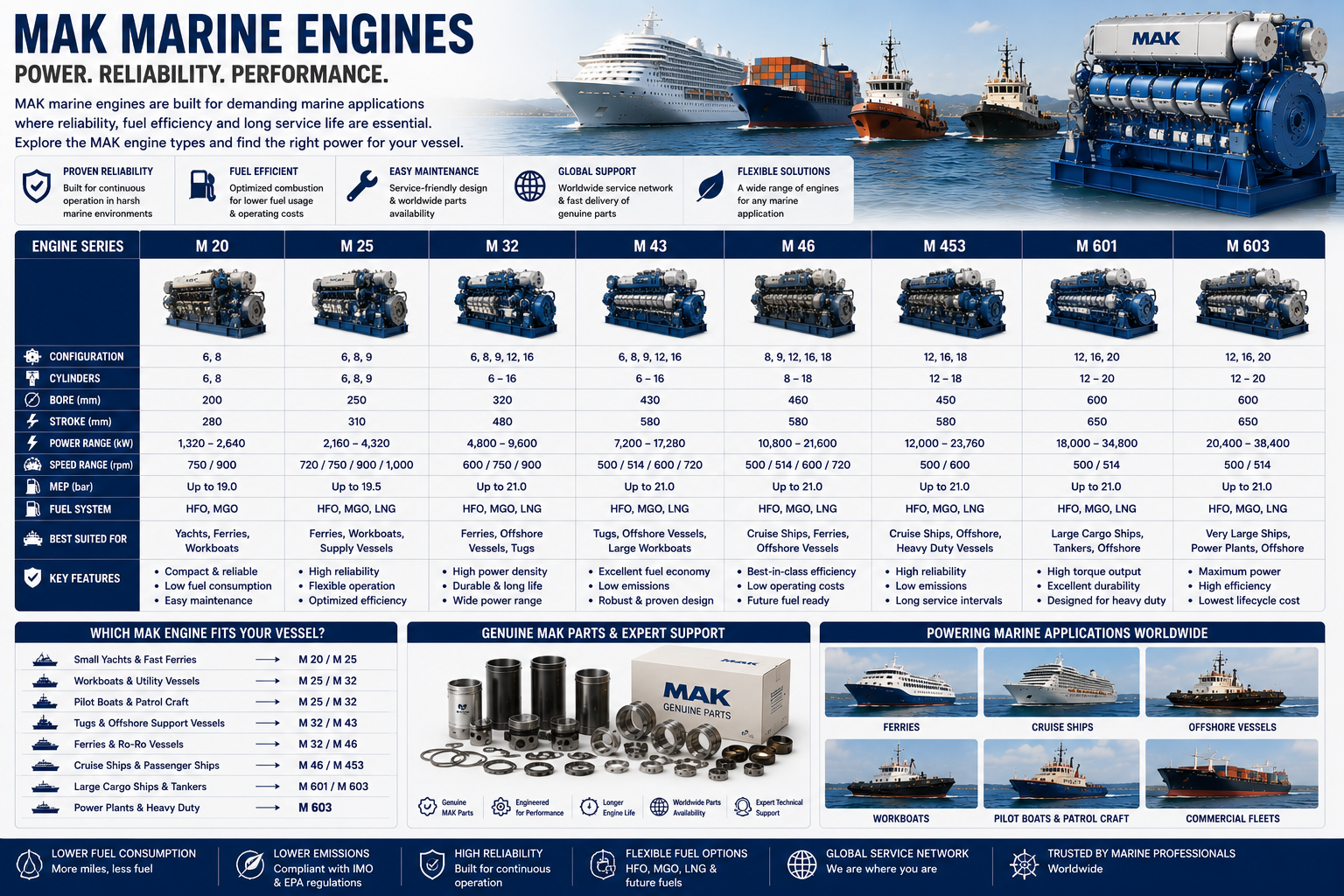
Understanding the Main MaK Marine Engine Families
Marine engineers may encounter several important MaK families, including:
- MaK M 20 C
- MaK M 25 C
- MaK M 25 E
- MaK M 32 C
- MaK M 32 E
- MaK M 34 DF
- MaK M 43 C
- MaK M 46 DF
Some of these are primarily diesel platforms.
Others were developed specifically for dual-fuel operation, including LNG.
And some families can be converted or upgraded because Caterpillar deliberately engineered related platforms with common installation characteristics.
A simple way to understand them is this:
| MaK Engine FamilyGeneral CharacterTypical Marine Application | ||
| M 20 C | Compact medium-speed diesel | Auxiliary power, gensets, offshore vessels |
| M 25 C / M 25 E | Small-medium commercial engine | Gensets, smaller propulsion systems |
| M 32 C | Proven medium-speed workhorse | Cargo, offshore, passenger, generators |
| M 32 E | Higher-output development | Diesel-electric and offshore applications |
| M 34 DF | Dual-fuel development | LNG-capable commercial vessels |
| M 43 C | Large high-output diesel | Ferries, RoPax, cargo and large ships |
| M 46 DF | Large dual-fuel platform | Cruise ships, ferries, LNG carriers |
Why MaK Engines Are Different From Smaller Marine Diesels
Compare a MaK engine with a yacht engine.
On a small yacht, you may have one compact diesel connected to one marine gearbox.
A large vessel powered by MaK may instead have:
four generator engines
feeding
an electric propulsion system
plus
additional auxiliary generating sets.
Or it may have two large MaK engines connected mechanically through gearboxes to controllable-pitch propellers.
This changes everything about:
- Maintenance
- Spare-parts planning
- Engine-room layout
- Overhaul schedules
- Fuel consumption
- Redundancy
- Vessel operation
A MaK engine is part of a ship power system, not simply a standalone propulsion unit.
MaK M 20 C: The Compact Member of the Family
The MaK M 20 C sits toward the smaller end of the MaK medium-speed range.
But “small” is relative.
Caterpillar has documented offshore construction vessels using 6 M 20 C engines producing approximately 1,140 kW each, while eight-cylinder versions were used at approximately 1,440 kW in another offshore installation.
That already places the M 20 C far above typical recreational marine engines.
Where Does an M 20 C Fit?
Think:
- Marine generator sets
- Offshore vessels
- Diesel-electric vessels
- Smaller commercial propulsion systems
- Auxiliary power
- Multi-engine power plants
It is particularly useful where a vessel wants medium-speed durability but does not need the output of an M 32 or M 43.
M 20 C Personality
The Compact Ship Worker
Small by MaK standards, but still capable of more than a megawatt of marine power.
Why Would a Large Ship Use Several Smaller Engines?
Imagine an offshore vessel.
At maximum transit speed, it needs substantial power.
But while conducting subsea operations, it may need much less propulsion power while still running:
- Thrusters
- Cranes
- Pumps
- Control systems
- Hotel loads
Instead of running one huge engine inefficiently at low load, the vessel can use several generating sets and switch engines on or off depending on demand.
That is one reason engines such as the M 20 C work well in diesel-electric installations.
MaK M 25 C and M 25 E: Another Step Up
The M 25 family occupies another important position in the MaK range.
The later M 25 E represents an updated development.
Caterpillar has provided the M 25 E with IMO Tier III certification capability, illustrating how established medium-speed platforms have continued evolving to meet stricter emissions requirements.
Where Does the M 25 Class Fit?
Potential roles include:
- Generator sets
- Auxiliary power
- Smaller commercial propulsion
- Coastal shipping
- Specialized vessels
- Diesel-electric systems
The M 25 family is interesting because it sits between the compact M 20 class and the substantially larger M 32 platform.
M 25 C vs. M 25 E
A useful way to think about the difference is:
M 25 C
Established medium-speed architecture.
Familiar commercial marine platform.
M 25 E
Later development emphasizing updated performance and emissions capability.
Better suited where modern certification requirements matter.
The exact specification still has to be checked against the engine serial number and vessel installation.
MaK M 32 C: One of the Most Important MaK Engines
The M 32 C is one of the key MaK medium-speed platforms.
It has been used in a wide variety of vessel types and forms the foundation for later developments.
The M 32 family is important because it can serve both:
mechanical propulsion
and
generator/diesel-electric applications.
Its architecture also became the basis for the dual-fuel M 34 DF conversion concept. Caterpillar specifically states that existing M 32 C engines can be converted to the M 34 DF platform.
That tells you how strategically important this engine family became.
Where Does an M 32 C Fit?
Think:
- Cargo vessels
- Offshore support vessels
- Ferries
- Passenger vessels
- Research vessels
- Generator sets
- Diesel-electric ships
- Mechanical propulsion systems
M 32 C Personality
The Proven Medium-Speed Workhorse
Large enough for serious commercial power, but flexible enough for many different ship types.
Why the M 32 C Became So Useful
Shipowners like engines with a large installed base.
Why?
Because crews become familiar with them.
Workshops know how to overhaul them.
Spare-parts requirements become predictable.
Typical maintenance may involve:
- Cylinder heads
- Pistons
- Cylinder liners
- Fuel injection equipment
- Turbochargers
- Connecting-rod bearings
- Main bearings
- Cooling-water pumps
- Oil pumps
- Charge-air coolers
- Exhaust valves
This is very different from replacing a filter on a small boat engine.
A single cylinder unit can itself represent a serious maintenance project.
MaK M 32 E: More Power From the M 32 Platform
The M 32 E is an increased-power development.
Caterpillar states that the engine produces approximately 550 kW per cylinder at 720 or 750 rpm.
That gives:
6 M 32 E → approximately 3,300 kW
8 M 32 E → approximately 4,400 kW
9 M 32 E → approximately 4,950 kW
depending on configuration.
That is an easy way to understand how medium-speed modular engine design works.
More cylinders = more total power.
Why the M 32 E Is Good for Diesel-Electric Ships
Caterpillar specifically describes the M 32 E as suitable for diesel-electric propulsion and auxiliary power, particularly in offshore multi-engine concepts.
That makes sense.
A ship can install several M 32 E generating sets and operate only the number needed at a given moment.
For example:
low load → two engines online
higher load → three engines
maximum operation → all required engines
That can improve operational flexibility.
Part-Load Operation Matters More Than Many People Think
Large ships rarely operate at maximum propulsion power 100% of the time.
They may spend enormous amounts of time:
- Maneuvering
- Waiting
- Holding station
- Slow steaming
- Operating cargo equipment
- Working offshore
Caterpillar developed part-load optimization kits for M 32 E engines specifically to improve fuel efficiency, load acceptance and smoke performance when engines spend significant time below full output.
This is a major difference between ship-engine design and simply chasing maximum horsepower.
MaK M 34 DF: Turning the M 32 Concept Into Dual Fuel
The M 34 DF is particularly interesting because Caterpillar designed it with conversion from existing M 32 C engines in mind.
Caterpillar states that M 32 C engines can be retrofitted to the M 34 DF dual-fuel platform, allowing operators to move toward gaseous fuel without replacing the complete engine installation.
That is a major advantage for an existing ship.
Replacing an entire engine may require:
- Cutting the ship open
- Dry docking
- Heavy lifting
- Rebuilding foundations
- Reworking piping
- Reworking exhaust
- New alignment
An in-hull conversion can avoid much of that.
What Does DF Mean?
DF = Dual Fuel.
A dual-fuel MaK engine can use gaseous fuel such as LNG while retaining liquid-fuel capability.
That provides operational flexibility.
Depending on the platform, liquid fuels can serve as:
- Pilot fuel
- Backup fuel
- Alternative fuel when gas is unavailable
This is particularly attractive for ships operating on LNG.
MaK M 43 C: Large Commercial Ship Power
The M 43 C moves the MaK range firmly into large-ship propulsion.
Caterpillar has documented 12 M 43 C engines producing up to approximately 12,600 kW.
These engines were developed particularly with the cruise and ferry sectors in mind.
Twelve and a half megawatts from one engine is serious propulsion power.
Where Does the M 43 C Fit?
Think:
- RoPax ferries
- Cruise vessels
- Cargo vessels
- Large passenger ships
- Large commercial vessels
Caterpillar selected twin 12 M 43 C engines for large Stena Line RoPax ferries, driving controllable-pitch propellers through gearboxes.
That gives a very clear picture of the engine's natural environment.
What Is a 12 M 43 C?
The designation tells you something.
12 = twelve cylinders.
M 43 C = engine family.
So:
12 M 43 C
is a twelve-cylinder configuration of the M 43 C platform.
This is why you should never request:
“MaK M43 parts.”
without specifying the complete engine configuration.
Why Ferries Like Engines Such as the M 43 C
A ferry may run several crossings every day.
It needs:
- High reliability
- Good fuel consumption
- Strong maneuvering capability
- Predictable maintenance
- High annual availability
The propulsion system may also use controllable-pitch propellers, allowing the engine and propeller to be optimized across varying operating conditions.
Caterpillar's Stena installation combines M 43 C engines with controllable-pitch propellers specifically to improve efficiency and operating flexibility.
MaK M 46 DF: Large Dual-Fuel Power
Then we reach one of the most recognizable large MaK engines:
M 46 DF
This is a large dual-fuel platform designed for both:
- Mechanical propulsion
- Electric-drive propulsion
Caterpillar gives the M 46 DF a 460 mm bore and 610 mm stroke, and the engine was designed to operate on LNG as well as liquid fuels.
This puts it firmly into large commercial ship territory.
How Powerful Is the M 46 DF?
A useful real-world example is the 9 M 46 DF.
Caterpillar documented ferry conversions in which a nine-cylinder M 46 DF was rated at approximately 8,685 kW.
At the other end, large cruise ships have been equipped with:
16 M 46 DF
engines.
Caterpillar has supplied four-engine installations using 16 M 46 DF units for LNG-powered cruise ships.
That shows how scalable the platform is.
Which Ships Suit the MaK M 46 DF?
Think:
- Cruise ships
- Large ferries
- LNG carriers
- RoPax vessels
- Large merchant ships
- Diesel-electric vessels
Caterpillar has specifically documented M 46 DF installations and conversions across LNG carriers, ferries and cruise vessels.
M 46 DF Personality
The Dual-Fuel Heavyweight
Large-bore commercial power for ships where fuel flexibility and megawatt output both matter.
M 43 C vs. M 46 DF: What Is the Main Difference?
This comparison is very useful.
MaK M 43 C
Large diesel engine
Strong mechanical propulsion heritage.
Excellent fit for ferries and large commercial ships.
MaK M 46 DF
Large dual-fuel engine
Designed around LNG plus liquid-fuel capability.
Particularly attractive for cruise ships, LNG vessels and ferries.
The two families are actually related closely enough that Caterpillar engineered in-hull conversion of M 43 C engines to M 46 DF.
That was demonstrated commercially on an LNG carrier.
Why Would a Shipowner Convert an M 43 C to M 46 DF?
Because replacing a ship is expensive.
If the vessel itself still has many years of economic life, modifying its propulsion plant may make more sense.
A conversion can potentially provide:
- LNG capability
- Reduced sulfur emissions
- Lower particulate emissions
- Greater fuel flexibility
- Compliance advantages
without completely replacing the propulsion machinery.
Caterpillar's documented M 43 C-to-M 46 DF conversion was performed in the hull, avoiding structural modification for engine removal.
Diesel vs. Dual Fuel: Which Is Better?
There is no universal answer.
Diesel
Advantages can include:
- Familiar infrastructure
- Simpler fuel storage
- Established maintenance practices
- Broad fuel availability
Dual Fuel
Potential advantages include:
- LNG operation
- Lower sulfur and particulate emissions in gas mode
- Fuel flexibility
- Ability to retain liquid-fuel operation
Caterpillar notes that MaK M 46 DF engines can operate on gas as well as diesel or heavy fuel oil depending on configuration.
The correct choice depends on the vessel's routes, fuel supply, emissions regulations and lifecycle economics.
MaK Marine Engines and LNG
MaK became particularly important in large LNG-fuelled ships.
Caterpillar's cruise-sector projects include ships equipped with four MaK 16 M 46 DF engines and complete LNG handling systems.
That means the engine is only one part of the system.
An LNG vessel also requires:
- Storage tanks
- Gas handling
- Fuel conditioning
- Safety systems
- Gas detection
- Ventilation
- Control systems
- Bunkering infrastructure
This is why large dual-fuel propulsion is a ship-system project rather than simply an engine purchase.
Which MaK Engine Makes Sense for an Offshore Vessel?
Offshore vessels often have extremely variable power requirements.
During transit, they need propulsion.
During work, they may need enormous electrical power for:
- Dynamic positioning
- Thrusters
- Cranes
- Subsea equipment
- Cable laying
- Pumps
This makes diesel-electric propulsion particularly attractive.
Caterpillar has documented offshore construction and subsea vessels combining M 32 E and M 20 C generating sets specifically for these types of operations.
For this type of ship:
M 20 C + M 32 E
can be a very logical combination.
Which MaK Engine Makes Sense for a Ferry?
Depending on vessel size and fuel strategy:
- M 25 family
- M 32 family
- M 43 C
- M 46 DF
can all become relevant.
Large RoPax ferries have used twin 12 M 43 C propulsion engines, while other ferries have been converted to 9 M 46 DF dual-fuel operation.
That shows how the choice changes when fuel strategy changes.
Which MaK Engine Makes Sense for a Cruise Ship?
For modern cruise ships, the large dual-fuel family becomes especially important.
Cruise ships consume enormous electrical power for:
- Propulsion
- Air conditioning
- Kitchens
- Lighting
- Elevators
- Entertainment
- Pumps
- Hotel services
Large MaK M 46 DF engines have been selected for LNG-powered cruise ships in multi-engine power plants.
This provides redundancy.
If one engine is down for maintenance, the vessel may still have several others available.
Which MaK Engine Makes Sense for a Cargo Vessel?
Cargo vessels may use MaK engines for both mechanical and electric propulsion depending on vessel design.
Caterpillar currently positions Cat and MaK engines for cargo vessels, including diesel and dual-fuel solutions.
Depending on ship size:
- M 25
- M 32
- M 43
- M 46 DF
can all be relevant.
The key questions are:
How large is the ship?
Mechanical or electric propulsion?
What fuel will be used?
How many annual hours?
What About Commercial Fishing Vessels?
MaK sits naturally at the larger end of commercial fishing.
This is not the engine family you would expect in a small coastal fishing boat.
For a substantial trawler or factory vessel, however, a medium-speed engine can provide:
- Continuous-duty capability
- Efficient operation
- Long service life
- Large overhaulable components
Caterpillar's marine portfolio supports long-duty-cycle fishing applications and positions medium-speed solutions as part of its wider commercial marine ecosystem.
Mechanical Propulsion vs. Diesel-Electric
This is one of the biggest differences in how MaK engines are used.
Mechanical Propulsion
The engine directly drives:
gearbox → shaft → propeller
This is particularly natural for:
- Ferries
- Cargo ships
- Some LNG carriers
- Conventional commercial vessels
Diesel-Electric Propulsion
The engine drives:
generator → electrical network → propulsion motor
This is particularly attractive for:
- Offshore vessels
- Cruise ships
- Research ships
- Dynamic-positioning vessels
MaK engines such as the M 32 E were explicitly developed with diesel-electric applications in mind.
Why Diesel-Electric Can Be Better at Variable Load
Imagine a vessel has four generator engines.
At low power demand:
one or two engines run.
At medium demand:
three run.
At maximum demand:
all four run.
This lets the operator keep running engines closer to efficient load ranges rather than forcing one huge engine to operate inefficiently.
It also provides redundancy.
That is extremely valuable offshore and on cruise ships.
MaK Engines Are Medium-Speed Engines
This is another important distinction.
Many small marine engines run at:
2,000–3,000+ rpm.
MaK medium-speed engines operate much slower.
For example, the M 32 E operates at 720 or 750 rpm.
That has a major influence on:
- Engine dimensions
- Piston speed
- Torque
- Gearbox design
- Propeller system
- Maintenance philosophy
A 4,000-kW medium-speed engine and a 4,000-kW high-speed engine are very different machines.
Why Medium-Speed Engines Are So Large
Lower rpm means each combustion cycle occurs less frequently.
To produce very high total power, the engine uses large cylinders and considerable displacement.
That's why you see bore dimensions such as 460 mm on the M 46 DF.
One piston can be enormous compared with an ordinary automotive or yacht-engine piston.
And that changes maintenance completely.
One Cylinder Can Be a Major Overhaul Job
On a MaK medium-speed engine, a cylinder unit can involve:
- Large cylinder head
- Large piston
- Cylinder liner
- Connecting rod
- Fuel injector
- Exhaust valves
- Intake valves
- Cooling passages
- Sealing components
Removing one piston may require:
- Engine-room crane
- Lifting tools
- Special fixtures
- Multiple technicians
- Careful measurements
This is not a small-engine repair.
Quick MaK Marine Engine Comparison
| MaK FamilyTypical CharacterExample OutputTypical Application | |||
| M 20 C | Compact medium-speed diesel | ~1.1–1.4 MW in cited 6/8-cylinder installations | Auxiliary, offshore, diesel-electric |
| M 25 C / E | Small-medium ship engine | Model dependent | Gensets, propulsion, auxiliary |
| M 32 C | Established workhorse | Multi-MW | Cargo, offshore, ferries, gensets |
| M 32 E | Higher-output development | 3.3–4.95 MW | Diesel-electric, offshore |
| M 34 DF | Dual-fuel development | Model dependent | LNG-capable vessels |
| M 43 C | Large commercial diesel | Up to ~12.6 MW cited for 12-cylinder | Ferries, cargo, large passenger ships |
| M 46 DF | Large dual-fuel engine | ~8.685 MW cited for 9-cylinder | Cruise, ferries, LNG carriers |
The specific outputs above are examples from Caterpillar-documented installations and should not be interpreted as universal ratings for every engine version.
MaK Marine Engine “Personalities”
M 20 C — The Compact Worker
More than a megawatt is possible, yet it remains small enough to complement larger engines in multi-engine power plants.
M 25 — The Middle Step
A useful bridge between compact auxiliary power and the larger M 32 class.
M 32 C — The Proven Workhorse
Flexible enough for propulsion or generating duty and important enough to become the foundation for later dual-fuel development.
M 32 E — The Offshore Specialist
High power per cylinder and optimized for multi-engine diesel-electric installations.
M 34 DF — The Conversion-Friendly Dual-Fuel Engine
Particularly interesting because existing M 32 C installations can be converted toward this platform.
M 43 C — The Ferry Heavyweight
Up to about 12.6 MW in the documented twelve-cylinder configuration and proven in large RoPax propulsion.
M 46 DF — The LNG Heavyweight
Large-bore dual-fuel power proven in cruise ships, ferries and LNG carriers.
Diesel M 43 C vs. Dual-Fuel M 46 DF
This deserves another simple comparison.
| FeatureM 43 CM 46 DF | ||
| Fuel Concept | Diesel | Dual fuel |
| Typical Fuel | Liquid marine fuel | LNG + liquid fuel |
| Typical Vessel | Ferry, cargo, passenger | Cruise, ferry, LNG vessel |
| Propulsion | Mechanical / system dependent | Mechanical or electric |
| Conversion Relationship | Can be converted | Conversion target |
| Main Advantage | Proven diesel propulsion | Fuel flexibility |
Caterpillar demonstrated this relationship by converting an operational 6 M 43 C into a 6 M 46 DF in the hull of an LNG carrier.
Common MaK Marine Engine Spare Parts
Depending on engine family and configuration, maintenance requirements may include:
- Fuel injectors
- Fuel pumps
- Injection components
- Gas-system components on DF engines
- Cylinder heads
- Exhaust valves
- Intake valves
- Valve seats
- Valve guides
- Piston crowns
- Pistons
- Piston rings
- Cylinder liners
- Connecting rods
- Main bearings
- Connecting-rod bearings
- Crankshaft components
- Camshaft components
- Turbochargers
- Turbocharger repair components
- Charge-air coolers
- Cooling-water pumps
- Lubricating-oil pumps
- Oil coolers
- Thermostatic valves
- Exhaust components
- Gaskets
- O-rings
- Sealing rings
- Sensors
- Control-system components
- Complete cylinder-unit overhaul components
Caterpillar continues to provide dedicated MaK parts, repair options and overhaul support, including genuine components and remanufactured/REParts solutions.
Why Cylinder-Head Parts Matter So Much
On a medium-speed MaK engine, the cylinder head is a major assembly.
It can contain or support:
- Fuel injector
- Intake valves
- Exhaust valves
- Valve seats
- Guides
- Springs
- Cooling passages
Caterpillar even maintains specific MaK support resources around components such as exhaust valves and piston crowns, highlighting how important these individual major-engine parts are.
Piston Crowns and Liners Tell a Story
When a MaK cylinder is opened, don't immediately clean everything.
Inspect first.
A piston crown may show:
- Abnormal deposits
- Hot spots
- Fuel-spray problems
- Thermal damage
- Combustion differences
A cylinder liner may reveal:
- Polishing
- Scuffing
- Lubrication problems
- Wear patterns
- Ring problems
Compare one cylinder with the others.
On a multi-cylinder engine, the other units give you a built-in reference.
Turbocharger Condition Matters Enormously
A large medium-speed engine depends heavily on turbocharging.
Poor turbocharger performance can affect:
- Charge-air pressure
- Fuel consumption
- Exhaust temperature
- Smoke
- Maximum output
- Cylinder balance
Monitor trends rather than waiting for failure.
A gradual increase in exhaust temperature combined with falling boost pressure may tell you something long before a turbocharger alarm occurs.
Oil and Fluid Analysis
Large MaK engines are valuable assets.
Oil analysis therefore becomes more than a routine maintenance exercise.
Caterpillar's marine support program emphasizes analysis of:
- Lubricating oil
- Coolant
- Diesel fuel
as tools for understanding equipment condition.
Oil analysis can help identify trends involving:
- Bearing wear
- Fuel dilution
- Coolant contamination
- Abnormal metal levels
- Oil deterioration
On a large engine, catching a bearing problem early can prevent extremely expensive crankshaft damage.
Why Exact MaK Engine Identification Matters
A request saying:
“Need MaK M32 piston rings.”
is a beginning.
But we still need more information.
Is it:
6 M 32 C?
8 M 32 C?
9 M 32 C?
M 32 E?
What is the serial number?
What is the installed part number?
Which cylinder position?
What maintenance scope is being performed?
A better inquiry looks like:
Engine: MaK 8 M 32 C
Serial Number: __________
Current Part Number: __________
Application: Main engine / generator
Fuel: __________
Quantity: __________
Photos: Available
Don't Confuse Similar MaK Engine Names
The difference between:
M 32 C
and
M 32 E
matters.
The difference between:
M 43 C
and
M 46 DF
matters even more.
The latter changes not only displacement and engine architecture but also the entire fuel strategy.
For expensive parts, never rely on:
“It looks like an M32 part.”
Use documentation and serial-number verification.
Marine Engineer Tip
For MaK engines, identify the complete engine configuration before ordering anything.
Check:
Engine family
Cylinder count
C / E / DF version
Serial number
Rated rpm
Main propulsion or generator
Mechanical or diesel-electric
Fuel type
Current part number
Required maintenance scope
On large marine engines, the cost of the wrong component can be much greater than the price of the part itself.
A wrong part can also cost:
shipyard time + crane time + crew time + delayed sailing.
Frequently Asked Questions
Is MaK part of Caterpillar?
Yes. Caterpillar identifies MaK as one of its brands, with the MaK product line covering marine diesel, gas and dual-fuel engines.
How powerful are MaK marine engines?
Caterpillar states that the MaK line covers approximately 1,020–16,800 kW for main propulsion and 979–16,111 kWe for generator sets.
What is the MaK M 20 C used for?
The M 20 C is used in commercial and auxiliary power applications. Caterpillar has documented M 20 C generating sets in offshore diesel-electric vessels at approximately 1.1–1.4 MW per engine depending on cited configuration.
What is the MaK M 32 E?
It is an increased-output development of the M 32 platform. Caterpillar lists approximately 550 kW per cylinder, with six- to nine-cylinder versions producing about 3.3–4.95 MW.
Is the M 32 E suitable for diesel-electric ships?
Yes. Caterpillar specifically identifies it for diesel-electric propulsion and auxiliary power, particularly in offshore multi-engine concepts.
Can an M 32 C be converted to dual fuel?
Caterpillar states that existing M 32 C engines can be converted to the M 34 DF platform.
How powerful is the MaK M 43 C?
Caterpillar has documented the 12 M 43 C at up to approximately 12,600 kW.
What vessels use the M 43 C?
Large RoPax ferries are one documented application. Stena Line ferries have been equipped with twin 12 M 43 C propulsion engines.
What does DF mean on a MaK engine?
DF means Dual Fuel.
These engines are designed to operate on gaseous and liquid fuels according to configuration.
What is the M 46 DF used for?
Caterpillar has installed M 46 DF engines in cruise ships, ferries and LNG carriers, including multi-engine LNG cruise-ship power plants.
Can an M 43 C be converted into an M 46 DF?
Yes. Caterpillar completed an in-hull commercial conversion of a 6 M 43 C diesel engine into a 6 M 46 DF dual-fuel configuration.
How powerful is a 9 M 46 DF?
A documented ferry conversion uses 9 M 46 DF engines rated at approximately 8,685 kW each.
Are MaK engines used on cruise ships?
Yes. Caterpillar has supplied 16 M 46 DF engines for large LNG-powered cruise ships.
MaK Marine Engine Spare Parts
Alfa Marine Spare Parts can assist with spare-parts inquiries for MaK marine engine families including:
- MaK M 20 C
- MaK M 25 C
- MaK M 25 E
- MaK M 32 C
- MaK M 32 E
- MaK M 34 DF
- MaK M 43 C
- MaK M 46 DF
- Selected older MaK marine engine configurations
- MaK marine generator engines
Depending on the exact engine and availability, requirements may include genuine, OEM, aftermarket, remanufactured or reconditioned components.
Common MaK Parts We Can Help Identify
Parts requirements can include:
- Cylinder heads
- Exhaust valves
- Intake valves
- Valve seats
- Valve guides
- Fuel injectors
- Fuel pumps
- Injection-system components
- Piston crowns
- Pistons
- Piston rings
- Cylinder liners
- Connecting rods
- Main bearings
- Connecting-rod bearings
- Crankshaft components
- Camshaft components
- Turbochargers
- Turbocharger components
- Cooling-water pumps
- Lubricating-oil pumps
- Charge-air coolers
- Oil coolers
- Gaskets
- O-rings
- Sealing rings
- Sensors
- Electronic control components
- Dual-fuel system components
- Complete cylinder overhaul parts
Related MaK Marine Engine Pages
- MaK M 20 C Marine Engine Spare Parts
- MaK M 25 C Marine Engine Spare Parts
- MaK M 25 E Marine Engine Spare Parts
- MaK M 32 C Marine Engine Spare Parts
- MaK M 32 E Marine Engine Spare Parts
- MaK M 34 DF Marine Engine Spare Parts
- MaK M 43 C Marine Engine Spare Parts
- MaK M 46 DF Marine Engine Spare Parts
- MaK Marine Generator Spare Parts
Why Choose Alfa Marine Spare Parts?
MaK engines are large enough that accurate parts identification becomes critical.
A request saying:
“Need MaK M 43 C cylinder parts.”
still leaves several questions.
We want to establish:
How many cylinders?
What is the engine serial number?
What part number is currently installed?
Which cylinder-unit components are required?
Is this routine maintenance or a major overhaul?
How many engines are involved?
Alfa Marine Spare Parts supports shipyards, ship repair companies, marine engineers, chief engineers, technical superintendents, fleet operators and marine service companies sourcing parts for MaK marine engines.
The objective is straightforward:
identify the exact engine first, then identify the correct component and quantity.
Worldwide MaK Marine Spare Parts Supply
Alfa Marine Spare Parts supports:
- Shipyards
- Ship repairers
- Chief engineers
- Marine engineers
- Technical superintendents
- Fleet managers
- Ferry operators
- Cruise operators
- Cargo fleets
- Offshore operators
- LNG vessel operators
- Fishing fleets
- Passenger-vessel operators
- Maritime contractors
- Marine service companies
- Marine equipment distributors
For a MaK parts inquiry, provide:
Complete engine designation + cylinder configuration + serial number + current part number + quantity + photographs where available.
Contact Alfa Marine Spare Parts
Email: request@alfamarinespareparts.com
Website:
https://alfamarinespareparts.com
Marine Spare Parts Catalog:
https://alfamarinespareparts.com/spareparts
One Final Thought
The easiest way to understand MaK marine engines is to think of them as a progression in ship power.
The M 20 C is the compact medium-speed worker.
The M 25 family occupies the next step in commercial propulsion and auxiliary power.
The M 32 C is the proven workhorse, while the M 32 E raises output to approximately 550 kW per cylinder and fits particularly well into diesel-electric offshore installations.
The M 34 DF adds a pathway into dual-fuel operation, including conversion opportunities for M 32 C installations.
Then the scale changes significantly.
The M 43 C enters major ferry and commercial-ship propulsion, reaching approximately 12.6 MW in a documented 12-cylinder configuration.
And the M 46 DF takes MaK into large dual-fuel propulsion, powering LNG carriers, ferries and some of the world's large LNG cruise vessels.
So when somebody asks:
“Which MaK marine engine is best?”
the answer should begin with:
What type of ship, how much power is required, mechanical or diesel-electric propulsion, and what fuel strategy will the vessel use?
Because the right MaK for an offshore construction vessel, RoPax ferry, LNG carrier and cruise ship will never be exactly the same.