
Genuine, OEM, Aftermarket & Replacement Marine Parts Explained
When buying marine engine parts, you may be offered different options:
Genuine. OEM. Aftermarket. Replacement.
These words are common in the marine spare-parts business, but they are not always explained clearly.
The simple difference is:
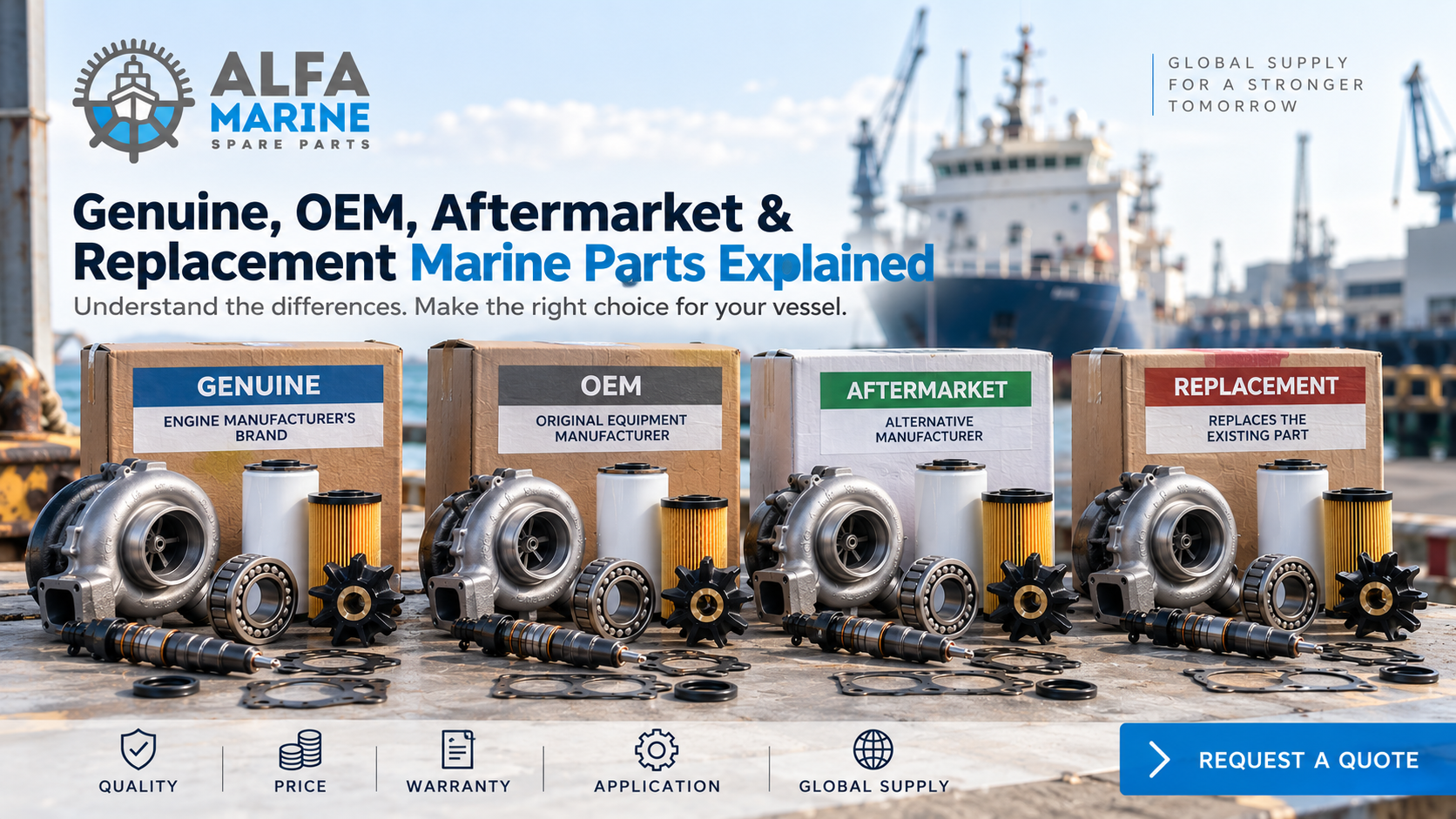
Genuine — supplied under the engine manufacturer's brand.
OEM — OEM stands for Original Equipment Manufacturer. In spare-parts quotations, an OEM part normally comes from a manufacturer that made original equipment for that particular part or application.
Aftermarket — made by another manufacturer as an alternative to the original part.
Replacement — a part offered to replace another part. A replacement can be genuine, OEM or aftermarket.
The easiest way to understand the difference is to look at how marine engine parts are actually made and supplied.
What Is a Genuine Marine Part?
A genuine part is supplied under the engine or equipment manufacturer's brand and part-number system.
But this does not always mean the engine manufacturer made the part in its own factory.
Marine engines use parts from many specialist manufacturers. For example, an engine manufacturer may use a specialist factory to make a seawater pump.
That factory makes the pump and supplies it to the engine manufacturer. The engine manufacturer then supplies the pump under its own brand and part number.
For the customer, this is a genuine part.
So the easy way to remember it is:
Genuine = supplied under the engine manufacturer's brand.
It may have been made in the engine manufacturer's factory, or it may have been made for them by another manufacturer.
What Does OEM Mean?
OEM stands for Original Equipment Manufacturer.
Let's use the same seawater pump example.
Imagine an engine manufacturer needs a seawater pump for a particular engine but does not manufacture the pump itself.
A specialist pump factory makes the pump used as original equipment on that engine.
For that particular pump and application, the specialist manufacturer is an OEM.
The supply may look like this:
OEM factory → engine manufacturer → marine engine
The engine manufacturer may later sell that pump under its own brand as a genuine replacement.
The original equipment manufacturer may also offer an appropriate replacement through its own brand or sales channel. In the spare-parts market, this may be described as an OEM replacement.
So:
Genuine = engine manufacturer's branded supply
OEM = manufacturer that made original equipment for that particular part or application
There is an important point here.
A company may be an OEM for one part on an engine, but that does not make it the OEM for every part on that engine.
The OEM relationship should always be checked for the part and application being offered.
Is OEM the Same as Genuine?
Not automatically.
The OEM may be the factory that made the original part for the engine manufacturer, but you should not assume every similar part it sells is exactly the same as the genuine version.
There may be differences in the part number, materials, specification, design, revision, testing or warranty.
So be careful when somebody says:
“It's exactly the same as genuine, just without the logo.”
Instead, ask:
Who is the OEM?
Did this manufacturer make original equipment for this particular application?
What is the OEM part number?
Which genuine number does it replace or cross-reference to?
Also be careful with the words “OEM quality.”
A part advertised as “OEM quality” is not necessarily made by the actual Original Equipment Manufacturer.
What Is an Aftermarket Marine Part?
An aftermarket part is made by another manufacturer as an alternative to the original part.
For example, Factory A made the original seawater pump for the engine manufacturer.
Factory A = OEM for that pump
Later, Factory B makes its own pump designed to replace the original one.
Factory B = aftermarket manufacturer
That pump is an aftermarket replacement.
Aftermarket does not automatically mean poor quality.
There are established aftermarket manufacturers producing good replacement parts for marine and industrial diesel engines. There are also cheaper alternatives where the manufacturing quality, materials or origin may be less clear.
So don't judge a part only because it is called aftermarket.
Ask:
Who manufactured it?
What Is a Replacement Part?
A replacement part is simply a part offered to replace another part.
Replacement does not tell you who manufactured it.
If the seawater pump on your engine fails, you may be offered:
Genuine replacement — supplied under the engine manufacturer's brand.
OEM replacement — supplied by a manufacturer that made original equipment for that particular part or application.
Aftermarket replacement — made by another manufacturer as an alternative.
All three are replacement parts because they are being offered to replace the old pump.
So:
Replacement does not mean aftermarket.
If a quotation only says “replacement pump,” ask:
“Is it genuine, OEM or aftermarket, and who manufactured it?”
One Simple Example
Imagine your marine engine needs a new seawater pump.
Genuine: You buy the pump under the engine manufacturer's brand and part number.
OEM: You buy an appropriate replacement from a manufacturer that made original equipment for that particular pump or application.
Aftermarket: You buy a replacement from another manufacturer that did not make the original pump for that application.
Replacement: Any of these three can be a replacement because it is replacing the old pump.
That is the main difference.
Genuine vs OEM vs Aftermarket vs Replacement
| TermEasy explanation | |
| Genuine | Supplied under the engine manufacturer's brand |
| OEM | From a manufacturer that made original equipment for that particular part or application |
| Aftermarket | Made by another manufacturer as an alternative |
| Replacement | A part offered to replace another part; it can be genuine, OEM or aftermarket |
What About Quality?
There is no simple rule that says genuine is always good and aftermarket is always bad.
With genuine supply, the part comes through the engine manufacturer's branded parts system.
With an OEM part, check who the actual OEM is and whether the offered part is correct for your application.
With aftermarket parts, quality can vary between manufacturers. Some established manufacturers produce very good replacement parts, while other products may be made mainly to compete on price.
For any option, look at:
Manufacturer + correct application + specification + traceability + warranty
The label alone does not tell you everything about the quality of the part.
What About Price?
Genuine parts are often more expensive.
OEM replacements may sometimes cost less than genuine supply.
Aftermarket replacements are often cheaper, although this depends on the manufacturer and the part.
But price should not be the only reason for your decision.
A cheaper part is not a saving if it fails early and the repair has to be done again.
This is especially important with critical engine parts such as injectors, bearings, pistons, cylinder liners, turbochargers and pumps.
What About Warranty?
There is no standard warranty for every genuine, OEM or aftermarket part.
Warranty depends on the manufacturer, supplier, part, condition and sales terms.
Before ordering, ask:
How long is the warranty?
Who provides it?
What does it cover?
Do not assume that genuine always has a longer warranty or that aftermarket always has a shorter one.
Check the warranty for the actual part being offered.
Which Type Should You Buy?
There is no single answer for every engine or repair.
Genuine may be preferred when you want the engine manufacturer's branded part or when specific documentation or traceability is required.
OEM may be a good option when the actual Original Equipment Manufacturer is known and the offered part is confirmed for your engine.
Aftermarket may also be a good option when the part comes from a trusted manufacturer and is correct for the application.
For critical engine parts, take extra care with the manufacturer, part number and specification.
The cheapest option is not always the best choice.
But the most expensive option is not automatically the best choice either.
The important thing is knowing what you are buying and who made it.
New, Used and Reconditioned Are Different
There is one more difference worth understanding.
Genuine, OEM and aftermarket describe the source or manufacturer relationship.
Replacement means the part is being used to replace another part.
New, used and reconditioned describe the condition of the part.
For example, you could be offered a genuine new replacement, an OEM new replacement or an aftermarket new replacement.
You could also be offered certain parts as used or reconditioned.
So always check both what type of part is being offered and its condition.
What Should You Ask Before Buying?
You don't need a complicated checklist.
Ask:
Who manufactured the part?
Is it genuine, actual OEM or aftermarket?
What is the part number?
Which part number does it replace or cross-reference to?
Is it correct for my engine model and serial number?
Is it new, used or reconditioned?
What warranty applies?
Once you know these answers, it becomes much easier to compare quotations.
Request a Marine Engine Parts Quote
Alfa Marine Spare Parts supplies marine engine spare parts for commercial vessels, yachts, shipyards, marine service companies and B2B customers.
Depending on the requirement and availability, we may offer genuine, OEM, aftermarket, new, used and reconditioned replacement parts.
For an accurate quotation, please send:
Part number + description + quantity + complete engine model + engine serial number
A photo of the existing part or engine data plate can also help when additional identification is needed.
Request a Quote
Frequently Asked Questions
What is the simple difference between genuine, OEM and aftermarket marine parts?
Genuine is supplied under the engine manufacturer's brand. OEM refers to a manufacturer that made original equipment for that particular part or application. Aftermarket is made by another manufacturer as an alternative replacement.
Is an OEM part always exactly the same as a genuine part?
No. An OEM may have made the original part for the engine manufacturer, but that does not mean every similar part it sells is exactly the same as the genuine version. Always check the manufacturer, part number, specification and correct engine application.
Does replacement mean aftermarket?
No. Replacement simply means the part is being offered to replace another part. A replacement can be genuine, OEM or aftermarket. If a quotation only says “replacement,” ask who manufactured it and what type of replacement is being offered.
Independent Supplier Notice
Alfa Marine Spare Parts is an independent marine spare-parts supplier and is not an official or authorized dealer, representative or partner of the manufacturers whose names may appear on this website. Manufacturer names, trademarks, engine models and part numbers are used only for identification and cross-reference purposes.