Why Does My DEUTZ 1015 Marine Overheat Only at High RPM?
A DEUTZ 1015 marine engine that maintains normal temperature at low or moderate RPM but begins overheating at high RPM is showing an important diagnostic pattern.
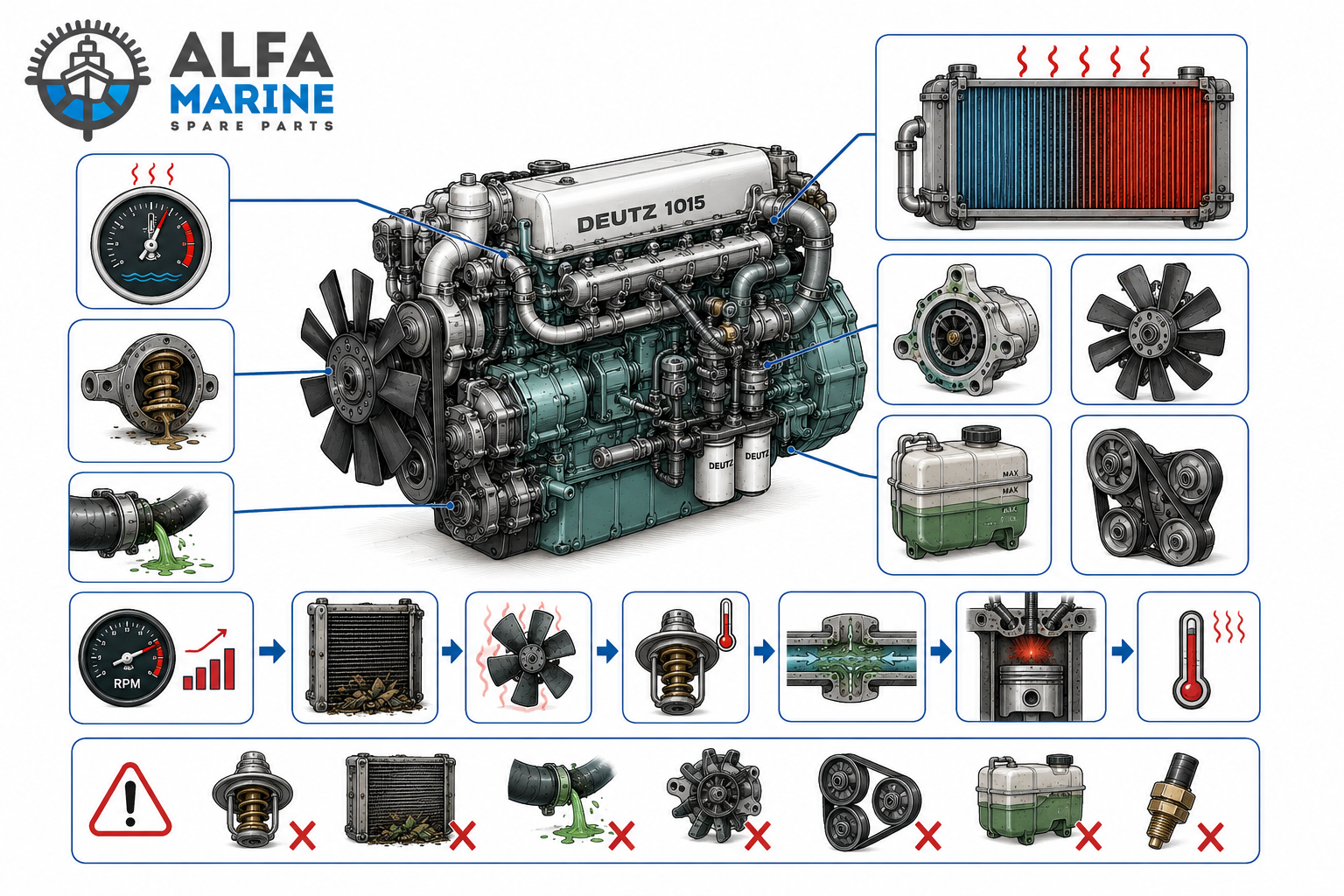
As engine speed and load increase, the cooling system must remove substantially more heat. A system with a partial restriction, reduced pump performance, fouled heat-transfer surfaces or weak coolant circulation may still cope at low load but become insufficient when engine output rises.
The important question is not simply:
“Why is my DEUTZ 1015 running hot?”
It is:
“Why can the cooling system control temperature at lower RPM but not when heat rejection increases?”
For the DEUTZ 1015M marine family, the investigation should focus on the cooling configuration, external cooling-water flow, pump condition, heat exchanger, coolers, internal coolant circulation and engine load.
Which DEUTZ 1015 Marine Engines Are Covered?
This article refers to the DEUTZ BFM 1015M marine engine family, including:
| DEUTZ Marine EngineCylindersGeneral Configuration | ||
| BF6M1015M | 6 | V6 marine diesel |
| BF6M1015MC | 6 | V6 marine diesel with charge-air cooling |
| BF8M1015MC | 8 | V8 marine diesel with charge-air cooling |
These marine engines should not automatically be treated as identical to industrial BF6M1015 or BF8M1015 applications when ordering replacement components.
The M marine designation and exact engine serial number matter.
Browse DEUTZ Marine Engine Parts for DEUTZ engine and spare-parts enquiries.
Why Does a DEUTZ 1015M Overheat at High RPM?
At lower engine load, less heat needs to be removed.
As RPM and load increase, the cooling system must maintain:
- Adequate external cooling-water flow
- Correct engine-coolant circulation
- Effective heat transfer
- Correct thermostat operation
- Unrestricted cooling passages
- Correct system pressure
A partially restricted cooling system may therefore behave normally at low RPM.
At higher engine output, the available cooling capacity becomes insufficient.
This creates the common pattern:
Normal temperature at low RPM → temperature gradually rises as RPM and load increase
That symptom does not identify one failed component by itself.
It tells you that the cooling system should be evaluated under load, not only at idle.
First Identify the Cooling Configuration
Before diagnosing or ordering parts, determine which cooling arrangement is installed.
DEUTZ 1015M marine installations can use different cooling configurations, including raw-water/heat-exchanger systems and keel-cooling arrangements.
This distinction is important.
A raw-water-pump problem is relevant only to an installation that actually uses that type of external cooling circuit.
Before ordering cooling components, identify:
Engine model + Engine Serial Number + cooling configuration + existing component part number
Start With the Raw-Water Circuit
On a raw-water or heat-exchanger-cooled installation, the external water circuit is one of the first areas worth inspecting.
A typical arrangement may include:
Seacock → seawater intake → sea strainer → raw-water pump → cooler / heat exchanger circuit → discharge
Possible restrictions include:
- Blocked seawater intake
- Dirty sea strainer
- Marine growth
- Sand or shell fragments
- Collapsed suction hose
- Internally deteriorated hose
- Air entering the suction side
- Raw-water pump wear
- Heat-exchanger restriction
- Oil-cooler restriction
- Charge-air-cooler restriction where applicable
- Restricted discharge
A particularly important diagnostic point is:
Visible Water Flow Does Not Prove Sufficient Water Flow
Water can still appear at the discharge while total flow has already fallen below what the engine needs at high load.
That is why a cooling problem can remain almost invisible at idle.
DEUTZ 04228547 Raw-Water Pump Reference
A documented raw-water-pump reference associated with the DEUTZ BF6M1015M is:
DEUTZ 04228547
For search purposes, the number may also appear as:
0422 8547
The primary technical format should remain:
04228547
| DEUTZ Part NumberComponentDocumented Association | ||
| 04228547 | Raw-Water Pump | BF6M1015M |
The 04228547 should not be treated as a universal pump for every BF6M1015M, BF6M1015MC or BF8M1015MC installation.
Before ordering, verify:
- Complete engine designation
- Engine Serial Number
- Cooling configuration
- Existing pump number
- Existing pump design
This is especially important because the wider DEUTZ 1015 family also includes non-marine applications.
Can a Worn Raw-Water Pump Cause High-RPM Overheating?
Yes.
A deteriorating raw-water pump may still provide enough flow during low-load operation.
As engine load increases, reduced pump efficiency can become more noticeable.
Potential pump-related problems include:
- Internal wear
- Shaft wear
- Bearing deterioration
- Seal leakage
- Corrosion
- Reduced pumping efficiency
- Restricted suction
- Air leakage on the suction side
- Drive-related problems
The symptom may appear as:
Normal temperature at low RPM → rising temperature during sustained high-load operation
Do not replace the pump based only on temperature.
First establish whether raw-water delivery is actually insufficient.
Do Not Confuse the Raw-Water Pump With the Coolant Pump
This is an important parts-identification issue.
The raw-water pump and engine coolant pump perform different functions.
The raw-water pump moves external cooling water through the marine cooling circuit.
The engine coolant pump circulates coolant through the engine's closed freshwater or jacket-water circuit.
A request saying:
“I need a water pump for a DEUTZ BF6M1015M.”
may therefore not provide enough information.
Instead specify:
Raw-water pump or coolant pump + complete engine model + Engine Serial Number + existing part number
Why Other DEUTZ 1015 Water-Pump Numbers Are Not Listed
There are numerous water-pump references associated with the wider DEUTZ 1015 engine family.
However, a part being listed for BF6M1015 or BF8M1015 does not automatically prove that it is the correct marine raw-water pump for a BF6M1015M, BF6M1015MC or BF8M1015MC.
For that reason, this article does not add generic industrial 1015 pump numbers simply for SEO.
The correct component should be established from the individual engine.
Can Pump or Impeller Damage Cause Overheating?
Yes, depending on the design of the installed raw-water pump.
Damage to internal pumping components can reduce water delivery.
Possible indications include:
- Reduced water discharge
- Temperature increasing with load
- Pump leakage
- Abnormal pump noise
- Previous dry running
- Visible internal damage
If a pump component or impeller has failed, the downstream circuit should also be inspected.
Check for Debris Downstream
Fragments from a damaged pump or impeller can travel through the cooling system.
Potential collection points include:
- Heat exchanger
- Oil cooler
- Charge-air cooler
- Pipe connections
- Hose connections
- Narrow cooling passages
This can create a situation where:
Pump repaired → water flow improves → engine still overheats
The original pump failure may have created a secondary restriction elsewhere in the system.
Could the Heat Exchanger Cause High-RPM Overheating?
Yes.
A partially restricted heat exchanger is one of the most logical causes when temperature remains normal at lower RPM but rises during sustained high-load operation.
Possible contamination includes:
- Marine growth
- Salt deposits
- Scale
- Sand
- Mud
- Shell fragments
- Corrosion products
- Pump debris
- Other foreign material
The exchanger does not need to be completely blocked.
At low load, it may still transfer sufficient heat.
As engine output increases:
Heat production increases → heat-transfer capacity becomes insufficient → coolant temperature rises
This is why partial fouling can cause overheating primarily at high RPM.
Check the Oil Cooler and Charge-Air Cooling System
The main heat exchanger is not always the only component that affects cooling capacity.
Depending on the exact engine and installation, additional heat-transfer components can include:
- Engine oil cooler
- Charge-air cooler
- Other auxiliary coolers
This is especially relevant to BF6M1015MC and BF8M1015MC engines.
A restricted cooler can contribute to:
- Higher engine temperature
- Higher intake-air temperature
- Reduced engine performance
- Increased exhaust temperature
- Black smoke under load
Cooling-system diagnosis should therefore consider the complete circuit.
Do Not Ignore the Closed Coolant Circuit
The raw-water side is only one half of the cooling process.
Heat must first move from the engine into the internal coolant circuit before it can be transferred to the external cooling water.
Check:
- Coolant level
- Coolant condition
- Correct coolant mixture
- External coolant leaks
- Air trapped in the system
- Engine coolant-pump performance
- Thermostat operation
- Restricted coolant passages
- Expansion system
- Cooling-system pressure
If the cooling system was recently opened, drained or repaired, trapped air deserves particular attention.
Can the Thermostat Cause High-RPM Overheating?
Yes.
A thermostat that does not open completely can restrict coolant circulation.
At lower engine load, the remaining coolant flow may still be sufficient.
As heat production increases, the restriction becomes more significant.
Possible thermostat-related problems include:
- Thermostat stuck partially closed
- Incorrect thermostat
- Incorrect opening characteristics
- Deposits affecting movement
- Incorrect installation
- Bypass-circuit problems
Why No Universal Thermostat Part Number Is Listed
This article deliberately does not assign one thermostat number to the complete BFM1015M marine family.
The correct thermostat should be identified from the exact engine and serial number rather than assuming that one generic 1015 thermostat fits every marine configuration.
Raw-Water Pump, Heat Exchanger or Coolant Circuit?
The symptom pattern can help guide diagnosis.
| SymptomArea Worth Investigating | |
| Normal at low RPM, hot at high RPM | Cooling capacity / water flow |
| Reduced water discharge | Intake / strainer / pump |
| Temperature gradually rises with load | Pump / heat exchanger / cooler |
| Cooling problem after pump damage | Downstream debris |
| Overheating after cooling-system work | Trapped air / coolant circulation |
| Good external water flow but engine remains hot | Heat exchanger / internal coolant circuit |
| Repeated coolant loss | Leak / pressure problem |
| High temperature with black smoke | Engine load / air supply |
| Engine cannot reach expected RPM | Propulsion load / engine performance |
| Sudden temperature rise | Major cooling-flow loss |
These are diagnostic directions rather than proof that a specific component has failed.
Can Excessive Propulsion Load Cause Overheating?
Yes.
Not every overheating complaint begins with the cooling system.
A marine engine can also run hot because it is being overloaded.
Possible causes include:
- Fouled hull
- Fouled propeller
- Damaged propeller
- Incorrect propeller pitch
- Excessive vessel loading
- Gearbox problems
- Driveline problems
- Engine-performance problems
If the engine cannot achieve its expected rated speed under normal full-load conditions, determine why.
An overloaded engine can generate excessive heat and make a marginal cooling problem considerably worse.
Black Smoke Plus High Temperature
If overheating is accompanied by black smoke, investigate beyond the cooling system.
Possible areas include:
- Excessive propulsion load
- Restricted intake air
- Turbocharger performance
- Charge-air cooling
- Exhaust restriction
- Fuel-system condition
Black smoke together with high temperature can indicate abnormal load or combustion conditions.
Watch How the Temperature Changes
The temperature trend itself provides useful diagnostic information.
Slow Temperature Rise as RPM Increases
This often points toward insufficient cooling reserve caused by:
- Partial water restriction
- Reduced pump performance
- Fouled heat exchanger
- Restricted cooler
- Reduced coolant circulation
Rapid Temperature Rise
A sudden increase deserves immediate investigation.
Possible causes include:
- Sudden loss of raw-water flow
- Pump failure
- Coolant loss
- Hose failure
- Severe blockage
- Major circulation problem
Confirm the Engine Is Actually Overheating
Before dismantling the cooling system, confirm that the temperature reading is genuine.
Possible instrumentation problems include:
- Temperature sensor
- Wiring
- Electrical connectors
- Gauge
- Monitoring system
Where appropriate, compare the indicated temperature with an independent measurement.
If actual engine temperature is normal, investigate the instrumentation.
If actual temperature is genuinely high, continue with cooling-system diagnosis.
Practical DEUTZ 1015M High-RPM Overheating Check
A logical diagnostic sequence is:
- Confirm actual engine temperature.
- Check coolant level and condition.
- Identify whether the installation uses raw-water or keel cooling.
- Inspect the seawater intake where applicable.
- Clean and inspect the sea strainer.
- Inspect suction hoses.
- Evaluate raw-water flow.
- Inspect the raw-water pump.
- Record the installed pump part number.
- If 04228547 is installed, verify it against the BF6M1015M engine identification before replacement.
- Inspect for downstream debris.
- Inspect the heat exchanger.
- Inspect oil and charge-air coolers where applicable.
- Check engine-coolant circulation.
- Check thermostat operation.
- Check for trapped air.
- Verify cooling-system pressure.
- Determine whether the engine reaches its expected rated RPM under load.
- Investigate propulsion load where necessary.
- Expand diagnosis to turbocharger, air, fuel and exhaust systems if required.
The objective is to determine why cooling capacity becomes insufficient at high RPM, rather than replacing parts one after another.
DEUTZ 1015 Marine Engine Parts
Alfa Marine Spare Parts supplies replacement components for DEUTZ marine diesel engines.
Browse:
DEUTZ Marine Engine Parts
DEUTZ Brand Parts
Parts enquiries can include:
- Raw-water pumps
- Coolant pumps
- Heat-exchanger components
- Oil coolers
- Charge-air cooling components
- Thermostats
- Cooling-system gaskets
- O-rings and seals
- Turbochargers
- Fuel-system components
- Cylinder heads
- Pistons and liners
- Bearings
- Overhaul components
Exact application should always be verified against the individual engine.
Why DEUTZ 1015M Part Identification Matters
The distinction between 1015 and 1015M marine applications matters when sourcing parts.
A component advertised simply as:
“DEUTZ BF6M1015 water pump”
should not automatically be assumed correct for a BF6M1015M marine installation.
Before ordering, provide:
- Complete engine model
- Engine Serial Number
- Existing DEUTZ part number
- Cooling configuration
- Existing component photograph
- Engine data-plate photograph
- Propulsion or auxiliary application
- Quantity required
For a BF6M1015M raw-water-pump enquiry, the existing number may be:
04228547
but it should still be verified against the individual engine before supply.
Request DEUTZ 1015 Marine Parts
If your DEUTZ 1015 marine engine overheats only at high RPM, avoid immediately replacing the pump, heat exchanger or thermostat based only on the symptom.
First determine where cooling capacity is being lost.
For accurate parts identification, provide:
Engine model + Engine Serial Number + existing part number + cooling configuration
Email: request@alfamarinespareparts.com
Request a Quote
Alfa Marine Spare Parts
Frequently Asked Questions
Why does my DEUTZ 1015 marine engine overheat only at high RPM?
The cooling system may have sufficient capacity at lower load but become unable to remove enough heat as engine output increases. Check raw-water flow, pump performance, heat exchangers, coolers and internal coolant circulation.
Which DEUTZ 1015 models are marine engines?
The BFM1015M marine family includes BF6M1015M, BF6M1015MC and BF8M1015MC.
What is DEUTZ 04228547?
04228547 is a documented raw-water-pump reference associated with BF6M1015M applications. Exact fitment should be confirmed from the engine serial number and existing pump.
Is 04228547 used on every DEUTZ 1015M?
No. It should not be treated as a universal pump for every BF6M1015M, BF6M1015MC or BF8M1015MC installation.
Can a dirty heat exchanger cause overheating only at high RPM?
Yes. A partially fouled heat exchanger may have enough capacity at low load but become unable to transfer sufficient heat during sustained high-load operation.
Can pump or impeller damage cause continued overheating?
Yes. Debris from damaged pump components can potentially restrict downstream heat exchangers, coolers or water passages.
Can a thermostat cause overheating only at high RPM?
Yes. A thermostat that does not open completely can restrict coolant circulation enough to create a problem primarily at higher engine load.
Can a fouled propeller cause a DEUTZ marine engine to overheat?
Yes. Excessive propulsion load can increase engine heat production and prevent the engine from achieving its expected operating speed.
Are industrial BF6M1015 parts automatically suitable for BF6M1015M marine engines?
No. Marine configuration and engine identification should always be checked before ordering.
How do I identify the correct DEUTZ 1015M cooling part?
Provide the complete engine designation, Engine Serial Number, existing part number, cooling configuration and component photograph.