Detroit Diesel Marine Engine Names Explained: Official Terms vs Engine Room Slang
Detroit Diesel Marine Engine Names Explained: Official Terms vs Engine Room Slang
Introduction
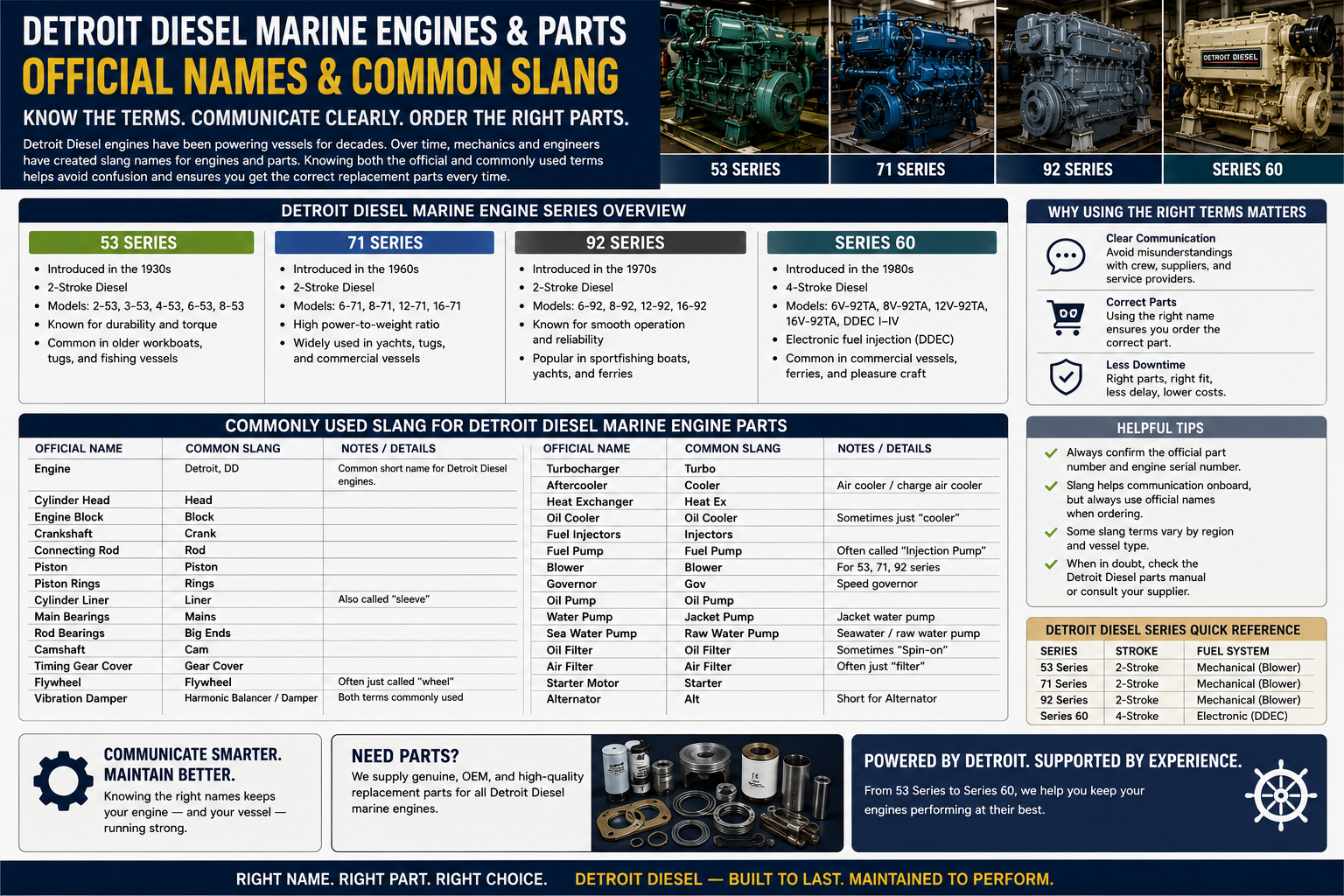
Walk into almost any engine room where a Detroit Diesel Marine Engine is installed, and you'll quickly notice that marine engineers don't always use the official names found in service manuals.
Instead of saying "blower," someone may simply say "the blower." A cylinder head might be called "the head," while a fuel injector is often referred to as simply "an injector." These informal names have been passed down through generations of marine engineers and mechanics, becoming part of everyday engine room language.
Although these slang terms make communication faster onboard, they can sometimes create confusion when ordering replacement parts or discussing repairs with suppliers. A nickname used on one vessel may mean something slightly different on another, especially when different Detroit Diesel engine families are involved.
At Alfa Marine Spare Parts, we regularly assist marine engineers, chief engineers, technical superintendents, shipyards, and vessel owners in identifying the correct Detroit Diesel marine engine parts. Understanding both the official terminology and the commonly used slang helps ensure the correct components are identified the first time.
In this guide, we'll compare the official Detroit Diesel engine names with the slang terms most commonly heard in engine rooms around the world.
Table of Contents
- Why Official Engine Names Matter
- Detroit Diesel 71 Series
- Detroit Diesel 92 Series
- Detroit Diesel 53 Series
- Detroit Diesel Series 60
- Common Detroit Diesel Engine Room Slang
- Official Parts Names vs Slang Terms
- Frequently Asked Questions
- Related Detroit Diesel Marine Parts
- Why Choose Alfa Marine Spare Parts
- Technical Reference
- Final Thoughts
Why Official Engine Names Matter
Using the correct engine designation is important when identifying replacement parts.
Although two engines may appear very similar, they may use different:
- Cylinder heads.
- Pistons.
- Liners.
- Bearings.
- Injectors.
- Gaskets.
- Turbochargers.
For this reason, experienced marine engineers usually provide:
- Engine model.
- Engine serial number.
- Existing part number.
These details help ensure compatible components are supplied.
Slang names may work well in conversation, but official identification remains the safest approach when ordering parts.
Detroit Diesel 71 Series – The Most Iconic
The Detroit Diesel 71 Series remains one of the most recognised marine diesel engine families ever produced.
Originally introduced for industrial and military applications, the 71 Series became widely used in:
- Commercial fishing vessels.
- Tugboats.
- Passenger ferries.
- Offshore vessels.
- Patrol boats.
- Workboats.
- Recreational yachts.
Its two-stroke design, mechanical simplicity, and distinctive exhaust note made it famous throughout the marine industry.
Inline 71 Series Models
Common inline engines include:
- 2-71
- 3-71
- 4-71
- 6-71
These engines are often selected where simplicity, reliability, and straightforward maintenance are priorities.
V-Series 71 Models
Larger applications frequently use:
- 6V71
- 8V71
- 12V71
- 16V71
The "V" indicates the engine uses a V-configuration rather than an inline cylinder arrangement.
These engines have powered thousands of commercial and government vessels worldwide.
Common 71 Series Slang
Marine engineers commonly shorten official engine names.
Examples include:
| Official NameCommon Engine Room Slang | |
| Detroit Diesel 6-71 | Six-Seventy-One |
| Detroit Diesel 8V71 | Eight-Vee-Seventy-One |
| Detroit Diesel 12V71 | Twelve-Vee |
| Detroit Diesel 16V71 | Sixteen-Vee |
Some engineers simply refer to these engines as:
- "The Detroit"
- "Old Detroit"
- "Jimmy"
- "Screamin' Jimmy"
The nickname "Screamin' Jimmy" became popular because of the distinctive sound produced by Detroit Diesel two-stroke engines operating at higher RPM.
Detroit Diesel 92 Series – The Evolution of Power
The Detroit Diesel 92 Series built upon the success of the 71 Series while offering increased displacement and higher power output.
These engines became popular in:
- Offshore vessels.
- High-speed commercial craft.
- Fireboats.
- Patrol vessels.
- Large yachts.
- Crew boats.
V-Series 92 Models
Common marine versions include:
- 6V92
- 8V92
- 12V92
- 16V92
Like the 71 Series, the "V" identifies the engine's cylinder configuration.
Common 92 Series Slang
Onboard, engineers often shorten the official names.
Examples include:
| Official NameCommon Slang | |
| Detroit Diesel 6V92 | Six-Vee-Ninety-Two |
| Detroit Diesel 8V92 | Eight-Vee |
| Detroit Diesel 12V92 | Twelve-Vee |
| Detroit Diesel 16V92 | Sixteen-Vee |
Many engineers also simply refer to these engines as:
- "The Ninety-Two"
- "The V92"
Although these nicknames are widely recognised, official engine identification should always be used when sourcing replacement parts.
Engine Room Insight
Experienced marine engineers often switch effortlessly between official engine names and engine room slang.
However, when maintenance records, overhaul reports, or spare parts orders are involved, using the official engine designation helps avoid confusion—especially on vessels operating multiple Detroit Diesel engine models.
Chief Engineer's Tip
Before ordering any replacement part, confirm:
✔ Engine Model.
✔ Engine Serial Number.
✔ Existing Part Number.
✔ Engine Arrangement.
Many Detroit Diesel components appear similar but differ between engine families.
Taking a few moments to verify the correct engine identification can prevent ordering delays and unnecessary downtime.
We'll continue with:
- Detroit Diesel 53 Series
- Detroit Diesel Series 60
- Other Popular Detroit Diesel Nicknames
- Why Slang Can Cause Ordering Mistakes
- Practical Engine Room Examples
- Common Marine Terminology
Detroit Diesel 53 Series, Series 60 & Common Engine Room Nicknames
Detroit Diesel 53 Series – The Compact Workhorse
The Detroit Diesel 53 Series became well known for its compact size, dependable performance, and versatility. These two-stroke diesel engines powered a wide variety of marine, industrial, construction, agricultural, and military equipment.
Within the marine industry, the 53 Series was commonly installed in:
- Small workboats
- Fishing vessels
- Patrol boats
- Utility craft
- Auxiliary generator sets
- Small commercial vessels
Although physically smaller than the 71 and 92 Series, these engines earned a reputation for durability when maintained correctly.
Inline 53 Series Models
The most common inline versions include:
- 2-53
- 3-53
- 4-53
- 6-53
These engines are often recognised for their compact footprint and relatively simple mechanical design.
V-Series 53 Models
Larger versions include:
- 6V53
- 8V53
These V-configuration engines offered increased horsepower while maintaining many of the design principles found throughout the Detroit Diesel two-stroke engine family.
Common 53 Series Slang
In the engine room, official names are often shortened for convenience.
Examples include:
| Official NameCommon Slang | |
| Detroit Diesel 3-53 | Three-Fifty-Three |
| Detroit Diesel 4-53 | Four-Fifty-Three |
| Detroit Diesel 6-53 | Six-Fifty-Three |
| Detroit Diesel 6V53 | Six-Vee-Fifty-Three |
| Detroit Diesel 8V53 | Eight-Vee-Fifty-Three |
Many marine engineers also simply refer to them as:
- "The Fifty-Three"
- "Little Detroit"
- "Jimmy"
Although these nicknames are widely understood onboard, official engine identification should always be used when sourcing replacement parts.
Detroit Diesel Series 60 – The Modern Legend
Unlike the earlier two-stroke Detroit Diesel engines, the Detroit Diesel Series 60 introduced a modern four-stroke design with electronic engine management.
The Series 60 quickly became popular across heavy-duty transportation, industrial equipment, and marine propulsion because of its:
- Fuel efficiency.
- Long service life.
- Electronic diagnostics.
- Strong torque characteristics.
- Proven reliability.
Marine versions are commonly found in:
- Passenger vessels
- Offshore support vessels
- Crew boats
- Commercial workboats
- Larger recreational yachts
Common Series 60 Slang
The Series 60 has fewer nicknames than the older two-stroke engines, but marine engineers often shorten its name during everyday conversation.
Examples include:
| Official NameCommon Slang | |
| Detroit Diesel Series 60 | Series Sixty |
| Detroit Diesel Series 60 | Sixty Series |
| Detroit Diesel Series 60 | The Sixty |
Because several horsepower ratings exist, many engineers simply identify the engine by both its model and horsepower when discussing maintenance.
Other Popular Detroit Diesel Nicknames
Over decades of service, Detroit Diesel engines have accumulated numerous nicknames throughout the maritime industry.
Some of the most commonly heard include:
| NicknameTypical Meaning | |
| Jimmy | Any Detroit Diesel engine |
| Detroit | Detroit Diesel engine |
| Old Detroit | Older two-stroke Detroit Diesel engine |
| Screamin' Jimmy | High-speed Detroit two-stroke engine |
| Vee | V-configuration Detroit engine |
| Blower Motor | Detroit two-stroke engine using a Roots blower |
Although these names are familiar to experienced engineers, they should not replace the official engine model when ordering replacement parts.
Why Slang Can Cause Ordering Mistakes
Engine room slang makes communication easier onboard, but it can create confusion when purchasing replacement components.
For example, someone requesting:
"I need injectors for an Eight-Vee."
has not provided enough information.
The supplier still needs to know:
- Engine model.
- Engine serial number.
- Engine family.
- Existing part number.
- Engine arrangement.
Without this information, there is a risk of ordering incompatible parts.
Using the official engine designation helps eliminate unnecessary delays.
Practical Engine Room Examples
Example 1
Engineer:
"The Jimmy needs a new blower."
Supplier:
"Which Detroit Diesel engine?"
Correct identification:
Detroit Diesel 6V71 Marine Engine
Example 2
Engineer:
"The Eight-Vee is smoking."
Possible engines include:
- 8V53
- 8V71
- 8V92
Each engine uses different replacement parts.
Example 3
Engineer:
"We need a new water pump for the Detroit."
A supplier will normally request:
- Engine model.
- Serial number.
- Existing part number.
Providing this information ensures the correct component is supplied.
Common Marine Terminology
Many Detroit Diesel components are also known by informal names in the engine room.
Examples include:
| Official ComponentCommon Slang | |
| Turbocharger | Turbo |
| Cylinder Head | Head |
| Fuel Injector | Injector |
| Heat Exchanger | Cooler |
| Water Pump | Pump |
| Roots Blower | Blower |
| Air Cleaner | Air Filter |
| Exhaust Manifold | Manifold |
| Governor | Governor |
| Flywheel Housing | Bell Housing |
These shortened names are widely understood but should always be confirmed with the official component name or part number before ordering.
Engine Room Insight
Experienced Chief Engineers know that informal terminology works well during daily operations, but maintenance documentation should always use official engine and component names.
Clear documentation improves communication between vessel crews, repair facilities, and spare parts suppliers while reducing the likelihood of ordering errors.
Chief Engineer's Tip
When requesting Detroit Diesel parts, provide:
✔ Engine Model.
✔ Engine Serial Number.
✔ Existing Part Number.
✔ Official Component Name.
Doing so speeds up the identification process and helps ensure compatible replacement parts are supplied the first time.
We'll complete the guide with:
- Detroit Diesel Engine Parts: Official Names vs Slang Terms
- Cylinder Head and Block Components
- Pistons and Connecting Rods
- Crankshaft and Camshaft Components
- Valvetrain and Air Intake Components
- Fuel System Components
- Cooling System Components
- Frequently Asked Questions
- Why Choose Alfa Marine Spare Parts
- Final Thoughts
Part 3 – Detroit Diesel Engine Parts: Official Names vs. Engine Room Slang
Detroit Diesel Engine Parts: Official Names vs. Slang Terms
Just as Detroit Diesel engines have acquired nicknames over the years, many individual engine components are also known by informal names in the engine room.
These shortened names make everyday communication faster, but they can also create confusion when ordering replacement parts or preparing maintenance documentation.
Understanding both the official component names and the slang terms commonly used by marine engineers helps ensure everyone is referring to the same part.
1. Cylinder Head and Block Components
The cylinder block and cylinder head form the foundation of every Detroit Diesel Marine Engine.
Although service manuals use precise terminology, engineers often shorten these names during daily maintenance.
| Official ComponentCommon Engine Room Slang | |
| Cylinder Head | Head |
| Cylinder Block | Block |
| Cylinder Liner | Liner |
| Head Gasket | Head Gasket (usually shortened to "gasket") |
| Core Plug | Freeze Plug |
| Cylinder Sleeve | Sleeve |
For example:
Official:
"Inspect the cylinder head for cracks."
Engine room:
"Pull the head."
Both refer to the same component.
2. Pistons and Connecting Rods
These moving components convert combustion pressure into crankshaft rotation.
Common terminology includes:
| Official ComponentCommon Slang | |
| Piston | Slug |
| Piston Rings | Rings |
| Wrist Pin | Pin |
| Connecting Rod | Rod |
| Connecting Rod Bearing | Big End Bearing or Big Ends |
Examples onboard include:
"Replace the rings."
"Check the big ends."
Although widely understood, official terminology should always be used in parts documentation.
3. Crankshaft and Camshaft Components
The crankshaft and camshaft control engine rotation and valve timing.
Engine room terminology often includes:
| Official ComponentCommon Slang | |
| Crankshaft | Crank |
| Main Bearings | Mains |
| Camshaft | Cam |
| Cam Followers | Lifters |
| Timing Gears | Gear Train |
For example:
Official:
"Inspect the crankshaft main bearings."
Common:
"Check the mains."
4. Valvetrain and Air Intake Components
Detroit Diesel two-stroke engines include several components that have become well known throughout the marine industry.
Common examples include:
| Official ComponentCommon Slang | |
| Intake Valve | Intake |
| Exhaust Valve | Exhaust |
| Rocker Arm | Rocker |
| Push Rod | Pushrod |
| Valve Spring | Spring |
| Roots Blower | Blower |
| Turbocharger | Turbo |
| Air Cleaner | Air Filter |
The Roots blower is particularly associated with classic Detroit Diesel two-stroke engines and is often referred to simply as:
"The blower."
5. Fuel System Components
The fuel system contains several components that are routinely identified using shortened names.
| Official ComponentCommon Slang | |
| Fuel Injector | Injector |
| Fuel Pump | Fuel Pump |
| Fuel Filter | Fuel Filter |
| Governor | Governor |
| Fuel Rail (where applicable) | Rail |
Example:
"Swap the injectors."
Instead of:
"Replace the fuel injectors."
6. Cooling System Components
Cooling system components also have widely recognised informal names.
| Official ComponentCommon Slang | |
| Water Pump | Pump |
| Heat Exchanger | Cooler |
| Thermostat | Stat |
| Radiator (industrial applications) | Rad |
| Coolant Hose | Hose |
Although these shortened terms are familiar to experienced engineers, official component names should always be confirmed before ordering replacement parts.
Why Official Part Names Matter
Using the correct part description becomes especially important when multiple Detroit Diesel engine families are operating within the same fleet.
For example:
A request for:
"A new head gasket."
is incomplete.
The supplier still needs to know:
- Engine model.
- Engine serial number.
- Engine family.
- Existing part number.
A 6V53, 8V71, and 8V92 all require different replacement components, even though the slang terminology may sound similar.
Providing accurate information reduces ordering errors and minimises vessel downtime.
Engine Room Insight
Experienced Chief Engineers understand that slang has an important place in daily engine room communication.
However, maintenance reports, overhaul documentation, inventory systems, and spare parts orders should always use official engine and component names whenever possible.
Clear documentation benefits everyone involved, from vessel crews to maintenance teams and parts suppliers.
Chief Engineer's Tip
Whenever you're ordering Detroit Diesel replacement parts, provide as much information as possible, including:
✔ Engine Model.
✔ Engine Serial Number.
✔ Existing Part Number.
✔ Official Component Name.
✔ Quantity Required.
A few extra details at the beginning can prevent costly delays and ensure the correct parts arrive the first time.
Frequently Asked Questions
Why do Detroit Diesel engines have so many nicknames?
Many Detroit Diesel engines have been in service for decades. Over time, marine engineers, mechanics, and operators developed informal names that became part of everyday engine room language.
What is "Screamin' Jimmy"?
"Screamin' Jimmy" is a well-known nickname for classic Detroit Diesel two-stroke engines. The name comes from the distinctive high-pitched sound these engines produce while operating.
Can I order parts using slang names?
While many suppliers understand common engine room terminology, using the official engine model, serial number, and part number greatly reduces the risk of ordering the wrong component.
Why is the engine serial number important?
The serial number helps identify the exact engine configuration and ensures replacement parts are compatible with that specific engine.
Which Detroit Diesel engines are still common in marine applications?
Many vessels continue to operate engines from the:
- 53 Series
- 71 Series
- 92 Series
- Series 60
These engines remain popular because of their durability, established service history, and continued availability of replacement parts.
Related Detroit Diesel Marine Parts
At Alfa Marine Spare Parts, we supply replacement parts for many Detroit Diesel marine engines, including:
- Detroit Diesel 53 Series Parts
- Detroit Diesel 71 Series Parts
- Detroit Diesel 92 Series Parts
- Detroit Diesel Series 60 Parts
Available components include:
- Cylinder Heads
- Cylinder Liners
- Pistons
- Piston Rings
- Connecting Rods
- Main Bearings
- Connecting Rod Bearings
- Crankshafts
- Camshafts
- Fuel Injectors
- Water Pumps
- Heat Exchangers
- Turbochargers
- Blower Components
- Gasket Sets
- Complete Overhaul Kits
Why Choose Alfa Marine Spare Parts?
At Alfa Marine Spare Parts, we understand that identifying the correct replacement part begins with identifying the correct engine.
Our experienced team assists customers using:
- Engine Model
- Engine Serial Number
- Existing Part Numbers
- Technical Documentation
We supply:
- Genuine Marine Parts
- OEM Replacement Parts
- Premium Aftermarket Parts
- Professionally Remanufactured Components
- Complete Engine Overhaul Parts
Whether you're maintaining a single engine or managing an entire fleet, we help you source compatible Detroit Diesel marine engine parts quickly and accurately.
Industries We Support
We proudly support:
- Marine Engineers
- Chief Engineers
- Technical Superintendents
- Shipyards
- Commercial Shipping Companies
- Offshore Operators
- Fishing Fleets
- Tugboat Operators
- Passenger Ferry Companies
- Government Fleets
- Yacht Management Companies
- Marine Service Companies
- Boat Builders
- Marine Equipment Distributors
Worldwide Marine Spare Parts Supply
Alfa Marine Spare Parts supplies Detroit Diesel marine engine parts worldwide, including:
- Spain
- Netherlands
- Germany
- Italy
- France
- Norway
- Greece
- United Kingdom
- United States
- Canada
- Brazil
- United Arab Emirates
- Saudi Arabia
- Qatar
- Nigeria
- South Africa
- Singapore
- Australia
Our customers include operators of commercial vessels, offshore fleets, fishing boats, workboats, ferries, patrol vessels, and recreational yachts across major maritime markets.
Browse Our Complete Marine Spare Parts Catalog
Looking for replacement parts for your Detroit Diesel Marine Engine?
Browse our complete catalogue:
https://alfamarinespareparts.com/spareparts
Contact Alfa Marine Spare Parts
Need assistance identifying the correct Detroit Diesel replacement parts?
Our experienced team is ready to help.
Website
https://alfamarinespareparts.com
Browse Our Marine Spare Parts Catalog
https://alfamarinespareparts.com/spareparts
request@alfamarinespareparts.com
Providing your engine model, engine serial number, and existing part number helps us identify compatible replacement parts quickly and accurately.
Technical Reference
This guide is based on recognised marine engineering terminology, established Detroit Diesel service practices, and commonly used engine room language. Official engine designations and component names should always be verified using the appropriate manufacturer service documentation when performing maintenance or ordering replacement parts.
Final Thoughts
For generations of marine engineers, Detroit Diesel engines have earned not only a reputation for reliability but also a language of their own. Nicknames such as "Jimmy," "Screamin' Jimmy," and shorthand terms like "head," "turbo," or "mains" have become part of everyday conversations in engine rooms around the world. These expressions reflect decades of practical experience and shared knowledge within the maritime industry.
While engine room slang makes communication quicker among experienced crews, using the official engine model, serial number, and component names remains essential when ordering replacement parts or documenting maintenance. Accurate identification helps prevent costly mistakes and ensures the correct parts are supplied for engines in the 53 Series, 71 Series, 92 Series, and Series 60 families.
At Alfa Marine Spare Parts, we proudly support marine engineers, chief engineers, technical superintendents, shipyards, fleet operators, mechanics, and vessel owners with genuine, OEM replacement, premium aftermarket, and professionally remanufactured Detroit Diesel Marine Engine parts. Whether you're discussing a "Screamin' Jimmy" in the engine room or ordering a cylinder head for a specific engine model, our experienced team is ready to help you identify the right parts and keep your vessel operating safely, efficiently, and reliably.