
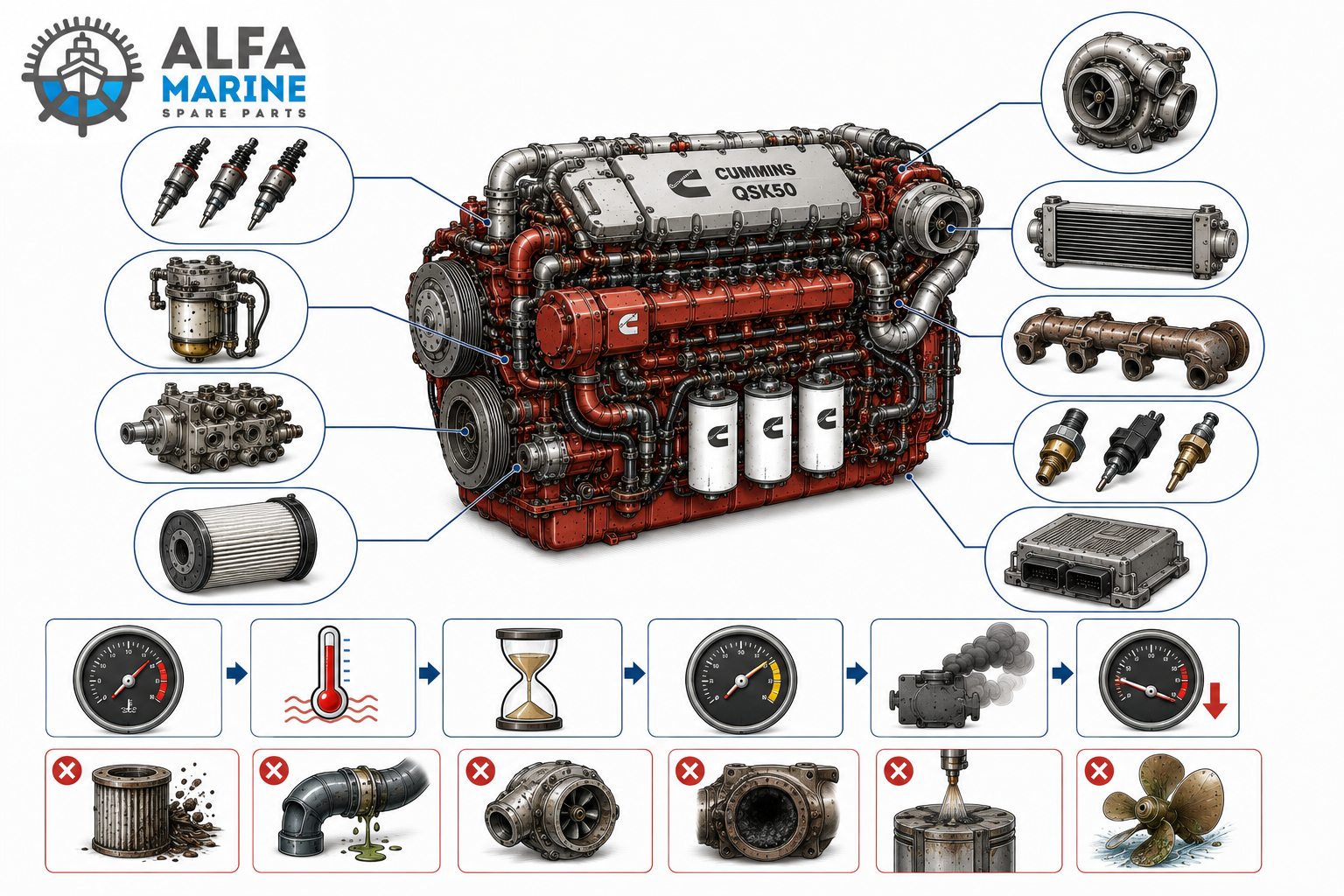

Why Does My Cummins QSK50 Marine Lose Power After Warming Up?
A Cummins QSK50 marine engine that performs normally when cold but begins losing power after reaching operating temperature presents a useful diagnostic pattern.
The fact that the problem appears after warm-up matters. Instead of immediately replacing injectors, a fuel pump or turbocharger, the investigation should focus on what changes as temperature and sustained engine load increase.
Important areas include:
- Fuel supply and filtration
- Fuel-pressure performance
- Injectors
- Electronic engine controls
- Sensors, wiring and connectors
- Turbocharger performance
- Charge-air system
- Aftercooling system
- Engine cooling system
- Exhaust restriction
- Engine-protection functions
- Propeller and vessel load
The key diagnostic question is:
What changes between normal cold operation and the point where the warm engine begins losing power?
Finding that change is usually more valuable than replacing parts based on the symptom alone.
Cummins QSK50 Marine Engine
The Cummins QSK50 is a large-displacement V16 diesel platform used in demanding marine applications.
| SpecificationCummins QSK50 Marine | |
| Configuration | V16 |
| Cycle | Four-stroke diesel |
| Displacement | Approximately 50 liters |
| Bore | Approximately 159 mm |
| Stroke | Approximately 159 mm |
| Aspiration | Turbocharged |
| Charge-air system | Aftercooled |
| Engine management | Electronic |
Applicable QSK50 marine configurations use Cummins Modular Common Rail fuel injection and electronic engine management.
The QSK50 marine platform also incorporates dedicated cooling and charge-air temperature management. Depending on the exact marine configuration, this can include a low-temperature aftercooling circuit and marine heat-exchanger arrangement.
These systems matter because power loss after warm-up can involve the interaction of the fuel, electronic, air and cooling systems, rather than one isolated component.
Browse Cummins QSK50 Marine Engine Parts.
Why Does a QSK50 Lose Power Only After Warming Up?
Consider the operating pattern:
Cold engine → normal power
Engine reaches operating temperature → initially normal
Sustained load → power begins falling
This suggests looking for conditions affected by:
- Increasing engine temperature
- Sustained fuel demand
- Sustained boost
- Charge-air temperature
- Cooling-system performance
- Electrical temperature
- Engine protection
- Continuous propulsion load
Ideally, the engine should be diagnosed while the power loss is actually occurring.
A temperature-dependent problem may disappear once the engine has cooled.
Start With the Fuel Supply
Before investigating expensive high-pressure fuel components, check whether the engine is receiving a reliable fuel supply.
Inspect:
- Fuel level
- Fuel condition
- Tank pickup
- Shutoff valves
- Primary fuel filtration
- Secondary fuel filtration
- Fuel hoses
- Fuel lines
- Restricted fittings
- Low-pressure fuel supply
- Air entering the fuel system
- Fuel-return circuit
A restriction may allow the engine to operate normally at relatively low fuel demand but become significant during sustained high-load operation.
The pattern can look like:
Normal idle → normal light load → increasing fuel demand → insufficient supply → reduced available power
Can a Restricted Fuel Filter Cause Power Loss?
Yes.
A partially restricted filter may allow normal starting and light-load operation while limiting fuel delivery as demand increases.
However, replacing the filter should not automatically end the investigation.
If filters repeatedly become restricted, investigate the underlying cause.
Possible problems include:
- Contaminated fuel
- Tank contamination
- Restricted tank pickup
- Deteriorating fuel hoses
- Contaminated filter housing
- Water or debris in the fuel
- Other upstream restrictions
The goal is not simply to replace the filter.
It is to determine why adequate fuel delivery cannot be maintained under load.
Check for Air Entering the Fuel System
Air intrusion can also create intermittent power problems.
Inspect:
- Fuel fittings
- Hose connections
- Filter seals
- Filter housings
- Suction lines
- Damaged hoses
A suction-side leak may draw air into the system without producing an obvious external diesel leak.
Possible symptoms include:
- Hesitation
- Unstable engine operation
- Reduced power
- Difficult starting
- Poor response under load
The complete low-pressure fuel supply should therefore be inspected before assuming that the high-pressure pump or injectors have failed.
Check the QSK50 High-Pressure Fuel System
Once the low-pressure fuel supply has been confirmed, diagnosis can move toward the high-pressure system on applicable Modular Common Rail configurations.
Important areas can include:
- High-pressure fuel pump
- Fuel rail
- Injectors
- Fuel-pressure control
- Fuel-pressure sensing
- Electrical connections
- Wiring
- Electronic control
The important question is not simply whether fuel pressure exists.
It is:
Can the fuel system maintain the required operating conditions when the warm engine is under load?
Where diagnostic data is available, comparing requested and actual operating values can help identify abnormalities.
Can QSK50 Injectors Cause Power Loss When Hot?
Yes, injector problems can contribute to reduced engine performance.
Possible symptoms include:
- Reduced power
- Uneven cylinder contribution
- Rough operation
- Abnormal exhaust temperature
- Smoke
- Increased fuel consumption
- Poor response under load
However:
QSK50 loses power after warming up ≠ injectors automatically failed
Fuel supply, fuel-pressure behavior, electronic controls and individual-cylinder performance should be evaluated before replacing multiple injectors.
Why No Universal QSK50 Injector Part Number Is Listed
This article intentionally does not assign one injector part number to every QSK50 marine engine.
QSK50 engines exist in different ratings, production arrangements and marine configurations.
Correct injector identification should therefore be based on:
Engine model + Engine Serial Number (ESN) + existing injector part number
The same principle applies to:
- High-pressure fuel pumps
- Turbochargers
- Sensors
- Cooling components
- Electronic components
A component should not be selected simply because it is advertised as a “Cummins QSK50 part.”
Check the Electronic Engine Controls
The QSK50 uses electronic engine management.
This makes electronic diagnosis particularly important when engine performance changes as operating temperature increases.
Check:
- Active fault codes
- Stored fault codes
- Fuel-pressure information
- Coolant temperature
- Charge-air or intake temperature
- Oil pressure
- Engine speed
- Engine load
- Relevant pressure readings
- Sensor values
- Wiring
- Connectors
- Electrical grounds
Ideally, operating data should be recorded:
Before power loss → while power is falling → during reduced-power operation
That can reveal which parameter changes as the fault develops.
Could a Sensor or Wiring Problem Cause Hot Power Loss?
Potentially.
Electrical components, wiring or connections can behave differently as temperatures change.
However, a sensor should not be replaced simply because the problem occurs when the engine becomes warm.
Instead compare:
ECM-reported value → actual operating condition
Investigate:
- Implausible temperature readings
- Implausible pressure readings
- Intermittent signals
- Wiring damage
- Loose connectors
- Corrosion
- Poor electrical grounds
The objective is to prove that a signal is incorrect before replacing the component.
Could the QSK50 Be Entering Engine Protection?
This should be considered when engine power changes after operating conditions become abnormal.
The electronic engine-management system monitors important operating parameters and can provide engine-protection functions.
Depending on the specific engine calibration and detected condition, abnormal operating parameters may affect available performance.
Therefore:
Warm engine + reduced power does not automatically mean turbocharger failure.
Check:
- Active faults
- Stored faults
- Coolant temperature
- Oil pressure
- Fuel-system data
- Charge-air temperature
- Other relevant monitored parameters
The engine may be responding to a problem elsewhere.
Check the Cooling System
Because the power loss appears after warm-up, cooling-system performance deserves careful attention.
Depending on the exact QSK50 marine configuration, important areas can include:
- External cooling-water supply
- Sea strainer
- Seawater flow
- Heat exchanger
- Engine coolant level
- Coolant condition
- Coolant circulation
- Cooling pumps
- Low-temperature cooling circuit
- Aftercooling circuit
- Cooling-system restrictions
A cooling problem does not always begin with an immediate high-temperature alarm.
Watch how temperatures behave as engine load increases.
Why Temperature Trends Matter
Consider this progression:
Cold engine → normal performance
Engine warms → cooling demand increases
Sustained load → marginal cooling condition becomes more significant
Monitored parameter becomes abnormal → engine protection may respond
The trend leading up to the power loss can therefore be more useful than one isolated temperature reading.
Record relevant temperatures and pressures while the engine is operating normally and compare them with readings when power decreases.
Check the Aftercooling System
Compressed intake air becomes hotter as the turbocharger increases its pressure.
The aftercooling system removes heat from that compressed air before it enters the engine.
If charge-air cooling becomes less effective, intake-air temperature can rise.
Inspect applicable components for:
- Restricted cooling flow
- Fouling
- Reduced heat transfer
- Cooling-circuit restriction
- Leakage
- Abnormal temperature differences
An aftercooling problem should not automatically be diagnosed as a turbocharger failure.
Can the Turbocharger Cause Power Loss After Warm-Up?
Yes, but the turbocharger is only one part of the complete air system.
Possible problems include:
- Compressor fouling
- Turbine fouling
- Bearing deterioration
- Shaft damage
- Oil leakage
- Air-intake restriction
- Charge-air leakage
- Exhaust leakage before the turbine
- Exhaust restriction
One useful symptom combination is:
Power loss + abnormal boost + black smoke
This makes the complete air path worth investigating.
However:
Low Boost Does Not Automatically Mean a Bad Turbocharger
Low boost can also result from:
- Insufficient fueling
- Charge-air leakage
- Intake restriction
- Exhaust problems
- Abnormal engine load
- Other engine-performance problems
The turbocharger should therefore be diagnosed as part of the complete system.
Check for Charge-Air Leaks
Compressed air must travel from the turbocharger through the charge-air system without significant leakage.
Inspect:
- Charge-air piping
- Connections
- Clamps
- Flexible connections
- Seals
- Aftercooler connections
A leak can become much more significant as boost rises under load.
Possible symptoms include:
- Reduced power
- Lower-than-expected boost
- Black smoke
- Increased exhaust temperature
The turbocharger itself may still be operating correctly.
Don't Ignore the Exhaust System
The engine must also discharge exhaust gas efficiently.
Inspect for:
- Restricted exhaust piping
- Silencer or muffler restriction
- Internal damage
- Installation-related restriction
- Exhaust leakage before the turbocharger
A restriction may cause relatively little trouble at lower output but become significant as exhaust flow increases.
Consider the complete breathing path:
Air intake → turbocharger → aftercooling → engine → exhaust → turbine → vessel exhaust
What Does the Exhaust Smoke Tell You?
Smoke behavior can help guide diagnosis.
Black Smoke With Power Loss
Investigate:
- Air-intake restriction
- Turbocharger performance
- Charge-air leakage
- Aftercooling
- Exhaust restriction
- Excessive vessel load
- Fuel-system condition
Little Black Smoke With Power Loss
Investigate:
- Fuel supply
- Fuel filtration
- Fuel-pressure behavior
- Electronic fuel control
- Engine-protection response
These are diagnostic clues rather than proof of a particular component failure.
Could the Propeller or Vessel Load Be Responsible?
Yes.
Not every apparent QSK50 power problem originates inside the engine.
Inspect:
- Hull fouling
- Propeller fouling
- Propeller damage
- Propeller specification
- Vessel loading
- Gearbox condition
- Driveline condition
Increased vessel resistance can increase engine load and reduce achievable performance.
Expected RPM and load should always be compared with the specific engine rating and vessel installation, rather than a generic QSK50 figure.
What if Power Returns After the Engine Cools?
This is particularly useful diagnostic information.
If the pattern repeatedly looks like:
Cold → normal power
Warm → reduced power
Cool down → normal power returns
prioritize systems affected by temperature or sustained operation.
These include:
- Electronic engine protection
- Temperature-dependent sensor faults
- Temperature-dependent wiring or connector problems
- Fuel supply under sustained demand
- Cooling-system performance
- Charge-air temperature
- Air-system performance under sustained load
A repeatable cold-good/hot-bad pattern should be documented carefully.
Fuel, Turbo, Cooling or Electronic Problem?
The symptom combination can help narrow the investigation.
| SymptomArea Worth Investigating | |
| Normal cold, loses power warm | Temperature-dependent condition |
| Power loss after sustained load | Fuel / cooling / air / vessel load |
| Power loss + black smoke | Air / turbo / charge air / overload |
| Power loss + little smoke | Fuel delivery / electronic control |
| Rising coolant temperature + power loss | Cooling / engine protection |
| Abnormal charge-air temperature | Aftercooling / cooling circuit |
| Low boost under load | Air / turbo / charge-air leak / exhaust / fueling |
| Abnormal fuel-pressure behavior | Fuel supply / high-pressure fuel system |
| Fault appears when warm | Electronic diagnosis |
| Power returns after cooling | Temperature-dependent fault |
These observations provide diagnostic direction rather than proof of component failure.
Practical Cummins QSK50 Hot Power-Loss Check
A logical diagnostic sequence is:
- Confirm the exact QSK50 model, ESN and engine rating.
- Reproduce the complaint under controlled operating conditions.
- Check active and stored diagnostic faults.
- Record live engine data as the problem develops.
- Inspect primary and secondary fuel filtration.
- Check the low-pressure fuel supply for restrictions and air intrusion.
- Evaluate applicable fuel-pressure behavior under load.
- Compare individual-cylinder performance where appropriate.
- Inspect the air intake.
- Evaluate turbocharger performance.
- Inspect charge-air piping for leakage.
- Check the aftercooling system.
- Monitor coolant and charge-air temperatures.
- Inspect external cooling-water flow and heat-exchanger condition where applicable.
- Check the exhaust system for restriction.
- Compare actual engine load and RPM with the specific engine rating.
- Inspect hull and propeller condition.
- Check gearbox and driveline condition.
- Reproduce the warm power-loss condition while monitoring engine data.
- Identify the affected system before replacing components.
The objective is simple:
Find what changes when the QSK50 becomes warm.
Why QSK50 Part Identification Matters
The description:
“Cummins QSK50 Marine”
may not provide enough information to identify the correct injector, fuel pump, turbocharger, sensor or cooling-system component.
Before ordering, provide:
- Complete engine model
- Engine Serial Number (ESN)
- Engine rating
- Existing Cummins part number
- Component description
- Component photograph
- Propulsion or auxiliary application
This article intentionally avoids generic injector, fuel-pump and turbocharger part numbers that cannot be safely applied to every QSK50 marine engine.
Cummins QSK50 Marine Engine Parts
Alfa Marine Spare Parts supports parts enquiries for Cummins QSK50 marine engines.
Browse Cummins QSK50 Marine Engine Parts.
QSK50 parts enquiries can include:
- Fuel injectors
- Fuel pumps
- High-pressure fuel components
- Turbochargers
- Turbocharger components
- Sensors
- Cooling-system components
- Water pumps
- Heat-exchanger components
- Aftercooler components
- Oil coolers
- Gaskets and seals
- Cylinder heads
- Pistons
- Cylinder liners
- Bearings
- Overhaul components
Exact application should be verified against the individual Engine Serial Number before ordering.
Request Cummins QSK50 Marine Parts
If your Cummins QSK50 marine engine produces normal power cold but loses power after warming up, avoid immediately replacing the injectors, fuel pump or turbocharger.
First determine whether the problem originates from:
Fuel supply → high-pressure fuel system → electronic controls → turbo/air system → cooling/aftercooling → engine condition → vessel load
For accurate parts identification, provide:
Engine model + ESN + existing part number + component photograph
Email: request@alfamarinespareparts.com
Request a Quote
Alfa Marine Spare Parts
Frequently Asked Questions
Why does my Cummins QSK50 lose power after warming up?
Possible causes include restricted fuel supply, abnormal fuel-pressure behavior, electronic engine protection, temperature-dependent electrical faults, inadequate cooling, charge-air problems, turbocharger/air-system problems or excessive vessel load.
Can a restricted fuel filter cause QSK50 power loss?
Yes. A restriction may provide sufficient fuel at lighter loads but become inadequate as fuel demand increases during sustained operation.
Can QSK50 injectors cause power loss?
Yes. Injector problems can affect individual-cylinder performance and total engine power. However, the complete fuel system should be diagnosed before replacing injectors.
Can the QSK50 electronic system reduce engine performance?
Depending on the exact configuration and calibration, the electronic engine-management system can provide engine-protection functions. Check faults and live operating data when power loss occurs.
Can a cooling problem contribute to power loss after warm-up?
Potentially. Cooling-system and charge-air temperatures should be monitored because the symptom develops as the engine reaches operating temperature.
Can a turbocharger cause QSK50 power loss?
Yes. However, low boost can also result from charge-air leakage, intake restriction, exhaust problems, insufficient fueling or abnormal engine load.
Can a charge-air leak cause low power and black smoke?
Yes. Losing compressed air downstream of the turbocharger can reduce available combustion air and contribute to low power and black smoke.
Can a dirty propeller cause apparent QSK50 power loss?
Yes. Hull or propeller fouling can increase propulsion resistance and engine load, affecting achievable RPM and vessel performance.
Why does QSK50 power return after cooling down?
A repeatable cold-good/hot-bad condition makes temperature-dependent electrical faults, engine protection, fuel supply, cooling performance and charge-air temperature important areas to investigate.
How do I identify the correct QSK50 parts?
Provide the complete engine model, Engine Serial Number, rating, existing Cummins part number and clear component photographs.