
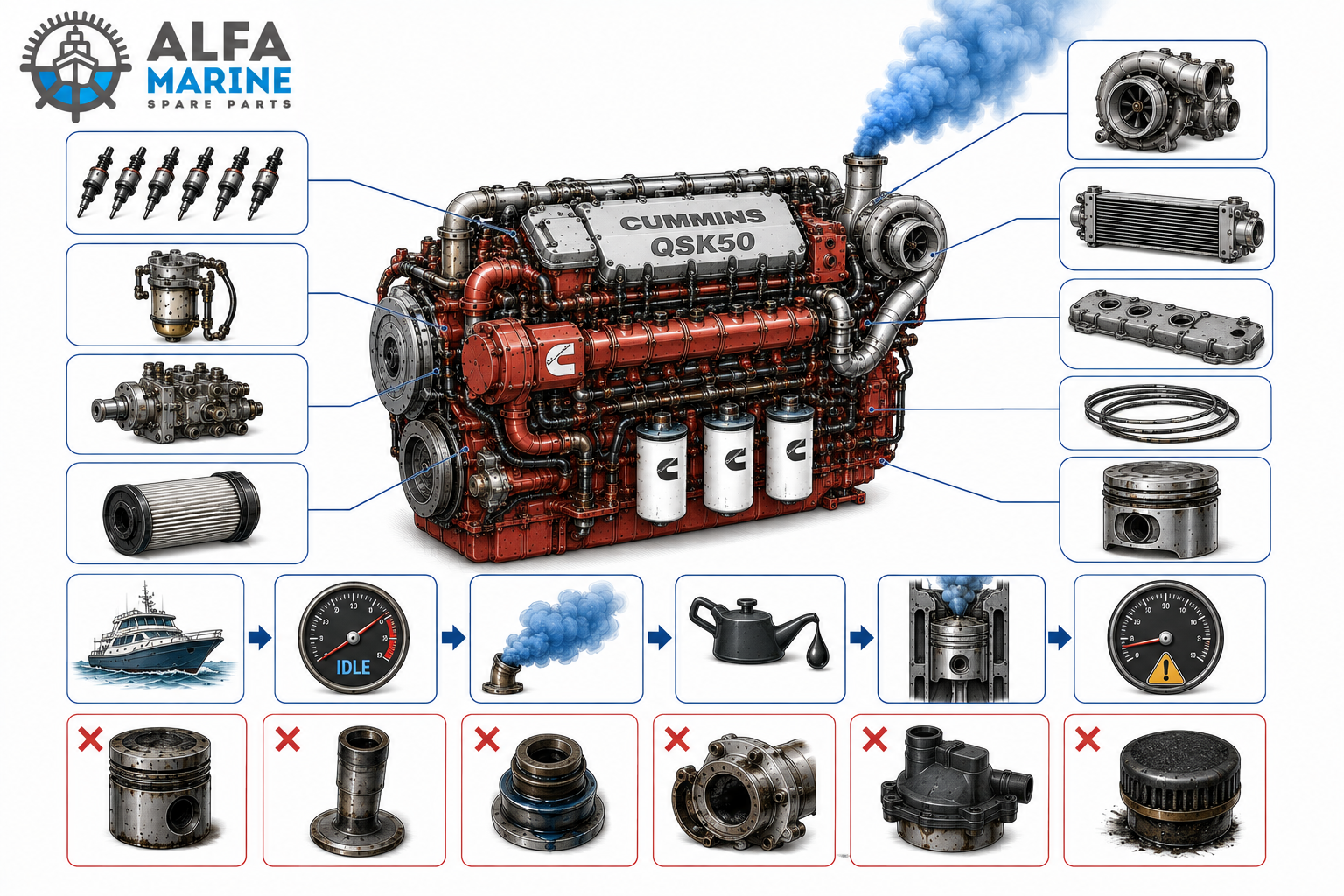

Why Does My Cummins QSK50 Marine Produce Blue Smoke at Idle?
A Cummins QSK50 marine engine producing blue or blue-grey smoke at idle usually directs the investigation toward lubricating oil entering the combustion process.
That does not automatically mean the engine needs an overhaul.
Important areas to investigate include:
- Turbocharger oil leakage
- Piston-ring sealing
- Cylinder-liner condition
- Valve and guide area
- Excessive blow-by
- Crankcase ventilation
- Incorrect lubricating-oil level
- Incorrect lubricant
- Extended low-load operation
- Internal engine wear
The first useful question is:
Does the blue smoke occur only at idle, or does it continue when engine load and temperature increase?
That distinction can considerably narrow the diagnosis.
Cummins QSK50 Marine Engine
The Cummins QSK50 is a large V16 four-stroke marine diesel engine with approximately 50 litres displacement and a 159 × 159 mm bore and stroke. Marine QSK50 configurations are turbocharged and aftercooled and use electronically controlled high-pressure fuel injection.
Exact ratings and equipment can vary according to the individual marine configuration.
| SpecificationCummins QSK50 Marine | |
| Configuration | V16 |
| Cycle | Four-stroke diesel |
| Displacement | Approx. 50 L |
| Bore | 159 mm |
| Stroke | 159 mm |
| Aspiration | Turbocharged / aftercooled |
| Fuel system | High-pressure fuel injection |
| Engine management | Electronic |
For replacement components, browse Cummins QSK50 Marine Engine Parts.
What Does Blue Smoke From a QSK50 Usually Mean?
Blue or blue-grey diesel exhaust generally directs the investigation toward lubricating oil being burned during combustion.
In simple terms:
Lubricating oil enters combustion → oil burns → blue or blue-grey exhaust appears
The next question is therefore:
Where is the oil entering the combustion process?
Possible paths include:
Turbocharger / air system → combustion chamber
Valve and guide area → combustion chamber
Piston rings / cylinder liners → combustion chamber
The source should be diagnosed before major components are replaced.
Why Is Blue Smoke More Noticeable at Idle?
Idle is an important diagnostic clue.
Several engine conditions are different at idle compared with operation under load, including:
- Cylinder pressure
- Combustion temperature
- Turbocharger speed
- Exhaust temperature
- Airflow
- Oil-control conditions
A marginal problem may therefore become more noticeable during:
- Cold idle
- Warm idle
- Extended idle
- Prolonged low-load operation
- Acceleration immediately after idling
For example:
Blue smoke after prolonged idle that clears when load increases
is a different diagnostic pattern from:
Continuous blue smoke at idle and under load combined with increasing oil consumption.
Start With Lubricating-Oil Consumption
Before dismantling the engine, determine whether it is actually consuming excessive lubricating oil.
Check:
- Oil level
- Oil-consumption history
- Frequency of oil top-ups
- Recent oil changes
- Correct lubricant specification
- External oil leakage
- Changes in consumption over operating hours
Establish a trend rather than relying on one oil-level reading.
If blue smoke appears together with steadily increasing oil consumption, the evidence for lubricating oil entering the combustion process becomes stronger.
Check the Oil Level and Recent Maintenance
Determine whether the problem started after:
- An oil change
- Oil top-up
- Change in lubricant
- Turbocharger work
- Cylinder-head repair
- Engine overhaul
- Other recent maintenance
Verify the lubricating-oil level using the correct procedure for the particular engine installation.
If blue smoke appeared immediately after maintenance, investigate what changed before assuming that major internal wear has suddenly developed.
Can the QSK50 Turbocharger Cause Blue Smoke?
Yes.
The QSK50 marine engine is turbocharged and aftercooled.
If lubricating oil passes through a turbocharger into the intake or exhaust path, it can contribute to blue or blue-grey exhaust smoke.
Investigate for evidence such as:
- Abnormal oil accumulation
- Oil in intake or charge-air piping
- Turbocharger bearing problems
- Abnormal shaft condition
- Compressor-side oil contamination
- Turbine-side oil contamination
- Abnormal turbocharger noise
- Changes in turbocharger performance
However:
Oil in the Intake Does Not Automatically Mean the Turbocharger Has Failed
The source of the oil still needs to be established.
Crankcase ventilation and other engine conditions can also contribute to oil contamination within the air system.
Do not replace an expensive QSK50 turbocharger simply because oil has been found in an intake pipe.
Blue Smoke After Extended Idle
A useful symptom pattern is:
Normal operation → prolonged idle → blue smoke develops → load increases → smoke decreases or clears
Possible areas worth investigating include:
- Turbocharger oil leakage
- Valve/guide-area oil control
- Cylinder oil control
- Crankcase ventilation
- Low-load operating conditions
This pattern provides diagnostic direction, but it does not identify a failed component by itself.
Can QSK50 Piston Rings Cause Blue Smoke?
Yes.
Piston rings are important for both combustion sealing and lubricating-oil control.
If ring sealing or oil control deteriorates, excessive oil may reach the combustion chamber.
Possible accompanying symptoms include:
- Blue smoke
- Increasing oil consumption
- Increased blow-by
- Abnormal crankcase pressure
- Reduced compression
- Reduced cylinder performance
The important point is to look for a combination of symptoms rather than diagnosing worn piston rings from exhaust color alone.
Check for Excessive Blow-By
Blow-by can provide useful information about the piston, ring and cylinder system.
Some crankcase gas is normal.
The concern is a significant change from previous operating condition or measured crankcase pressure outside the applicable specification.
Investigate:
- Crankcase pressure
- Breather condition
- Oil mist
- Oil carryover
- Oil consumption
- Cylinder performance
- Changes from historical engine behavior
Do not diagnose worn rings simply because visible vapor is present around a breather.
Use appropriate measurements and the correct specifications for the individual QSK50.
Can Cylinder-Liner Wear Cause Blue Smoke?
Yes.
The piston rings and cylinder liners work together to provide cylinder sealing and oil control.
If liner condition deteriorates, ring sealing and oil control can also deteriorate.
Possible concerns include:
- Liner wear
- Surface damage
- Scoring
- Abnormal ring-to-liner sealing
- Localized cylinder damage
A combination such as:
Blue smoke + increasing oil consumption + excessive blow-by
makes power-cylinder condition more important to investigate.
What About Valve Guides?
The cylinder-head and valve-guide area is another possible path for lubricating oil to reach the combustion process.
This area becomes more relevant when blue smoke appears primarily:
- After extended idle
- During certain transient operating conditions
- After cylinder-head work
- Together with increasing oil consumption
However, do not automatically diagnose valve-guide wear because the engine smokes at idle.
Turbocharger condition, piston rings, cylinder liners, crankcase ventilation and operating history should also remain in the diagnostic process.
Check the Crankcase Ventilation System
The crankcase ventilation system deserves attention before major engine disassembly.
Inspect the applicable system for:
- Restriction
- Contamination
- Abnormal oil carryover
- Damaged components
- Excessive crankcase pressure
There is an important distinction between:
A ventilation problem affecting oil control
and
Internal engine wear creating excessive blow-by that becomes visible through the ventilation system
The symptoms can overlap.
Finding oil around the breather does not automatically mean the breather itself is the root cause.
Does Extended Low-Load Operation Matter?
Operating history matters.
A large marine diesel spending extended periods at idle or very low load can behave differently from an engine operating regularly under normal working load.
If blue smoke occurs mainly after prolonged idle, record:
- Duration of idle
- Engine temperature
- Oil temperature where available
- Whether smoke clears under load
- Whether oil consumption is increasing
- Whether the symptom is progressively worsening
Do not automatically conclude that low-load operation has damaged the engine.
Use the operating pattern as part of the diagnosis.
Blue Smoke Only When Cold
If blue-grey smoke appears primarily immediately after cold starting, investigate:
- Oil entry while the engine is stopped
- Turbocharger oil leakage
- Cylinder condition
- Valve-area oil entry
- Cold combustion behavior
Also make sure the exhaust is genuinely blue rather than white or pale grey.
Incomplete combustion during cold operation can produce pale exhaust that may visually be mistaken for oil smoke.
Smoke smell, persistence and oil-consumption history can help distinguish the symptoms.
Blue Smoke When Fully Warm
Blue smoke from a fully warmed QSK50 deserves more attention, especially if measurable oil consumption is increasing.
Investigate:
- Turbocharger oil leakage
- Piston-ring sealing
- Cylinder-liner condition
- Crankcase pressure
- Breather condition
- Valve/guide area
- Overall mechanical condition
A repeatable warm-engine symptom generally provides stronger evidence of an ongoing oil-control problem than an occasional brief cold-start plume.
Blue Smoke Under Load as Well as Idle
If blue smoke continues as engine load increases, broaden the investigation.
Pay particular attention to:
- Lubricating-oil consumption
- Turbocharger condition
- Blow-by
- Piston-ring sealing
- Cylinder-liner condition
- Individual-cylinder performance
- Crankcase pressure
Persistent blue smoke across the operating range provides stronger evidence of continuing lubricating-oil entry than an idle-only symptom.
Blue, Black or White Smoke?
Smoke color can help determine where to begin troubleshooting.
| SmokeMain Areas to Investigate | |
| Blue / blue-grey | Lubricating oil, turbocharger, rings, liners, valve/guide area |
| Black | Air supply, fuel-to-air balance, boost, fuel system, engine load |
| White / pale | Incomplete combustion, fuel injection, cold combustion, compression |
Smoke color should always be evaluated together with actual engine operating data.
Compare Individual Cylinders
The QSK50 is a V16 engine, so determining whether the condition affects the complete engine or particular cylinders can be valuable.
Depending on the available diagnostic methods, compare:
- Exhaust temperatures
- Cylinder contribution
- Engine-control information
- Cylinder-to-cylinder behavior
- Other available measurements
If one cylinder consistently behaves differently, investigate that cylinder more closely.
Possible areas include:
- Ring/liner condition
- Valve condition
- Localized mechanical problems
- Combustion problems
Do not assume that visible blue smoke means all 16 cylinders require overhaul.
Turbocharger, Rings or Valve Area?
The symptom combination can help guide the investigation.
| SymptomArea Worth Investigating | |
| Blue smoke + increasing oil consumption | Lubricating-oil entry |
| Blue smoke + oil in charge-air system | Turbo / ventilation / oil source |
| Blue smoke + excessive blow-by | Rings / liners / cylinders |
| Blue smoke mainly after long idle | Turbo / valve area / oil control |
| Blue smoke at idle and load | Turbo / power cylinders / internal wear |
| Blue smoke + reduced compression | Rings / liners / valves |
| Blue smoke after maintenance | Oil level / lubricant / repaired component |
| One cylinder abnormal | Localized cylinder / valve condition |
| Smoke clears under load | Investigate idle/low-load oil entry |
| Smoke worsens with load | Broaden turbo/mechanical diagnosis |
These are diagnostic directions, not proof of a specific component failure.
Practical Cummins QSK50 Blue-Smoke Check
A sensible diagnostic sequence is:
- Confirm the exact QSK50 model and Engine Serial Number.
- Verify that the exhaust is actually blue or blue-grey.
- Determine whether the symptom occurs cold, warm or both.
- Record whether it appears only at idle.
- Determine what happens when engine load increases.
- Verify lubricating-oil level.
- Confirm the correct lubricant is being used.
- Establish actual oil-consumption history.
- Inspect for external oil leakage.
- Check crankcase ventilation.
- Evaluate crankcase pressure and blow-by where appropriate.
- Inspect the intake and charge-air system for abnormal oil accumulation.
- Evaluate turbocharger condition.
- Compare individual-cylinder behavior.
- Investigate cylinder sealing where evidence supports it.
- Consider piston-ring and liner condition.
- Investigate the valve/guide area when indicated.
- Identify the oil-entry path before ordering major components.
The objective is to determine whether lubricating oil is entering through:
Turbocharger / air system → valve area → piston rings and liners → crankcase ventilation
Why QSK50 Part Identification Matters
A request for:
“Cummins QSK50 turbocharger”
or:
“Cummins QSK50 piston rings”
may not provide enough information to select the correct replacement component.
Before ordering, provide:
- Exact engine model
- Engine Serial Number (ESN)
- Engine rating
- Existing Cummins part number
- Component manufacturer number where applicable
- Part description
- Clear component photographs
- Vessel application
A useful starting combination is:
QSK50 + ESN + existing part number
This reduces the risk of selecting a component for the wrong QSK50 configuration.
Why No Universal QSK50 Part Numbers Are Listed
This article intentionally does not publish a universal:
- Turbocharger part number
- Piston part number
- Piston-ring part number
- Cylinder-liner part number
- Valve/guide part number
for every Cummins QSK50 marine engine.
The exact replacement component should be verified against the individual engine configuration and ESN.
This is preferable to assigning a part number to a QSK50 simply because a component appears physically similar.
Cummins QSK50 Marine Engine Parts
Alfa Marine Spare Parts supports replacement-part enquiries for Cummins QSK50 marine engines.
Browse Cummins QSK50 Marine Engine Parts.
Parts enquiries can include:
- Turbochargers
- Turbocharger components
- Pistons
- Piston rings
- Cylinder liners
- Cylinder heads
- Valve-train components
- Main and connecting-rod bearings
- Fuel injectors
- Fuel-system components
- Cooling-system components
- Water pumps
- Aftercooler components
- Gaskets and seals
- Lubrication-system components
- Overhaul components
Exact application should be verified against the individual Engine Serial Number before ordering.
Request Cummins QSK50 Marine Parts
If your Cummins QSK50 marine engine produces blue smoke at idle, avoid immediately ordering a turbocharger or complete overhaul kit.
First establish whether lubricating oil is entering through the:
Turbocharger/air system → valve area → piston rings/liners → crankcase ventilation system
Then identify the affected component.
For accurate parts identification, provide:
Engine model + Engine Serial Number + existing part number + component photographs
Email: request@alfamarinespareparts.com
Request a Quote
Alfa Marine Spare Parts
Frequently Asked Questions
Why does my Cummins QSK50 produce blue smoke at idle?
Blue or blue-grey exhaust usually directs attention toward lubricating oil entering the combustion process. Investigate the turbocharger, crankcase ventilation, piston rings, cylinder liners and valve/guide area.
Can a QSK50 turbocharger cause blue smoke?
Yes. Turbocharger oil leakage can contribute to blue smoke and oil consumption. Confirm the source before replacing the turbocharger.
Can worn QSK50 piston rings cause blue smoke?
Yes. Deteriorated ring sealing or oil control can allow excessive lubricating oil into the combustion chamber and may also be associated with increased blow-by.
Can worn cylinder liners contribute to blue smoke?
Yes. Ring and liner condition work together to provide cylinder sealing and oil control.
Can valve-guide wear cause blue smoke at idle?
The valve/guide area is one possible oil-entry path, particularly when smoke behavior changes with operating conditions. It should be diagnosed rather than assumed.
Why does blue smoke appear after prolonged idling?
Extended idle changes cylinder temperature, turbocharger operation and oil-control conditions. Turbocharger oil leakage, valve-area oil control, crankcase ventilation and power-cylinder condition are worth investigating.
Should I replace the turbocharger if I find oil in the intake?
Not automatically. Determine whether the oil originates from the turbocharger, crankcase ventilation or another source before replacing components.
Does blue smoke mean my QSK50 needs an overhaul?
No. A turbocharger, ventilation-system or localized mechanical problem can also produce oil-related smoke. Establish the source first.
What if the QSK50 has blue smoke and excessive blow-by?
That combination makes piston-ring, liner and general cylinder condition more important to investigate.
How do I identify the correct QSK50 parts?
Provide the exact engine model, Engine Serial Number, engine rating, existing Cummins part number and clear component photographs.