
Cummins Marine Engine Lineup: From Compact Auxiliaries to Heavy-Duty Commercial Power
How small—or how big—can a Cummins marine engine get?
The answer depends on what kind of vessel you are standing next to.
At one end of the Cummins marine range are compact B-Series engines suited to smaller propulsion and auxiliary applications.
At the other end sits the Cummins QSK95: a 95-litre V16 built for high-output commercial marine applications.
That is an enormous difference.
But bigger does not automatically mean better.
A small fishing boat or harbour workboat does not need a 95-litre V16. Likewise, a large tug, offshore-support vessel or heavy commercial application cannot do its job with a compact four- or six-cylinder engine.
The more useful question is:
Where does each Cummins marine engine fit between those two extremes?
In this guide, we move through the Cummins marine engine lineup from compact engines to the largest high-output platforms, looking at engine size, cylinder configuration, power class, applications, engine generations and spare-parts requirements.
If you already know your engine model, browse our Cummins Marine Engine Parts catalogue.
Need a specific component? Request a Quote and send us your engine model, Engine Serial Number (ESN), CPL and existing part number whenever available.
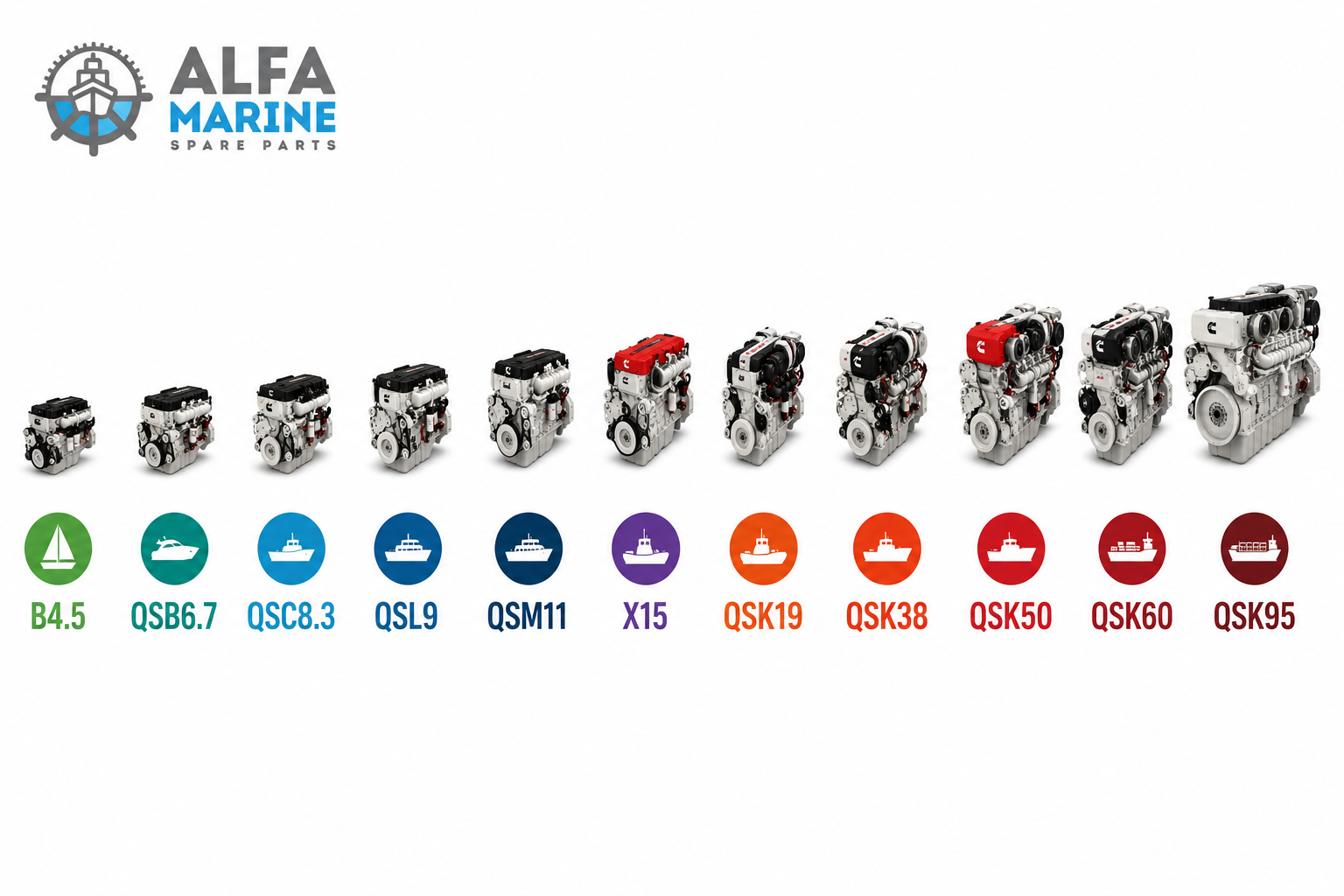
Cummins Marine Engines From Smallest to Biggest
The Cummins marine family covers everything from compact four-cylinder machinery to extremely large V16 commercial engines.
For a practical comparison, the progression looks broadly like this:
| Cummins EngineConfigurationApprox. DisplacementGeneral Marine Position | |||
| Cummins 4B | Inline 4 | 3.9 L class | Compact legacy |
| Cummins 4BT | Inline 4 | 3.9 L class | Compact turbocharged |
| Cummins 4BTA | Inline 4 | 3.9 L class | Compact turbocharged / aftercooled |
| Cummins B4.5 | Inline 4 | 4.5 L | Compact modern B-Series |
| Cummins 6BT | Inline 6 | 5.9 L | Small / medium marine |
| Cummins 6BTA | Inline 6 | 5.9 L | Small / medium marine |
| Cummins QSB5.9 | Inline 6 | 5.9 L | Electronic compact marine |
| Cummins QSB6.7 / QSB7 | Inline 6 | 6.7 L | Modern compact marine |
| Cummins 6CTA8.3 | Inline 6 | 8.3 L | Legacy commercial |
| Cummins QSC8.3 | Inline 6 | 8.3 L | Recreational / commercial |
| Cummins QSL9 | Inline 6 | 8.9 L | Commercial / recreational |
| Cummins QSM11 | Inline 6 | 10.8 L | Yacht / commercial |
| Cummins NT855 | Inline 6 | Approx. 14 L | Legacy heavy commercial |
| Cummins NTA855 | Inline 6 | Approx. 14 L | Legacy turbocharged / aftercooled |
| Cummins X15 | Inline 6 | Approx. 15 L | Modern commercial |
| Cummins KTA19 | Inline 6 | Approx. 19 L | Heavy-duty legacy |
| Cummins QSK19 | Inline 6 | Approx. 19 L | Heavy commercial |
| Cummins VTA28 | V12 | Approx. 28 L | Legacy heavy commercial |
| Cummins KTA38 | V12 | Approx. 38 L | Heavy commercial |
| Cummins QSK38 | V12 | Approx. 38 L | Heavy commercial |
| Cummins KTA50 | V16 | Approx. 50 L | Large commercial |
| Cummins QSK50 | V16 | Approx. 50 L | High-output commercial |
| Cummins QSK60 | V16 | Approx. 60 L | Very high-output commercial |
| Cummins QSK95 | V16 | Approx. 95 L | Highest-output class covered here |
This is a family and size comparison, not a parts-interchangeability chart.
Engines of similar displacement can belong to completely different generations and use different fuel systems, turbochargers, cooling arrangements, controls and internal components.
1. Cummins 4B, 4BT & 4BTA: Compact Legacy Workhorses
Among older Cummins marine installations, the Cummins 4B, Cummins 4BT and Cummins 4BTA sit at the compact end of the family.
These are four-cylinder B-Series engines in the approximately 3.9-litre class.
They are a completely different proposition from a Cummins QSK50 or Cummins QSK95.
Their compact dimensions and relatively straightforward mechanical layouts made them useful where space, weight and serviceability matter.
Typical applications can include small commercial boats, fishing vessels, harbour craft, utility boats, marine generators, auxiliary installations and repower projects.
In broad terms:
4B identifies the base four-cylinder B-Series platform.
4BT identifies a turbocharged configuration.
4BTA identifies turbocharged and aftercooled configurations.
That difference matters when ordering parts.
A water pump, turbocharger, manifold or cooling component should never be selected simply because someone says:
“It is for a Cummins 4B.”
Use the complete engine designation, serial number and existing component number whenever possible.
2. Cummins B4.5: Modern Compact Four-Cylinder Power
The Cummins B4.5 represents a newer compact B-Series platform.
It uses an inline four-cylinder arrangement and sits toward the smaller end of the modern Cummins marine offering.
Its compact dimensions make this type of engine suitable for applications where machinery-space dimensions, engine weight and service access are important.
Potential applications can include workboats, patrol craft, passenger boats, harbour vessels, auxiliary systems and marine generator installations.
The newer fuel-system and electronic architecture also means that parts selection differs from the older Cummins 4B, 4BT and 4BTA.
Do not order B4.5 parts simply because another engine is also described as a Cummins B-Series.
3. Cummins 6BT & 6BTA: The Famous 5.9-Litre Workhorse
Move from four cylinders to six and you reach one of the most recognisable Cummins diesel families:
Cummins 6BT Marine Engine Parts
and:
Cummins 6BTA Marine Engine Parts
These engines are based around the familiar 5.9-litre inline-six B-Series platform.
They have accumulated a long service history in fishing boats, workboats, pleasure craft, passenger boats, commercial vessels, marine generators and repower installations.
One reason they remain familiar to engineers is their relative mechanical simplicity compared with later electronic engines.
Open the engine room of an older commercial vessel and find a Cummins 6BTA, and you are dealing with a very different fuel and control system from a Cummins QSB6.7.
Frequently required components can include injectors, injection-pump components, water pumps, oil pumps, turbocharger components, pistons, piston rings, bearings, gaskets, seals and overhaul parts.
4. Cummins QSB5.9: The 5.9-Litre Platform Moves Into a New Generation
The Cummins QSB5.9 Marine Engine represents an important generational step.
The displacement remains in the familiar 5.9-litre class, but the QSB belongs to a later electronically controlled generation.
This is where a common parts mistake can happen.
Someone sees:
Cummins 6BTA
and:
Cummins QSB5.9
and assumes:
“Both are 5.9-litre Cummins engines, so the parts should fit.”
Not necessarily.
Fuel-system equipment, sensors, controls and other components can differ considerably.
Displacement tells you approximately how large the engine is.
It does not give you the correct parts list.
5. Cummins QSB6.7 / QSB7: Compact Modern Marine Power
Next comes the Cummins QSB6.7 / QSB7 Marine Engine.
The QSB6.7 is an inline six-cylinder, four-stroke, turbocharged and charge-air-cooled marine diesel with approximately 6.7 litres of displacement.
Depending on the rating and application, this compact platform can produce substantial propulsion power.
Potential applications can include motor yachts, sportfishing vessels, patrol craft, pilot boats, fishing vessels, passenger boats, rescue craft and commercial workboats.
So when we describe the Cummins QSB6.7 as compact, remember the context.
It is compact compared with a Cummins QSK38 or Cummins QSK50.
It is still capable of serious marine propulsion work.
6. Cummins 6CTA8.3: The Legacy 8.3-Litre Step
Before moving into the QSC generation, there is another important engine:
Cummins 6CTA8.3 Marine Engine Parts
The 6CTA8.3 belongs to the older C-Series generation and uses an approximately 8.3-litre inline-six platform.
It remains in service in commercial vessels, fishing boats, passenger applications and workboats.
The Cummins 6CTA8.3 is particularly useful for understanding why displacement cannot be used as a replacement-parts guide.
A Cummins 6CTA8.3 and Cummins QSC8.3 both belong to the 8.3-litre class.
But that does not make them the same engine.
Their fuel-system, electronic and other component requirements can differ substantially.
7. Cummins QSC8.3: More Output Without Going Huge
The Cummins QSC8.3 Marine Engine moves the 8.3-litre class into a later electronically controlled generation.
It uses an inline six-cylinder configuration with turbocharging, charge-air cooling and electronic fuel management.
This gives the Cummins QSC8.3 an interesting position within the lineup.
A vessel operator needing more output than a compact Cummins QSB6.7 does not necessarily have to move immediately into a physically huge engine.
Potential applications can include yachts, sportfishing vessels, patrol boats, pilot vessels, passenger craft and commercial workboats.
8. Cummins QSL9: Why Displacement Does Not Tell the Whole Story
Next comes the Cummins QSL9 Marine Engine.
The QSL9 sits in approximately the 8.9-litre class and uses an inline six-cylinder configuration.
It occupies an important position in commercial marine applications where engine duty can matter more than achieving the highest possible headline horsepower figure.
This is where operators sometimes ask:
“Why can one smaller Cummins engine have a higher advertised horsepower than a larger one?”
Because displacement alone does not determine the job an engine is designed to perform.
Duty rating matters.
When comparing the Cummins QSL9 with a Cummins QSC8.3, ask:
How much power?
But also:
At what rpm?
Under what duty rating?
For what type of vessel?
9. Cummins QSM11: The Familiar 11-Litre Marine Platform
The Cummins QSM11 Marine Engine has become particularly familiar in yacht and commercial marine installations.
The engine sits in approximately the 10.8-litre class and uses an inline six-cylinder configuration.
Potential applications include motor yachts, sportfishing vessels, passenger craft, commercial fishing boats, patrol vessels and workboats.
The Cummins QSM11 occupies an interesting middle ground.
It is considerably larger than a Cummins QSB6.7, yet still far removed from the V12 and V16 machinery found further up the range.
10. Cummins NT855 & NTA855: Heavy-Duty Legacy Six-Cylinder Engines
Before later-generation engines such as the Cummins X15 and Cummins QSK19, Cummins built a long reputation around heavy-duty platforms such as the Cummins NT855 and Cummins NTA855.
These engines sit in approximately the 14-litre class and remain familiar in older commercial propulsion, auxiliary and generator installations.
The Cummins NT855 and Cummins NTA855 belong to a very different generation from modern QSK engines.
For older engines like these, identification becomes especially important.
Why?
Because an engine may have been in service for decades.
During that time it may have received previous overhauls, replacement pumps, replacement turbochargers, superseded components, modified accessories or other configuration changes.
Never assume the component currently installed is necessarily the component the engine originally left the factory with.
11. Cummins X15: Modern 15-Litre Commercial Power
Next comes the Cummins X15 Marine Engine.
The X15 sits in approximately the 15-litre class while retaining an inline six-cylinder configuration.
It is aimed particularly at demanding commercial marine applications.
Potential uses can include commercial fishing vessels, inland-waterway vessels, workboats, passenger craft, dredging applications and repower projects.
The Cummins X15 is another reminder that engine displacement and maximum horsepower are not the same thing.
A larger commercial engine may have a lower peak horsepower number than a smaller high-output recreational engine because they can be designed around different operating profiles.
12. Cummins KTA19: The Big Mechanical Inline Six
Now the engines become substantially larger.
The Cummins KTA19 Marine Engine belongs to approximately the 19-litre class.
Despite its displacement, it remains an inline six-cylinder engine.
Consider the progression:
Cummins QSB6.7 — approximately 6.7 litres
Cummins QSC8.3 — approximately 8.3 litres
Cummins QSL9 — approximately 8.9 litres
Cummins QSM11 — approximately 10.8 litres
Cummins X15 — approximately 15 litres
Cummins KTA19 — approximately 19 litres
The KTA19 belongs to Cummins' well-established heavy-duty K-Series generation.
These engines have been used in commercial fishing vessels, workboats, tugboats, marine generators, auxiliary systems and heavy commercial propulsion.
13. Cummins QSK19: Similar Size Class, Different Generation
Then comes the Cummins QSK19 Marine Engine.
Again, we are in approximately the 19-litre inline-six class.
But do not treat the Cummins QSK19 simply as another Cummins KTA19.
They belong to different engine generations.
Fuel-system equipment, electronic controls and other components can differ significantly.
Potential Cummins QSK19 applications include commercial vessels, fishing vessels, workboats, dredgers, auxiliary installations and heavy propulsion requirements.
The QSK19 is an excellent example of why engine family matters more than displacement alone.
14. Cummins VTA28: Moving Into V12 Territory
Next comes the Cummins VTA28 Marine Engine.
This represents an important architectural change.
We move away from the large inline-six layout into a V12 configuration.
The VTA28 sits in approximately the 28-litre displacement class and combines a V12 layout with turbocharging and aftercooling.
It has been used in demanding propulsion, auxiliary and marine-generator applications.
At this point, overhaul scale starts changing dramatically.
Twelve cylinders mean twelve combustion positions to consider, together with larger cylinder components, more extensive valve-train requirements and substantially larger cooling and lubrication systems.
15. Cummins KTA38: Heavy-Duty V12 Power
The Cummins KTA38 Marine Engine moves further into heavy commercial territory.
The platform is approximately:
38 litres
V12
The Cummins KTA38 has a long service history in demanding marine applications including tugboats, offshore vessels, dredgers, commercial fishing vessels, workboats and generator installations.
Think about the overhaul difference compared with a Cummins QSB6.7.
The QSB6.7 has six cylinders.
The KTA38 has twelve.
That means substantially more cylinder components, valve-train parts, bearings, gaskets and associated overhaul requirements.
16. Cummins QSK38: Later-Generation Heavy Commercial V12
The Cummins QSK38 Marine Engine remains in approximately the 38-litre V12 class but belongs to a later engine generation.
This places it firmly in heavy commercial marine territory.
Potential applications can include tugboats, offshore vessels, dredgers, large workboats, commercial vessels and generator installations.
Parts requirements can include cylinder components, bearings, fuel-system equipment, turbocharger components, pumps, cooling-system parts, valve-train components, gaskets, seals and electronic controls.
And again:
Cummins KTA38 and Cummins QSK38 are not interchangeable engine platforms.
17. Cummins KTA50: Entering V16 Territory
Move upward again and we reach the Cummins KTA50 Marine Engine.
Now we have an approximately 50-litre class engine with a V16 cylinder arrangement.
This is large commercial marine-engine territory.
Sixteen cylinders mean sixteen combustion positions.
During a major overhaul, quantities scale quickly.
A requirement can involve pistons, rings, bearings, cylinder components, fuel equipment, cylinder-head components, cooling parts, turbocharger parts, gaskets and seals in substantial quantities.
At this scale, one incorrect parts assumption multiplied across sixteen cylinders can become a very expensive purchasing mistake.
18. Cummins QSK50: Later-Generation 50-Litre V16 Power
The Cummins QSK50 Marine Engine takes the approximately 50-litre V16 class into a later electronic generation.
At this size, maintenance planning begins to change significantly.
On a compact engine, many components can be handled with ordinary workshop equipment.
On a Cummins QSK50, maintenance planning may need to consider cylinder-head removal, turbocharger access, major-component lifting, overhead lifting capacity, engine-room clearance, cooling-system capacity and future overhaul access.
The engine room effectively becomes part of the maintenance strategy.
And although the Cummins KTA50 and Cummins QSK50 occupy a similar displacement class, they should not be treated as identical for parts identification.
19. Cummins QSK60: Very High-Output Commercial Marine Power
Next comes the Cummins QSK60 Marine Engine.
The QSK60 occupies the very-high-output section of the Cummins marine range.
Its V16 layout and approximately 60-litre displacement move it well beyond the mid-range engines discussed earlier.
Typical applications can include large tugboats, offshore vessels, commercial workboats and specialized marine installations.
At this level, reliability planning becomes as important as repair.
Operators should be thinking about:
- Preventive maintenance
- Critical spare-parts planning
- Fuel filtration
- Lubrication
- Cooling-system condition
- Turbocharger condition
- Sensor and control-system reliability
- Oil analysis
- Planned overhaul intervals
Waiting for a major component to fail before identifying its replacement can create unnecessary vessel downtime.
20. Cummins QSK95: The Giant at the Top
Finally, we reach the Cummins QSK95 Marine Engine.
The numbers tell the story:
Approximately 95 litres
V16
Approximately 190 mm bore
Approximately 210 mm stroke
Turbocharged
Charge-air cooled
Think about the journey through this article.
We began with compact four-cylinder Cummins 4B, 4BT and 4BTA engines.
Now we are discussing a 95-litre V16.
Both are Cummins marine diesels.
They are simply built for completely different jobs.
Potential Cummins QSK95 applications can include large tugboats, offshore-support vessels, large commercial workboats, high-power propulsion installations and other demanding applications.
At this scale, engine selection becomes inseparable from the rest of the vessel.
The propulsion package can involve:
- Gearbox
- Shafting
- Propeller
- Fuel supply
- Cooling system
- Exhaust system
- Ventilation
- Electrical system
- Engine foundations
- Engine-room service access
- Classification requirements
- Future overhaul access
A QSK95 is not simply an engine that is placed inside a machinery space.
The machinery space must be capable of supporting equipment of this scale.
From Cummins B-Series to QSK95: What Actually Changes?
It is tempting to say:
“Everything just gets bigger.”
That is only part of the story.
Several things change at the same time.
Engine Displacement
The progression moves through approximately:
3.9 litres
4.5 litres
5.9 litres
6.7 litres
8.3 litres
8.9 litres
10.8 litres
14 litres
15 litres
19 litres
28 litres
38 litres
50 litres
60 litres
and finally approximately 95 litres.
Cylinder Configuration
Smaller engines use inline-four and inline-six layouts.
The larger families then move into V12 and V16 configurations.
That affects engine dimensions, cooling demand, exhaust arrangements, component quantities, overhaul cost and service access.
Fuel-System Technology
Older platforms such as the Cummins 6BT, Cummins NT855 and Cummins KTA19 belong to different fuel-system generations from engines such as the Cummins QSB6.7, Cummins X15 and larger Cummins QSK platforms.
This affects injectors, pumps, sensors, controls and diagnostic procedures.
Maintenance Scale
A six-cylinder overhaul and a sixteen-cylinder overhaul are very different projects.
As the engine becomes larger, operators need to consider not only the price of individual components but also:
- Quantity of parts
- Component weight
- Lifting equipment
- Labour requirements
- Machinery-space access
- Transport
- Storage
- Planned downtime
Why the Biggest Cummins Marine Engine Is Not Automatically the Best
Imagine someone says:
“I will just install the biggest engine that fits.”
That is not how marine propulsion should be selected.
An engine needs to match the vessel.
Important considerations include:
- Vessel displacement
- Hull design
- Propeller
- Gear ratio
- Operating speed
- Bollard-pull requirement
- Duty cycle
- Fuel capacity
- Cooling capacity
- Engine-room dimensions
- Weight distribution
- Exhaust arrangement
- Classification requirements
An oversized engine can be just as inappropriate as an undersized engine.
Marine engine selection is not a competition for the largest horsepower number.
Why Cummins Marine Duty Ratings Matter
Suppose one engine has a higher maximum horsepower figure than another.
Is it automatically the better engine?
No.
Ask:
At what rpm?
For what duty rating?
At what load factor?
For how many operating hours?
For what vessel type?
A high-output yacht rating should not be compared directly with a heavy commercial rating as though both engines are expected to operate under identical conditions.
For commercial vessels, the correct duty rating can matter more than the headline horsepower figure.
Mechanical vs Electronic Cummins Marine Engines
Another useful way to understand the range is by engine generation.
Legacy & Earlier Cummins Marine Engine Families
These include:
Cummins 4B
Cummins 4BT
Cummins 4BTA
Cummins 6BT
Cummins 6BTA
Cummins 6CTA8.3
Cummins NT855
Cummins NTA855
Cummins VTA28
Cummins KTA19
Cummins KTA38
Cummins KTA50
These families represent different generations and should not themselves be assumed to use identical components.
Later Cummins Marine Engine Families
These include:
Cummins B4.5
Cummins QSB5.9
Cummins QSC8.3
Cummins QSL9
Cummins QSM11
Cummins X15
Cummins QSK19
Cummins QSK38
Cummins QSK50
Cummins QSK60
Cummins QSK95
Later electronic platforms introduce additional requirements for sensors, engine controls, wiring, electronic fuel systems and diagnostics.
Which Cummins Marine Engine Is Best for a Yacht?
There is no single best Cummins yacht engine.
Common families can include:
Cummins QSC8.3
Cummins QSL9
Cummins QSM11
depending on vessel size, hull design, required speed and operating profile.
A smaller yacht may benefit from compact Cummins QSB6.7 / QSB7 machinery.
A larger motor yacht may use Cummins QSM11-class machinery.
The correct choice depends on the vessel—not simply the engine.
Which Cummins Engine Is Best for a Workboat?
This question is even broader.
A ten-metre harbour utility vessel and a large offshore workboat are both called workboats.
Their propulsion requirements may be completely different.
Potential Cummins families can include:
Cummins 6BTA
Cummins QSC8.3
Cummins QSL9
Cummins QSM11
Cummins X15
Cummins KTA19
Cummins QSK19
and, for substantially larger applications:
Cummins QSK38
Cummins QSK50
Cummins QSK60
Cummins QSK95
The correct question is:
What work does the vessel actually perform?
Which Cummins Engines Are Used in Tugboat Applications?
Tugboats require power and a duty rating suited to demanding commercial operation.
Depending on vessel size, propulsion arrangement and required bollard pull, applicable engine classes can include:
Cummins QSK60
Cummins QSK95
The correct engine still depends on required bollard pull, duty cycle, gearbox selection, propeller arrangement, classification requirements and available engine-room space.
Which Cummins Engines Are Common in Fishing Vessels?
Fishing vessels vary enormously in size, from small coastal boats to large commercial fishing vessels operating for long periods offshore.
Cummins platforms encountered across this broad sector can include:
Cummins 4BT
Cummins 4BTA
Cummins 6BT
Cummins 6BTA
Cummins 6CTA8.3
Cummins QSB6.7
Cummins QSC8.3
Cummins QSL9
Cummins QSM11
Cummins NT855
Cummins NTA855
Cummins KTA19
Cummins QSK19
and larger engines for heavier vessels.
Fishing-vessel engine selection should consider not only propulsion power but also continuous operating hours, vessel loading, hydraulic demand, auxiliary equipment and the ability to obtain service parts quickly when operating away from the home port.
Which Cummins Engines Are Used for Marine Auxiliary Applications?
Marine engines are not used only for main propulsion.
Depending on vessel design and installation, Cummins engines can also be used for generator sets, hydraulic drives, pumps and other auxiliary systems.
Relevant families can include compact platforms such as:
Cummins 4B
Cummins 4BT
Cummins 4BTA
Cummins 6BT
Cummins 6BTA
through larger commercial platforms such as:
Cummins NT855
Cummins NTA855
Cummins KTA19
Cummins QSK19
Cummins KTA38
Cummins QSK38
and larger engines where substantial auxiliary power is required.
Always identify whether the engine is used for propulsion, generator, auxiliary or other service when requesting parts.
Cummins Marine Spare Parts From Small Engines to QSK95
Whether you operate a compact Cummins 4BT or a huge Cummins QSK95, the engine still depends on the same fundamental systems:
Fuel
Air
Cooling
Lubrication
Combustion
Starting and charging
Engine control
The scale and technology simply change dramatically.
Alfa Marine Spare Parts can assist with requirements across these systems.
Cummins Fuel-System Parts
Depending on the engine family and configuration, fuel-system requirements can include:
- Fuel injectors
- Injector nozzles
- Mechanical injection-pump parts
- PT fuel-system components
- High-pressure fuel pumps
- Fuel rails
- Fuel lines
- Fuel-pressure components
- Fuel filters
- Fuel-water separator elements
- Injector seals
- O-rings
- Gaskets
A fuel-system component for a Cummins 6BTA should not be assumed to fit a Cummins QSB5.9 simply because both engines belong to the 5.9-litre class.
Cummins Cooling-System Parts
Cooling-system requirements can include:
- Seawater pumps
- Raw-water pumps
- Freshwater pumps
- Coolant pumps
- Heat exchangers
- Aftercoolers
- Charge-air coolers
- Oil coolers
- Thermostats
- Cooling pipes
- Hoses
- Gaskets
- O-rings
- Seals
Cooling arrangements can differ between engine ratings and vessel installations.
The engine model alone may therefore not be sufficient to identify the correct pump or cooler.
Cummins Turbocharger & Air-System Parts
Depending on the engine, requirements can include:
- Complete turbochargers
- Turbocharger cartridges
- Compressor components
- Turbine components
- Bearings
- Turbocharger seals
- Oil-feed components
- Oil-drain components
- Intake pipes
- Air hoses
- Aftercooler components
- Exhaust connections
- Turbocharger gaskets
Always confirm the existing turbocharger identification where possible.
This is especially important on older engines such as the Cummins NTA855, Cummins VTA28, Cummins KTA19, Cummins KTA38 and Cummins KTA50, because components may have been replaced during previous repairs.
Cummins Internal Engine Components
Depending on the engine and overhaul requirement, components can include:
- Pistons
- Piston rings
- Piston pins
- Cylinder liners
- Connecting rods
- Main bearings
- Connecting-rod bearings
- Crankshafts
- Camshafts
- Cylinder heads
- Valves
- Valve guides
- Valve seats
- Valve springs
- Rocker components
- Timing components
- Gaskets
- Seals
As cylinder count increases from four or six cylinders to twelve or sixteen cylinders, complete overhaul requirements become considerably larger.
Cummins Electrical & Electronic Components
Later engine platforms can also require:
- Temperature sensors
- Pressure sensors
- Speed sensors
- Position sensors
- Wiring harnesses
- Electronic control modules
- Displays
- Engine-control components
- Starter motors
- Alternators
- Relays
- Switches
- Senders
- Electrical connectors
For engines such as the Cummins QSB6.7, Cummins QSC8.3, Cummins QSL9, Cummins QSM11, Cummins X15 and larger QSK engines, accurate electronic-component identification is particularly important.
Cummins Overhaul Parts
For planned engine overhauls, requirements can include:
- Complete gasket sets
- Upper gasket sets
- Lower gasket sets
- Seal kits
- Bearing sets
- Pistons
- Piston rings
- Cylinder liners
- Cylinder-head components
- Valve-train components
- Fuel-system parts
- Water pumps
- Oil pumps
- Turbocharger components
- Filters
- Maintenance kits
Browse our Cummins Marine Engine Parts Catalogue or our wider Marine Engine Spare Parts Catalogue.
Why the Cummins Engine Serial Number Matters
Whether you have a compact Cummins 4BT or a Cummins QSK95, one rule remains the same:
Identify the engine correctly.
An enquiry saying:
“Need water pump for Cummins.”
is not enough.
Even:
“Need water pump for QSK50.”
may not be enough.
A better enquiry includes:
Engine model: Cummins QSK50
Engine Serial Number: XXXXXXXX
CPL: XXXX
Existing part number: XXXXXXX
Part description: Water Pump
Quantity: 1
Vessel: XXXXX
Current location: Rotterdam
Required date: XXXXX
Engine configuration, duty rating, production revision, cooling arrangement and installation can affect the correct component.
Our preferred starting point is:
Engine model + ESN + CPL + existing part number
If the existing number cannot be read, send clear photographs of the engine dataplate and existing component.
Cummins Marine Parts Shipped Worldwide
The difference between a compact Cummins 4B and a Cummins QSK95 is enormous.
The logistical problem is often exactly the same:
The vessel needs the correct part where the vessel is.
That could be a yacht in Miami, a fishing vessel in France, a commercial vessel in England, a workboat in Spain, a yacht in Monaco, an offshore vessel in Dubai or a ship undergoing repair in the Netherlands.
Alfa Marine Spare Parts supports enquiries from marinas, shipyards, marine workshops, yacht-service companies, commercial-vessel operators, fishing fleets, tug operators, offshore companies, workboat operators, marine engineers, chief engineers, technical superintendents and vessel managers.
We arrange worldwide parts supply to customers across the United States, Canada, United Kingdom, Netherlands, Belgium, Germany, France, Spain, Portugal, Italy, Croatia, United Arab Emirates, Middle East, Brazil, Caribbean, Africa, Asia and other international marine locations.
For urgent requirements, send the current port, marina or shipyard together with the required delivery date and complete delivery destination.
Frequently Asked Questions About Cummins Marine Engines
What is the smallest Cummins marine engine?
Compact B-Series platforms sit at the smaller end of the Cummins marine family.
Legacy examples include the Cummins 4B, Cummins 4BT and Cummins 4BTA.
The newer Cummins B4.5 also sits in the compact four-cylinder section of the marine range.
What is the biggest Cummins marine engine covered in this guide?
The Cummins QSK95 sits at the top of the range covered here.
It uses a V16 configuration and approximately 95 litres of displacement.
How many cylinders does the Cummins QSB6.7 have?
The Cummins QSB6.7 / QSB7 uses an inline six-cylinder configuration.
How many cylinders does the Cummins QSK95 have?
The Cummins QSK95 uses a V16 configuration.
How big is the Cummins QSK19?
The Cummins QSK19 sits in approximately the 19-litre class and uses an inline six-cylinder configuration.
How big is the Cummins QSK38?
The Cummins QSK38 sits in approximately the 38-litre class and uses a V12 configuration.
How big is the Cummins QSK50?
The Cummins QSK50 sits in approximately the 50-litre class and uses a V16 configuration.
Is Cummins QSK19 the same as KTA19?
No.
The Cummins KTA19 and Cummins QSK19 occupy a similar displacement class but belong to different engine generations.
Fuel-system, electronic and other components should not automatically be treated as interchangeable.
Is Cummins QSK38 the same as KTA38?
No.
The Cummins KTA38 and Cummins QSK38 should be treated as separate engine platforms for parts identification.
Is Cummins QSK50 the same as KTA50?
No.
The Cummins KTA50 and Cummins QSK50 belong to different generations and can use different fuel-system, control and other components.
Is the Cummins 6CTA8.3 the same as the QSC8.3?
No.
The Cummins 6CTA8.3 and Cummins QSC8.3 share a similar displacement class but belong to different engine generations.
Do not assume their fuel-system, turbocharger, cooling or electronic components are interchangeable.
Is the Cummins 6BTA the same as the QSB5.9?
No.
The Cummins 6BTA and Cummins QSB5.9 are related by displacement class but belong to different generations.
Always identify parts from the exact engine.
Why can a smaller Cummins engine have more horsepower than a larger engine?
Because marine engine output depends on more than displacement.
Duty rating, engine speed, operating profile and permitted load factor all influence how an engine is rated.
This is why maximum horsepower should never be the only factor used when comparing marine engines.
Which Cummins marine engine is best for a yacht?
There is no single answer.
Depending on vessel size and required performance, yacht applications can use engines such as the Cummins QSB6.7, Cummins QSC8.3, Cummins QSL9 and Cummins QSM11.
The engine should be matched to the vessel and intended duty.
Which Cummins marine engine is best for a workboat?
Workboat requirements vary enormously.
Potential families range from the Cummins 6BTA and Cummins QSB6.7 through the Cummins QSC8.3, Cummins QSL9, Cummins QSM11, Cummins X15, Cummins KTA19 and Cummins QSK19 to considerably larger engines.
Which Cummins engines can be used in tugboat applications?
Depending on vessel size and propulsion requirements, relevant heavy-duty classes can include the Cummins KTA19, Cummins QSK19, Cummins KTA38, Cummins QSK38, Cummins KTA50, Cummins QSK50, Cummins QSK60 and Cummins QSK95.
The actual engine selection must be based on the individual vessel.
Is a larger Cummins marine engine automatically more reliable?
No.
Engine size alone does not determine reliability.
Correct engine selection, duty rating, installation, fuel quality, cooling, lubrication, filtration, operating conditions and maintenance history all matter.
Can I replace a smaller Cummins engine with a larger one?
A marine repower is not simply an engine swap.
The gearbox, propeller, shafting, cooling system, exhaust, ventilation, engine mounts, weight distribution, electrical system, available engine-room space and applicable regulatory requirements all need to be considered.
Can you supply parts for older Cummins marine engines?
Yes. Alfa Marine Spare Parts can assist with requirements for current and legacy Cummins engine families, subject to correct identification and availability.
This includes engines such as:
Cummins 4B
Cummins 4BT
Cummins 4BTA
Cummins 6BT
Cummins 6BTA
Cummins 6CTA8.3
Cummins NT855
Cummins NTA855
Cummins VTA28
Cummins KTA19
Cummins KTA38
Cummins KTA50
as well as later Cummins Q-Series and QSK engines.
Do you supply Cummins engine overhaul parts?
Yes. Depending on the engine and availability, we can assist with requirements including pistons, rings, liners, bearings, cylinder components, gaskets, seals, fuel-system components, pumps and other applicable overhaul parts.
Always supply the complete engine model, ESN and CPL whenever possible.
Can you ship Cummins marine parts directly to a marina or shipyard?
Depending on the shipment and destination, parts can be arranged for delivery to marinas, shipyards, workshops, vessel agents and other marine locations worldwide.
Include the complete delivery details when requesting a quotation.
What information should I send when requesting Cummins marine parts?
Ideally send:
Complete engine model
Engine Serial Number (ESN)
CPL
Existing part number
Part description
Quantity
Photographs where available
Vessel or generator application
Current vessel location
Delivery destination
Required delivery date
This information makes accurate parts identification considerably easier.
Browse Cummins Marine Engine Parts by Engine Type
For direct access to the individual Alfa Marine Spare Parts engine pages:
Cummins 4B Marine Engine Parts
Cummins 4BT Marine Engine Parts
Cummins 4BTA Marine Engine Parts
Cummins 6BT Marine Engine Parts
Cummins 6BTA Marine Engine Parts
Cummins 6CTA8.3 Marine Engine Parts
Cummins QSB5.9 Marine Engine Parts
Cummins QSB6.7 / QSB7 Marine Engine Parts
Cummins QSC8.3 Marine Engine Parts
Cummins QSL9 Marine Engine Parts
Cummins QSM11 Marine Engine Parts
Cummins NT855 Marine Engine Parts
Cummins NTA855 Marine Engine Parts
Cummins X15 Marine Engine Parts
Cummins KTA19 Marine Engine Parts
Cummins QSK19 Marine Engine Parts
Cummins VTA28 Marine Engine Parts
Cummins KTA38 Marine Engine Parts
Cummins QSK38 Marine Engine Parts
Cummins KTA50 Marine Engine Parts
Cummins QSK50 Marine Engine Parts
Cummins QSK60 Marine Engine Parts
Cummins QSK95 Marine Engine Parts
For the complete family, visit our Cummins Marine Engine Parts Catalogue.
Request Cummins Marine Engine Parts
Do you need parts for a compact Cummins B-Series engine, or are you planning maintenance or overhaul work on a Cummins QSK19, Cummins QSK38, Cummins QSK50, Cummins QSK60 or Cummins QSK95?
Send us as much information as possible:
Engine model:
Engine Serial Number (ESN):
CPL:
Existing part number:
Part description:
Quantity:
Required condition: Genuine / OEM-quality / Replacement / Remanufactured where applicable
Vessel name:
Vessel application:
Current port or marina:
Delivery destination:
Required date:
Don't know the part number?
Send clear photographs of the engine dataplate and existing component, including all visible identification numbers.
Our team can assist with Cummins requirements for routine maintenance, urgent repairs, fuel-system work, cooling-system repairs, turbocharger requirements, planned overhauls and major engine-parts requirements.
Email: request@alfamarinespareparts.com
Request a Quote
Browse our complete Cummins Marine Engine Parts Catalogue or explore our Marine Engine Spare Parts Catalogue.