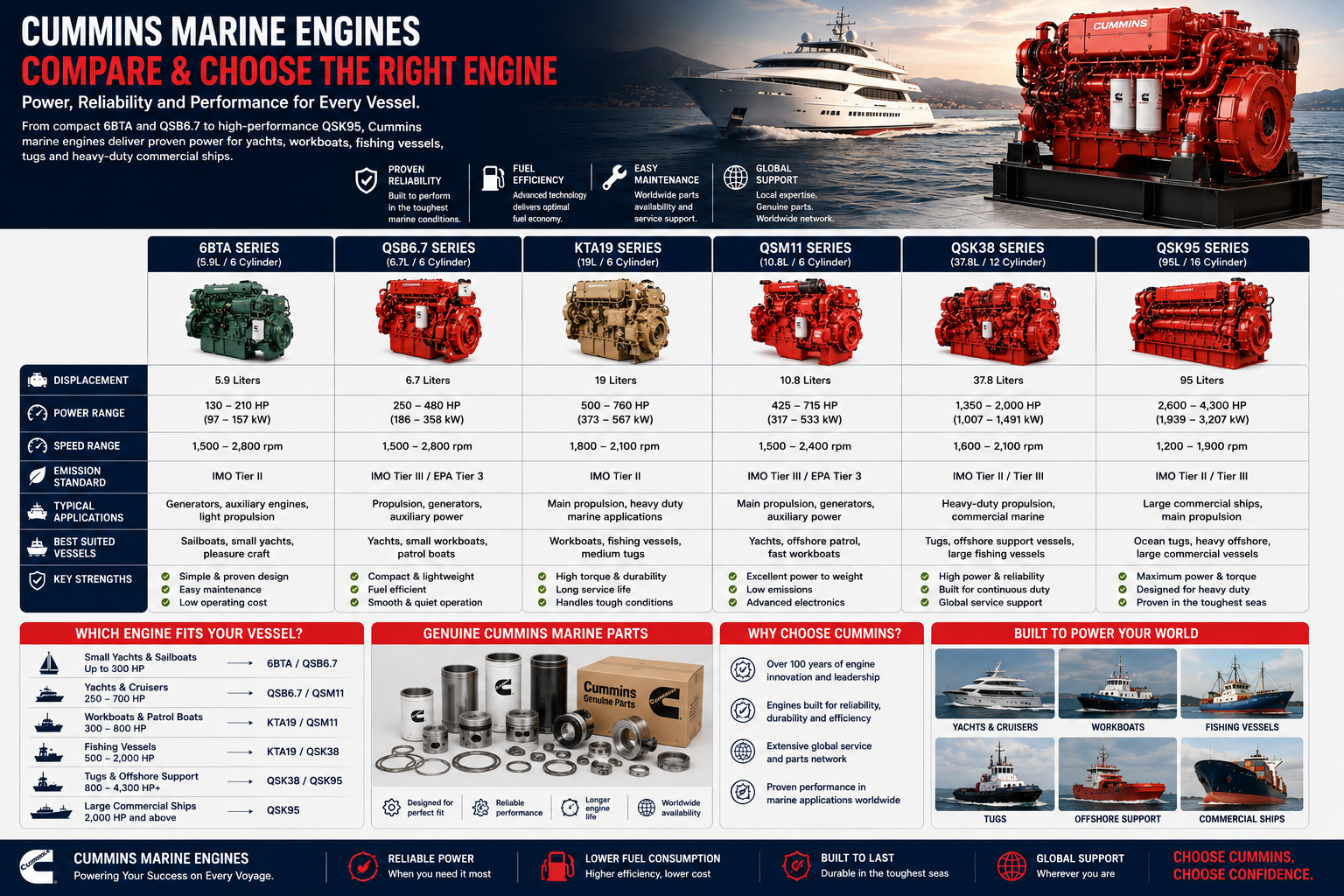
Cummins Marine Engine Types: What Is the Difference, and Which Engine Fits Which Vessel?
When somebody says:
“I have a Cummins marine engine.”
that could mean almost anything from a compact B-Series diesel in a small fishing boat to a QSK95 V16 producing more than 4,000 hp in a large commercial vessel.
Cummins has one of the broadest installed marine diesel populations in the world.
You may come across older engines such as:
- 4B / 4BT / 4BTA
- 6B / 6BT / 6BTA
- 6CT / 6CTA8.3
- N855 / NT855 / NTA855
- V28
- KTA19
- KTA38
- KTA50
Then there are the electronic Quantum-generation engines:
- QSB5.9
- QSB6.7 / QSB7
- QSC8.3
- QSL9
- QSM11
- X15
- QSK19
- QSK38
- QSK50
- QSK60
- QSK95
Cummins officially describes its marine propulsion range as covering commercial, government and recreational vessels, with both the established mechanical N/K families and newer electronic Quantum engines represented in the marine market.
The interesting question therefore isn't:
“Is Cummins a good marine engine?”
A much better question is:
“Which Cummins engine makes sense for this particular vessel and duty cycle?”
First: Understanding the Cummins Marine Engine Families
A simple way to understand the range is to divide it into several generations and power classes.
| Cummins FamilyGeneral CharacterTypical Marine Application | ||
| 4B / 4BT / 4BTA | Compact mechanical diesel | Small boats and auxiliaries |
| 6B / 6BT / 6BTA | Compact inline-six | Fishing boats, workboats, pleasure craft |
| 6CT / 6CTA8.3 | Larger mechanical inline-six | Commercial fishing and workboats |
| N855 / NT855 / NTA855 | Classic heavy-duty inline-six | Fishing vessels and commercial craft |
| KTA19 | Large inline-six | Workboats, fishing vessels, commercial propulsion |
| KTA38 | V12 heavy-duty engine | Tugs, offshore and larger vessels |
| KTA50 | V16 heavy-duty engine | Large commercial propulsion |
| QSB6.7 | Modern electronic inline-six | Yachts, workboats, patrol and fishing craft |
| QSC8.3 | Electronic 8.3-liter inline-six | Yachts and fast commercial craft |
| QSL9 | Electronic inline-six | Commercial and recreational propulsion |
| QSM11 | 11-liter electronic inline-six | Yachts and medium commercial vessels |
| X15 | Modern 15-liter inline-six | Commercial marine propulsion |
| QSK19 | Heavy-duty electronic inline-six | Commercial vessels and auxiliaries |
| QSK38 | Electronic V12 | Tugs and heavy commercial vessels |
| QSK50 | Electronic V16 | Large commercial vessels |
| QSK60 | Large V16 | Tugs, offshore and high-power applications |
| QSK95 | 95-liter V16 | Very large high-power marine applications |
Cummins' current published marine lineup runs from the QSB6.7 at roughly 230–550 hp all the way to the QSK95 at 3,200–4,200 hp.
That is a huge difference.
Cummins B Series: The Small Engine That Became a Marine Favorite
The Cummins B Series is probably one of the most familiar Cummins engine families.
Marine installations include versions such as:
4B
4BT
4BTA
6B
6BT
6BTA
The letters help tell the story.
A basic engine may be naturally aspirated.
Add a T, and turbocharging enters the picture.
Add aftercooling, and the engine can support more power from essentially the same basic displacement.
Where Do B-Series Marine Engines Fit?
These engines became popular in:
- Small fishing vessels
- Workboats
- Trawlers
- Motorboats
- Small passenger craft
- Auxiliary installations
- Repower projects
Why?
Because they combine relatively compact dimensions with a straightforward diesel architecture.
For an older fishing boat where the owner wants something familiar and mechanically understandable, the B Series can still be very attractive.
4B vs. 6B: What Is the Main Difference?
The basic distinction is easy.
Cummins 4B
Four cylinders
Smaller and lighter.
Suitable where modest propulsion or auxiliary power is required.
Cummins 6B
Six cylinders
Greater displacement and substantially more power potential.
Better suited to larger fishing boats, workboats and higher-power propulsion applications.
A six-cylinder engine also tends to deliver smoother power than a four-cylinder engine, although the complete installation, mounts and driveline also affect vibration.
Cummins 6BT and 6BTA: Why Are They So Popular?
The 6BT and 6BTA became especially familiar in the marine world.
They offer a useful combination of:
compact inline-six design
turbocharged power
relatively simple mechanical construction
and
large worldwide installed population.
Cummins continues to recognize 6BT/6BTA Marine engines within its commercial marine support structure.
That matters because many of these engines are no longer young.
Yet they are still working.
Cummins 6CTA8.3: More Displacement for More Work
Move upward and you encounter the 6CT / 6CTA8.3 family.
This is an approximately 8.3-liter class inline-six engine.
Cummins currently lists marine 6CT/6CTA8.3 configurations from approximately 164–270 hp in its product catalog, depending on configuration and rating.
What Kind of Vessel Fits a 6CTA8.3?
Think:
- Commercial fishing boats
- Workboats
- Passenger launches
- Utility vessels
- Trawlers
- Displacement craft
The 6CTA is particularly interesting for operators who want more displacement and commercial capability than the smaller B Series without moving immediately into the much larger N or K engines.
Cummins N855, NT855 and NTA855: The Classic Workhorse
Mention NT855 to experienced diesel mechanics and many will know exactly what you are talking about.
This is one of the classic Cummins heavy-duty inline-six engine families.
Marine versions can appear under names including:
- N855
- NT855
- NTA855
The exact designation and configuration matter when sourcing parts.
Cummins currently lists N855 marine configurations at approximately 270–480 hp and continues to include N855 within its commercial marine support program.
Where Do You Find an N855?
Typical installed applications include:
- Fishing vessels
- Workboats
- Commercial vessels
- Tug-related applications
- Marine auxiliaries
- Generator sets
This is an engine family known much more for working than for looking pretty in a yacht engine room.
What Is the Difference Between N, NT and NTA?
In practical engine terminology, the additional letters generally indicate developments in the air system.
The basic idea is:
N → basic engine family
NT → turbocharged
NTA → turbocharged and aftercooled
That progression is important because getting more air into the cylinders allows the engine to support greater fuel delivery and output.
But every additional system also brings maintenance requirements.
A turbocharger needs proper lubrication.
An aftercooler needs proper cooling and cleaning.
More power always comes with additional engineering responsibility.
Cummins KTA19: The Big Inline-Six
The KTA19 is where Cummins marine power starts becoming seriously heavy-duty.
Despite its large displacement, it remains an inline-six.
Cummins currently lists KTA19 marine versions around 500–700 hp.
Where Does a KTA19 Fit?
Think:
- Large fishing vessels
- Commercial workboats
- Tugboats
- Dredgers
- Offshore vessels
- Passenger vessels
- Marine generators
The KTA19 is an interesting engine because it provides substantial commercial power without requiring a V12 layout.
For a vessel with enough engine-room length, that can be attractive.
Why Would an Engineer Like a Large Inline-Six?
A large inline-six can offer good service accessibility.
You have:
- One cylinder bank
- One row of cylinder heads
- Straightforward valve-train access
- Simpler exhaust routing than many V-engines
- No second bank hidden against another side of the engine room
The disadvantage is length.
Eventually, when power requirements become high enough, packaging many cylinders in a V arrangement becomes more practical.
That is exactly what happens as we move to the KTA38.
Cummins KTA38: Welcome to V12 Territory
The KTA38 is a much larger engine.
Cummins currently lists KTA38 marine versions around 850–1,500 hp.
Now we are dealing with a heavy commercial V-engine.
What Kind of Vessel Uses a KTA38?
Typical applications include:
- Tugboats
- Offshore vessels
- Large fishing vessels
- Dredgers
- Commercial passenger vessels
- Workboats
- Marine generators
A KTA38 installation belongs in a completely different maintenance category from a 6BTA.
Cummins KTA50: Sixteen Cylinders of Commercial Power
The KTA50 moves another step upward.
Cummins currently lists KTA50 marine ratings from approximately 1,180–1,875 hp.
The KTA50 is a V16.
That means a major overhaul can become a very substantial project.
You potentially have sixteen:
- Pistons
- Liners
- Connecting rods
- Injector positions
- Cylinder positions
- Sets of valve components
plus the associated bearings, seals, gaskets and other components.
This is where overhaul planning becomes as much a logistics exercise as a mechanical one.
Mechanical Cummins vs. Quantum Cummins
This is one of the most important dividing lines in the Cummins marine range.
Cummins describes its propulsion portfolio as including the traditional mechanical N and K Series and the newer electronic Quantum Series.
With an older mechanical engine, troubleshooting is heavily based around physical measurements:
- Fuel pressure
- Injection timing
- Compression
- Valve clearance
- Turbocharger condition
- Cooling performance
- Exhaust temperature
- Smoke
With a Quantum engine, you add another layer:
- Electronic control modules
- Sensors
- Fault codes
- Electronic fuel systems
- J1939 engine data
- Electronic monitoring
Cummins' C Command Connect system, for example, provides access to engine data and fault codes on QSB6.7, QSC8.3, QSL9 and QSM11 marine engines.
Cummins QSB6.7: The Modern Compact All-Rounder
The QSB6.7 is one of the most versatile smaller modern Cummins marine engines.
Cummins currently lists QSB6.7/QSB7 marine ratings from approximately 230–550 hp.
It is a six-cylinder, four-stroke inline diesel.
Where Does a QSB6.7 Fit?
Think:
- Motor yachts
- Sportfishing boats
- Commercial fishing vessels
- Patrol boats
- Workboats
- Passenger craft
- Utility vessels
Cummins itself includes the QSB6.7 among its recommended yacht engines.
That tells you something about this engine's personality.
It can work commercially, but it can also fit comfortably into the recreational marine world.
Old 6BTA vs. Modern QSB6.7
These engines share a recognizable Cummins compact inline-six philosophy, but they belong to different generations.
6BTA
Character: Mechanical, straightforward, familiar.
Good for: Older commercial boats, fishing vessels and repower installations where simplicity matters.
QSB6.7
Character: Electronic, modern and higher-output.
Good for: Modern yachts, patrol craft, fishing vessels and commercial boats where electronic control and monitoring are valuable.
One isn't automatically “better.”
The right answer depends on the vessel.
Cummins QSC8.3: More Power From a Compact Six
The QSC8.3 moves upward in displacement and output.
Cummins currently lists marine versions around 490–600 hp.
The QSC8.3 uses a high-pressure common-rail fuel system, which Cummins highlights for improved fuel economy.
Where Does the QSC8.3 Fit?
Potential applications include:
- Yachts
- Sportfishing vessels
- Patrol craft
- Fast workboats
- Passenger boats
- Commercial fishing vessels
It provides significant power without moving to the physical size of a large K-Series engine.
Cummins QSL9: Commercial Power Without Going Huge
The QSL9 is another inline-six platform.
Cummins currently lists marine output around 290–410 hp in its published portfolio.
It occupies an interesting position for vessels requiring a modern electronically controlled commercial engine without needing QSM11 or QSK-class output.
Potential applications include workboats, fishing vessels, passenger craft, government vessels and auxiliary systems.
Cummins QSM11: One of the Best-Known Modern Marine Cummins Engines
The QSM11 is particularly recognizable in yachts and commercial craft.
Cummins currently lists marine ratings from approximately 300–715 hp.
Cummins also specifically promotes the QSM11 for yacht applications.
What Kind of Boat Fits a QSM11?
Think:
- Motor yachts
- Sportfishing vessels
- Commercial fishing boats
- Patrol craft
- Passenger vessels
- Workboats
- Auxiliary applications
This is one of those engines that comfortably crosses between recreational and commercial marine markets.
QSB6.7 vs. QSC8.3 vs. QSM11
This is a useful comparison for yacht and workboat owners.
QSB6.7
Smaller package
Up to roughly 550 hp in current Cummins listings.
Excellent where weight and engine-room space matter.
QSC8.3
Middle step
Around 490–600 hp.
More displacement and strong high-output capability.
QSM11
Larger 11-liter class
Up to roughly 715 hp.
Useful where the vessel needs more displacement and torque without moving into a large V-engine.
All three appear in Cummins' marine portfolio, and QSB6.7, QSC8.3 and QSM11 are specifically highlighted for yacht use.
Cummins X15 Marine: A Modern 15-Liter Option
The X15 brings one of Cummins' major modern engine platforms into marine service.
Current Cummins marine information lists approximately 450–600 hp.
The X15 fits naturally into applications requiring a substantial inline-six but where operators want newer technology and emissions capability.
Potential applications include:
- Commercial fishing vessels
- Workboats
- Dredgers
- Government vessels
- Utility craft
- Commercial propulsion
Cummins currently highlights the X15 alongside QSK engines for demanding dredging applications.
Cummins QSK19: The Modern Successor to Big Mechanical Power
The QSK19 takes the big inline-six concept into the electronic era.
Cummins currently offers marine propulsion ratings from approximately 500–800 hp.
It uses a modular common-rail fuel system designed to maintain high injection pressure regardless of engine speed or load. Cummins also uses a water-cooled exhaust manifold and marine cooling arrangements on the engine.
Which Vessels Suit a QSK19?
Think:
- Commercial fishing vessels
- Workboats
- Dredgers
- Offshore craft
- Passenger vessels
- Marine auxiliary applications
Cummins publishes QSK19 ratings including continuous, heavy-duty and medium-continuous applications.
That is important.
Again, horsepower alone doesn't tell the full story.
Cummins QSK38: Modern V12 Commercial Power
The QSK38 is the modern electronic counterpart to Cummins' large 38-liter-class commercial engine heritage.
Cummins currently lists marine ratings around 1,000–1,400 hp.
This is serious V12 commercial propulsion.
Cummins highlights the QSK38 specifically for demanding marine applications such as tugboats and dredging.
Where Does It Fit?
- Tugboats
- Dredgers
- Offshore vessels
- Large fishing vessels
- Workboats
- Commercial passenger craft
- Auxiliary power
Cummins QSK50: V16 Power for Large Vessels
Move upward and you reach the QSK50.
Current Cummins marine ratings are approximately 1,700–2,200 hp.
At this level, we are firmly in large commercial marine territory.
Typical applications can include:
- Large tugs
- Offshore vessels
- Dredgers
- Large fishing vessels
- Commercial ships
- Large generator installations
Cummins has documented dredging installations using twin QSK50 engines producing approximately 1,700 hp each.
Cummins QSK60: Around 3,000 Horsepower
The QSK60 takes Cummins marine propulsion into another class.
Cummins currently lists the marine QSK60 at approximately 3,000 hp / 2,237 kW.
Cummins specifically positions the QSK60 for demanding commercial marine service and offers modern emissions configurations including IMO III and Tier 4 versions.
Where Does a QSK60 Fit?
Think:
- Large tugboats
- Offshore support vessels
- Large dredgers
- Commercial ships
- Specialized work vessels
- Large auxiliary installations
Cummins even cites hybrid tug installations using two QSK60 engines.
Cummins QSK95: The Giant of the Family
Then we arrive at the QSK95.
This is not simply a bigger yacht engine.
It is a 95-liter V16 marine diesel.
Cummins currently lists marine output at approximately:
QSK95 MARINE
3,200–4,200 hp
2,386–3,132 kW
V16
Four-stroke diesel
Cummins describes the QSK95 as its most powerful high-speed engine built for marine vessels.
That is a completely different engineering world from a 6BTA.
Which Vessels Suit a QSK95?
Think:
- Large tugboats
- Offshore support vessels
- Large commercial craft
- Specialized vessels
- High-power diesel-electric applications
- Large marine generator installations
At this scale, engine selection involves much more than the engine.
You are planning:
- Gearbox
- Shafting
- Propeller
- Cooling
- Exhaust
- Ventilation
- Fuel system
- Structural foundation
- Lifting equipment
- Classification requirements
- Future overhaul access
The engine room is part of the vessel's engineering architecture.
The Cummins Marine Range in One Simple Picture
SMALL COMMERCIAL / PLEASURE
4B / 6B / 6BTA
↓
MEDIUM COMMERCIAL
6CTA8.3 / QSB6.7 / QSC8.3 / QSL9
↓
LARGER INLINE-SIX POWER
NT855 / QSM11 / X15 / KTA19 / QSK19
↓
V12 COMMERCIAL POWER
KTA38 / QSK38
↓
V16 HEAVY COMMERCIAL
KTA50 / QSK50
↓
VERY HIGH OUTPUT
QSK60
↓
LARGE HIGH-SPEED MARINE POWER
QSK95
This is a simplified family guide rather than an interchangeability chart.
Which Cummins Marine Engine Is Best for a Fishing Boat?
Fishing boats are one of the areas where Cummins has an enormous installed base.
For a smaller fishing vessel, engines from the B Series can make sense.
Examples include:
6BT
6BTA
For a larger vessel:
6CTA8.3
QSB6.7
QSC8.3
QSM11
may become relevant.
Move into heavier commercial fishing and you may encounter:
NT855
KTA19
QSK19
KTA38
or QSK38.
The deciding factor is not simply boat length.
Look at:
displacement + propeller load + annual hours + duty rating + required cruise speed.
Which Cummins Engine Is Best for a Yacht?
Cummins specifically identifies the QSB6.7/QSB7, QSC8.3 and QSM11 among its yacht-engine offerings.
For many yachts, these engines offer an attractive balance between:
- Power
- Compact size
- Electronic monitoring
- Smoothness
- Weight
- Serviceability
Older yachts may still have mechanical engines such as 6BTA or other legacy Cummins installations.
That does not automatically make them inferior.
A properly maintained mechanical Cummins can remain an excellent engine.
Which Cummins Engine Is Best for a Workboat?
Workboats vary enormously.
A small harbor utility boat may be suited to:
6BTA or QSB6.7
A larger workboat might use:
QSC8.3
QSM11
X15
KTA19
or
QSK19
A heavy workboat may require:
QSK38
or larger.
This is why “workboat engine” isn't really an engine category.
A 10-meter harbor launch and a large offshore workboat both work for a living, but they do completely different jobs.
Which Cummins Engine Is Best for a Tugboat?
Tugboats need serious torque and commercial-duty capability.
This is where the larger Cummins engines become particularly interesting.
Potential families include:
- KTA19
- QSK19
- KTA38
- QSK38
- KTA50
- QSK50
- QSK60
- QSK95
depending on vessel size and bollard-pull requirements.
Cummins specifically highlights the QSK38, QSK60 and QSK95 in its tugboat portfolio.
Which Cummins Engine Is Best for a Dredger?
Dredging is extremely demanding.
Engines may operate for long periods under significant load.
Cummins highlights the QSK19, QSK38 and X15 for dredging and has documented applications using QSK50 and KTA38 engines.
The lesson here is important:
A dredger needs an engine selected around commercial duty, not simply peak horsepower.
Which Cummins Engines Can Be Used as Marine Auxiliary Engines?
Many Cummins marine families are available or have historically been used in auxiliary applications.
Cummins' commercial marine support specifically covers engines including:
- 6BT / 6BTA
- 6CT / 6CTA8.3
- QSB7
- QSM11
- N855
- KTA19
- QSK19
- V28
- KTA38
- QSK38
- KTA50
- QSK50
- QSK60
- QSK95
across its high-horsepower marine commercial propulsion and auxiliary program.
That makes Cummins particularly useful when a fleet wants engine-family familiarity across propulsion and auxiliary machinery.
What About Cummins VTA28 / V28?
The V28 family is another important name in older Cummins heavy-duty marine installations.
You may encounter designations such as VTA28 in older vessels and parts inquiries.
The family belongs to the large V-engine side of Cummins' historical range and continues to appear in Cummins' commercial marine support documentation under V28.
Typical applications include commercial propulsion and auxiliary power.
For older V28-family engines, exact model and serial identification becomes especially important because age, rating and configuration can significantly affect the parts required.
Mechanical vs. Electronic: Which Would You Choose?
Imagine two fishing vessels.
Vessel A
The boat works from a remote harbor.
The local mechanic knows mechanical Cummins engines extremely well.
Electronic diagnostic support is limited.
A well-maintained 6BTA, NT855 or KTA19 may be very attractive.
Vessel B
The vessel operates from modern commercial ports.
The owner wants:
- Fault-code monitoring
- Electronic engine data
- Modern fuel control
- Emissions compliance
- Integration with vessel displays
A QSB, QSC, QSM or QSK engine may make more sense.
Neither approach is automatically correct.
The operating environment matters.
Common Rail: Why Does It Matter?
Modern Cummins marine engines increasingly use electronically controlled high-pressure fuel systems.
The QSK19, for example, uses Cummins' modular common-rail system, maintaining high injection pressure across different engine speeds and load conditions.
This can improve:
- Combustion control
- Idle stability
- Noise
- Low-speed torque
- Emissions performance
But it also changes the workshop environment.
Fuel-system cleanliness becomes extremely important.
Contamination that an older mechanical fuel system might tolerate can cause serious problems in a high-pressure common-rail system.
Marine Engineer Tip
NEVER ORDER BY “CUMMINS ENGINE” ALONE
Before ordering a part, identify:
Complete engine model
Engine serial number
CPL where applicable
Existing part number
Propulsion or auxiliary
Duty rating
Rated rpm
Quantity
Photographs when possible
This becomes particularly important because engines from the same basic family can have different ratings and marine configurations.
Why the Cummins CPL Can Matter
Cummins users often encounter the term CPL, or Control Parts List.
Two engines may share the same basic model name while using different internal or external components because they were built to different specifications.
This is one reason experienced parts suppliers ask for the engine serial number rather than relying only on:
“Cummins KTA19.”
The more accurately the engine is identified, the lower the risk of ordering the wrong piston, injector, gasket, turbocharger or other component.
Why Horsepower Alone Is Not Enough
Suppose you have two Cummins engines producing similar horsepower.
Can they do the same job?
Not necessarily.
One may be intended for high-hour continuous commercial service.
Another may reach that output under a less demanding rating.
Cummins publishes multiple rating categories on engines such as the QSK19, including continuous, heavy-duty and medium-continuous configurations.
So don't ask only:
“How many horsepower?”
Ask:
“At what rating and rpm?”
That is a much more useful marine-engine question.
Quick Cummins Marine Engine Comparison
| Engine FamilyGeneral Power ClassTypical Application | ||
| 4B / 4BT / 4BTA | Small | Small boats, auxiliaries |
| 6B / 6BT / 6BTA | Small-medium | Fishing, workboats, pleasure craft |
| 6CT / 6CTA8.3 | Medium | Fishing and commercial vessels |
| N855 / NT855 | Medium-heavy | Commercial fishing and workboats |
| QSB6.7 | 230–550 hp | Yachts, fishing, workboats |
| QSC8.3 | 490–600 hp | Yachts, patrol and fast commercial craft |
| QSL9 | 290–410 hp | Commercial and recreational applications |
| QSM11 | 300–715 hp | Yachts and commercial craft |
| X15 | 450–600 hp | Commercial workboats and dredging |
| KTA19 | 500–700 hp | Fishing, workboats, commercial vessels |
| QSK19 | 500–800 hp | Heavy commercial propulsion |
| KTA38 | 850–1,500 hp | Tugs, offshore, dredgers |
| QSK38 | 1,000–1,400 hp | Tugs and heavy commercial vessels |
| KTA50 | 1,180–1,875 hp | Large commercial vessels |
| QSK50 | 1,700–2,200 hp | Large tugs, offshore and dredgers |
| QSK60 | ~3,000 hp | High-power commercial marine |
| QSK95 | 3,200–4,200 hp | Very large high-power applications |
Current power ranges shown for the modern and K-Series products are based on Cummins' published marine listings.
Cummins Marine Engine “Personalities”
Sometimes the easiest way to remember the range is to give each family a character.
6BTA — The Compact Veteran
Simple, familiar and still working in countless boats.
6CTA8.3 — The Bigger Worker
More displacement for commercial boats that need a step above the B Series.
NT855 — The Old-School Workhorse
A name generations of diesel mechanics recognize.
KTA19 — The Big Straight-Six
Serious commercial power without moving into a V-engine.
KTA38 — The Mechanical Heavyweight
V12 territory for tugs, offshore craft and hard-working vessels.
QSB6.7 — The Modern All-Rounder
Compact enough for yachts but capable of commercial work.
QSC8.3 — The Compact Performer
Significant output from a manageable inline-six package.
QSM11 — The Yacht-and-Workboat Crossover
Large enough for serious power but still relatively compact.
QSK19 — The Electronic Workhorse
Big inline-six durability combined with modern electronic fuel control.
QSK38 — The Modern V12
Built for demanding commercial applications.
QSK50 — The Large V16
When the vessel has moved well beyond ordinary workboat power.
QSK60 — The 3,000-Horsepower Machine
Serious tug and offshore territory.
QSK95 — The Giant
A 95-liter V16 producing up to 4,200 hp.
Common Cummins Marine Engine Spare Parts
Depending on the engine family, common requirements include:
- Oil filters
- Fuel filters
- Air filters
- Fuel injectors
- Injector nozzles
- Injection pumps
- High-pressure fuel pumps
- Fuel transfer pumps
- Turbochargers
- Aftercoolers
- Charge-air coolers
- Seawater pumps
- Raw-water pump impellers
- Freshwater pumps
- Heat exchangers
- Thermostats
- Water-cooled exhaust manifolds
- Cylinder heads
- Intake valves
- Exhaust valves
- Valve guides
- Valve seats
- Pistons
- Piston rings
- Cylinder liners
- Connecting rods
- Main bearings
- Connecting-rod bearings
- Crankshafts
- Camshafts
- Oil pumps
- Gaskets
- O-rings
- Oil seals
- Sensors
- Electronic control components
- Complete overhaul kits
The exact part should always be verified against the engine serial number and configuration.
Why Cooling-System Parts Matter So Much on Cummins Marine Engines
A truck engine has one environment.
A marine engine has another.
The marine engine may depend on:
seawater pumps
heat exchangers
aftercoolers
water-cooled exhaust manifolds
and multiple cooling circuits.
The QSK19 is a good example. Cummins specifies a marine cooling system with an engine-mounted titanium plate heat exchanger and a water-cooled exhaust manifold.
That means cooling-system maintenance is not secondary.
It is fundamental to engine life.
A perfectly healthy piston cannot save an engine that is being continuously overheated.
Why Exact Cummins Engine Identification Matters
Imagine receiving this request:
“Need Cummins water pump.”
That is nowhere near enough information.
Even:
“Need KTA19 water pump.”
may still not be enough.
A better inquiry looks like:
Engine: Cummins KTA19-M
Engine Serial Number: __________
CPL: __________
Current Part Number: __________
Application: Marine propulsion
Quantity: __________
Photos: Attached
The same applies to QSB, QSC, QSM and QSK engines.
Correct identification before shipment can prevent expensive downtime.
Frequently Asked Questions
What are the main Cummins marine engine families?
The Cummins marine fleet includes older B, C, N and K-Series engines alongside modern QSB, QSC, QSL, QSM, X15 and QSK engines. Cummins currently describes its propulsion portfolio as spanning mechanical N/K products and electronic Quantum engines.
What Cummins engine is commonly used in yachts?
Cummins specifically highlights the QSB6.7/QSB7, QSC8.3 and QSM11 for yacht applications.
What is the power range of the QSB6.7?
Current Cummins marine listings show approximately 230–550 hp, depending on configuration and rating.
What is the difference between KTA19 and QSK19?
Both belong to Cummins' large 19-liter-class commercial-engine heritage, but the QSK19 represents a newer electronically controlled generation and uses modern common-rail fuel-system technology.
Is the KTA38 a large marine engine?
Yes. Current Cummins listings show marine KTA38 versions around 850–1,500 hp.
How much power does a QSK50 produce?
Cummins currently lists the QSK50 marine engine at approximately 1,700–2,200 hp.
How powerful is the QSK60?
Cummins currently lists approximately 3,000 hp / 2,237 kW for the marine QSK60.
What is the largest Cummins marine engine covered here?
The QSK95 is the largest engine discussed in this guide. Cummins lists it at approximately 3,200–4,200 hp, and identifies it as a 95-liter V16.
Are Cummins marine engines used in generators?
Yes. Numerous Cummins families are available or supported for marine auxiliary applications, from smaller engines through QSK19, QSK38, QSK50, QSK60 and QSK95.
Are older Cummins mechanical engines still relevant?
Yes. Cummins continues to list and support several established marine families including 6BT/6BTA, 6CT/6CTA8.3, N855, KTA19, KTA38 and KTA50 within its commercial marine programs.
Cummins Marine Engine Spare Parts
Alfa Marine Spare Parts can assist with spare-parts requirements for Cummins marine engine families including:
4B / 4BT / 4BTA
6B / 6BT / 6BTA
6CT / 6CTA8.3
N855 / NT855 / NTA855
V28 / VTA28
KTA19
KTA38
KTA50
QSB5.9
QSB6.7 / QSB7
QSC8.3
QSL9
QSM11
X15
QSK19
QSK38
QSK50
QSK60
QSK95
Depending on the engine and availability, requirements may include genuine, OEM, aftermarket, remanufactured or reconditioned components.
Related Cummins Marine Engine Pages
- Cummins 4B Marine Engine Spare Parts
- Cummins 4BT Marine Engine Spare Parts
- Cummins 4BTA Marine Engine Spare Parts
- Cummins 6BT Marine Engine Spare Parts
- Cummins 6BTA Marine Engine Spare Parts
- Cummins 6CTA8.3 Marine Engine Spare Parts
- Cummins NT855 Marine Engine Spare Parts
- Cummins NTA855 Marine Engine Spare Parts
- Cummins VTA28 Marine Engine Spare Parts
- Cummins KTA19 Marine Engine Spare Parts
- Cummins KTA38 Marine Engine Spare Parts
- Cummins KTA50 Marine Engine Spare Parts
- Cummins QSB5.9 Marine Engine Spare Parts
- Cummins QSB6.7 Marine Engine Spare Parts
- Cummins QSC8.3 Marine Engine Spare Parts
- Cummins QSL9 Marine Engine Spare Parts
- Cummins QSM11 Marine Engine Spare Parts
- Cummins X15 Marine Engine Spare Parts
- Cummins QSK19 Marine Engine Spare Parts
- Cummins QSK38 Marine Engine Spare Parts
- Cummins QSK50 Marine Engine Spare Parts
- Cummins QSK60 Marine Engine Spare Parts
- Cummins QSK95 Marine Engine Spare Parts
Why Choose Alfa Marine Spare Parts?
Cummins is exactly the kind of engine brand where the complete engine information matters.
A customer may request:
“Cummins 6BTA injectors.”
Another might need:
“KTA38 seawater pump.”
A yacht engineer may be searching for a QSM11 heat exchanger.
A tug operator may need QSK38 overhaul components.
And an offshore operator may be planning maintenance on a QSK60.
These are all Cummins engines, but they require very different parts.
Alfa Marine Spare Parts assists shipyards, marine engineers, chief engineers, technical superintendents, fishing companies, workboat operators, yacht managers, tug operators and offshore companies with Cummins marine diesel spare-parts requirements.
The objective is straightforward:
identify the engine correctly before identifying the part.
Worldwide Cummins Marine Spare Parts Supply
Alfa Marine Spare Parts supports shipyards, ship repairers, marine engineers, chief engineers, technical superintendents, fishing fleets, workboat operators, tug operators, yacht managers, passenger-vessel operators, offshore companies, government fleets, maritime contractors, marine service companies, boat builders and marine equipment distributors.
For an inquiry, send the:
Cummins engine model + engine serial number + CPL where available + existing part number + quantity + photographs.
Contact Alfa Marine Spare Parts
Email: request@alfamarinespareparts.com
Alfa Marine Spare Parts
Marine Spare Parts Catalog
One Final Thought
The Cummins marine family becomes much easier to understand when you stop looking at it as one enormous list of model numbers.
A 6BTA is the compact mechanical veteran.
The 6CTA8.3 gives the commercial operator more displacement.
The NT855 represents classic heavy-duty Cummins engineering.
The KTA19 is the big inline-six workhorse.
The KTA38 and KTA50 move into large mechanical V-engine territory.
Then the Quantum family changes the picture.
The QSB6.7, QSC8.3 and QSM11 provide modern electronic power for yachts and smaller commercial vessels, while the QSK19, QSK38, QSK50 and QSK60 progressively move into heavier commercial service.
At the top, the QSK95 delivers up to approximately 4,200 hp from a 95-liter V16.
So when somebody asks:
“Which Cummins marine engine is best?”
the answer should always begin with another question:
What vessel, what duty and how many operating hours?
Because the best Cummins engine for a sportfishing boat is not the best Cummins engine for a tug—and the best engine for a tug is certainly not the same one you would choose for a small harbor workboat.