
Cummins Marine Engine Exhaust Systems: Manifolds, Turbochargers, Risers, Elbows, Leaks & Troubleshooting
The exhaust system on a Cummins marine engine does much more than carry combustion gases out of the vessel.
It directly affects turbocharger performance, engine-room temperature, exhaust backpressure, cylinder temperatures, noise, and—on many wet-exhaust installations—the safe discharge of cooling water and exhaust gas overboard.
A small exhaust leak can begin as nothing more than a black soot mark around a joint.
A restricted exhaust elbow may first appear as slightly higher exhaust temperature.
A leaking water-cooled component can become much more serious if seawater is able to reach parts of the engine where it should never be.
This is why the exhaust system should be inspected as part of the complete Cummins marine engine system, not simply as piping behind the turbocharger.
The useful question is not only:
“Is exhaust coming out?”
It is:
“Is exhaust leaving the engine with the correct flow, temperature and backpressure—and is the marine cooling arrangement keeping water where it belongs?”
1. Cummins Marine Engine Types Covered in This Guide
This guide applies broadly to Cummins marine engines including older mechanical families and newer electronically controlled engines.
Common types include Cummins 4B, 4BT, 4BTA, 6B, 6BT, 6BTA, 6CTA8.3, NT855, NTA855, VTA28, VTA1710, KTA19, KTA38, KTA50, QSB5.9, QSB6.7, QSC8.3, QSL9, QSM11, QSK19, QSK38, QSK50, QSK60 and QSK95.
The exhaust arrangement can differ considerably between a small 4BTA installation and a large QSK50 or QSK60 commercial engine.
Always identify the complete engine model, serial number, rating and vessel installation before ordering exhaust components.
2. What Does a Cummins Marine Exhaust System Do?
The obvious job is to remove combustion gases.
But the exhaust system also influences how efficiently the turbocharger operates and how easily the cylinders can expel exhaust gas.
On a turbocharged engine, the basic flow is approximately:
Cylinder → exhaust manifold → turbine side of turbocharger → exhaust outlet → marine exhaust piping → silencer/water-injection arrangement where fitted → overboard discharge
Every part of this path needs to operate correctly.
A restriction near the vessel outlet can influence the engine much farther upstream.
3. Why Exhaust Backpressure Matters
The engine has to push exhaust gas out of the cylinders.
If the exhaust system becomes too restrictive, the engine must work harder to clear those gases.
Excessive backpressure can contribute to:
higher exhaust temperature, reduced engine output, increased fuel consumption, poorer turbocharger performance and increased thermal loading.
A restricted exhaust system does not always create an immediate alarm.
Performance can deteriorate gradually.
4. Situation: The Cummins Engine No Longer Reaches Normal RPM
Many technicians first look at the fuel system.
That is reasonable—but the exhaust system should not be forgotten.
Possible exhaust-related causes can include a restricted elbow, damaged silencer, internal exhaust-hose deterioration, excessive backpressure or another downstream restriction.
Before assuming the Cummins engine has lost power internally, consider whether it can breathe out as well as in.
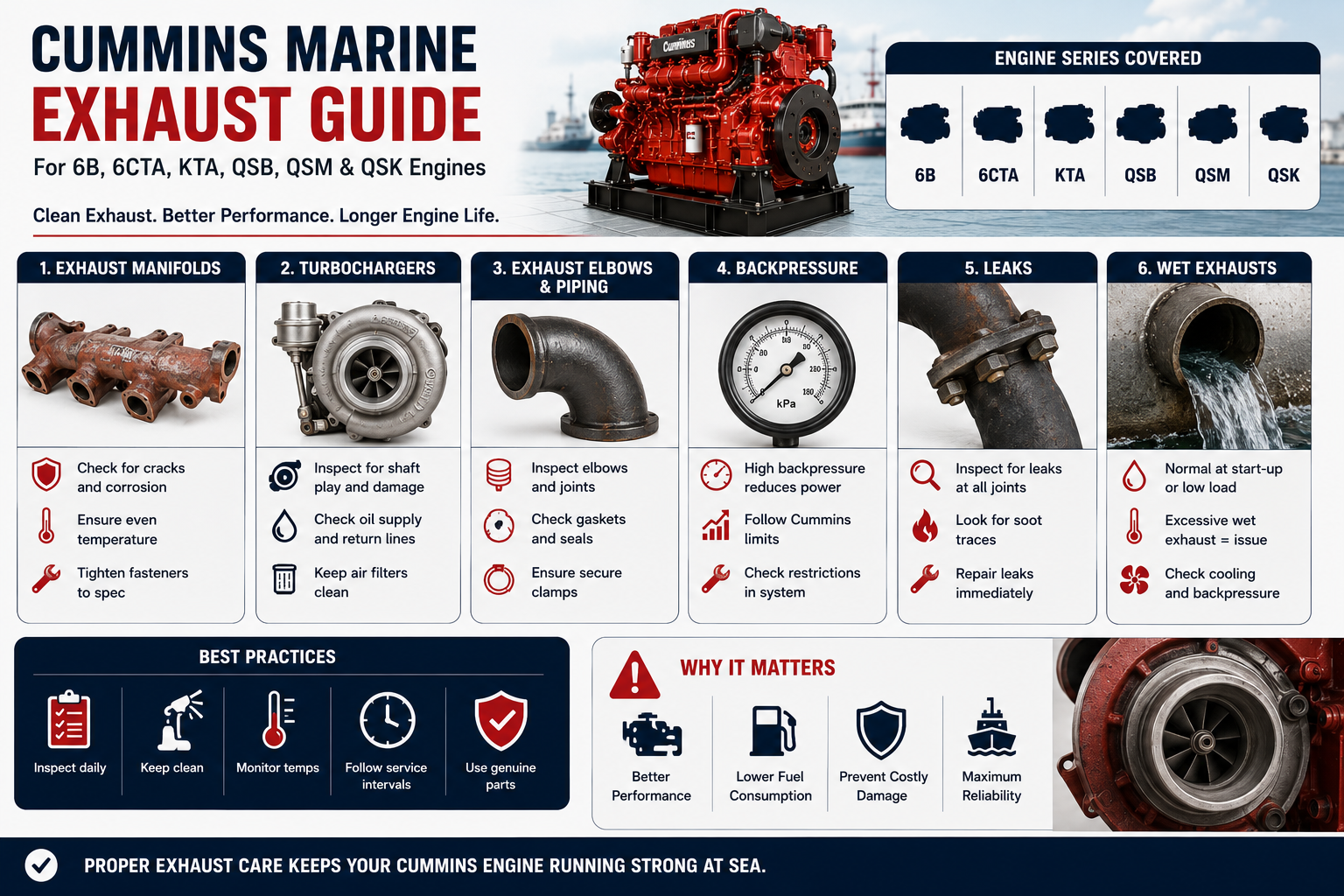
5. Exhaust Manifolds on Cummins Marine Engines
The exhaust manifold collects gas from the individual cylinders and directs it toward the turbocharger or exhaust outlet.
It operates under severe thermal conditions.
Depending on the engine and installation, problems can include cracking, gasket leakage, loose fasteners, corrosion, distortion and carbon deposits.
A manifold problem may initially show itself as a black soot mark rather than a major visible crack.
6. Black Soot Around the Exhaust Manifold
Soot is one of the most useful visual clues in an engine room.
If black deposits appear around a manifold connection, gasket or turbocharger mounting area, exhaust gas may be escaping.
Do not simply clean the soot off.
Ask:
“Where is the exhaust escaping?”
Then inspect the joint carefully.
7. Why an Exhaust Leak Before the Turbocharger Matters
The turbocharger turbine relies on exhaust energy.
If hot exhaust gas escapes before reaching the turbine, less energy is available to drive the turbocharger.
Possible symptoms can include lower boost, slower acceleration, increased smoke, higher exhaust temperature and reduced power.
This means an apparently minor manifold leak can eventually look like a turbocharger problem.
8. Exhaust Leaks Can Raise Engine-Room Temperature
Hot exhaust gas leaking into the engine room can damage more than the exhaust system.
Nearby components may include wiring harnesses, hoses, insulation, sensors and electrical equipment.
Heat also affects engine-room ventilation and intake-air temperature.
A small exhaust leak should therefore not become accepted as:
“normal for an old engine.”
9. Cummins 4B, 4BT & 4BTA Exhaust Systems
The smaller B-Series engines are commonly used in smaller commercial boats, generators and propulsion installations.
On turbocharged versions such as the 4BT and 4BTA, inspect the connection between the exhaust manifold and turbocharger carefully.
On marine installations, also pay attention to the exhaust elbow or water-injection section where fitted.
Corrosion becomes particularly important wherever seawater and exhaust components operate close together.
10. Cummins 6B, 6BT & 6BTA Exhaust Systems
The 6B family is widely used in marine propulsion.
Common inspection areas include the exhaust manifold, turbocharger connections, exhaust elbow, wet-exhaust hose and cooling-water injection arrangement.
If a 6BTA develops:
black smoke + low boost + soot around the manifold,
do not replace the turbocharger before repairing the exhaust leak.
11. Cummins 6CTA8.3 Exhaust System
The 6CTA8.3 is frequently found in workboats, fishing vessels and commercial propulsion.
As operating hours accumulate, monitor for manifold leakage, turbocharger connection problems, elbow corrosion, exhaust-hose deterioration and increasing backpressure.
If the engine historically reached normal loaded RPM but no longer does, the exhaust system belongs on the troubleshooting list.
12. Cummins NT855 & NTA855 Exhaust Systems
Older NT855 and NTA855 engines can have decades of operating history.
Previous repairs may include replacement manifolds, turbochargers, elbows or fabricated exhaust piping.
This means the system currently installed may not be exactly as it left the factory.
Inspect the actual components fitted to the engine rather than relying only on old vessel documentation.
13. Cummins KTA19 Exhaust System
The KTA19 is widely used in heavy commercial marine service.
Its exhaust system should be inspected for manifold condition, turbocharger connections, exhaust leakage, insulation condition and downstream restriction.
A KTA19 operating thousands of hours per year can accumulate thermal cycles that eventually affect gaskets and joints.
Changes in exhaust temperature are worth recording.
14. Cummins KTA38 & KTA50 Exhaust Systems
Larger engines such as the KTA38 and KTA50 produce substantial exhaust-gas flow.
On these engines, bank-to-bank comparisons can become valuable.
If one bank shows different exhaust temperature or turbocharger behavior from the other, investigate the reason.
Possible areas include the exhaust manifold, turbocharger, fuel delivery and cylinder condition.
15. Cummins QSB5.9 & QSB6.7 Exhaust Systems
The QSB family combines compact size with modern electronic engine management.
Do not assume an electronic fault is responsible for every power complaint.
Mechanical exhaust problems can still cause low boost, high temperature and reduced performance.
Inspect the physical exhaust system alongside the electronic data.
16. Cummins QSC8.3 Exhaust System
For the QSC8.3, monitor the complete path from the cylinder head to the turbocharger and downstream marine exhaust components.
A charge-air problem and an exhaust problem can create similar symptoms.
Use boost, temperature, smoke and physical inspection together.
17. Cummins QSL9 Exhaust System
The QSL9 can operate in commercial applications where stable loading makes trend monitoring especially useful.
If exhaust temperature gradually rises at the same RPM and load, investigate air, fuel and exhaust conditions before the change becomes severe.
18. Cummins QSM11 Exhaust System
The QSM11 marine engine deserves particular attention around the turbocharger, exhaust manifold and marine outlet arrangement.
If the engine develops black smoke or slower acceleration, check both sides of the turbocharger:
air going in
and:
exhaust gas coming out.
A turbocharger cannot work correctly if either side is restricted.
19. Cummins QSK19 Exhaust System
The QSK19 belongs to a heavier commercial engine class.
Useful monitored information can include exhaust temperature, boost, load and fuel-related parameters.
If one cylinder or group of cylinders behaves differently, use the data to determine whether the problem is localized or system-wide.
20. Cummins QSK38, QSK50, QSK60 & QSK95 Exhaust Systems
Large QSK engines move enormous quantities of exhaust gas.
At this scale, exhaust-system condition affects significant engine power.
Inspection should consider manifolds, turbochargers, expansion connections, insulation, exhaust piping, backpressure and temperature trends.
The cost of an unnoticed exhaust problem also increases with engine size.
21. What Is a Wet Marine Exhaust System?
Many smaller and medium marine engines use a wet exhaust arrangement.
Cooling water is introduced into the exhaust downstream of critical hot engine components.
The injected water helps reduce exhaust temperature before gases travel through marine exhaust hose and related components.
This allows exhaust systems to be routed through areas where completely dry exhaust piping would create excessive heat.
But wet exhaust introduces another concern:
water must never be allowed to travel backward into the engine.
22. Why Water Injection Location Matters
Seawater should enter the exhaust system at the correctly designed location.
If the installation geometry is wrong, there can be risk of water migrating toward the engine.
This is especially important when:
- Vessel trim changes
- The boat pitches heavily
- Exhaust components are installed too low
- Drainage is poor
- Anti-siphon arrangements are incorrect
- The exhaust riser is improperly designed
Water entering a cylinder can cause extremely serious damage.
23. Exhaust Risers
An exhaust riser helps position the exhaust path appropriately before water injection and discharge, depending on installation.
Marine risers operate in a harsh combination of:
heat + exhaust gas + seawater + corrosion.
They should therefore be inspected carefully.
Internal corrosion may be much worse than the exterior appearance suggests.
24. Exhaust Elbows
The marine exhaust elbow is another important component.
Depending on engine and installation, it may combine hot exhaust flow with cooling-water introduction.
Common problems can include internal corrosion, carbon accumulation, restricted passages and leakage.
A clean-looking exterior does not guarantee the inside is healthy.
25. A Restricted Exhaust Elbow Can Reduce Engine Power
Inside the elbow, deposits or corrosion can gradually reduce the available flow area.
The engine may then show:
- Reduced RPM
- Slower acceleration
- Black smoke
- Higher exhaust temperature
- Increased fuel consumption
This can easily be mistaken for a turbocharger or fuel-system problem.
26. Corrosion in Water-Cooled Exhaust Components
Marine exhaust components live in one of the most corrosive environments onboard.
Saltwater can attack:
- Elbows
- Risers
- Water-injection fittings
- Internal passages
- Sealing surfaces
Corrosion can eventually create internal or external leakage.
Inspect older components before failure becomes obvious.
27. Water Leaking Into the Exhaust Gas Side
This is a much more serious situation than an external seawater drip.
Internal leakage can allow cooling water into parts of the exhaust path where it should not be.
Depending on installation and engine position, this can create risk to the turbocharger or engine.
Any unexplained internal water evidence in the exhaust system deserves immediate investigation.
28. Water Entering a Cylinder
Water does not compress like air.
If enough water enters a cylinder, serious mechanical damage can occur.
Potential consequences can include damage to connecting rods, pistons, valves or other internal engine components.
This is why correct exhaust-system design and anti-backflow protection matter so much in marine installations.
29. Signs of Possible Water Ingress
Possible warning signs can include difficult cranking, abnormal starting behavior, unusual white vapor, corrosion evidence or unexplained moisture in areas that should remain dry.
These symptoms can have other causes.
But seawater ingress should never be treated casually.
30. Exhaust Hoses
Wet-exhaust hose is designed to handle a demanding environment.
Inspect for:
- Cracking
- Soft areas
- Bulging
- Delamination
- Heat damage
- Chafing
- Loose clamps
A damaged exhaust hose can introduce exhaust gases and water into the vessel.
31. Do Not Ignore Soft or Swollen Exhaust Hose
A hose can deteriorate internally before it fails completely.
If the hose feels abnormally soft, swollen or deformed, investigate.
Internal delamination can also restrict flow.
Again, exhaust backpressure may rise even though the hose has not visibly burst.
32. Exhaust Hose Clamps
Marine exhaust hoses may use substantial clamping arrangements.
Inspect for:
- Corrosion
- Loose clamps
- Broken bands
- Damaged fasteners
- Incorrect positioning
A large exhaust hose coming loose underway can create a serious engine-room problem.
33. Dry Exhaust Systems
Larger commercial Cummins engines may use dry exhaust arrangements.
These systems can include:
- Exhaust manifolds
- Turbochargers
- Expansion joints
- Insulated piping
- Silencers
- Stack components
Thermal expansion becomes especially important.
Rigidly installed hot piping without adequate expansion accommodation can place stress on manifolds and turbocharger connections.
34. Exhaust Expansion Joints
Expansion joints help accommodate thermal growth and vibration.
Inspect for:
- Cracking
- Soot
- Distortion
- Loose connections
- Heat damage
A failed expansion joint can leak extremely hot exhaust gas into the engine room.
35. Exhaust Insulation
Insulation helps control surface temperature.
Damaged insulation can expose nearby components and personnel to excessive heat.
Inspect for:
- Missing insulation
- Wet insulation
- Damaged covers
- Hot spots
- Exhaust soot underneath the covering
Do not treat insulation as purely cosmetic.
36. Situation: The Engine Room Is Suddenly Hotter
If ventilation has not changed but engine-room temperature is increasing, inspect the exhaust system.
Possible causes include:
- Exhaust leak
- Damaged insulation
- Turbocharger connection leak
- Manifold leak
A hot engine room can also increase intake-air temperature, so one exhaust problem can begin influencing engine performance elsewhere.
37. Situation: Black Soot Appears Near the Turbocharger
Possible areas include the manifold-to-turbo connection, turbocharger outlet, gasketed joints or another exhaust connection.
Clean the area, operate the engine safely and inspect whether fresh soot returns.
Repeated soot deposition is evidence worth investigating.
38. Situation: One Cummins Engine Has Lower Boost Than Its Twin
In a twin-engine boat, compare both engines under similar operating conditions.
If one engine has lower boost, inspect:
- Air intake
- Turbocharger
- Charge-air cooler
- Exhaust manifold
- Exhaust leaks
- Downstream exhaust restriction
One engine can act as a reference for the other.
39. Situation: Black Smoke but Boost Looks Normal
Now the diagnosis may move in another direction.
Possible causes can include fuel delivery, injector condition, engine overload or inaccurate instrumentation.
The exhaust system should still be checked, but normal boost changes the evidence.
This is why several parameters should be considered together.
40. Situation: High Exhaust Temperature but Coolant Temperature Is Normal
This is an important distinction.
The problem may involve combustion or airflow rather than the main engine cooling circuit.
Possible areas include:
- Turbocharger
- Charge-air system
- Injector
- Exhaust restriction
- Engine load
Do not diagnose every high-temperature reading as a coolant-system problem.
41. Situation: Exhaust Temperature Is High Across All Cylinders
A system-wide increase can point toward:
- Excessive engine load
- Air restriction
- Turbocharger deterioration
- Charge-air cooling problems
- Exhaust restriction
This is different from only one cylinder being abnormal.
Patterns matter.
42. Situation: Only One Cylinder Has High Exhaust Temperature
A single-cylinder difference may direct attention toward:
- Injector
- Valve condition
- Compression
- Fuel delivery
- Cylinder condition
The common exhaust system generally affects multiple cylinders.
A localized temperature problem deserves localized investigation.
43. Exhaust Backpressure Measurement
When restriction is suspected, actual backpressure measurement can be far more useful than guessing.
A system may look fine externally while being restricted internally.
Backpressure should be evaluated according to the correct limits for the exact engine and installation.
Do not invent a universal figure for all Cummins marine engines.
44. Why Backpressure Can Increase Over Time
Possible causes include:
- Carbon accumulation
- Internal corrosion
- Collapsed hose
- Silencer deterioration
- Restricted elbow
- Poor modifications
- Added exhaust components
This becomes particularly relevant after vessel modifications.
45. Exhaust Problems After Repowering
A new engine may produce different exhaust flow from the engine it replaced.
If the old exhaust system is reused without proper evaluation, the vessel may develop excessive backpressure.
Repowering should therefore consider:
- Exhaust pipe size
- Hose size
- Silencer capacity
- Riser design
- Water injection
- Outlet location
A new Cummins engine deserves an exhaust system designed for its actual requirements.
46. Exhaust Problems After Adding a Silencer
Adding additional restriction can change the exhaust system.
If engine performance changes after exhaust modifications, measure and inspect the modified system.
Do not immediately assume the engine developed an unrelated problem at the same time.
47. Turbocharger Damage and the Exhaust System
The turbine wheel lives directly in the exhaust stream.
Abnormal exhaust conditions can contribute to turbocharger problems.
Inspect for:
- High-temperature exposure
- Foreign-object damage
- Heavy deposits
- Upstream exhaust-component failure
If the turbine is damaged, ask:
“Did something come from the engine or exhaust system?”
48. Foreign Material on the Turbine Side
If turbine blades show impact damage, investigate upstream components.
Possible sources can include damaged engine components or material from the exhaust path.
Replacing the turbocharger without finding the origin of the debris leaves the replacement vulnerable.
49. Fuel Injectors and Exhaust Temperature
Poor injection can change exhaust temperature dramatically.
An injector problem may create:
- High temperature
- Smoke
- Uneven combustion
- Abnormal exhaust deposits
Do not condemn the exhaust system when the real problem begins inside the cylinder.
50. Valve Condition and Exhaust Gas
A leaking or damaged exhaust valve can affect:
- Cylinder compression
- Exhaust temperature
- Combustion
- Gas flow
Again, the exhaust system should be diagnosed together with the engine itself.
51. Propeller Overload Can Raise Exhaust Temperature
An over-pitched, fouled or damaged propeller can make the engine work harder.
Possible symptoms include:
- High engine load
- Reduced RPM
- Black smoke
- Higher exhaust temperature
- Increased fuel consumption
The exhaust system may be completely healthy.
The engine is simply overloaded.
52. Hull Fouling Can Do the Same
Marine growth increases hull resistance.
Then the engine requires more power to maintain the same vessel speed.
If fuel consumption and exhaust temperature rise while speed falls, inspect the vessel before dismantling the engine.
53. Inspect Exhaust Components During Daily Engine-Room Rounds
A basic visual inspection can look for:
- Soot
- Water leakage
- Corrosion
- Loose clamps
- Damaged insulation
- Exhaust-hose deterioration
- New smells
- New noises
You do not need to dismantle the system every day.
You do need to recognize changes.
54. Keep the Exhaust Area Clean
Old soot can hide new soot.
Old corrosion stains can hide a fresh leak.
Keeping the area reasonably clean makes developing problems easier to identify.
Cleaning is therefore part of condition monitoring.
55. Do Not Touch Hot Exhaust Components
Marine exhaust components can remain extremely hot.
Inspection should follow safe engine-room procedures.
Use suitable instruments where temperature comparison is required rather than touching components to see whether they are hot.
56. Exhaust-System Maintenance Is Different for Every Cummins Engine
Do not apply one maintenance interval blindly to:
4BTA, QSM11 and QSK50.
The correct inspection and replacement requirements depend on the exact engine and vessel installation.
Also consider:
- Operating hours
- Saltwater exposure
- Vessel duty
- Exhaust-system material
- Wet or dry exhaust arrangement
57. Older Vessels Need Extra Attention
On an older boat, exhaust-system age may be different from engine age.
The engine may have been rebuilt or replaced while:
- Exhaust hoses
- Silencers
- Risers
- Elbows
- Supports
are much older.
Do not assume a recently overhauled Cummins engine means the entire exhaust installation is in good condition.
58. Common Cummins Marine Exhaust-System Parts
Typical requirements can include exhaust manifolds, manifold gaskets, turbocharger exhaust housings, turbocharger gaskets, exhaust elbows, risers, water-injection elbows, expansion joints, exhaust hoses, clamps, exhaust piping, silencers, insulating components, seals, O-rings and fasteners.
Exact requirements depend on the engine and vessel arrangement.
59. Other Parts Often Checked During Exhaust Troubleshooting
Exhaust-system symptoms may lead to inspection of the turbocharger, air filters, charge-air cooler, fuel injectors, fuel pumps, cylinder heads, exhaust valves, seawater pump, heat exchanger and temperature or pressure sensors.
The exhaust system is connected to several other engine systems.
60. How to Order the Correct Cummins Exhaust Part
Do not send:
“Need Cummins exhaust elbow.”
Send:
Manufacturer: Cummins
Complete Engine Model: __________
Engine Serial Number: __________
CPL where applicable: __________
Rated Power: __________
Rated RPM: __________
Existing Part Number: __________
Part Required: Exhaust Manifold / Elbow / Riser / Other
Wet or Dry Exhaust: __________
Quantity: __________
Photographs: Attached
Delivery Location: __________
For marine exhaust components, photographs can be particularly useful because vessel installations vary.
61. Frequently Asked Questions
Why Is My Cummins Marine Engine Producing Black Smoke?
Possible causes include air restriction, turbocharger problems, charge-air leakage, injector problems, excessive engine load or exhaust restriction.
Can a Restricted Exhaust Cause Power Loss?
Yes. Excessive exhaust restriction can increase backpressure and reduce engine performance.
Can an Exhaust Leak Cause Low Turbo Boost?
A leak upstream of the turbine can reduce the exhaust energy available to drive the turbocharger.
Why Is There Black Soot Around My Exhaust Manifold?
Soot can indicate exhaust leakage from a gasket, connection, crack or other sealing point.
Can a Marine Exhaust Elbow Become Blocked?
Yes. Corrosion and deposits can reduce internal flow area, depending on the installation and component design.
Why Are Wet Exhaust Systems Used?
Introducing cooling water downstream can reduce exhaust temperature so the gases can travel safely through suitable marine exhaust components.
Can Seawater Enter a Cummins Engine Through the Exhaust?
Incorrect exhaust design, damaged components or backflow conditions can create water-ingress risk. Any suspected seawater entry should be investigated immediately.
Can a Bad Exhaust Hose Cause High Backpressure?
Internal deterioration or collapse can restrict flow even before the hose fails externally.
Does High Exhaust Temperature Mean the Exhaust Is Blocked?
Not necessarily. Fuel injection, airflow, engine loading and turbocharger condition can also increase exhaust temperature.
What Information Is Needed to Order Cummins Marine Exhaust Parts?
Provide the complete engine model, engine serial number, CPL where applicable, existing component number, photographs and vessel exhaust configuration.
Cummins Marine Engine Types
Common Cummins marine engine families include:
4B / 4BT / 4BTA — 6B / 6BT / 6BTA — 6CTA8.3 — NT855 / NTA855 — VTA28 / VTA1710 — KTA19 / KTA38 / KTA50 — QSB5.9 / QSB6.7 — QSC8.3 — QSL9 — QSM11 — QSK19 / QSK38 / QSK50 / QSK60 / QSK95.
Because exhaust manifolds, turbocharger arrangements, elbows and piping differ between models and ratings, engine identification should always be confirmed before sourcing parts.
Cummins Marine Exhaust & Engine Spare Parts
Alfa Marine Spare Parts can assist with inquiries for components including exhaust manifolds, exhaust elbows, risers, turbochargers, exhaust gaskets, water-injection components, expansion joints, cylinder heads, injectors, fuel pumps, seawater pumps, freshwater pumps, heat exchangers, aftercoolers, oil pumps, pistons, liners, bearings, gaskets, seals, filters and overhaul parts.
Depending on the component and availability, requirements may involve genuine, OEM-quality, aftermarket, remanufactured or reconditioned replacement options.
Browse Our Complete Catalog
Marine engine brands:
https://alfamarinespareparts.com/our-brand
Marine spare parts:
https://alfamarinespareparts.com/spareparts
Contact Alfa Marine Spare Parts
For Cummins marine engine exhaust manifolds, elbows, turbocharger parts and related spare parts:
Email: request@alfamarinespareparts.com
For faster identification, provide:
Cummins engine model + engine serial number + CPL where available + existing part number + photographs + quantity + delivery location.
Final Word
The exhaust system on a Cummins marine engine should never be treated as nothing more than a pipe leading out of the boat.
It begins at the cylinders.
It affects the turbocharger.
It carries enormous heat.
It can influence boost pressure.
It determines exhaust backpressure.
And in a wet marine installation, it also has to manage seawater safely without allowing that water to move backward toward the engine.
That is why small clues matter.
Black soot around a manifold joint matters.
A new exhaust smell matters.
A QSM11 that suddenly develops lower boost matters.
A 6BTA that no longer reaches normal RPM matters.
A KTA19 running higher exhaust temperature under the same load matters.
And a corroded exhaust elbow deserves attention before it becomes an internal water leak.
When a Cummins marine engine develops an exhaust-related problem, follow the system logically:
cylinder → manifold → turbocharger → exhaust piping → riser/elbow → silencer/hose → overboard outlet.
Then ask:
Where is exhaust energy being lost?
Where is flow being restricted?
Where is heat escaping?
And on a wet system, is seawater staying exactly where it belongs?
Finding that answer early can protect not only the exhaust system, but also the turbocharger, cylinder head, valves and the engine itself.