Cummins B Series Marine Engine Storage Guide: Long-Term Storage and Maintenance Best Practices
Cummins B Series Marine Engine Storage Guide: How to Protect Your Engine During Long-Term Storage
Introduction
Not every marine engine operates throughout the year. Fishing vessels may be laid up between seasons, recreational boats are often stored during the winter months, and commercial vessels occasionally remain inactive while awaiting maintenance or new assignments.
Although an engine may not be running, it still requires protection.
Without proper storage procedures, moisture, corrosion, contaminated fuel, deteriorating lubricants, and internal condensation can gradually affect engine components, increasing the likelihood of maintenance issues when the engine is returned to service.
Whether you operate a Cummins 4B, 4BT, 4BTA, 6B, 6BT, or 6BTA Marine Engine, preparing the engine correctly before long-term storage helps preserve reliability and reduce unnecessary repairs.
At Alfa Marine Spare Parts, we support marine engineers, chief engineers, technical superintendents, shipyards, vessel owners, and marine service companies by supplying replacement parts and sharing practical maintenance guidance. In this guide, we'll explain how to prepare a Cummins B Series Marine Engine for long-term storage and what steps can help keep it ready for reliable operation when it's time to return to the water.
Table of Contents
- Why Proper Engine Storage Matters
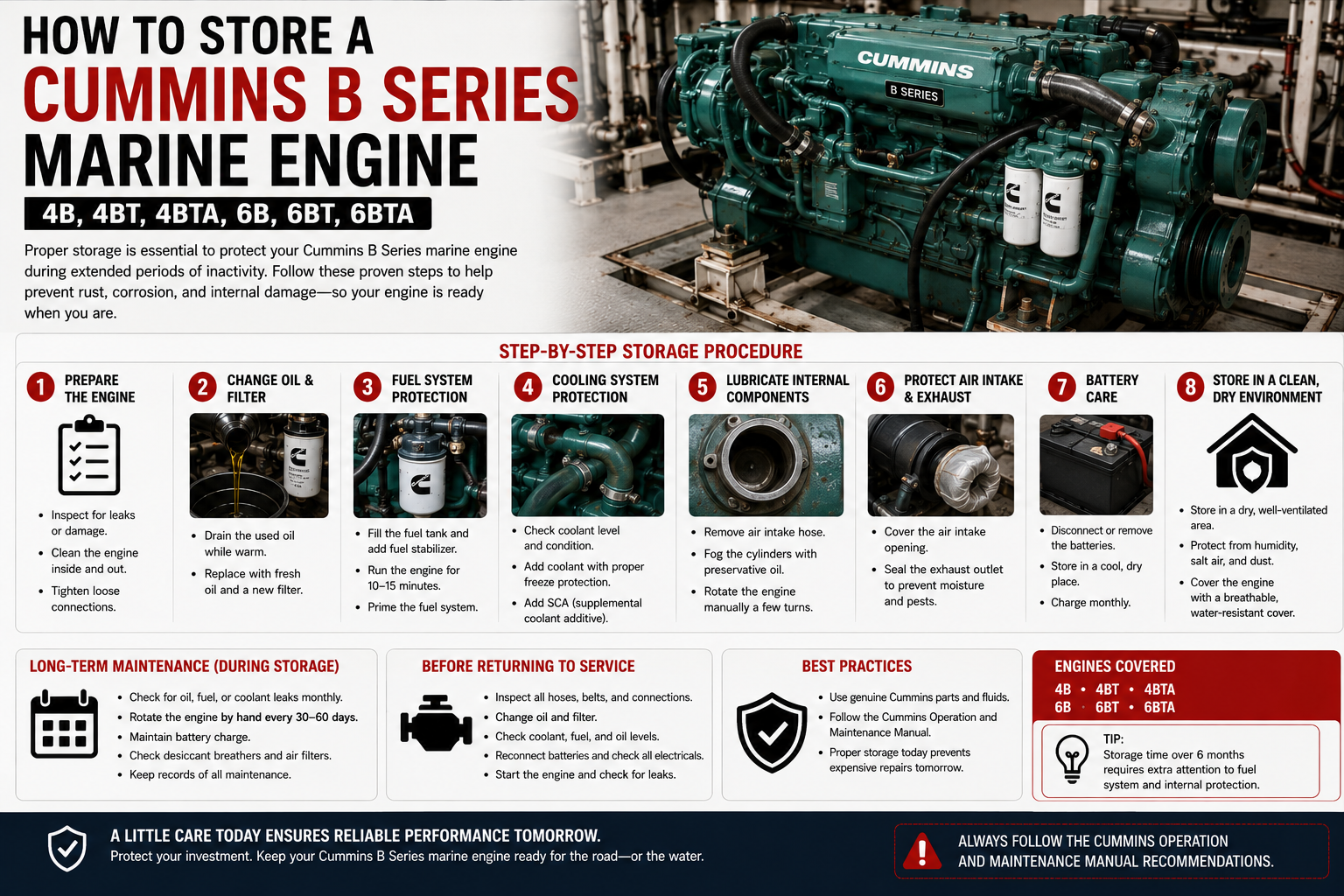
- Best Practices for Storing a Cummins B Series Marine Engine
- Preparing the Engine for Long Periods of Inactivity
- Restarting the Engine After Storage
- Engine Room Insight
- Chief Engineer's Tip
- Frequently Asked Questions
- Related Cummins Marine Engine Parts
- Why Choose Alfa Marine Spare Parts
- Technical Reference
- Final Thoughts
Why Proper Engine Storage Matters
Long-term engine storage is about more than parking the vessel and shutting down the engine.
When an engine remains inactive for weeks or months, environmental conditions can begin affecting internal components even though the engine is not operating.
Common risks during storage include:
- Internal corrosion.
- Fuel deterioration.
- Moisture accumulation.
- Lubricant degradation.
- Cooling system corrosion.
- Electrical system deterioration.
- Dust and debris contamination.
A well-prepared storage programme helps minimise these risks while reducing the work required before the engine returns to service.
Best Practices for Storing a Cummins B Series Marine Engine
Experienced marine engineers generally prepare the engine systematically before placing it into long-term storage.
Although storage procedures may vary depending on the vessel and operating environment, several best practices apply to most Cummins B Series Marine Engines.
1. Choose a Suitable Storage Location
Where possible, store the vessel or engine in an environment that helps minimise exposure to excessive moisture, salt, dust, and large temperature fluctuations.
A suitable storage location should ideally provide:
- Good ventilation.
- Protection from direct weather exposure.
- Reduced humidity where practical.
- Clean surroundings.
- Secure access.
Although not every vessel can be stored indoors, reducing environmental exposure helps slow corrosion and component deterioration.
2. Clean the Engine Before Storage
A clean engine is easier to inspect before storage and again when maintenance resumes.
Remove:
- Oil residue.
- Dirt.
- Salt deposits.
- Dust.
- Grease accumulation.
Cleaning also makes it easier to identify existing coolant leaks, oil leaks, or damaged components before storage begins.
3. Drain or Stabilise the Fuel System
Fuel quality naturally changes over time.
Depending on the storage duration and maintenance programme, marine engineers may:
- Stabilise the fuel.
- Inspect fuel filters.
- Drain water separators.
- Verify fuel tank condition.
Keeping the fuel system clean helps reduce contamination when the engine is restarted.
4. Change the Engine Oil and Oil Filter
Changing engine oil before storage removes contaminants that may have accumulated during operation.
Fresh lubricating oil helps protect internal engine components while the engine remains inactive.
Replacing the oil filter at the same time supports good lubrication when the engine is returned to service.
5. Protect the Cooling System
The cooling system should also be inspected before long-term storage.
Routine checks may include:
- Coolant condition.
- Hose inspection.
- Clamp condition.
- Water pump inspection.
- Heat exchanger inspection.
- Coolant level.
Maintaining a healthy cooling system helps reduce corrosion and supports reliable engine operation after storage.
Engine Room Insight
Experienced Chief Engineers often say that engines deteriorate fastest when they are ignored—not necessarily when they are working.
A properly prepared engine can remain in storage for extended periods with minimal deterioration, while an engine left unattended may develop corrosion, contaminated fuel, and cooling system problems before it is ever started again.
Chief Engineer's Tip
Before placing any engine into storage, complete one final walk-around inspection.
Ask yourself:
✔ Are there any existing leaks?
✔ Is the cooling system in good condition?
✔ Has the oil been changed?
✔ Is the fuel system protected?
✔ Is the engine clean?
Taking care of these items before storage is usually far easier than correcting them months later.
We'll continue with:
- Lubricating Critical Engine Components
- Protecting the Battery and Electrical System
- Sealing Openings to Prevent Contamination
- Rotating the Engine Periodically
- Creating a Storage Checklist
- Preparing the Engine for Long Periods of Inactivity
- Engine Storage Best Practices
- Common Storage Mistakes to Avoid
Long-Term Storage Procedures for the Cummins B Series Marine Engine
6. Lubricate Critical Engine Components
Before placing a Cummins B Series Marine Engine into long-term storage, it is important to ensure that critical moving components remain protected against corrosion and dry starts.
Lubrication helps create a protective film on internal metal surfaces while the engine is inactive.
Components that deserve particular attention include:
- Valve train components.
- Turbocharger bearings.
- Water pump bearings (where applicable).
- Fuel injection pump linkage.
- External moving linkages.
- Control cables.
- Throttle mechanisms.
Maintaining adequate lubrication helps reduce corrosion and minimises wear when the engine is restarted after storage.
7. Protect the Battery and Electrical System
Even when the engine is not operating, the electrical system continues to require attention.
Battery condition can deteriorate during long periods of inactivity, particularly in environments with fluctuating temperatures.
Before storage, consider:
- Disconnecting batteries if appropriate.
- Cleaning battery terminals.
- Inspecting battery cables.
- Checking electrical connections.
- Protecting exposed terminals from corrosion.
For vessels stored over extended periods, periodic battery charging or maintenance charging may help preserve battery condition.
A healthy electrical system improves the likelihood of a smooth engine restart.
8. Seal Openings to Prevent Contamination
Dust, insects, moisture, and salt-laden air can enter an engine during storage if exposed openings are left unprotected.
Areas commonly protected include:
- Air intake.
- Exhaust outlet.
- Crankcase breather openings.
- Ventilation openings where appropriate.
Temporary protective covers help reduce contamination while allowing the engine to be prepared correctly before returning to service.
Any protective covers installed during storage should always be removed before engine start-up.
9. Rotate the Engine Periodically
When practical and following the appropriate maintenance procedures, rotating the engine periodically during long-term storage may help distribute lubricating oil across internal components.
This practice can assist in protecting:
- Cylinder walls.
- Piston rings.
- Bearings.
- Valve train components.
Periodic rotation may also help reduce the likelihood of internal corrosion developing on stationary components.
The frequency and procedure should always follow the applicable manufacturer recommendations.
Preparing the Engine for Long Periods of Inactivity
Successful long-term storage begins before the engine is shut down for the final time.
Experienced marine engineers typically prepare the engine systematically rather than relying on memory alone.
Planning each step helps reduce the possibility of overlooking important maintenance tasks.
Create a Storage Checklist
A written storage checklist helps ensure consistency, particularly for fleet operators managing multiple vessels.
Typical storage records include:
- Engine operating hours.
- Date placed into storage.
- Oil change completed.
- Oil filter replaced.
- Fuel system protected.
- Cooling system inspected.
- Battery condition recorded.
- Air intake sealed.
- Exhaust protected.
- External engine inspection completed.
Keeping detailed records also simplifies recommissioning when the vessel returns to service.
Common Storage Mistakes to Avoid
Long-term storage problems often result from small oversights rather than major mechanical failures.
Common mistakes include:
❌ Storing the engine with contaminated oil.
❌ Ignoring the cooling system.
❌ Leaving fuel untreated for extended periods.
❌ Failing to protect exposed engine openings.
❌ Forgetting battery maintenance.
❌ Allowing moisture to accumulate around the engine.
❌ Neglecting routine inspections during storage.
Avoiding these common mistakes helps reduce future maintenance costs and protects engine reliability.
Engine Room Insight
Experienced Chief Engineers understand that long-term storage is simply another form of preventive maintenance.
The work completed before storage often determines how easily the engine returns to service months later.
A few hours spent preparing the engine properly can prevent many days of troubleshooting after storage.
Chief Engineer's Tip
Before leaving the engine in storage, complete one final inspection.
Confirm:
✔ Engine cleaned.
✔ Fresh engine oil installed.
✔ Fuel system protected.
✔ Cooling system inspected.
✔ Battery maintained.
✔ Openings sealed.
✔ Storage records completed.
This final review helps ensure nothing important has been overlooked.
Marine Engineer's Long-Term Storage Checklist
Before Storage
✔ Clean engine externally.
✔ Change engine oil.
✔ Replace oil filter.
✔ Inspect cooling system.
✔ Check coolant condition.
✔ Protect fuel system.
✔ Lubricate external moving parts.
Electrical System
✔ Inspect batteries.
✔ Clean battery terminals.
✔ Protect electrical connections.
✔ Disconnect batteries if appropriate.
Engine Protection
✔ Seal air intake.
✔ Seal exhaust outlet.
✔ Inspect turbocharger.
✔ Inspect hoses.
✔ Inspect belts.
✔ Check for leaks.
Documentation
✔ Record engine hours.
✔ Record storage date.
✔ Record maintenance completed.
✔ Schedule future inspection dates.
A detailed checklist helps maintain consistency and reduces the likelihood of missed maintenance tasks during long-term storage.
We'll complete the guide with:
- Steps for Restarting the Engine After Storage
- Post-Storage Inspection
- Frequently Asked Questions
- Related Cummins B Series Marine Engine Parts
- Why Choose Alfa Marine Spare Parts
- Industries We Support
- Worldwide Marine Spare Parts Supply
- Technical Reference
- Final Thoughts
Restarting the Cummins B Series Marine Engine After Storage, FAQs & Final Thoughts
Steps for Restarting the Engine After Storage
When it's time to return a Cummins B Series Marine Engine to service, avoid the temptation to simply start the engine and head out on the water.
A careful restart procedure allows marine engineers to identify potential issues before the engine is placed under load.
Whether you're recommissioning a Cummins 4B, 4BT, 4BTA, 6B, 6BT, or 6BTA Marine Engine, taking a systematic approach helps protect the engine and improve reliability.
Step 1 – Perform a Complete Visual Inspection
Before attempting to start the engine, carry out a thorough external inspection.
Look for:
- Oil leaks.
- Coolant leaks.
- Fuel leaks.
- Loose hoses.
- Damaged wiring.
- Corrosion.
- Signs of rodent or insect activity.
- Loose mounting hardware.
Addressing small issues before start-up can prevent larger problems later.
Step 2 – Remove All Protective Covers
If intake, exhaust, or ventilation openings were sealed during storage, ensure every protective cover is removed.
Check:
- Air intake.
- Turbocharger inlet.
- Exhaust outlet.
- Crankcase breather.
- Cooling system vents where applicable.
Starting the engine with protective covers still installed can cause severe engine damage.
Step 3 – Inspect Fluid Levels
Verify that all operating fluids are at the correct level.
Inspect:
- Engine oil.
- Coolant.
- Fuel system.
- Hydraulic systems where applicable.
Also inspect the condition of each fluid for signs of contamination or deterioration.
Step 4 – Inspect Belts, Hoses and Electrical Connections
Before starting the engine, inspect:
- Drive belts.
- Coolant hoses.
- Fuel hoses.
- Hose clamps.
- Battery cables.
- Electrical connectors.
Look for cracking, swelling, corrosion, loose connections, or other signs of deterioration that may have developed during storage.
Step 5 – Start the Engine and Monitor Carefully
Once all inspections have been completed, start the engine and allow it to idle while monitoring its operation.
Observe:
- Oil pressure.
- Coolant temperature.
- Charging system operation.
- Exhaust appearance.
- Engine noise.
- Vibration.
- Fluid leaks.
Allow the engine to reach normal operating temperature before applying significant load.
Step 6 – Perform a Final Inspection
After the engine has reached operating temperature and been shut down again, perform one final inspection.
Check for:
- Oil leaks.
- Coolant leaks.
- Fuel leaks.
- Loose fasteners.
- Belt tension.
- Fluid levels.
A final inspection often identifies minor issues that were not visible before the engine was restarted.
Post-Storage Maintenance Tips
Even after a successful restart, continue monitoring the engine during the first several operating hours.
Pay particular attention to:
- Oil pressure stability.
- Coolant temperature.
- Fuel system performance.
- Charging voltage.
- Turbocharger operation.
- Unusual vibration.
- Fluid consumption.
Recording these observations helps establish a new performance baseline following storage.
Engine Room Insight
Experienced marine engineers understand that the first engine start after long-term storage is one of the most important operating periods.
Rather than rushing to place the engine under load, they allow sufficient time to confirm that every major system is functioning normally.
This careful approach often prevents avoidable failures during the first voyage after recommissioning.
Chief Engineer's Tip
Treat the first start after storage like the commissioning of a newly rebuilt engine.
Take your time.
Verify:
✔ Oil pressure.
✔ Coolant circulation.
✔ Charging voltage.
✔ Exhaust condition.
✔ Engine temperature.
✔ Fuel system integrity.
Patience during recommissioning often saves considerable repair time later.
Frequently Asked Questions About Cummins B Series Marine Engine Storage
How long can a Cummins B Series Marine Engine remain in storage?
The storage period depends on environmental conditions and how well the engine was prepared before storage.
Proper cleaning, lubrication, cooling system maintenance, and fuel protection all contribute to preserving engine condition during extended periods of inactivity.
Should engine oil be changed before storage?
Yes.
Fresh engine oil helps remove contaminants and provides improved corrosion protection for internal engine components while the engine is inactive.
Why is fuel system protection important?
Fuel quality can deteriorate during storage.
Preparing the fuel system helps reduce contamination and improves the likelihood of reliable engine operation when the engine is restarted.
Is it necessary to rotate the engine during storage?
Periodic engine rotation may help distribute lubricating oil across internal components and reduce the likelihood of corrosion developing on stationary surfaces.
Always follow the appropriate manufacturer recommendations for storage procedures.
Why inspect the engine again after restarting?
The first operating cycle provides an opportunity to identify leaks, loose connections, abnormal noises, or other issues that may not have been visible while the engine was stationary.
A final inspection helps confirm that the engine is ready for normal operation.
Related Cummins B Series Marine Engine Parts
During storage preparation and recommissioning, marine engineers frequently inspect or replace components such as:
- Water Pumps
- Seawater Pumps
- Fuel Injectors
- Fuel Lift Pumps
- Turbochargers
- Air Filters
- Fuel Filters
- Oil Filters
- Thermostats
- Heat Exchangers
- Alternators
- Starter Motors
- Gasket Sets
- Engine Mounts
- Belts
- Hoses
- Cooling System Components
- Complete Overhaul Kits
Replacing worn components during scheduled maintenance helps improve long-term engine reliability.
Why Choose Alfa Marine Spare Parts?
At Alfa Marine Spare Parts, we help marine professionals identify the correct replacement parts for Cummins B Series Marine Engines, including:
- Cummins 4B Marine Engine
- Cummins 4BT Marine Engine
- Cummins 4BTA Marine Engine
- Cummins 6B Marine Engine
- Cummins 6BT Marine Engine
- Cummins 6BTA Marine Engine
Our experienced team can assist using:
- Engine Model
- Engine Serial Number
- Existing Part Numbers
- Technical Documentation
We supply:
- Genuine Marine Parts
- OEM Replacement Parts
- Premium Aftermarket Components
- Professionally Remanufactured Parts
- Complete Engine Overhaul Components
Whether you're preparing an engine for storage or returning it to service, we can help you identify compatible replacement parts.
Industries We Support
We proudly support:
- Marine Engineers
- Chief Engineers
- Technical Superintendents
- Shipyards
- Commercial Shipping Companies
- Offshore Operators
- Commercial Fishing Fleets
- Tugboat Operators
- Passenger Ferry Companies
- Government Fleets
- Yacht Management Companies
- Marine Service Companies
- Boat Builders
- Marine Equipment Distributors
Worldwide Marine Spare Parts Supply
Alfa Marine Spare Parts supplies marine engine components worldwide, including:
- Spain
- Netherlands
- Germany
- Italy
- France
- Norway
- Greece
- United Kingdom
- United States
- Canada
- Brazil
- United Arab Emirates
- Saudi Arabia
- Qatar
- Nigeria
- South Africa
- Singapore
- Australia
We support commercial vessels, offshore fleets, fishing boats, ferries, patrol vessels, workboats, and recreational marine operators around the world.
Browse Our Complete Marine Spare Parts Catalog
Looking for replacement parts for your Cummins B Series Marine Engine?
Browse our complete catalogue:
https://alfamarinespareparts.com/spareparts
Contact Alfa Marine Spare Parts
Need assistance identifying the correct parts for your Cummins 4B, 4BT, 4BTA, 6B, 6BT, or 6BTA Marine Engine?
Our experienced team is ready to assist.
Website
https://alfamarinespareparts.com
Browse Our Marine Spare Parts Catalog
https://alfamarinespareparts.com/spareparts
request@alfamarinespareparts.com
Providing your engine model, engine serial number, or existing part number allows us to identify compatible replacement parts more accurately.
Technical Reference
This guide is based on recognised marine engineering practices and maintenance principles applicable to Cummins B Series marine diesel engines. Storage procedures, maintenance intervals, recommissioning methods, and inspection requirements may vary depending on engine configuration, operating environment, and vessel application. Always consult the appropriate manufacturer service documentation before placing an engine into long-term storage or returning it to service.
Final Thoughts
Proper long-term storage is an investment in the future reliability of your Cummins B Series Marine Engine. Whether your vessel is laid up for the off-season, undergoing refit, or temporarily out of service, taking the time to clean the engine, protect the fuel and cooling systems, lubricate critical components, and secure the electrical system can significantly reduce corrosion, contamination, and unnecessary wear.
Equally important is the recommissioning process. A careful inspection, controlled restart, and thorough post-start checks help ensure that your Cummins 4B, 4BT, 4BTA, 6B, 6BT, or 6BTA Marine Engine returns to reliable service with confidence. Preventive maintenance before, during, and after storage is far more cost-effective than repairing avoidable damage caused by neglect.
At Alfa Marine Spare Parts, we proudly support marine engineers, chief engineers, technical superintendents, shipyards, fleet operators, mechanics, and vessel owners with genuine, OEM replacement, premium aftermarket, and professionally remanufactured Cummins marine engine parts. Whether you're preparing your engine for extended storage or getting ready for the next voyage, our experienced team is here to help you keep your engine operating safely, efficiently, and reliably.