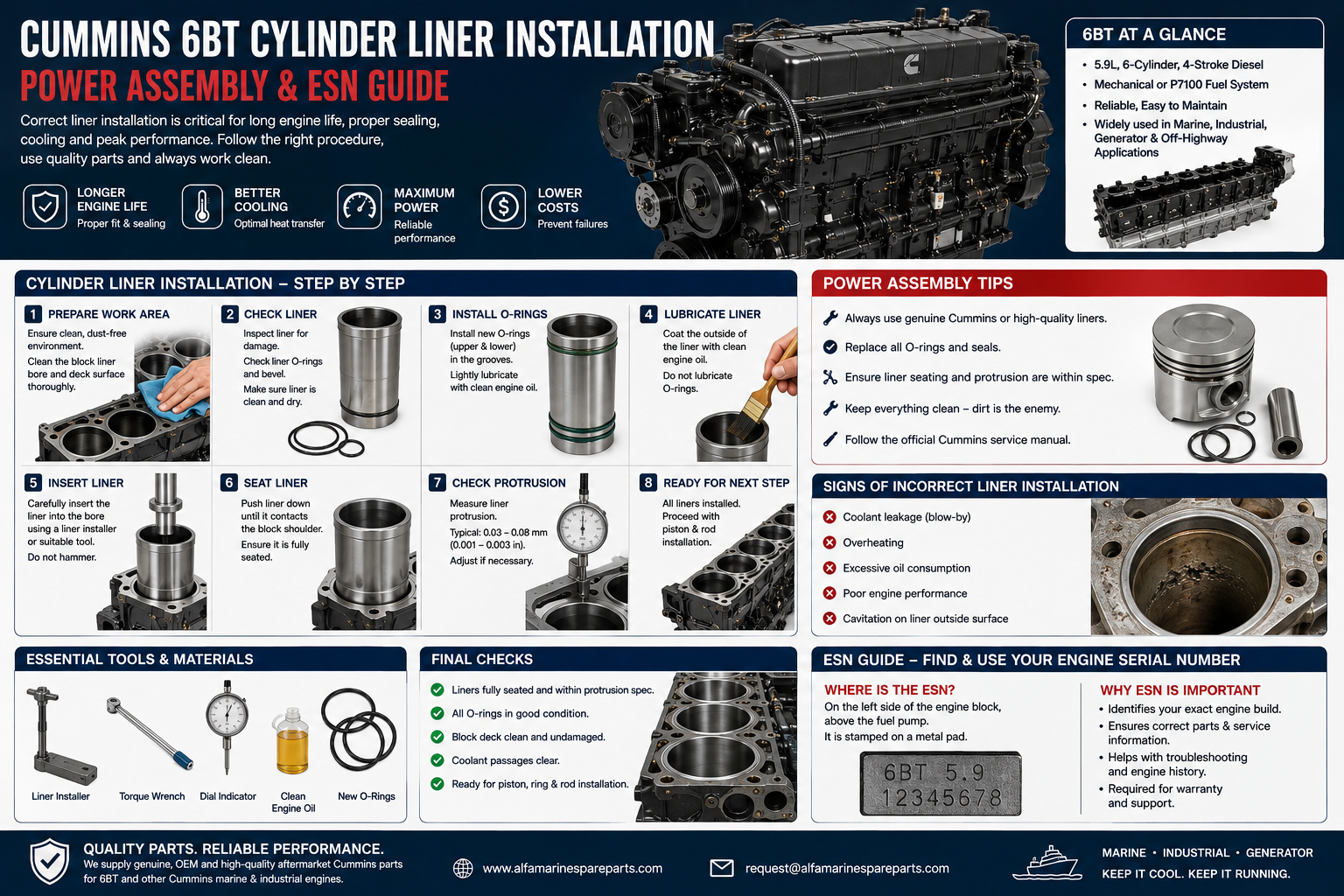

Cummins 6BT Cylinder Liner Installation | Power Assembly & ESN Guide
The Cummins 6BT 5.9L is legendary across both automotive and marine industries for its bulletproof reliability. However, maintaining that legendary durability during a major engine overhaul requires absolute precision. One of the most critical stages of rebuilding a marine Cummins 6BT is the power assembly inspection and cylinder liner evaluation.
Unlike larger commercial marine diesel engines that use "wet" removable cylinder liners, the standard Cummins 6BT features a parent-bore block design—meaning the cylinders are machined directly into the cast iron engine block. When a cylinder wall scores, wears past its service limit, or suffers from cavitation erosion, it must be machined out to accept a high-quality dry repair sleeve (cylinder liner). Achieving a flawless press-fit during a Cummins 6BT cylinder liner installation requires strict adherence to technical dimensions, structural clearances, and proper verification of your Engine Serial Number (ESN).
1. The Critical Link: Engine Serial Numbers (ESN) & Component Sizing
You should never order a power assembly kit, piston set, or cylinder repair sleeve based purely on the generic label “Cummins 6BT.” Throughout its long manufacturing history, the 6BT 5.9L engine family has undergone numerous design variations involving piston bowl shapes, wrist pin diameters, piston ring profiles, and marine vs. industrial duty ratings.
Before ordering parts or sending your block to a machine shop, you must locate and verify your Cummins Engine Serial Number (ESN). On the 6BT, this 8-digit number is typically stamped on the dataplate located on the side of the gear housing or near the oil cooler housing. Sourcing components using your specific ESN ensures that your replacement pistons, piston rings, and dry repair sleeves precisely match the compression ratio, thermal profile, and injection timing required for your specific marine rating.
🛒 Sourcing Rebuild Components? Avoid costly ordering mistakes. Provide our specialists with your ESN and browse our complete inventory of Genuine & OEM Cummins Marine Engine Parts to secure a perfect match.
2. Preparing the Block for Dry Liner Installation
Because the Cummins 6BT uses a dry repair sleeve, the sleeve depends entirely on the surrounding cast iron block for structural support and heat dissipation. If a cylinder bore is damaged due to a broken piston ring or severe corrosion, the individual cylinder must be bored out on a precision machining fixture.
The success of a dry liner installation relies entirely on achieving the correct interference fit (press-fit). The target dimensions for standard 6BT dry sleeve installations typically adhere to these strict tolerances:
| ParameterRequired Specification / DimensionImportance | ||
| Block Bore (Parent Hole) | Machined to match the sleeve manufacturer's specification | Ensures structural block integrity |
| Interference Fit Tolerance | 0.051 mm to 0.102 mm (0.002" to 0.004") | Prevents the liner from moving or slipping |
| Liner Flange/Cylinder Deck | Must be machined flush or with proper protrusion | Ensures correct cylinder head gasket sealing |
If the interference fit is too loose, the liner will slip downward or rotate during engine operation, resulting in catastrophic engine failure. If the fit is too tight, pressing the sleeve into place can distort the cylinder bore or fracture the engine block.
3. Step-by-Step Installation Best Practices
To ensure a reliable, distortion-free installation that can survive thousands of operating hours under heavy marine loads, your workshop team should follow these strict assembly rules:
- Impeccable Cleanliness: After boring the parent hole, completely clean the bore and remove all oil, grease, and metal shavings. The interface between the block and the dry sleeve must be perfectly clean and dry to allow maximum heat transfer.
- Thermal Assembly (The Freeze & Heat Method): To minimize the force required to press the liner home, place the replacement cylinder liner in a deep freezer for several hours before installation. This causes the metal to shrink slightly. Concurrently, keep the engine block at room temperature.
- Smooth Pressing Sequence: Apply a specialized dry lubricant or a high-strength retaining compound (if recommended by the sleeve manufacturer) to the bore. Using a hydraulic press and a dedicated flat driver puck, press the chilled liner down into the block in one smooth, continuous motion. Never hammer a dry liner into place, as this causes microscopic fractures.
- Final Boring and Honing: Once pressed into the block, a dry sleeve will contract slightly due to the tight interference fit. The inside diameter of the liner must now be bored and finish-honed to match the exact size category of your new replacement pistons.
4. Preventing Cylinder Liner Cavitation & Overheating
In high-output marine applications, cylinder walls are subjected to intense lateral forces from the pistons, causing the liner walls to vibrate at microscopic frequencies. In a poorly maintained cooling system, these vibrations cause tiny vacuum bubbles to form in the coolant jacket. When these bubbles collapse against the outside wall of the cylinder bore, they act like miniature explosions, drilling tiny pits through the metal—a phenomenon known as liner cavitation erosion.
While cavitation is more common in wet-liner engines, a poorly fitted dry sleeve can develop air gaps between the sleeve and the parent block. These air gaps trap heat, leading to localized hotspots, accelerated piston ring wear, and premature power assembly failure. To prevent this, always ensure a perfect metal-to-metal interference fit, and strictly maintain your marine cooling system using high-quality Supplemental Coolant Additives (SCAs) to prevent bubble formation.
🛠️ Complete Rebuild Support: Don't source your overhaul piecemeal. We stock comprehensive, brand-specific Cummins 6BT Major Overhaul Kits including matching pistons, wrist pins, ring sets, main bearings, and premium gasket kits.
Conclusion & Final Measurement Checks
After the Cummins 6BT cylinder liner installation is complete, final quality control checks are mandatory. Use a dial bore gauge to measure the finished cylinder for out-of-roundness and taper at the top, middle, and bottom of the stroke. The maximum allowable out-of-round limit is typically 0.038 mm (0.0015"). Any variation beyond this will prevent the piston rings from seating correctly, leading to high oil consumption, excessive blow-by smoke, and rapid compression loss. Take your time, measure twice, and always cross-reference your ESN to guarantee a successful overhaul.