Caterpillar Marine C32 Seawater Pump: How It Works, What's Inside, and Why It Matters
If you've ever experienced a marine engine overheating alarm, one of the first components worth checking is the Caterpillar Marine C32 seawater pump.
Although it sits on the outside of the engine, this pump plays one of the biggest roles in protecting the entire cooling system. Every minute the engine is running, the seawater pump continuously supplies cooling water to the heat exchangers, aftercoolers, transmission oil cooler, and other heat exchangers that remove heat from the engine.
Without a properly functioning seawater pump, even a healthy Caterpillar C32 engine can overheat within minutes.
In this guide, we'll explain how the Caterpillar Marine C32 seawater pump works, what's inside it, the spare parts that wear over time, and how preventive maintenance can help avoid expensive downtime.
This information is based on Caterpillar service information and parts documentation, together with Caterpillar C32 workshop and parts manuals available through Scribd.
What Does the Caterpillar Marine C32 Seawater Pump Do?
Question:
What is the purpose of the seawater pump?
Answer:
Unlike the freshwater pump that circulates coolant inside the engine, the Caterpillar Marine C32 seawater pump draws seawater directly from outside the vessel.
The pump then circulates seawater through:
- Heat exchanger
- Jacket water cooler
- Charge air cooler (aftercooler)
- Transmission oil cooler
- Auxiliary cooling equipment
After absorbing heat, the seawater is discharged overboard.
The seawater never mixes with the engine coolant.
Instead, it removes heat from the closed freshwater cooling circuit through the heat exchanger.
This cooling design helps protect the engine against corrosion while maintaining stable operating temperatures.
How Does the Caterpillar Marine C32 Seawater Pump Work?
Think of the seawater pump as the heart of the cooling system.
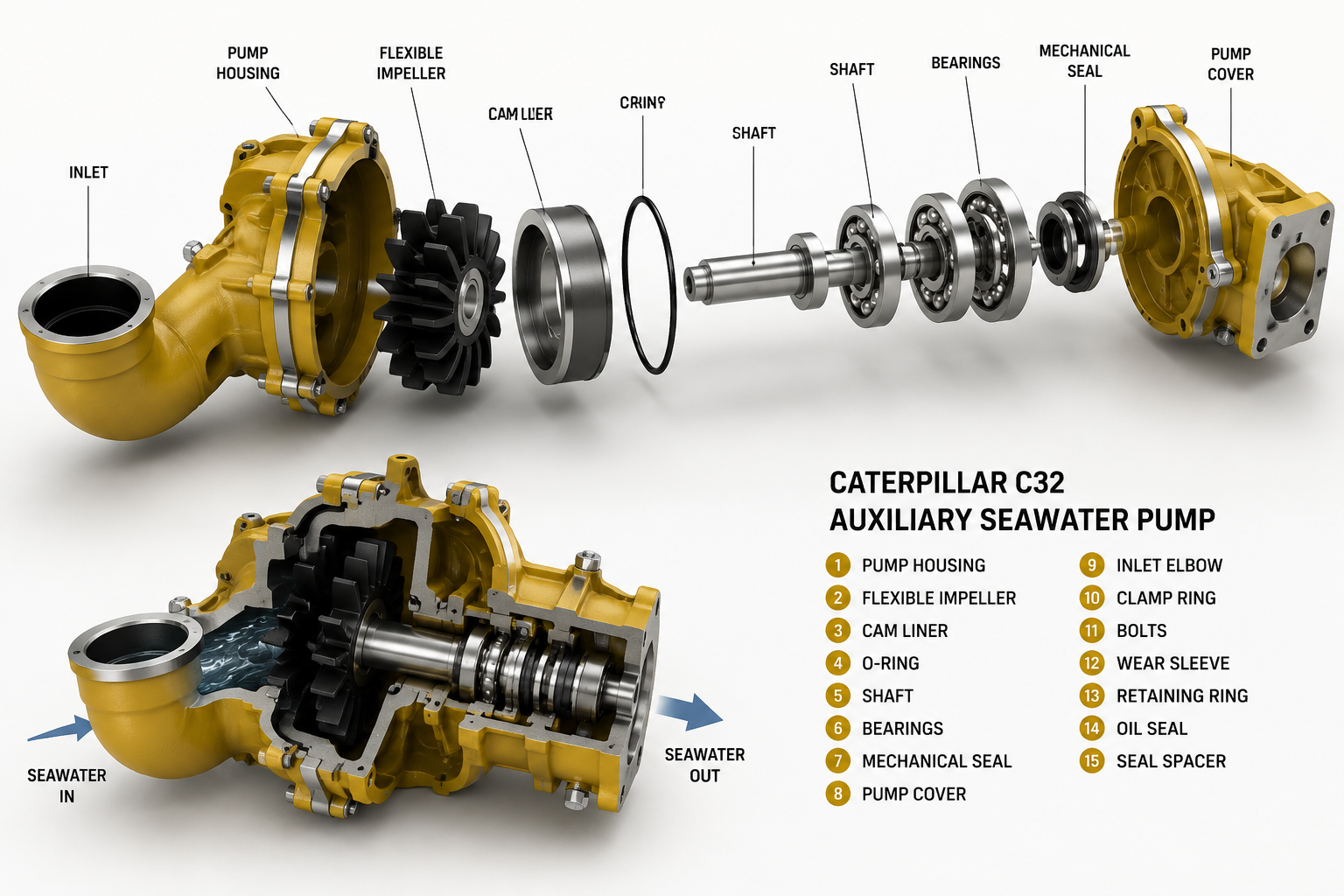
Inside the housing is a flexible impeller.
As the engine turns the pump shaft, the impeller rotates inside the pump housing.
Its flexible rubber vanes bend against a cam liner.
This creates two important actions:
✔ Vacuum at the inlet
✔ Pressure at the outlet
The result is a continuous flow of seawater throughout the engine's cooling system.
What Is Inside a Caterpillar Marine C32 Seawater Pump?
Many engineers are surprised by how many precision parts are hidden inside this relatively compact assembly.
Let's look inside.
1. Pump Housing
The housing is the structural body of the pump.
It directs seawater from the inlet to the outlet while supporting every internal component.
Because marine pumps constantly handle saltwater, the housing is built to resist corrosion and provide long service life.
2. Flexible Impeller
The impeller is the most recognizable internal component.
It consists of flexible rubber vanes mounted on a metal hub.
As it rotates:
- seawater is drawn into the pump
- water pressure is created
- cooling water flows continuously
The impeller is also the component that most commonly requires replacement during scheduled maintenance.
3. Stainless Steel Shaft
The shaft connects the engine drive to the impeller.
It transfers rotational power while remaining precisely aligned inside the pump.
Any shaft wear can damage seals and reduce pump performance.
4. Ball Bearings
Inside the rear housing are precision bearings.
Their job is to:
- support the shaft
- reduce friction
- maintain alignment
- prevent excessive vibration
Worn bearings often produce noise before complete failure.
5. Mechanical Seal
The mechanical seal protects the bearing cavity.
It prevents:
- seawater entering the bearings
- lubricant escaping
- external leaks
A damaged seal is one of the leading causes of bearing failure.
6. Cam Liner
Many people never see this component.
The cam liner sits inside the housing.
As the impeller rotates, its vanes bend against the cam.
This creates suction and pumping pressure.
A worn cam liner can reduce water flow even if a new impeller is installed.
7. O-Rings and Gaskets
Several O-rings seal the housing and covers.
During every overhaul, these seals should be replaced.
Small leaks often begin with hardened O-rings.
8. Wear Sleeve
Some pump versions include a replaceable wear sleeve.
Instead of replacing the shaft, the sleeve protects the sealing surface and can often be renewed during rebuilding.
Which Spare Parts Wear the Most?
The following components experience the greatest wear during normal operation:
- Flexible impeller
- Mechanical seal
- Bearings
- O-rings
- Gaskets
- Cam liner
- Shaft sleeve
- Pump cover
- Shaft
- Bearing retainer
- Seal kit
- Complete repair kit
Most overhaul kits include the parts needed to restore cooling performance without replacing the complete pump.
What Causes a Caterpillar Marine C32 Seawater Pump to Fail?
The pump operates every time the engine is running.
Common causes of failure include:
Running the pump dry
Without water, the rubber impeller overheats within seconds.
Saltwater corrosion
Marine environments naturally attack metal components over time.
Sand or debris
Foreign material can damage the impeller and score the housing.
Worn mechanical seals
Once seawater reaches the bearings, bearing failure usually follows.
Bearing wear
Loose bearings create shaft movement, vibration, and seal damage.
Impeller fatigue
Rubber vanes eventually harden, crack, or break.
Broken vanes may travel through the cooling system and partially block heat exchangers.
What Are the Early Warning Signs?
Watch for:
- Engine overheating
- Reduced seawater discharge
- Water leaks
- Bearing noise
- Excessive shaft play
- Vibration
- Rust around the seal
- Broken impeller blades
- Low cooling efficiency
Catching these symptoms early usually prevents major repairs.
Maintenance Tips for Longer Pump Life
Routine inspection is far less expensive than emergency repairs.
A preventive maintenance schedule should include:
- Inspect the impeller regularly
- Replace worn seals
- Check bearing condition
- Inspect the cam liner
- Replace O-rings during service
- Flush the cooling system
- Check seawater strainers
- Monitor engine temperature
- Replace damaged hoses
- Inspect shaft wear
Small maintenance tasks can dramatically increase the service life of the entire cooling system.
Frequently Asked Questions
How often should the impeller be replaced?
This depends on operating hours and water conditions, but many operators inspect it annually or according to Caterpillar maintenance intervals.
Can I rebuild a Caterpillar Marine C32 seawater pump?
Yes. Most pumps can be rebuilt using replacement impellers, bearings, seals, O-rings, cam liners, and repair kits if the housing and shaft remain serviceable.
What happens if the impeller loses vanes?
Cooling water flow decreases, and detached rubber pieces can travel into the heat exchanger or aftercooler, restricting coolant flow and contributing to overheating.
What causes seawater pump leaks?
Leaks are commonly associated with worn mechanical seals, damaged O-rings, shaft wear, or bearing movement that affects seal alignment.
Can worn bearings damage the shaft?
Yes. Excessive bearing play allows shaft movement, accelerating wear on seals and shaft surfaces and potentially leading to more extensive repairs.
Why Choose Alfa Marine Spare Parts?
At Alfa Marine Spare Parts, we supply high-quality marine engine spare parts for commercial vessels, workboats, offshore operators, fishing fleets, ferries, tugboats, and yachts worldwide.
We supply:
- Genuine OEM parts
- OEM-quality replacement parts
- Aftermarket solutions
- Reconditioned components
- Pump repair kits
- Mechanical seals
- Bearings
- Impellers
- Heat exchanger components
- Complete marine engine spare parts
We proudly serve marine customers across Europe, the Middle East, Africa, Asia, and the Americas with reliable worldwide shipping.
Browse Our Complete Catalog
Explore our extensive inventory of marine engine spare parts for:
- Caterpillar Marine Engines
- MTU Series 2000
- MTU Series 4000
- Detroit Diesel
- Cummins
- Volvo Penta
- Perkins
- Scania
- Mitsubishi
- Yanmar
- John Deere
- Wärtsilä
- Deutz
- Doosan
- Komatsu
Browse our complete catalog:
https://alfamarinespareparts.com/spareparts
Related Products
You may also be interested in:
- Caterpillar C32 Auxiliary Seawater Pump
- Caterpillar C32 Impeller Kits
- Caterpillar Mechanical Seal Kits
- Caterpillar Pump Bearings
- Caterpillar Heat Exchanger Parts
- Caterpillar Aftercooler Components
- Caterpillar Water Pump Repair Kits
- Caterpillar Cooling System Parts
Related Engine Pages
- Caterpillar C32 Marine Engine
- Caterpillar C18 Marine Engine
- Caterpillar 3412 Marine Engine
- Caterpillar 3500 Series
- MTU Series 4000
- Cummins Marine Engines
Contact Alfa Marine Spare Parts
Need assistance identifying the correct Caterpillar Marine C32 seawater pump or repair components?
📧 Email: request@alfamarinespareparts.com
🌐 Website: https://www.alfamarinespareparts.com
Our team can help you identify the correct pump assembly, overhaul kits, impellers, bearings, seals, and other cooling system components for your Caterpillar marine engine, with worldwide shipping to major ports and shipyards.