
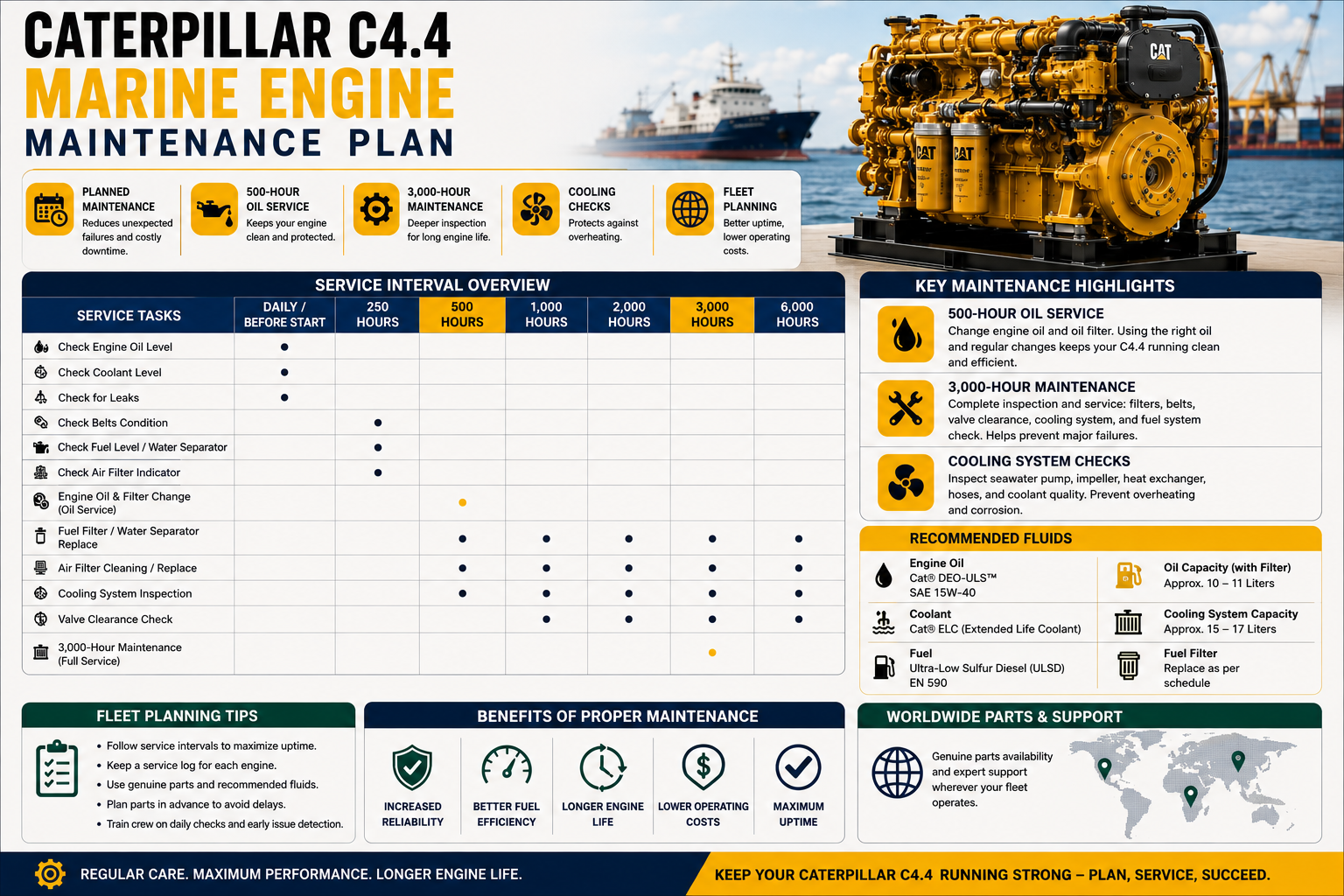

Caterpillar C4.4 Marine Engine Maintenance Schedule: A Practical Guide for Fleet Managers and Marine Engineers
The Caterpillar C4.4 marine engine is a compact four-cylinder diesel platform used primarily in marine auxiliary and generator applications. Caterpillar's current electronic C4.4 auxiliary engine is a 4.4-liter, inline four-cylinder, four-stroke engine, available with turbocharged or turbocharged-aftercooled configurations depending on rating. Caterpillar also offers several marine cooling arrangements, including heat-exchanger cooling and keel-cooling options.
For the engineer, maintenance is normally measured in operating hours.
For the vessel manager, purchasing department, or fleet superintendent, those hours become easier to understand when translated into calendar time.
That is exactly what we will do here.
We will use:
Low Usage: 3,000 operating hours per year
High Usage: 5,000 operating hours per year
The calculation is:
Maintenance interval ÷ annual operating hours × 12 = approximate months
The month values below are fleet-planning estimates. Your actual maintenance work should always follow the Operation & Maintenance Manual for the specific C4.4 engine serial number and marine configuration.
Where Does the Caterpillar C4.4 Marine Engine Fit?
Manufacturer: Caterpillar
Engine: C4.4 Marine
Displacement: 4.4 liters
Configuration: Inline 4-cylinder, 4-stroke
Aspiration: Turbocharged or turbocharged-aftercooled depending on rating
Rated speeds on current auxiliary version: 1,500 / 1,800 rpm
Marine applications: Auxiliary power and marine generator applications
Caterpillar's current C4.4 electronic auxiliary engine uses an A5 ECM and is available with heat exchanger, combined-circuit keel cooling, or separate-circuit keel cooling.
A C4.4 marine generator set is also offered for commercial and pleasure craft applications.
Why the Exact C4.4 Configuration Matters
A maintenance request that simply says:
"Caterpillar C4.4 marine engine"
still leaves important questions.
Is it:
- Electronic or mechanical?
- Auxiliary engine or generator set?
- Heat-exchanger cooled?
- Keel cooled?
- Turbocharged?
- Turbocharged and aftercooled?
- Which serial prefix?
That information can affect maintenance parts and procedures.
So before ordering anything substantial, record:
Engine model + serial number + application + cooling arrangement + existing part number
Caterpillar C4.4 Daily Maintenance
🟦 DAILY / BEFORE OPERATION
Interval: Every operating day
Low Usage: Daily
High Usage: Daily
Inspect:
- Engine oil level
- Coolant level
- Fuel leaks
- Oil leaks
- Coolant leaks
- Exhaust smoke
- Instrument readings
- Engine alarms
- Unusual vibration
- Unusual noise
Marine Engineer Focus: Compare today's engine with yesterday's engine.
A daily inspection should not simply confirm that the engine starts.
Look for changes.
A minor coolant stain, slight increase in oil consumption, or new vibration can be more useful than waiting for a shutdown alarm.
Initial 100-Hour Maintenance
Caterpillar's current C4.4 Marine equipment dashboard specifically identifies an initial 100-service-hour maintenance event.
🟦 INITIAL 100 HOURS
Maintenance point: 100 operating hours
Low Usage — 3,000 h/year: approximately 0.4 month
High Usage — 5,000 h/year: approximately 0.24 month
Planning meaning: This is an early-life maintenance point after commissioning or installation.
Engineer Focus: Use the serial-number-specific Caterpillar maintenance instructions for the exact task list.
An initial service is valuable because components have experienced their first period of real operating load.
Check maintenance documentation carefully rather than assuming the initial service is identical to later routine maintenance.
Engine Oil and Oil Filter
One of the clearest verified C4.4 maintenance specifications comes directly from Caterpillar.
The current C4.4 electronic auxiliary engine lists:
Oil change interval: 500 hours.
🟩 500-HOUR ENGINE OIL SERVICE
Verified interval: 500 operating hours
Low Usage — 3,000 h/year: approximately 2 months
High Usage — 5,000 h/year: approximately 1.2 months
Maintenance Focus:
- Engine oil
- Oil filter
- Oil condition
- Oil pressure
- Oil consumption
Engineer Focus: Inspect the old oil filter before throwing it away.
At 5,000 annual operating hours, a 500-hour interval can arrive approximately ten times per year.
That changes the way a commercial fleet should stock:
- Engine oil
- Oil filters
- Sealing washers
- Service consumables
Why Oil Analysis Still Matters on a Small Engine
A C4.4 is much smaller than a C18 or C32.
That does not make oil condition unimportant.
Oil analysis can help track:
- Iron
- Copper
- Aluminium
- Silicon
- Fuel dilution
- Water
- Viscosity
- Oxidation
A small engine operating continuously as an auxiliary can accumulate hours surprisingly quickly.
The useful question is not simply:
"Did we change the oil at 500 hours?"
Also ask:
"What did the old oil tell us?"
Fuel Filters
I did not find a reliable public Caterpillar source giving one universal fuel-filter hour interval for every marine C4.4 configuration, so it would be misleading to invent one.
Instead:
🟨 FUEL FILTER MAINTENANCE
Interval: Verify from the specific Caterpillar C4.4 OMM/SIS information
Low Usage: Convert the verified interval into months
High Usage: Convert the verified interval into months
Inspect for:
- Water
- Sediment
- Restriction
- Contamination
- Difficult starting
- Irregular engine operation
Engineer Focus: Fuel cleanliness protects much more expensive injection components.
For an auxiliary engine expected to start when required, neglected fuel filtration can quickly become an availability problem.
Air Filter Maintenance
🟨 AIR FILTER
Interval: Caterpillar schedule + restriction/condition
Marine Engineer Focus:
- Dust
- Oil contamination
- Restriction
- Intake leaks
- Turbocharger airflow
The current C4.4 auxiliary engine is turbocharged or turbocharged-aftercooled depending on configuration.
Restricted intake airflow can contribute to:
- Black exhaust smoke
- Reduced power
- Increased exhaust temperature
- Higher fuel consumption
Cooling System
The Caterpillar C4.4 marine platform deserves particular attention here because different cooling arrangements are available.
Caterpillar lists:
- Heat exchanger cooling
- Combined-circuit keel cooling
- Separate-circuit keel cooling
That means two C4.4 engines can require different cooling-system inspections even though the engine model is the same.
🟦 COOLING-SYSTEM CHECK
Interval: Daily observation + scheduled Caterpillar maintenance
Inspect:
- Coolant level
- Coolant temperature
- Hoses
- Clamps
- Heat exchanger where fitted
- Keel-cooling circuit where fitted
- Water pump
- Coolant leakage
Engineer Focus: Know which cooling arrangement is installed before ordering cooling-system components.
Heat-Exchanger-Cooled C4.4
If your C4.4 uses a marine heat exchanger, the raw-water side should be part of regular vessel maintenance.
🟦 RAW-WATER SYSTEM — HEAT EXCHANGER INSTALLATION
Inspect:
- Sea inlet
- Seacock
- Raw-water strainer
- Pump
- Hoses
- Heat exchanger
- Corrosion
- Discharge flow
Engineer Focus: A partially restricted seawater circuit can look normal at light load and struggle at heavy load.
Do not automatically replace a pump simply because engine temperature has increased.
Inspect the complete cooling circuit.
Keel-Cooled C4.4
A keel-cooled engine changes the maintenance picture.
🟦 KEEL-COOLING SYSTEM
Cooling options verified by Caterpillar: Combined circuit or separate circuit
Inspect:
- Coolant level
- External keel cooler condition
- Piping
- Hoses
- Connections
- Coolant chemistry
- Internal circulation
Engineer Focus: A keel-cooled engine does not have the same seawater-pump maintenance needs as a heat-exchanger installation.
This is exactly why engine configuration belongs in every fleet maintenance record.
Turbocharger Inspection
The current C4.4 can be turbocharged and aftercooled depending on rating.
🟦 TURBOCHARGER CONDITION CHECK
Interval: Follow C4.4-specific Caterpillar maintenance instructions
Watch:
- Oil leakage
- Compressor contamination
- Unusual noise
- Shaft condition
- Boost performance
- Exhaust smoke
Engineer Focus: Trend changes rather than waiting for a complete turbocharger failure.
A gradual loss in airflow may first appear as:
- Black smoke
- Slower load acceptance
- Higher fuel consumption
- Higher exhaust temperature
Aftercooler Maintenance
Where the engine is aftercooled:
🟦 AFTERCOOLER INSPECTION
Interval: Engine-specific Caterpillar schedule
Inspect:
- Cooling efficiency
- Air-side contamination
- Coolant-side leakage
- Hose condition
- Charge-air temperature
Engineer Focus: A dirty aftercooler can create symptoms that resemble turbocharger or fuel-system problems.
Belts
🟨 BELT DRIVE
Interval: Follow the C4.4-specific OMM
Inspect:
- Cracking
- Glazing
- Fraying
- Tension
- Pulley alignment
Engineer Focus: Belt inspection is cheap. Losing a belt during operation may not be.
If a belt is repeatedly losing tension, investigate the drive rather than simply retightening it.
Valve Train
The exact valve-lash interval should be confirmed against the specific C4.4 marine configuration.
🟨 VALVE-LASH / VALVE-TRAIN INSPECTION
Interval: Verify in Caterpillar OMM
When inspected, record:
- Intake clearances
- Exhaust clearances
- Cylinder position
- Adjustment required
- Abnormal wear
Engineer Focus: Record measurements before adjustment.
If one valve repeatedly requires correction while the others remain stable, that trend deserves investigation.
1,000-Hour Planning Box
Where the C4.4-specific maintenance manual assigns a task at 1,000 hours:
⏱️ 1,000 HOURS
Low Usage: approximately 4 months
High Usage: approximately 2.4 months
Important: This is a calendar conversion only. Do not assume every C4.4 component is serviced at 1,000 hours.
2,000-Hour Planning Box
⏱️ 2,000 HOURS
Low Usage: approximately 8 months
High Usage: approximately 4.8 months
Planning Focus: Begin thinking about any long-lead component or scheduled inspection well before reaching this point.
Again, use the C4.4 OMM to determine which actual tasks apply.
Caterpillar C4.4 3,000-Hour Maintenance
Caterpillar's current C4.4 Marine equipment dashboard explicitly identifies a 3,000-service-hour maintenance event.
🟥 3,000-HOUR MAINTENANCE
Verified maintenance point: 3,000 hours
Low Usage — 3,000 h/year: approximately 12 months
High Usage — 5,000 h/year: approximately 7.2 months
Planning level: Major scheduled maintenance event
Engineer Focus: Use the serial-number-specific Caterpillar task list before ordering the maintenance package.
This is where converting hours to months becomes especially useful.
A vessel running 5,000 hours annually reaches 3,000 hours in only around 7.2 months.
That means the maintenance team may need to prepare for this service within the same operating year.
What Should Happen Before 3,000 Hours?
Several months before the projected maintenance date:
- Confirm engine serial number.
- Retrieve the correct Caterpillar maintenance information.
- Review oil-analysis history.
- Review coolant condition.
- Check fuel-system history.
- Review turbocharger condition.
- Confirm cooling configuration.
- Identify all scheduled filters and seals.
- Check pump history.
- Review previous maintenance reports.
- Order predictable service parts.
- Identify long-lead components.
Don't wait for 2,990 hours.
5,000-Hour Planning Box
If the applicable C4.4 OMM assigns any task at 5,000 operating hours:
⏱️ 5,000 HOURS
Low Usage: approximately 20 months
High Usage: approximately 12 months
Fleet Focus: Major condition checks and longer-term parts forecasting may already need to be underway.
This is a planning conversion, not a claimed C4.4 service interval.
Major Overhaul
There is no reason to invent a universal overhaul interval for every C4.4 marine installation.
Actual overhaul planning depends on:
- Engine configuration
- Duty
- Load profile
- Fuel quality
- Lubrication history
- Cooling condition
- Annual operating hours
- Previous repairs
- Engine condition
🟥 CATERPILLAR C4.4 MAJOR OVERHAUL
Interval: Engine-specific
Determine using: Caterpillar documentation + engine condition + operational history
Potential overhaul components:
- Cylinder head
- Intake and exhaust valves
- Fuel injectors
- Pistons
- Piston rings
- Cylinder components
- Main bearings
- Connecting-rod bearings
- Crankshaft
- Turbocharger
- Water pump
- Oil pump
- Gaskets
- Seals
Engineer Focus: Measure and inspect before deciding which expensive parts require replacement.
Caterpillar C4.4 Maintenance Summary
⚙️ QUICK C4.4 FLEET PLANNING BLOCK
| IntervalLow Usage 3,000 h/yearHigh Usage 5,000 h/yearMaintenance Meaning | |||
| Daily | Daily | Daily | Fluids, leaks, instruments and walk-around checks |
| Initial 100 h | 0.4 mo | 0.24 mo | Caterpillar recognizes initial C4.4 Marine maintenance |
| 500 h | 2 mo | 1.2 mo | Verified oil-change interval for current electronic auxiliary C4.4 |
| 1,000 h | 4 mo | 2.4 mo | Planning conversion — verify task in OMM |
| 2,000 h | 8 mo | 4.8 mo | Planning conversion — verify task in OMM |
| 3,000 h | 12 mo | 7.2 mo | Verified Caterpillar C4.4 Marine maintenance event |
| 5,000 h | 20 mo | 12 mo | Planning conversion only unless confirmed |
| Major Overhaul | Engine-specific | Engine-specific | Condition and application dependent |
The 500-hour oil interval, engine construction, and cooling-system options are verified from Caterpillar's current electronic C4.4 marine auxiliary specifications. The 100-hour initial and 3,000-hour maintenance events are shown on Caterpillar's C4.4 Marine equipment dashboard.
Real Marine Maintenance Scenario
Imagine a commercial vessel using a Caterpillar C4.4 auxiliary engine and operating around 5,000 engine hours per year.
The fleet manager hears:
"Oil service every 500 hours."
That doesn't sound especially frequent.
But 500 hours at that utilization level means roughly:
every 1.2 months.
During one operating year, the maintenance department may require approximately ten routine oil-service events.
Then there is the 3,000-hour maintenance point.
At 5,000 hours annually, that arrives in approximately:
7.2 months.
Suddenly the annual purchasing plan needs:
- Multiple oil-service kits
- Fuel-service components
- Air-filtration components
- Gaskets
- Seals
- Cooling-system service parts
- A 3,000-hour maintenance package
The engine hasn't changed.
The way you understand its maintenance schedule has.
Engineer's Toolbox
CATERPILLAR C4.4 FLEET MAINTENANCE RECORD
Vessel: __________________
Engine: Caterpillar C4.4 Marine
Serial Number: __________________
Electronic / Mechanical: __________________
Auxiliary / Generator: __________________
Cooling System: Heat Exchanger / Keel Cooling / Other
Current Hours: __________________
Annual Operating Hours: __________________
Next 500-Hour Oil Service: __________________
Next 3,000-Hour Maintenance: __________________
Last Oil Analysis: __________________
Last Coolant Analysis: __________________
Turbocharger Status: __________________
Cooling-System Status: __________________
Parts Ordered: __________________
Open Technical Issues: __________________
Marine Engineer Tip
Write the cooling-system configuration beside "C4.4" in your maintenance file.
Caterpillar currently offers the C4.4 auxiliary engine with heat-exchanger and different keel-cooling arrangements.
Knowing that one detail immediately changes which marine cooling components you need to inspect and stock.
What Should Be Monitored Between Service Hours?
Do not let the maintenance schedule replace observation.
Track:
- Oil pressure
- Oil temperature
- Coolant temperature
- Oil consumption
- Coolant consumption
- Fuel consumption
- Exhaust smoke
- Air-filter restriction
- Turbocharger condition
- Raw-water flow where applicable
- Engine vibration
- Starting behavior
- Oil-analysis results
- Fault-code history
The engine doesn't know that the next scheduled service is still 150 hours away.
If something begins changing now, investigate now.
Caterpillar C4.4 Marine Spare Parts
Alfa Marine Spare Parts can assist with sourcing components such as:
- C4.4 oil filters
- C4.4 fuel filters
- C4.4 air filters
- C4.4 fuel injectors
- C4.4 turbocharger components
- C4.4 freshwater pumps
- C4.4 raw-water components where applicable
- C4.4 heat exchangers
- C4.4 thermostats
- C4.4 cylinder heads
- C4.4 valves
- C4.4 pistons
- C4.4 piston rings
- C4.4 bearings
- C4.4 sensors
- C4.4 gasket sets
- C4.4 O-rings and seals
- C4.4 overhaul components
Because Caterpillar notes that equipment configuration affects component compatibility, parts should be checked using the engine's serial information rather than model name alone.
Common Caterpillar C4.4 Maintenance Planning Mistakes
Avoid:
- Treating every C4.4 as the same installation.
- Ignoring electronic versus mechanical configurations.
- Confusing auxiliary and generator requirements.
- Forgetting the cooling-system arrangement.
- Missing the 500-hour oil service.
- Waiting until 3,000 hours to order service parts.
- Ignoring oil-analysis trends.
- Replacing a water pump before checking the rest of the cooling circuit.
- Adjusting valves without recording measurements.
- Ordering parts without the serial number.
- Using industrial C4.4 maintenance information blindly on a marine installation.
Frequently Asked Questions
What size is the Caterpillar C4.4 marine engine?
The current electronic C4.4 auxiliary engine is a 4.4-liter inline four-cylinder, four-stroke diesel engine.
What is the Caterpillar C4.4 oil-change interval?
Caterpillar lists a 500-hour oil-change interval for its current C4.4 electronic marine auxiliary engine.
Always confirm that this applies to your specific C4.4 configuration and serial number.
Is there an initial C4.4 maintenance service?
Yes. Caterpillar's C4.4 Marine equipment dashboard identifies an initial 100-hour maintenance event.
Is there a 3,000-hour Caterpillar C4.4 marine service?
Yes. Caterpillar currently identifies a 3,000-service-hour maintenance event for C4.4 Marine equipment.
What cooling systems are available on the C4.4?
Caterpillar lists heat exchanger, combined-circuit keel cooling, and separate-circuit keel cooling for the current electronic auxiliary C4.4.
Is the C4.4 turbocharged?
Current versions are available with turbocharged-aftercooled and turbocharged-only configurations depending on output.
Can maintenance hours be converted into months?
Yes. Divide the verified service interval by expected annual engine hours and multiply by 12.
For example, 500 hours at 5,000 annual operating hours equals roughly 1.2 months.
Related Caterpillar Engine Pages
- Caterpillar C4.4 Marine Engine Spare Parts
- Caterpillar C7 Marine Engine Spare Parts
- Caterpillar C7.1 Marine Engine Spare Parts
- Caterpillar C9 Marine Engine Spare Parts
- Caterpillar C9.3 Marine Engine Spare Parts
- Caterpillar C18 Marine Engine Spare Parts
- Caterpillar C32 Marine Engine Spare Parts
- Caterpillar 3406 Marine Engine Spare Parts
- Caterpillar 3408 Marine Engine Spare Parts
- Caterpillar 3412 Marine Engine Spare Parts
Worldwide Caterpillar Marine Spare Parts Supply
Alfa Marine Spare Parts supports:
- Shipyards
- Ship repairers
- Marine engineers
- Chief engineers
- Technical superintendents
- Fleet operators
- Commercial fishing companies
- Offshore operators
- Government fleets
- Maritime contractors
- Boat builders
- Marine service companies
- Marine equipment distributors
For a Caterpillar C4.4 parts inquiry, provide:
Engine model + serial number + application + existing part number + quantity + photographs where available.
Browse Our Complete Catalog
Website:
https://alfamarinespareparts.com
Marine Spare Parts Catalog:
https://alfamarinespareparts.com/spareparts
Why Choose Alfa Marine Spare Parts?
The words:
"Caterpillar C4.4 marine"
are a good starting point.
But accurate sourcing usually requires more.
We want to know:
Which serial number?
Auxiliary or generator?
Electronic or mechanical?
Heat exchanger or keel cooling?
Which part is currently installed?
Alfa Marine Spare Parts supports customers looking for genuine, OEM, aftermarket, remanufactured and reconditioned Caterpillar marine engine components, depending on application and availability.
The objective is to have the correct maintenance components ready before the engine reaches its next service hour.
Contact Alfa Marine Spare Parts
Email: request@alfamarinespareparts.com
Website:
https://alfamarinespareparts.com
Catalog:
https://alfamarinespareparts.com/spareparts
Contact Alfa Marine Spare Parts for Caterpillar C4.4 oil filters, fuel filters, injectors, turbocharger components, water pumps, cooling-system parts, cylinder heads, pistons, bearings, gasket sets and overhaul components with worldwide supply.
One Final Thought
A Caterpillar C4.4 Marine Engine Maintenance Schedule becomes far easier to understand when the operating hours are translated into real fleet time.
For a high-use vessel running 5,000 hours per year:
500 hours arrive in approximately 1.2 months.
3,000 hours arrive in approximately 7.2 months.
For a lower-use engine running 3,000 hours annually:
500 hours arrive roughly every 2 months.
3,000 hours equal approximately 12 months.
Those numbers make maintenance much easier to budget and schedule.
The important question isn't only:
"How many hours are on our Caterpillar C4.4?"
It is:
"Which C4.4 configuration do we have, what verified service point is coming next, and are the right parts already available?"